
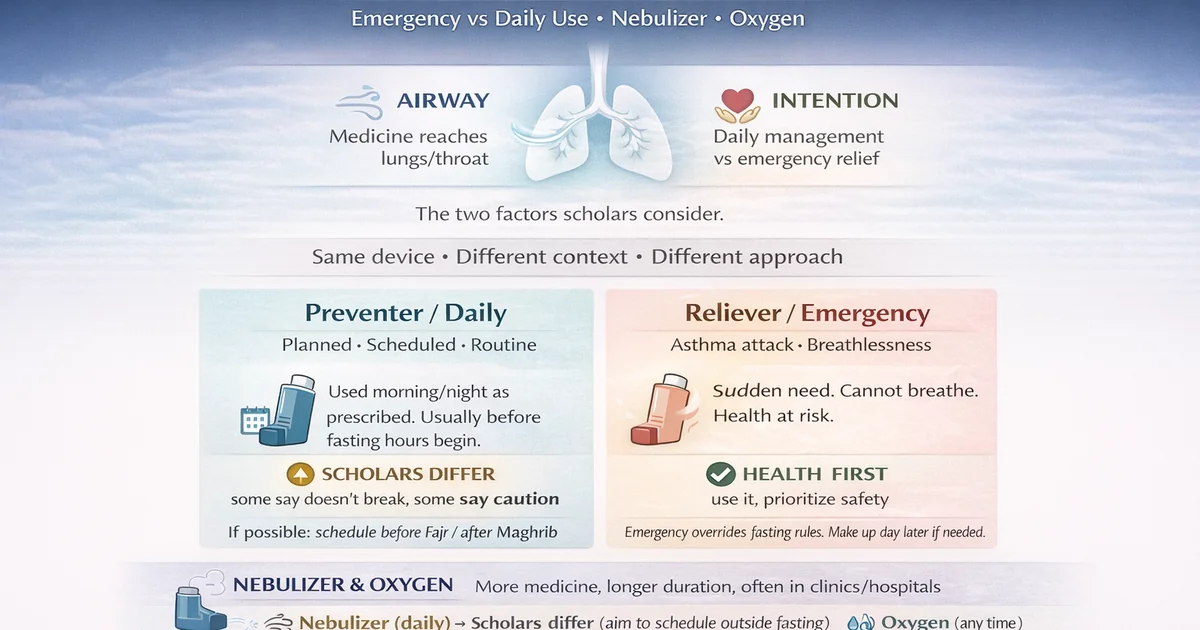
Asthma inhaler break fast Ramadan: Does an Asthma Inhaler Break the Fast in Ramadan? (Emergency vs Daily Use)
Asthma doesn’t care that it’s Ramadan.
It can hit at 2 p.m. in traffic. Or right before Maghrib when your chest feels tight and you’re telling yourself, “Just wait… just wait.”
And then the question lands hard: asthma inhaler break fast Ramadan or not?
I’ve seen people delay medicine out of fear. I’ve also seen people use medicine, then punish themselves with guilt the whole night. Neither of those helps your worship.
This page is meant to calm that panic. We’ll talk about why inhaler breaks fast Ramadan is debated, how scholars often think about it, and what to do in real situations—especially asthma attack Ramadan moments.
✅ TL;DR – asthma inhaler break fast Ramadan
asthma inhaler break fast Ramadan is discussed because inhaler medicine goes into the airway, and tiny particles may reach the throat. Many scholars treat it differently from eating and drinking, while others treat it more strictly. The safest rule for real life: in an emergency, take your rescue medicine and protect health. For daily routines, plan night use when possible, and if your asthma is chronic or unstable, follow a personal plan and handle qada later (and in some long-term cases, fidya case) with trusted guidance.
the core principle + why inhalers are debated
Direct answer: inhalers are debated because the medicine enters the airway, and some of it can reach the throat. Scholars then ask: “Is this more like eating and drinking, or more like necessary medication?” That’s why you’ll see different rulings and different levels of strictness.
Here’s an analogy I use when teaching beginners. Think of the fast like a “sealed window of worship” from Fajr to Maghrib. Food and drink are like opening the window and passing a meal inside. An inhaler is more like medicine delivered through breathing—small, targeted, and not taken as a meal. Some scholars say that difference matters. Others say, “Something entered, so the fast is affected.”
That’s the honest reason you see mixed answers for asthma inhaler fasting ruling.
One line of calm, because you need it: disagreement doesn’t mean you’re doomed.
If you want the least confusion in your life, this helps: separate “emergency breathing” from “routine schedule.” The rulings and emotions feel different for those two, and that’s exactly why this article keeps saying Emergency vs Daily Use.
Also, schools and scholars can differ in details. A beginner doesn’t need to win debates at iftar. You need a safe path that protects worship and health.
reliever vs preventer (what changes?)
Direct answer: the “type” matters mainly because the situation matters. A reliever is often used in the moment to stop symptoms. A preventer is planned and routine. People handle them differently in Ramadan: routine medicines are often scheduled at night when possible, while emergencies are treated as emergencies.
Let’s name them clearly, because people mix them up:
- reliever inhaler fasting: the fast-acting one you reach for during tightness or wheeze.
- preventer inhaler fasting: the routine one you take to keep attacks away.
Micro-scenario #1: you’re stable, no symptoms, and it’s the routine preventer dose. If you can safely move that dose to night with your doctor’s plan, many people do that to reduce worry and keep worship smooth.
Micro-scenario #2: your chest tightens, you can’t finish a sentence properly, and you’re thinking, “Maybe it’ll pass.” That’s not a “routine” moment. That’s breathlessness and possible danger.
There’s a quiet mistake I see: people treat a preventer like it’s optional “because it’s not emergency.” Then the emergency comes. So be careful with your routine plan.
And one more practical point: planning gets easier when you know your local fasting window. You can check timing in your city with the Ramadan fasting hours calculator and plan night doses between Maghrib and Suhoor.
emergency use: what Islam prioritizes
Direct answer: in an emergency, Islam prioritizes preserving life and preventing harm. If you need your inhaler during an asthma attack Ramadan moment, take it. Don’t let fear turn a medical flare-up into something dangerous.
This is not “being weak.” This is being responsible.
Micro-scenario #3: you’re in a masjid, standing for prayer, and your breathing suddenly tightens. You step out, use your inhaler, sit down, and breathe. That’s not a failure. That’s choosing safety first.
Micro-scenario #4: you’re driving home in KSA traffic, fasting, and the air feels dusty. Your chest feels squeezed. If you need the reliever, use it. Don’t gamble with an accident or collapse while driving.
People ask about hardship exemption as if it’s only for hunger. Breathing trouble is a different kind of hardship. It can become harm fast.
Also, if your asthma is recurring and Ramadan routines trigger symptoms, that points to a broader category: chronic illness exemption fasting may become relevant depending on severity and medical advice. Not everyone with asthma is in that category, but some people are.
nebulizer and oxygen scenarios
Direct answer: nebulizers are discussed more strictly by many because they deliver a larger amount of mist medicine and can increase what reaches the throat. Oxygen masks are different because oxygen itself isn’t food or drink, but the situation (hospital support, severe breathing trouble) often means you’re medically unwell and may need to break the fast for safety.
Let’s talk in the language people search:
nebulizer fasting ruling often comes up when someone has repeated wheezing, infection, or severe flare-ups. Nebulizers can feel “heavier” than a quick puff inhaler, and scholars often treat the scenario with more caution.
oxygen mask fasting is usually asked in hospital settings or for severe breathlessness. Oxygen is air support, not a meal. But if you’re on oxygen because you can’t breathe properly, you’re not in a “normal fast day” anymore. You’re in a “health first” day.
This is why the most honest answer for many oxygen/nebulizer situations is: don’t try to be your own mufti while your lungs are struggling. Get treated. Then sort out the religious steps in calm.
And yes, you might hear different views across school differences. Keep your heart humble. Nobody gets closer to Allah by mocking other Muslims’ fears.
if you used it—what happens to the fast?
Direct answer: what happens depends on which scholarly view you follow and what the situation was. Some scholars treat inhaler use as not the same as eating and drinking and allow the fast to continue. Others treat it as breaking the fast because material enters the body. In emergencies, you still take the medicine. Afterward, you either continue the day (if your view says it doesn’t break) or treat it as a day to make up (if your view says it breaks).
So what should a normal person do right now?
If this is your first time facing it and you don’t have a trusted answer yet, choose one of these “no-panic” paths:
Path A (routine planning): build a plan with your doctor for night medication scheduling where possible, then follow a trusted scholar’s guidance consistently for the whole month.
Path B (emergency use): use the inhaler, stabilize, then later ask a trusted scholar: “In my case, do I do make up fast after inhaler?”
One sentence that keeps you sane: don’t flip rulings every day based on guilt.
Now, the beginner mistakes. Not big sins—just real human confusion.
Quirky beginner mistake #1: taking the inhaler, then refusing iftar as “punishment.” Quick fix: if you had to treat an emergency, treat it as mercy, not shame.
Quirky beginner mistake #2: skipping the preventer all Ramadan, then using the reliever 5 times a day. Quick fix: routine care often prevents emergency care.
Quirky beginner mistake #3: thinking suhoor hydration alone “solves asthma.” Quick fix: hydration helps comfort, but asthma needs proper medical control.
Quirky beginner mistake #4: arguing at home: “You broke your fast!” “No I didn’t!” Quick fix: stop the shouting, pick a trusted answer, and stick with it.
Quirky beginner mistake #5: treating every tight chest as “just in my head,” then collapsing. Quick fix: learn your symptoms and act early.
A short story of a beginner mistake (and the simple fix):
A young sister once told me she kept her inhaler in her bag and refused to touch it in Ramadan.
By the third day she was waking up breathless, then “pushing through” the afternoon until her lips went pale.
That evening she cried, not from hunger, but from fear—she thought she was failing Allah.
We sat and made a plan: preventer at night (with her doctor’s advice), reliever always available, and a clear rule for emergencies.
The next week she said, “I finally worshiped without panic.”
That’s the goal: worship without guilt-driven danger.
qada/fidya pathway for chronic asthma
Direct answer: if asthma is occasional and controlled, many people can fast normally with planning. If asthma is chronic and unstable—frequent attacks, repeated nebulizers, hospital support—then you may fall into a category where fasting isn’t safe, and the path becomes qada later when able, or in some long-term cases, a fidya case with trusted guidance.
This section matters because people confuse “I had one flare-up” with “I have a condition that makes fasting unsafe.” Those are not the same.
If you’re sometimes wheezy, but stable with routine care, you might fast fine with smarter scheduling and doctor advice.
If you’re frequently breathless, needing rescue medicine often, or you’ve had serious attacks, your Ramadan plan must be personal. That’s where doctor advice and a trusted scholar’s guidance work together.
And please don’t feel ashamed about exemptions. Exemptions aren’t “lower Islam.” They’re part of Islam. Sometimes the most God-fearing move is to stop pushing your body into danger.
If you do miss days for health reasons, don’t leave them floating in your head. Write them down and plan your qada later days calmly.
If you’re uncertain whether your asthma counts as long-term inability to fast, don’t decide alone in the middle of an attack. Get stable first, then ask.
quick FAQ
Direct answer: these FAQs cover the common Ramadan questions around inhalers: emergency use, daily use, nebulizers, oxygen, missed days, and chronic asthma planning. If your case is severe or repeated, don’t rely on random internet answers—get one trusted plan and keep it consistent.
📘 asthma inhaler break fast Ramadan FAQs
does using an inhaler break your fast?
Show Answer
Scholars discuss inhalers because medicine enters the airway and may reach the throat. Some treat it differently from eating and drinking; others treat it more strictly. If you have a trusted view, follow it consistently. If you don’t, plan routine use at night when possible and ask for a personal answer if your asthma is ongoing.
what if it’s an emergency?
Show Answer
In an emergency, take your emergency medicine Ramadan and protect your health. Don’t delay treatment out of fear. After you’re stable, ask whether you need make up fast after inhaler based on your trusted scholarly view.
inhaler while fasting: should i stop my preventer?
Show Answer
Don’t stop prescribed routines on your own. Many people plan preventer doses at night with medical guidance. Skipping routine care can lead to more attacks and more day-time rescue use.
reliever inhaler fasting: what if i need it daily?
Show Answer
If you need rescue medicine daily, your asthma may be unstable. That’s a sign to get a medical plan and discuss fasting safety. This can connect to chronic illness exemption fasting in some cases, depending on severity.
nebulizer fasting ruling: same as inhaler?
Show Answer
Many treat nebulizers with more caution because of the larger mist delivery. If you need a nebulizer, you’re often in a stronger medical-need situation. Get treated first, then handle religious steps afterward with trusted guidance.
oxygen mask fasting: does it break the fast?
Show Answer
Oxygen itself isn’t food or drink, but needing oxygen often means you’re medically unwell and may need to break for safety. Treat the situation as health-first, then ask how to handle the day afterward.
if i used it, should i continue fasting?
Show Answer
If your trusted view says inhaler use doesn’t break the fast, continue. If your trusted view says it breaks, then you handle the day as broken and plan qada later. Don’t switch views daily based on guilt.
fidya for chronic asthma: when does that apply?
Show Answer
A fidya for chronic asthma discussion usually comes when someone truly can’t fast long-term and making up later isn’t realistic. That’s a personal ruling tied to medical reality. Don’t self-assign fidya just because fasting is uncomfortable.
traveling + asthma: does travel change anything?
Show Answer
Travel can already bring a separate allowance for fasting. If you’re also dealing with asthma symptoms while traveling, choose the safer path for health and worship. Don’t push yourself into danger on the road.
what’s a simple plan for medication while fasting?
Show Answer
Plan routine doses at night when possible, keep rescue medicine available, and know your warning signs. If you have repeated symptoms, get a personal plan rather than guessing each day.
i feel guilty even when i need it—what should i remember?
Show Answer
Ramadan isn’t meant to harm you. Worship includes honesty and responsibility. If your lungs need help, get help. Then handle the religious steps in calm, without self-hate.
📊 asthma inhaler + ramadan: safe plan vs debated zone
Use this table to explain the “real life” difference between routine planning and emergency breathing. It keeps families calm and stops shame-based decisions.
🌙 Show Asthma Fasting Table
| Situation | What’s happening | Beginner-safe move |
|---|---|---|
| Stable day + preventer | Routine control medicine | Plan night medication scheduling with medical advice when possible |
| Symptoms + reliever | Rescue medicine for tightness | Use it if needed; don’t risk harm |
| Severe flare-up | Possible danger, medical need | Health first; handle qada later if your trusted view requires it |
| Nebulizer | Heavier mist delivery | Often treated with more caution; get treated then ask for your case |
| Oxygen support | Serious breathing support context | Treat as illness day; don’t force dangerous fasting |
| Long-term unstable asthma | Repeated symptoms, frequent rescue use | Discuss chronic illness exemption fasting and possible fidya case with trusted guidance |
Related Internal Link Ideas
Ramadan fasting hours calculator

Farrukh Farooqi has been living in Sharaya, Makkah, Saudi Arabia since 2010. With over 14 years of firsthand experience witnessing the sacred journey of millions of pilgrims, Farrukh specializes in providing practical, insider tips for Hajj and Umrah travelers. His work blends real-world observations, the latest Saudi updates, and essential crowd management strategies — helping pilgrims and worshippers plan smarter, stay safer, and experience a spiritually fulfilling journey across the Holy Cities.


