
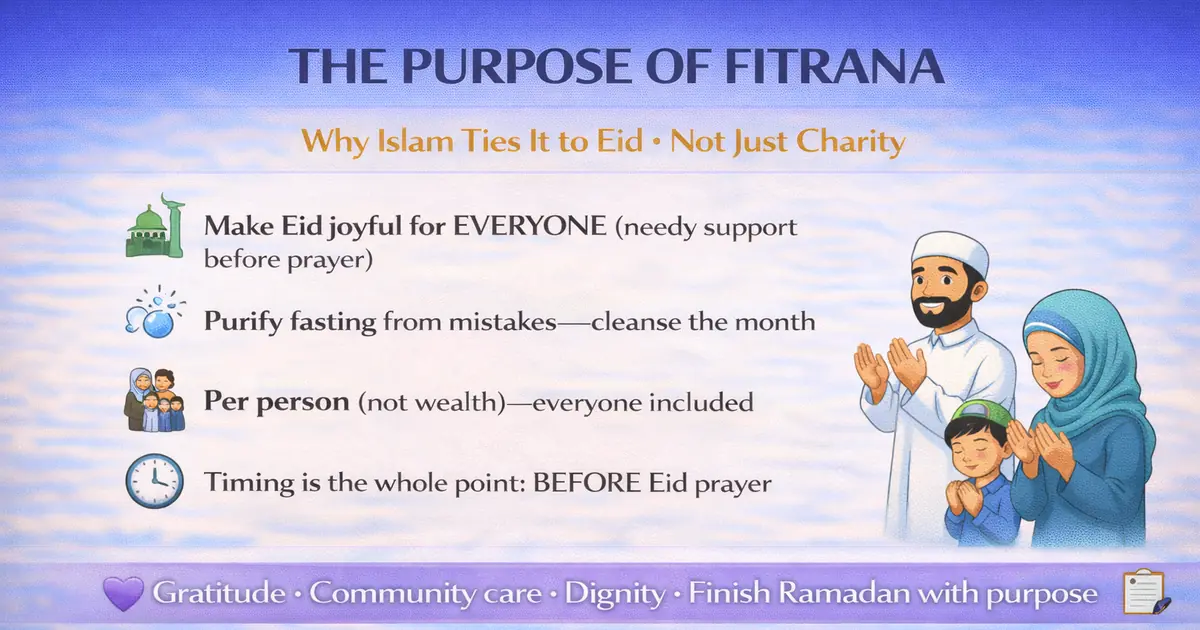
Spiritual meaning of Zakat al Fitr with Eid purpose explained for beginners, Ramadan completion and purification theme, dignity support for needy families, why it is per person, and why distribution timing before Eid prayer matters

Purpose of Fitrana: Why Islam Ties It to Eid (Not Just Charity)

Eid isn’t meant to be a “some people celebrate, some people watch” day.

That’s the heart of it.

Fitrana (also called Zakat al-Fitr or Sadaqat al-Fitr) comes right at the finish line of Ramadan to protect two things at once: your worship, and your community. The part most people miss? It’s not designed for “whenever I remember.” It’s designed for before Eid prayer, so families in need can actually feel Eid.

I used to mix this up when I was younger: I thought “charity is charity, so the date can be flexible.” Then I watched how a late payment can miss the moment completely. Same money… different impact.

✅ TL;DR – purpose of fitrana

The purpose of fitrana is to make Eid possible for everyone—especially people who need food and basics—by getting support to them before Eid prayer. It also helps you finish Ramadan with purification, gratitude, and community care. When it’s delayed, the “Eid purpose” gets weaker, even if the donation still helps.

If you want the Saudi-focused payment side, keep this open for later: Fitrana Saudi payment guide.

What fitrana is meant to achieve on Eid

What is the purpose of fitrana in Islam? It’s meant to protect the joy and dignity of Eid al-Fitr by getting help to people who need it before Eid prayer—so they can eat, prepare, and celebrate without embarrassment. It also helps the fasting person end Ramadan with a clean heart, not just an empty stomach.

Think of Zakat al-Fitr like the “last rinse” after washing a cup. You already washed it—Ramadan is the wash. But the rinse removes the tiny leftover bits you didn’t notice. Not because your fasting was worthless, but because we’re human, and Ramadan can still have rough edges: a harsh word, a lazy moment, a bad attitude.

So yes, there’s a spiritual meaning of zakat al fitr… and there’s also a very practical one: Eid day support that arrives on time.

Micro-scenario: A father has rent due, and Eid morning comes with zero food at home. A “late fitrana” that lands after prayer can’t fix that morning. A timely one can.

Another point people forget: staple food matters. Traditionally, it’s connected to what people actually eat and rely on, not luxury items. If you want amounts and local details, you can cross-check your year pages: Zakat al-Fitr 2026 amount and Zakat al-Fitr 2025 amount.

And if you’re using a tool inside the post, you can place the calculator like this:

Fitrana / Zakat al-Fitr Calculator
Estimate an amount in Saudi Riyal based on household size and local prices.
Household count
Count all adults and children you intend to include.
Tip: Use the + / − buttons for quick changes.
Optional breakdown men / women / kids
Method and item
Choose a method and (if needed) a staple item.
You can switch anytime; the result updates instantly.
Prices vary by brand and market; enter what applies locally.
“Sa’” is approximate and can be adjusted below.
kg
Adjust if your preferred estimate differs.
SAR/kg
If you’re paying in food, you can still estimate using a local market price.
Result
This is an estimate based on your entries.
Total estimate
0.00 SAR
Note: This widget provides an estimate for planning. For official local guidance, refer to trusted announcements in your area.
' ].join('');var w = window.open('', '_blank', 'noopener,noreferrer,width=900,height=700'); if (!w){ toast(widgetEl, 'Popup blocked'); return; } w.document.open(); w.document.write(html); w.document.close(); }function escapeHtml(s){ return String(s) .replace(/&/g,'&') .replace(//g,'>') .replace(/"/g,'"') .replace(/'/g,'''); } function escapeHtmlAttr(s){ return escapeHtml(s).replace(/"/g,'"'); }function boot(){ var widgets = qsa(document, '.ft-widget[data-ft-widget="fitr-calculator"]'); widgets.forEach(function(w, i){ initWidget(w, i); }); }if (document.readyState === 'loading'){ document.addEventListener('DOMContentLoaded', boot, { once: true }); }else{ boot(); } })();

Why it’s per person (not wealth-based)

Why is fitrana per person not based on wealth? Because its goal isn’t to “tax the rich.” Its goal is to bring every household into the Eid circle and to make sure every household thinks about others. That’s why it’s counted per person in the home—adults, children, even infants—when the family can afford basics beyond immediate need.

Here’s an everyday picture I use with students: imagine Eid is a community dinner where everyone brings one plate. Nobody is asked to bring a truckload. Everyone brings something so the table is shared, not divided.

This is also why you’ll see questions like purpose of fitrana for families and “Do I pay for my wife/kids?” come up every year. If you want the practical family rules, keep this for later reading: pay fitrana for family in Saudi.

Micro-scenario: A new dad panics: “My baby is only a few days old—does this count?” That anxiety usually comes from thinking fitrana is a punishment. It isn’t. It’s a gentle reminder that even a brand-new life is part of the ummah’s care.

Also, per-person fitrana reduces the “I gave a lot, so I’m done” mindset. It keeps the worship humble. It keeps the home involved.

Why timing is central (before Eid prayer)

Why is fitrana given before Eid prayer? Because that’s when it can achieve its main job: needy support for Eid itself. When it reaches people after the prayer, it may still be rewarded charity, but it no longer hits the Eid moment in the same way. Timing isn’t a small detail here—it’s the whole point.

Picture an umbrella that arrives after the rain. Helpful? Maybe later. But it missed the reason you needed it.

This is why “distribution timing” shows up in serious conversations. Some scholars also discuss the exact latest cut-off, and you’ll hear more than one view about whether the final deadline is strictly tied to the Eid prayer or earlier in the last day of Ramadan. If you’re a beginner, you don’t need to fight about it—just aim early enough that it clearly reaches people in time.

For a timing-only breakdown, keep this link handy: fitrana timing before Eid prayer.

Micro-scenario: You’re rushing, stuck in a queue, and the masjid is about to start Eid prayer. This is not the moment to “start learning the rules.” Pay earlier next time and keep Eid morning calm.

And yes—this also answers a common long-tail question: does paying fitrana late defeat its purpose? It doesn’t erase the good of giving, but it does damage the Eid-specific goal.

What goes wrong when people delay

What happens if fitrana is not paid on time? The biggest loss is simple: people who needed help for Eid don’t receive it when they needed it. Late fitrana can still feed someone later, but the “Eid dignity” part becomes weaker. And for the giver, delay often turns worship into stress, excuses, and last-minute confusion.

Honestly, the last day panic is where most mistakes happen.

Here are five quirky beginner mistakes I see again and again (and quick fixes):

  • Mistake 1: “I’ll do it after Eid prayer.” Quick fix: Treat “before prayer” as your red line. Pay earlier.
  • Mistake 2: Paying, but choosing the wrong category because you clicked too fast. Quick fix: Slow down and double-check the donation label first. (If you did this, see: wrong donation category for fitrana.)
  • Mistake 3: Turning it into a family argument: “Your method is wrong!” Quick fix: Keep your words soft. Pay your fitrana correctly. Don’t ruin Eid spirit at home.
  • Mistake 4: Paying for a person you forgot to count (like a visiting relative) and then spiraling. Quick fix: Count your household calmly, then pay. If you missed someone, fix it fast.
  • Mistake 5: Thinking “cash vs food” is the same everywhere and for everyone. Quick fix: Learn your local trusted method and stick with it. (See: cash vs food fitrana in Saudi.)

Short story (beginner mistake + fix):
A brother once told me he “kept fitrana for the last hour” because he thought it was more spiritual to do it on Eid morning.
He got distracted, went to the masjid early, prayed, hugged everyone, then remembered in the car.
He felt sick with guilt and said, “I ruined it, didn’t I?”
I told him, “You didn’t ruin your good deed. But you did miss the Eid target this time.”
Next year he paid two days early—and Eid morning finally felt light for him.

If your specific case is “I forgot and it’s after prayer,” you already have a dedicated page for it: forgot fitrana after Eid prayer.

Also, if you’re traveling and trying to understand your situation, this helps: fitrana for Umrah visitors in Saudi.

How to keep the intention clean (no showing off)

How do I keep the intention (niyyah) clean when paying fitrana? Keep it private when you can, keep it simple, and keep it focused on Allah—then on the people who need help. The moment you start paying to impress family, friends, or social media, the worship turns noisy inside your chest.

This is where beginners get stuck, so I’ll say it plainly: your heart doesn’t need a microphone.

Here are a few “intention cleaners” that actually work in real life:

1) Pay quietly. Online payments make this easier because nobody needs to know. If you want the step-by-step online method, use: online fitrana in Saudi step-by-step.

2) Don’t attach your ego to the amount. Fitrana is not a “flex.” It’s a shared duty. If you want bigger giving, that’s beautiful—just do it as extra charity, not as “I’m better than others.”

3) Choose a trustworthy charity channel. Intention isn’t only feelings—it’s also responsibility. If you’re unsure where to send it, start here: how to choose a trusted fitrana charity in KSA.

Micro-scenario: Someone asks, “How much did you pay?” You can smile and say, “Alhamdulillah, I took care of it.” Then change the topic. That’s not rude. That’s protection.

One more: sometimes people worry about paying early. That’s a real question, and it’s better than waiting until the last minute. You can read: can you pay fitrana early?

Quick FAQs

Quick FAQs about the purpose of fitrana come up because people mix three things: Eid needs, Ramadan worship, and general charity. The short answers below aim to keep you safe as a beginner—clear, calm, and focused on what fitrana is meant to do.

Before the questions, here’s a tiny checklist I tell families to do every Ramadan:

Quick checklist (2 minutes):
Count your household → pick a trusted channel → pay early enough to reach people before Eid prayer → don’t post it online.

If you want the difference between fitrana and general zakat topics, you already have: fitrana vs zakat difference. And for broader learning later: what is zakat (complete guide).

Finally, fitrana is not the same as fidya or kaffarah. Those are separate situations with separate rules, so don’t mash them together in your head at 2 a.m. (It happens.) Use: fidya in Islam and kaffarah in Islam.

The One Table

📊 Purpose of Fitrana: Eid impact vs late impact

SituationWhat it achievesBeginner-safe takeaway
Paid before Eid prayerSupports Eid day support and dignity on timeThis is the best match for the fitrana goal
Paid very lateStill helps as charity, but misses Eid timingFix it quickly, then plan earlier next year
Paid with showing offMoney moves, but the heart gets messyKeep it quiet and clean for Allah
Paid to wrong categoryCreates confusion about where it wentDouble-check the label before paying

This table is a simple way to explain why why fitrana is before eid isn’t “just a rule”—it’s the reason the worship exists.

FAQs

📘 purpose of fitrana FAQs

what is the purpose of fitrana in islam?

Show Answer

The purpose of fitrana is to support people in need in time for Eid al-Fitr and to help the fasting person finish Ramadan with purification and humility.

is fitrana just normal charity (sadaqah)?

Show Answer

No. Zakat al-Fitr is tied to Eid timing and purpose. If it’s given after Eid prayer, it’s still charity, but it misses the Eid-specific aim that makes it fitrana.

why is fitrana given before eid prayer?

Show Answer

Because the goal is Eid day support on time—food and basics that help families feel dignity during Eid, not after it has already passed.

does paying fitrana late defeat its purpose?

Show Answer

It weakens the Eid purpose because the support arrives too late for Eid needs. It can still count as charity, so don’t give up—just fix it fast and plan earlier next year.

what is sadaqatul fitr purpose?

Show Answer

Sadaqat al-Fitr aims to help the needy before Eid and to complete Ramadan with purification and gratitude. It’s purpose-driven charity with a deadline.

why is fitrana per person not based on wealth?

Show Answer

Because its message is communal: every household shares responsibility for Eid care. It keeps the worship humble and keeps the home involved, not only the “rich people.”

what does fitrana achieve spiritually?

Show Answer

It supports the idea of purification at the end of Ramadan—like a final “clean finish” after a month of worship—while also training gratitude and care for others.

does fitrana cleanse fasting?

Show Answer

Many scholars explain it as a way to cover shortcomings and rough edges of the month. A beginner-safe way to say it: it helps you end Ramadan with a cleaner heart and better manners.

who is deserving of fitrana?

Show Answer

It goes to eligible people in need through a trusted channel. For your detailed local breakdown, use: who can receive fitrana.

what happens if i forgot to pay zakat fitrah?

Show Answer

Pay it as soon as you remember and don’t delay again. You’ll still be doing good, but aim to protect the Eid timing next year.

purpose of fitrana vs sadaqah difference?

Show Answer

Fitrana is Eid-tied giving with a time-sensitive goal. Sadaqah is general charity anytime. Both are good, but fitrana has a “before Eid prayer” target that changes everything.

purpose of fitrana in saudi context?

Show Answer

In Saudi, the purpose stays the same—Eid dignity and purification—but the easiest path is usually paying through a trusted local channel early enough that distribution happens before Eid prayer.

Farrukh Farooqi Author Photo
About the Author

Farrukh Farooqi has been living in Sharaya, Makkah, Saudi Arabia since 2010. With over 14 years of firsthand experience witnessing the sacred journey of millions of pilgrims, Farrukh specializes in providing practical, insider tips for Hajj and Umrah travelers. His work blends real-world observations, the latest Saudi updates, and essential crowd management strategies — helping pilgrims and worshippers plan smarter, stay safer, and experience a spiritually fulfilling journey across the Holy Cities.

Related Posts