
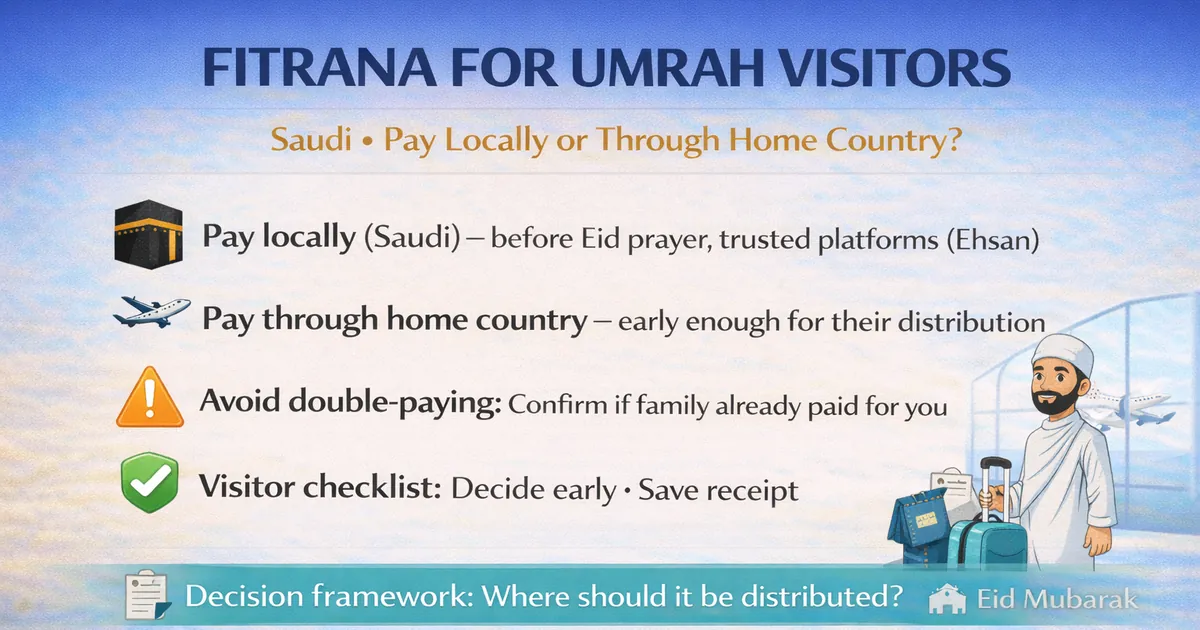
Fitrana for Umrah Visitors in Saudi: Pay Locally or Through Home Country?
Travel makes simple worship feel complicated.
You’re in Makkah or Madinah, your phone is full of family messages, and suddenly someone asks: “Did you pay Fitrana… and where should it be distributed?”
Here’s the calm answer: you can do this safely either way.
The real risk is double payment and missing the Eid prayer timing.
✅ TL;DR – fitrana for umrah visitors in saudi
If you’re in Saudi at the end of Ramadan, paying locally can be the easiest way to ensure it’s handled before Eid prayer. If your household back home already paid for you, don’t pay again. If you prefer home-country distribution, pay early enough for their timeline and keep a receipt so you can prove you paid once.
If you need the Saudi amount page for adults, check it here: Zakat al-Fitr 2026 amount. If you want a quick household total while traveling, use: Fitrana calculator.
the main question: where are you on eid week?
The main question: where will you be on Eid week—still in Saudi, already back home, or in transit? Your location affects timing and who is “responsible” in your family system.
Ask these three questions (I tell travelers to write them in Notes app):
1) Where will I be on Eid morning (Saudi / home / airport)?
2) Who normally pays for my household back home?
3) Did someone already include me in their count?
Micro-scenario: You’re staying in a hotel and your father says, “We already paid for everyone.” Don’t assume. Ask: “Did you include me too?”
pay locally: pros/cons
Pay locally: if you’re in Saudi near the end of Ramadan, local payment is usually the easiest way to meet timing and support local needy people. It also avoids the “will it reach in time back home?” worry.
Pros (real-life): you control timing, you can get a receipt immediately, and you’re done.
Cons (real-life): the biggest issue is double payment risk if your family back home already paid for you, or if you pay under the wrong category online.
If you’re paying online while traveling and you want a simple step flow, use this page: online fitrana saudi step-by-step.
pay through home country: pros/cons
Pay through home country: some visitors prefer home-country distribution because their dependents, relatives, or trusted charity is there. That can be fine—especially if your household giving is organized back home.
Pros: consistent family system, familiar charity, sometimes easier to coordinate dependents.
Cons: timing can get messy with travel, time zones, and distribution schedules. If you choose this route, pay early and keep proof.
Micro-scenario: You plan to “send it after landing,” but your flight delay eats the whole morning. That’s why travelers should not wait until the last hours.
avoid double-paying (scripts)
Avoid double-paying: the fastest fix is a short confirmation message. Most mistakes happen because everyone wants to do good… quietly… at the same time.
Script A (to family back home):
“Eid timing is close. Did you already pay Fitrana for me this year? If yes, I won’t pay again. If no, I’ll pay from Saudi and send you the receipt.”
Script B (to spouse / household payer):
“Please confirm who you’re paying for. If I’m included in your count, I won’t pay separately. If I’m not included, I’ll pay and send proof.”
Small personal aside: I’ve seen families double-pay just because nobody wanted to “bother” the other person with one question. Ask the question. It’s kindness, not bother.
If you already paid but later discover you chose the wrong donation label, use this fix page: found wrong donation category (Fitrana).
traveler checklist
Traveler checklist: do this once and you won’t be stuck in Eid morning confusion.
- Confirm who pays for you (family back home / sponsor / yourself).
- Pick one route: pay locally OR pay through home country.
- Pay early enough to meet the before-Eid-prayer purpose.
- Save proof (screenshot + receipt).
- Send one confirmation message so nobody repeats it for you.
If you missed it and remembered after Eid prayer, use this no-shame action page: forgot fitrana after eid prayer.
📊 quick decision table: pay locally or home country?
| Your Eid-week situation | Safest choice | One thing to confirm |
|---|---|---|
| You’re in Saudi for Eid week (Umrah / hotel) | Pay locally so timing is controlled | Did family back home already include you? |
| You fly home very close to Eid | Pay early (don’t wait for landing) | Eid prayer timing where you’ll land |
| Household payer back home always pays everyone | Let them pay (avoid duplicates) | Are you included in their count this year? |
| Nobody is paying for you | Pay where you can guarantee on-time handling | Correct label + receipt proof |
faqs
📘 fitrana for umrah visitors in saudi FAQs
should umrah visitors pay fitrana in saudi?
Show Answer
If you’re in Saudi at Ramadan’s end, paying locally can be the simplest for timing. Confirm first that your family back home did not already pay for you.
what if my family back home already paid?
Show Answer
If they included you, don’t pay again. Get a clear confirmation and move on.
how to avoid paying twice between countries?
Show Answer
Confirm who pays for you before you pay. Then pay once and keep a receipt.
can i pay fitrana online while traveling?
Show Answer
Yes. The safe approach is paying early enough and keeping proof so you don’t duplicate with family back home.
pay locally or send abroad: how to decide?
Show Answer
Decide based on where you can guarantee on-time handling before Eid prayer and avoid double-paying. Timing and clarity come first.
Related Articles
Fitrana Saudi payment guide (start here)
Who do you pay Fitrana for? (Saudi family guide)
How to choose trusted Fitrana charity (KSA)
Cash vs food Fitrana in Saudi (safe choice)
Fitrana vs Zakat difference (avoid wrong category)
Fitrana mistakes on the last day (avoid panic)

Farrukh Farooqi has been living in Sharaya, Makkah, Saudi Arabia since 2010. With over 14 years of firsthand experience witnessing the sacred journey of millions of pilgrims, Farrukh specializes in providing practical, insider tips for Hajj and Umrah travelers. His work blends real-world observations, the latest Saudi updates, and essential crowd management strategies — helping pilgrims and worshippers plan smarter, stay safer, and experience a spiritually fulfilling journey across the Holy Cities.


