
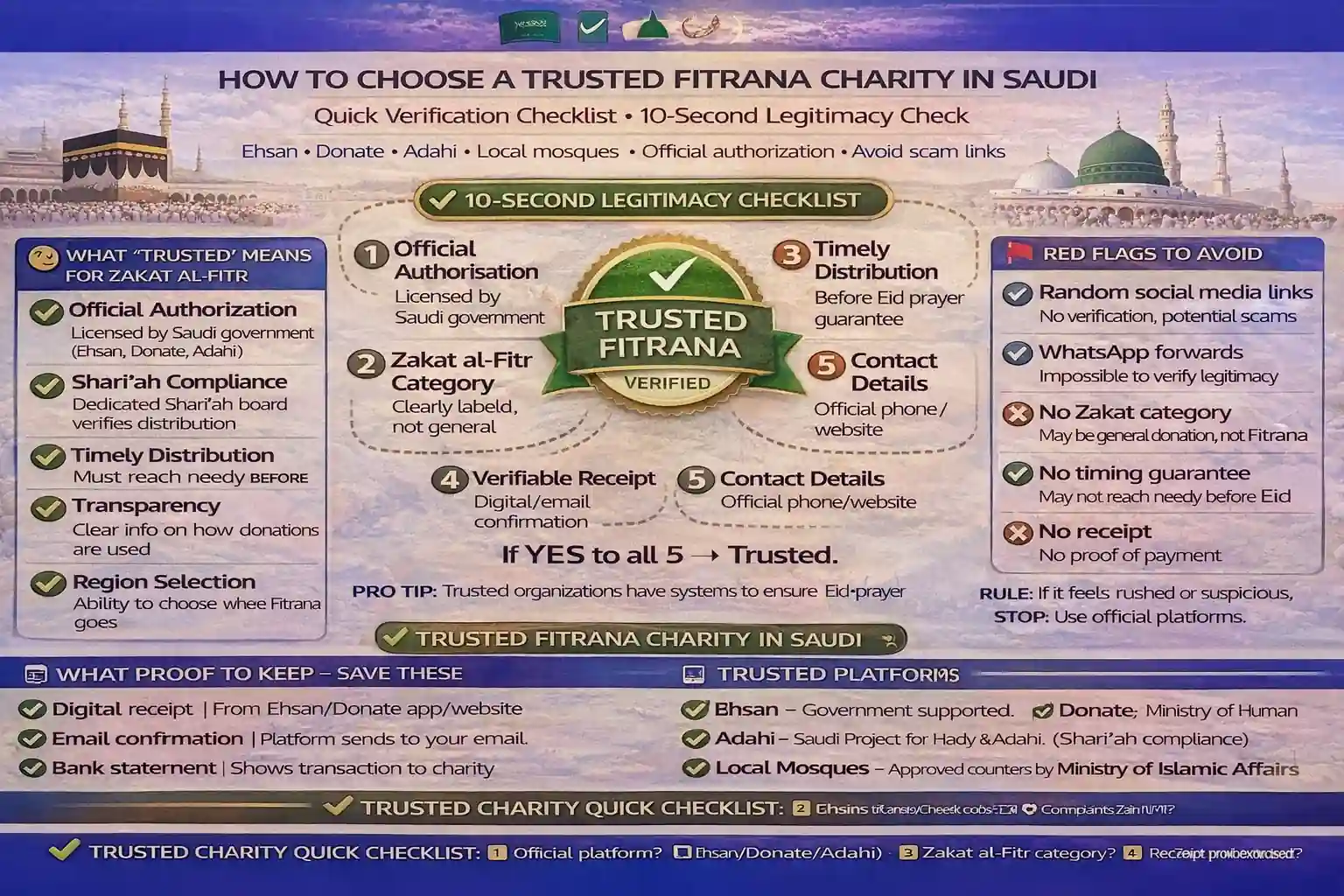
Trusted Fitrana Charity in Saudi: Quick Verification Checklist
On the last night of Ramadan, people don’t get scammed because they’re foolish.
They get rushed.
If you’re trying to find a trusted fitrana charity in saudi, the goal is simple: your donation should be clearly labeled as Zakat al-Fitr, distributed before Eid prayer, and backed by a real receipt you can verify.
I’ve seen the same mistake again and again: someone clicks a forwarded link, pays quickly, and only later realizes it was the wrong category. Not Fitrana. Just “general donation.” Good intention… messy result.
✅ TL;DR – trusted fitrana charity in saudi
A trusted fitrana charity in saudi clearly labels Zakat al-Fitr, explains zakat al fitr distribution timing (before Eid prayer), gives receipt verification, and provides real contact info. Avoid random links from social media. If unsure, pay earlier and keep proof so you can fix mistakes before the deadline.
AEO answer-first snippet: A trusted fitrana channel in Saudi clearly labels Zakat al-Fitr, explains distribution timing (before Eid prayer), provides a verifiable receipt, and offers official contact details. Avoid random links forwarded on social media; use known platforms or verified charity gateways. If you’re unsure, pay earlier and keep proof so you can correct mistakes before the deadline.
If you want the bigger Saudi context, keep these open while you decide: Fitrana Saudi payment guide, Fitrana timing before Eid prayer, and Online Fitrana step-by-step.
What “trusted” means for Zakat al-Fitr
Snippet-ready answer: “Trusted” for Zakat al-Fitr in Saudi means three things: the donation is placed in the correct zakat category correct (not general charity), it is delivered in the right distribution policy window (before Eid prayer), and you receive a real donor confirmation you can keep as proof.
Here’s a simple way to understand it.
Fitrana is not only “giving money.” It’s a timed delivery. Like sending food before guests arrive. If it reaches late, you still gave… but you missed the main Eid purpose.
So a trusted donation platform saudi (or a reputable physical collection) should be clear about timing, clear about the Zakat al-Fitr category, and clear about your receipt.
Some people ask about specific platforms by name. In Saudi, many donors use official donation portals and well-known regulated charities. The rule stays the same: don’t pay because a logo looks fancy—pay because the checks pass.
Different scholars discuss details like how early you may pay within Ramadan. Keep it respectful. The Saudi “safe execution” goal is still the same: deliver before Eid prayer.
10-second checklist
Answer-first: This 10-second checklist is how you verify donation platform ksa fast: check the link, check the category, check timing, check receipt, check contact. If any of these fail, stop and choose another channel.
- Link safety: Does the link look normal, or is it a weird short link from sms links / social media? If it’s weird, treat it as avoid scam donation links territory.
- Category label: Does it clearly say Zakat al-Fitr? This is the zakat category correct check.
- Timing promise: Does it explain zakat al fitr distribution timing before Eid prayer, or is it vague?
- Receipt exists: Will you receive receipt verification (confirmation message / email / reference number)?
- Official contact: Is there real contact info + donor support (not “DM us on Instagram”)?
That’s it.
Five checks. Ten seconds. A lot less regret.
🔎 “Official” doesn’t mean “looks official”
official charity confirmation means you can verify it through the platform’s own details: clear category, clear distribution timing, real receipt, and real support contact. Screenshots and forwarded messages don’t count as proof.
Micro-scenario: Someone sends a WhatsApp link saying “Eid urgent fitra.” You feel pressure. Do the checklist. If it fails even one check, close it and move on.
Red flags to avoid
Snippet-ready answer: Red flags for avoid scam donation links include rushed language (“last chance now”), unclear category (no mention of Zakat al-Fitr), no receipt, no contact details, and strange payment requests (personal bank accounts with no clear charity identity). If it feels shady, it usually is.
Here are the red flags I teach people to notice fast:
- Category confusion: It only says “Ramadan donation” or “help the poor” but not Zakat al-Fitr.
- No timing clarity: No mention of distribution before Eid prayer. That’s a problem for zakat al fitr distribution on time.
- Receipt missing: No receipt verification, no reference number, no confirmation message.
- Strange payment gateway: It avoids known payment gateway methods and pushes personal transfers without clarity.
- Contact is “social only”: Only a social media handle, no real support path, no clear identity.
Micro-scenario: The page asks you to send money to a personal IBAN and “screenshot your transfer.” That may be bank transfer safety trouble. A trusted route should not feel like buying something from a stranger.
People also ask: can i pay fitrana through mosque boxes safely?
Sometimes yes—if the collection is clearly organized by the mosque and known charity counters, with visible identity and a clear process. But a random unlabeled box with no information? That’s not the same thing as mosque collection legitimacy.
What proof to keep
Answer-first: Keep three proofs after you donate: a screenshot receipt, a confirmation message (email/SMS/app), and a short note of household count. This is your receipt and receipt verification safety net—especially if you need to correct a category mistake before the Eid deadline.
Proof is not about showing off your charity.
It’s about staying organized when the house is busy.
Save this basic bundle:
1) Screenshot the final confirmation page.
2) Save the confirmation message (SMS/email/app notice).
3) Note “Fitrana paid for X people” in your phone.
This directly answers: what proof to keep after paying fitrana.
If you want the “amount pages” so you don’t guess, use: Zakat al-Fitr 2026, Zakat al-Fitr 2025, and Fitrana calculator (embed: