
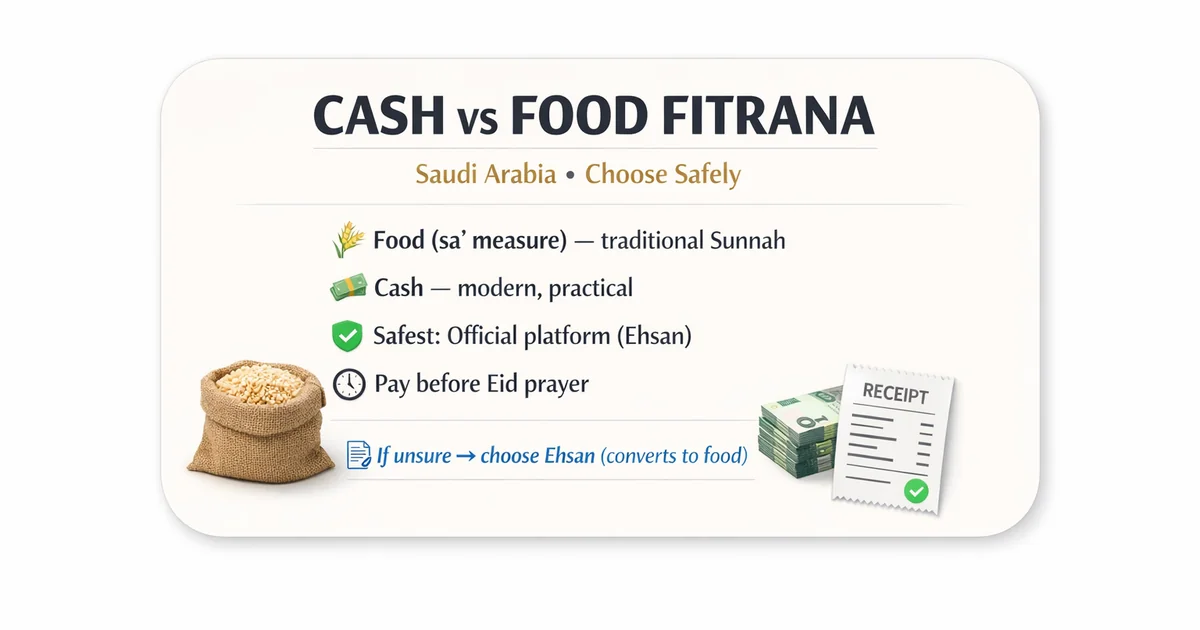
Cash vs Food Fitrana Saudi: Why People Differ (and How to Choose Safely)
This topic turns good families into debate clubs.
Someone says, “Food only.”
Someone else says, “Cash is easier.”
And you’re stuck in the middle, just trying to pay Zakat al-Fitr correctly before Eid prayer.
My students ask this every single Ramadan. And I get it—because online payments made things easier… and also created brand-new mistakes.
So we’ll do two things here: understand why scholars and communities differ, and then pick a choosing safest option path that keeps your worship clean and your heart calm.
✅ TL;DR – cash vs food fitrana saudi
People differ because Zakat al-Fitr was historically given as staple food in the sa’ measure, while many modern systems collect cash to distribute efficiently. If you’re unsure, the safest route is to use a trusted channel that clearly labels Zakat al-Fitr and delivers before Eid prayer, or give staple food in the sa’ measure yourself.
If you want the Saudi amount for this year, don’t rely on forwarded “rates.” Use your updated internal page like Zakat al-Fitr 2026 (and for last year: Zakat al-Fitr 2025). If you want a quick total for your household, use Fitrana calculator.
One sentence that saves stress: don’t argue—choose safely.
what fitrana is meant to achieve
What Fitrana is meant to achieve: it’s a final Ramadan gift that helps the eligible poor have something for Eid, and it cleans up small mistakes in fasting. The focus is simple: real benefit, on time, with the right Zakat al-Fitr category.
Here’s an everyday way to picture it.
Fitrana is like making sure the table is set before the guests arrive.
You don’t “set the table” after everyone already ate. You set it before Eid, so people can feel dignity on Eid day. That’s why timing sits at the center of this topic.
And yes—this is also why people care about food basket fitrana vs cash. Food feels direct. Cash feels flexible. Both sides are trying to protect the purpose.
Two one-sentence reminders:
Paying late changes the point.
Wrong category online also changes the point.
If you want the timing details in one place, link this naturally for readers: Fitrana timing before Eid prayer.
Micro-scenario: You’re busy on the last night and you think, “I’ll do it after Eid prayer.” That’s the moment to stop and do it now, even if it’s just a quick online payment.
food-based vs cash-based systems
Food-based vs cash-based systems: food is the original form—giving a sa’ of staple foods. Cash systems usually work through a trusted charity that takes money and arranges distribution on time. People differ because they weigh “literal form” and “practical delivery” differently.
Let’s talk about the sa’ without making it complicated.
sa’ is a measured amount that people used in the Prophet’s time. Instead of saying “kilograms,” they used a known container measure. Today, many guides explain it roughly as around a few kilograms of a common staple. That’s why you’ll hear phrases like staple food sa’ measure and “about a few kg of rice.”
So what staples are we talking about?
Usually basic, filling food: rice dates wheat fitrana (and similar staples in different countries). In Saudi homes, rice is the most common “default staple” because it’s widely used and easy to package.
Now the real disagreement point:
Value vs food debate.
Some people say: “Give the actual food. That’s safest. That matches the original form.” This is the “food-first” mindset. They like the clarity: the poor receives a real bag of staples.
Others say: “Cash can be allowed, especially if a trusted charity uses it to buy and deliver food or meet urgent needs.” This is the “purpose-first” mindset. They focus on what helps the needy most in today’s system.
And here’s the truth that keeps families calm: both groups are trying to protect fitrana compliance.
I’m not here to push you into a shouting match with your uncle.
I’m here to keep your worship safe.
Micro-scenario: Your friend says, “Cash is always wrong.” Your mosque says, “We collect cash for Zakat al-Fitr and distribute before Eid.” Instead of debating, you choose a path you trust and can explain to Allah with a clean conscience.
One more detail many beginners miss: when people say “cash,” they often mean two different things:
1) Cash given directly to a needy person as Zakat al-Fitr.
2) Cash paid to a trusted agent (charity/platform) that is clearly marked as Zakat al-Fitr category and distributed correctly.
Those are not the same in people’s minds. That’s why online clarity matters so much.
If your reader needs a separate “how to pay online” walkthrough, link: online fitrana saudi step-by-step.
how to choose safely (decision tree)
How to choose safely: pick the option that guarantees three things—correct Zakat al-Fitr labeling, correct distribution timing (before Eid prayer), and real benefit to eligible recipients. If you’re unsure, staple food in the sa’ measure is the most “argument-proof” choice, and a clearly labeled official channel is the most “system-proof” choice.
Here’s a simple decision tree you can follow without becoming a scholar overnight.
- If you can give food yourself (or through your local masjid distribution), give staple foods in the sa’ measure. Choose a staple people actually use (often rice, sometimes dates or wheat/barley depending on local practice).
- If you can’t deliver food, use a trusted channel that clearly labels the donation as Zakat al-Fitr (not “general donation”) and confirms it will be distributed before Eid prayer.
- If your household is split on the issue, pick the safest peace option: food for those who insist on food, and official labeled Zakat al-Fitr channel for those comfortable with cash—while still keeping the timing correct.
- If you’re worried about “wrong category” online, slow down and double-check the label before paying. A wrong label can turn it into normal charity, not Zakat al-Fitr.
- If you’re still unsure, don’t gamble. Choose staple food in sa’ measure or a trusted, clearly labeled Zakat al-Fitr channel. That’s the choosing safest option path.
That’s your calm answer to: cash vs food fitrana saudi explained simply.
Now let me answer the popular “but what should I personally choose?” question in a human way.
If you’re the kind of person who sleeps better when things are literal and clear—go with food.
If you’re the kind of person who knows distribution systems and trusts a proper channel that is explicit about Zakat al-Fitr and timing—cash through that channel may feel safer for you.
Both can be sincere. The danger isn’t sincerity. The danger is sloppy process.
“When unsure” safe line (no arguing):
“I’m choosing the option that guarantees Zakat al-Fitr label + distribution before Eid prayer. I don’t want a category mistake.”
Micro-scenario: You’re paying at 1:30 AM, half-asleep. You see “Sadaqah” and “Zakat al-Fitr” options. Your finger is already moving. Stop. Pick Zakat al-Fitr only.
How to choose a staple for food fitrana? Choose what people in your area actually eat daily. In Saudi, rice is often the simplest staple because it’s common, easy to package, and easy to distribute.
Can I give dates instead of rice? Many people do, because dates are a known staple historically and culturally. The safe approach is: give a staple that is truly food and is actually useful to people receiving it.
And if your mind is thinking: “How do I estimate one sa’ in common food?” then you’re already being careful. That’s good.
I’m going to say this gently: don’t turn sa’ into a math contest on Eid night.
If you want a clean household total (count + total amount using your chosen method), use Fitrana calculator. If you want the official per-person amount for Saudi for this year, use Zakat al-Fitr 2026.
Short story (beginner mistake + fix):
A brother once told me, “I paid early online—done.”
Then on Eid morning his wife said, “Which category did you choose?”
He checked and went quiet. It was “general donation,” not Zakat al-Fitr category.
He panicked and started blaming the site, the phone, the whole world.
I said, “No shame. Just fix it.”
He paid again under the correct label before the prayer, and then he set a reminder for next year: “Label first, pay second.”
That tiny label check saved his worship from a messy feeling.
online pitfalls (wrong category)
Online pitfalls: the biggest risk isn’t cash itself—it’s paying under the wrong label, paying too late, or assuming a platform will “figure it out.” If you’re paying online, your job is to ensure it’s clearly marked as Zakat al-Fitr and handled before Eid prayer.
People rarely mess up because they don’t care.
They mess up because they’re rushing.
Here are the most common online mistakes I see in Saudi households—real, practical, and fixable:
Mistake 1: choosing “general donation” instead of cash donation category zakat al fitr.
Quick fix: look for the exact Zakat al-Fitr label before you pay.
Mistake 2: paying “after prayer” because you assumed it’s still the same.
Quick fix: pay earlier. Use this timing guide to keep it simple.
Mistake 3: thinking “I paid cash, so it’s fine” without asking how it’s distributed.
Quick fix: choose a trusted channel that states it handles local charity distribution before Eid.
Mistake 4: double-paying because two adults both paid “for the family.”
Quick fix: agree who pays for whom. If you need the household script, use your related page: pay fitrana for family saudi.
Mistake 5: mixing up Fitrana with other Ramadan duties.
Quick fix: point readers to: Fidya in Islam and Kaffarah in Islam.
If your reader is asking “How do I choose a trusted place?” this link fits naturally here: how to choose trusted fitrana charity KSA.
Micro-scenario: You’re on a donation app and you see “Zakat,” “Zakat al-Fitr,” and “Sadaqah.” You pick “Zakat” because it looks close enough. But it’s not the same category. Choose Zakat al-Fitr specifically.
quick faqs
Quick FAQs: below are short, direct answers (snippet-friendly). After the table, you’ll find the full FAQ section with more detail and extra questions people search.
Is it allowed to pay Fitrana in cash in Saudi? People differ. If you choose cash, the safest way is through a trusted channel clearly labeled Zakat al-Fitr with distribution before Eid prayer.
Should I give rice or money for Zakat al-Fitr? If you’re unsure, giving staple food in the sa’ measure is the most argument-proof option.
Can a charity convert cash to food for Fitrana? Many systems are built around that idea, but your responsibility is choosing a trusted channel and the correct Zakat al-Fitr label.
Can I give food after Eid prayer? Timing matters for Fitrana. If you miss it, you can still give charity, but you should treat the timing seriously and aim for before the prayer.
The One Table📊 cash vs food fitrana saudi: safest choice map (no arguments)
Use this table to pick a safe option based on your situation. The goal is fitrana compliance, correct Zakat al-Fitr category, and on-time distribution.
| Your situation | Safest choice | What to double-check |
|---|---|---|
| You’re unsure about is cash allowed zakat al fitr | Staple food in sa’ measure | Choose a true staple (often rice) and deliver before Eid |
| You can’t deliver food yourself | Trusted channel with clear Zakat al-Fitr category | Label + distribution before Eid prayer |
| Family disagreement (food vs cash) | Choose the “peace” path: food for strict views, labeled channel for others | Don’t double-pay the same person |
| You’re paying online late at night | Slow down, pay once, correct label | Avoid cash donation category zakat al fitr mistakes |
| You’re worried about missing timing | Pay earlier (don’t wait for last hours) | Use timing reminder |
For the Saudi per-person amount and updates, use Zakat al-Fitr 2026. To total your household quickly, use Fitrana calculator.
📘 cash vs food fitrana saudi FAQs
is it allowed to pay fitrana in cash in saudi?
Show Answer
People differ because some prefer the original food form, while others allow cash when it reaches the needy correctly. If you choose cash, the safest route is a trusted channel clearly labeled Zakat al-Fitr category with on-time distribution before Eid prayer.
should i give rice or money for zakat al fitr?
Show Answer
If you want the safest “no debate” option, give rice (or another real staple) in the sa’ measure. If you choose money, use a trusted channel that clearly marks it as Zakat al-Fitr and distributes before Eid.
why do scholars differ on cash for zakat al fitr?
Show Answer
Some focus on keeping the original form: staple foods in sa’. Others focus on the purpose: helping people effectively, especially when trusted charities can distribute well. Both care about fitrana compliance.
what does the sa’ measure mean for food fitrana?
Show Answer
sa’ is a traditional measure used for staples. Many guides explain it as roughly a few kilograms of a common staple. The key is giving a real staple amount, not a tiny symbolic packet.
how to choose a staple for food fitrana?
Show Answer
Choose what people actually eat daily in your area. In Saudi, rice is often the simplest. Some also choose dates or wheat/barley depending on custom and availability.
can a charity convert cash to food for fitrana?
Show Answer
Many charities work that way. Your job is to choose a trusted channel, select the correct Zakat al-Fitr category, and pay early enough for proper distribution before Eid prayer.
does paying cash change the purpose of fitrana?
Show Answer
The purpose stays the same: helping eligible people in time for Eid. The risk is not cash itself—it’s wrong category, late timing, or unclear distribution.
what if i cannot deliver food myself?
Show Answer
Use a trusted channel that clearly labels Zakat al-Fitr and can distribute before Eid prayer. This is where clear online labeling matters most.
how to avoid wrong category online?
Show Answer
Don’t pick “general donation” or a vague “Zakat” option when you mean Fitrana. Choose the specific Zakat al-Fitr category. Use online step-by-step if you want a simple checklist.
can i split between cash and food?
Show Answer
Some people do split methods for household peace. The main rule is still: one valid payment per person, correct category, and correct timing.
can i give food after eid prayer?
Show Answer
Fitrana is tied to Eid timing. If you miss it, you can still give charity, but take the timing seriously and try to pay before the prayer. Use this timing guide.

Farrukh Farooqi has been living in Sharaya, Makkah, Saudi Arabia since 2010. With over 14 years of firsthand experience witnessing the sacred journey of millions of pilgrims, Farrukh specializes in providing practical, insider tips for Hajj and Umrah travelers. His work blends real-world observations, the latest Saudi updates, and essential crowd management strategies — helping pilgrims and worshippers plan smarter, stay safer, and experience a spiritually fulfilling journey across the Holy Cities.


