
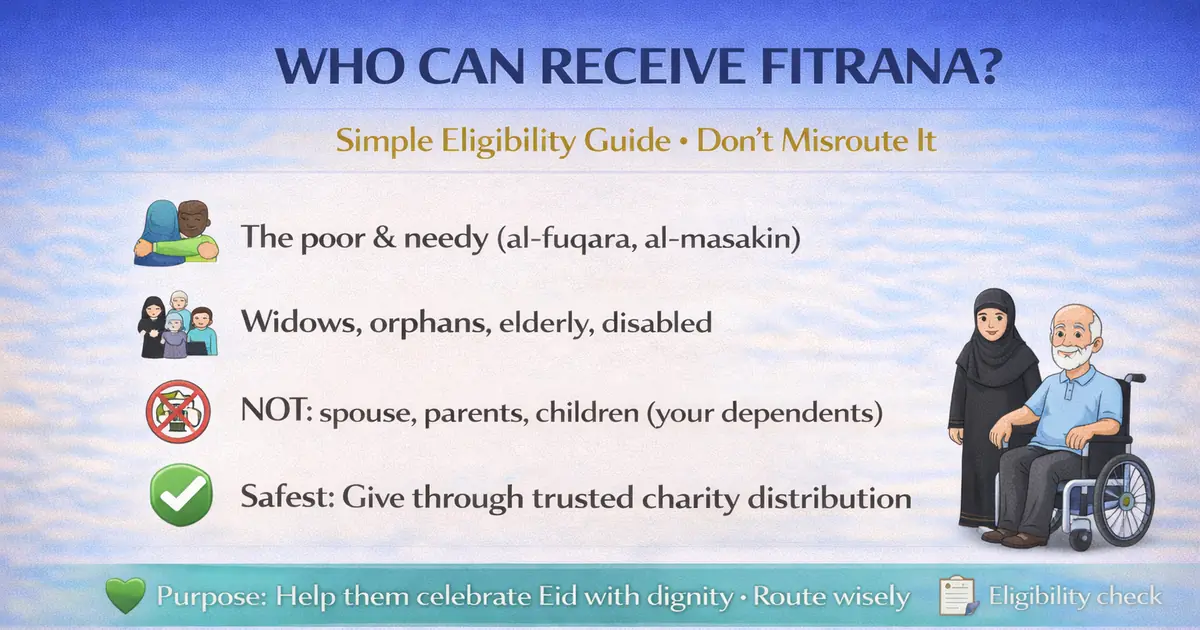
Who Can Receive Fitrana? A Simple Eligibility Guide (So You Don’t Misroute It)
Fitrana is meant to land in the right hands—fast.
Not in the “nice project” bucket. Not in the “general donation” box. And not with someone you already must support.
This is the part that hurts: misrouting doesn’t look sinful on the screen.
It looks like a successful transaction.
I’ve seen families do everything with a good heart… and still send it to the wrong place because nobody explained eligibility clearly.
✅ TL;DR – who can receive fitrana
Fitrana is for the poor and needy so they can enjoy Eid with dignity. The safest approach is to give through a trusted channel that targets eligible recipients zakat al fitr and distributes before Eid prayer. If giving directly, give to genuinely needy Muslims and avoid uncertain situations where eligibility isn’t clear—misrouting donation defeats the purpose.
If your main worry is timing, keep this separate and clean: Fitrana timing before Eid prayer.
And if you want to pay online but fear “wrong category,” this page is made for that exact headache: I chose the wrong donation category for Fitrana.
the purpose: eid support
The purpose: Fitrana is Eid support for people in need, so they can eat, prepare, and celebrate with dignity. It’s like making sure everyone has a seat at the Eid table—quietly, without humiliating anyone.
That’s the heart of it.
Fitrana isn’t meant to sit in a bank account for weeks.
It’s meant to arrive before Eid, so the person receiving it can actually benefit at Eid time.
When you understand that, eligibility becomes simpler.
Ask yourself: “Does this person genuinely need help to get through Eid?”
If yes, you’re close to the purpose.
If you’re planning household payments and who pays for whom, this internal guide connects nicely (use once): pay Fitrana for family in Saudi.
who qualifies (simple)
Who qualifies: the simplest, beginner-safe answer is poor and needy fitrana—people who genuinely struggle to cover basic needs. In traditional discussions, the eligible categories match the broader Zakat recipient groups, but for everyday Fitrana in Saudi, think: “real need, real benefit before Eid.”
Now let me make it practical.
Picture a small “Eid support” circle. The eligible people are inside that circle because their need is real.
The ineligible cases are outside because the money won’t serve the purpose—or because you’re already required to support them.
Common eligible examples (kept simple):
• The poor and • the needy—people with not enough for daily life.
• Vulnerable individuals who lack support (for example, someone elderly or a widow who genuinely can’t manage expenses).
• Needy travelers who are stuck and can’t reach funds.
• People burdened by genuine debt who can’t cope (this is discussed within Zakat categories; apply care and don’t guess).
Now, the big “restriction” that causes misrouting:
You generally shouldn’t give Fitrana to people you are already responsible to maintain.
That includes your own dependents in most normal cases (spouse, children, parents you must support). If you give to them, it’s not “charity to the needy,” it’s your duty of maintenance—different lane.
So, what about relatives?
Can relatives receive fitrana? Yes, relatives can receive if they’re genuinely eligible (poor/needy) and they are not the dependents you must maintain. In fact, helping a needy relative can be a beautiful way to keep support close and dignified.
Micro-scenario: your uncle is struggling, but he’s proud and won’t ask. If you know he’s truly in need, discreet support through Fitrana (or through a trusted channel) can protect his dignity.
And students?
fitrana for students is possible if the student is truly eligible (real hardship, not just “I want extra spending money”). Students can be needy. But don’t assume every student qualifies.
If your reader mixes up Zakat al-Fitr and annual Zakat categories, send them to this once: Fitrana vs Zakat difference.
direct giving vs charity route
Direct giving vs charity route: direct giving works when you are confident the person is eligible and you can give with dignity. The charity route is safer when you’re unsure, when you want structured charity distribution, or when timing is tight and you need trusted distribution rules to be followed before Eid.
Here’s the thing: “direct” feels more personal, but it can also be riskier.
Because you might be wrong about eligibility. Or the person might be too embarrassed to tell you their real situation.
So I teach this simple rule:
If you’re sure they’re eligible, direct giving can be excellent.
If you’re not sure, route through trusted distribution.
That’s not cowardice. That’s careful worship.
Micro-scenario: you want to give to a driver, but you don’t know if they are in real need or not. Instead of guessing, you give through a trusted channel that targets the genuinely needy. Your intention stays clean, and you avoid misrouting.
If you need a “trusted channel” filter for Saudi, use this once: how to choose a trusted Fitrana charity in KSA.
And if you’re paying online, this step-by-step can sit naturally as a supportive link: online Fitrana Saudi step-by-step.
What about local recipients?
Many people prefer giving to the local community because you feel the impact and you avoid delays. But if your local circle has no clear need and another area has stronger need, people do send support elsewhere too. Don’t make it political. Make it purposeful: where will it reach eligible recipients before Eid?
If you want to help Umrah visitors who need guidance around Fitrana, use this once: Fitrana for Umrah visitors in Saudi.
common misrouting mistakes
Common misrouting mistakes: giving to someone ineligible because you felt shy to ask, giving to dependents you already must support, sending it to a general fund by accident, giving to an institution instead of eligible individuals, and leaving distribution too late so the benefit misses Eid.
Let me be blunt: most mistakes are not “bad intention.”
They’re rushed payments.
Here are five quirky beginner mistakes I see every year (and quick fixes):
Mistake 1: Paying “Fitrana” but selecting “general donation.” Fix: confirm the category label. If you already did it, use: wrong category fix.
Mistake 2: Giving Fitrana to someone you already must maintain, thinking it “counts.” Fix: keep maintenance duty and charity duty separate.
Mistake 3: Giving to a random person because they “look needy.” Fix: choose dignity + verification. If unsure, route through a trusted channel.
Mistake 4: Sending it too late so it can’t be distributed before Eid prayer. Fix: don’t gamble with timing—use: can you pay Fitrana early?.
Mistake 5: Thinking “mosque construction” or “school building” is automatically a Fitrana recipient. Fix: Fitrana is about eligible people, not projects. If the money reaches eligible individuals through a controlled program, that’s different—but don’t assume.
Short story (beginner mistake + fix). I still remember this because it was so human.
A brother once told me, “I gave my Fitrana to a worker because I felt awkward asking questions.”
He was sincere.
Later he learned the worker was actually fine financially, and the truly needy person in his neighborhood was struggling silently.
He said, “I didn’t want to seem rude.”
I told him: “You weren’t rude. You were unsure.”
Next year, he sent his Fitrana through a trusted channel and gave extra personal help separately. His heart felt calmer.
If someone forgot and it’s after Eid prayer, don’t shame them—send them here once: forgot Fitrana after Eid prayer.
FAQs
📘 who can receive fitrana FAQs
who can receive fitrana in islam (simple)?
Show Answer
The simple answer: genuinely poor and needy Muslims who need Eid support. If you’re unsure about eligibility, use a trusted distribution route to avoid misrouting.
who is eligible for zakat al fitr recipients?
Show Answer
Eligible recipients are people in real need—commonly described as the poor and the needy. Many scholars align Fitrana eligibility with Zakat recipient categories, but your practical focus should be genuine need and timely Eid benefit.
can i give fitrana to my relatives?
Show Answer
Yes—can relatives receive fitrana if they are genuinely eligible (poor/needy) and they are not dependents you must maintain. If it’s unclear, route through trusted distribution.
can a family member receive fitrana if poor?
Show Answer
A family member who is truly poor may be eligible, as long as they are not the person you are already required to financially support as a dependent.
can i give fitrana to a worker or driver?
Show Answer
Only if the worker is genuinely eligible (needy). Don’t assume based on job title. If you can’t confirm eligibility, use a trusted charity route to avoid misrouting.
can workers receive fitrana if they are needy?
Show Answer
Yes, a worker who is truly needy can be an eligible recipient. The condition is need, not occupation.
can a student receive fitrana?
Show Answer
A student can receive if they are truly eligible (real hardship). Being a student alone doesn’t automatically qualify someone.
should fitrana go to local needy in saudi?
Show Answer
Many people prefer local distribution because it’s faster and clearer. If another region has stronger need and distribution can still happen before Eid, some people send it there. The key is eligible recipients and timing.
can i send fitrana to another country?
Show Answer
Some people do, especially when need is greater elsewhere. The practical check is timing: will it reach eligible recipients before Eid prayer? If you can’t be confident, keep it local or use a trusted channel.
can i split fitrana among multiple recipients?
Show Answer
People sometimes split support across more than one needy household. If you’re unsure about rules in your situation, using a trusted distribution route is the simplest way to stay safe.
can i give fitrana directly vs through charity?
Show Answer
Both can work. Direct giving is best when eligibility is clear and dignity is protected. Charity route is best when you want verification, structured distribution, and fewer mistakes.
what is a simple fitrana eligibility checklist?
Show Answer
Ask: 1) Are they genuinely needy? 2) Are they someone I’m already required to support? 3) Will this reach them before Eid? If any answer is unclear, route through trusted distribution.
the one table (eligibility quick map)
Fitrana recipients: “safe yes” vs “pause and check” vs “common no”
| Bucket | Who this usually includes | Simple rule |
|---|---|---|
| Safe Yes | Poor and needy people you’re confident about | Need is clear + Eid benefit is real |
| Pause & Check | Relatives, workers, students—when need isn’t obvious | Don’t assume; if unsure, use trusted distribution |
| Common No | Those you must maintain as dependents (in normal cases) | Maintenance duty ≠ Fitrana recipient |
If you want the Saudi amount pages for this year without guessing numbers, use: Zakat al-Fitr 2026 amount.

Farrukh Farooqi has been living in Sharaya, Makkah, Saudi Arabia since 2010. With over 14 years of firsthand experience witnessing the sacred journey of millions of pilgrims, Farrukh specializes in providing practical, insider tips for Hajj and Umrah travelers. His work blends real-world observations, the latest Saudi updates, and essential crowd management strategies — helping pilgrims and worshippers plan smarter, stay safer, and experience a spiritually fulfilling journey across the Holy Cities.


