
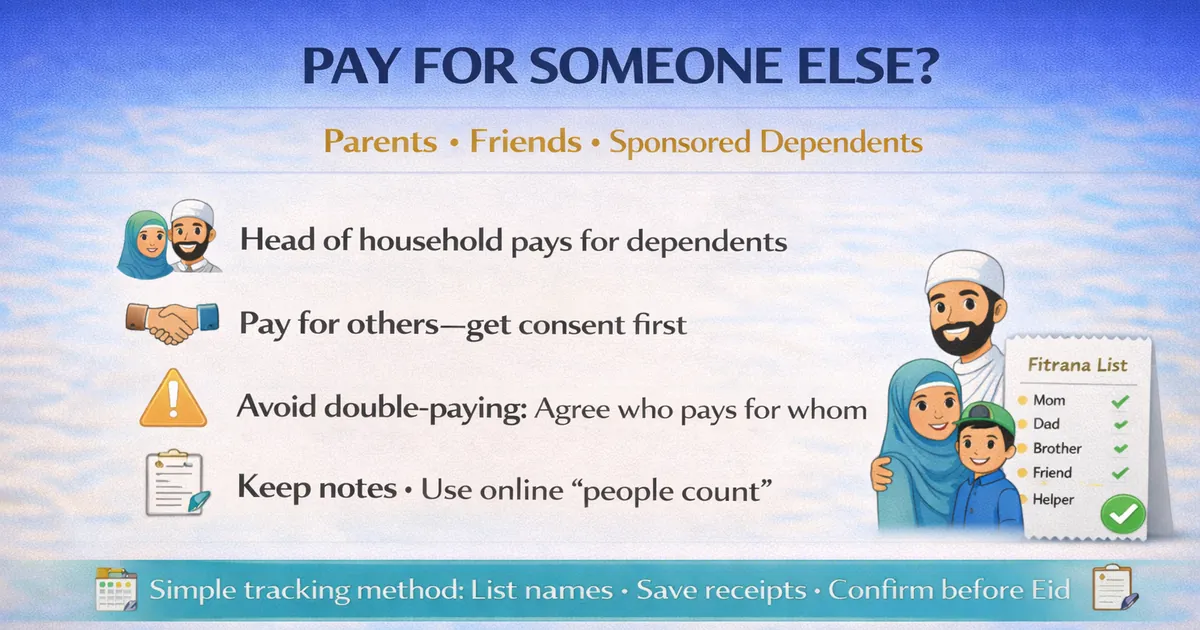
Pay Fitrana for Someone Else in saudi? (Parents, Friends, Sponsored Dependents)
Yes, you can pay it for someone else.
And in Saudi homes, it happens all the time—quietly, without announcements, because people are just trying to keep family duties tidy before Eid.
But here’s the catch: the “payment” part is easy. The “avoid double payment” part is what trips people up.
My students always ask the same thing: “If I pay for my parents… do I need to tell them?”
Let’s make this simple, safe, and stress-free.
✅ TL;DR – pay fitrana for someone else in saudi
Yes—people often pay zakat al fitr on behalf of dependents (kids, spouse, those they maintain) and sometimes as a gift fitrana for others (parents, relatives, friends). The safety rule is clarity: agree who is paying for whom to avoid double payment, choose the correct household responsibility and online count, pay before the Eid deadline, and keep a proof receipt. If the person already paid, don’t quietly pay again—either adjust your plan before Eid or treat it as extra charity with a clear intention.
If you want the “family counting” version of this topic, link once here: who you pay Fitrana for in Saudi (family guide).
And if you’re paying online and want a clean flow, this page fits: online Fitrana Saudi step-by-step.
when paying for others is common
When paying for others is common: when you’re the guardian pays fitrana person in a household (kids, dependents), when you’re supporting someone financially, or when you’re helping family abroad who may struggle with timing. It’s also common when someone is traveling, elderly, or just forgetful.
Some families like one person to handle everything in one go.
Others split it: one spouse pays for the kids, the other pays for themselves.
Either is fine if you coordinate.
Here are the most common Saudi situations I see:
1) Dependents in your home (this is normal household responsibility).
2) Parents abroad—especially: pay for parents abroad from Saudi when you know they might miss the window.
3) A friend who asked for help—yes, pay for friend is a thing, especially when someone is new in the country or had a tough month.
4) Sponsored or supported dependents—people ask about sponsored dependent fitrana when they financially maintain someone and want to cover them.
Micro-scenario: your father is in another country and says, “I’ll pay later.” You know “later” might become “after Eid prayer.” You pay early and send the receipt. That’s kindness plus safety.
If timing is your worry, this page matches this topic (use once): Fitrana timing before Eid prayer.
practical rules (avoid double-paying)
Practical rules: you can pay Fitrana on behalf of others, but you must keep three things clean—intention, coordination to avoid double payment, and timing before the Eid deadline. If any one of these is messy, the household becomes confused fast.
Think of this like booking seats for a family trip.
You’re allowed to buy tickets for others. But if two people buy the same seat, you don’t become “extra righteous.” You just waste money and create a headache.
Here are the 7 rules I teach as a safe default (not debate-heavy):
🧠 7 safe rules for paying on behalf of others
Rule 1: Be clear it’s Zakat al-Fitr (not general donation).
Rule 2: Make a quiet intention that you’re paying “on behalf of ____.” (intention for someone else)
Rule 3: Ask or agree first when it’s not your dependent (friends, parents who pay themselves). (consent avoids confusion)
Rule 4: Decide who pays for whom to avoid double payment.
Rule 5: Choose correct online count / people number before submitting.
Rule 6: Keep a proof receipt (screenshot/email).
Rule 7: Pay before the Eid deadline and don’t leave it to the last hour.
Now, the permission question.
Do i need permission to pay fitrana for someone? For dependents you’re responsible for, families usually treat it as normal and don’t make it a formal “permission ceremony.” For adults outside your responsibility (like a friend), it’s cleaner to get consent or at least tell them—mainly to avoid double-paying and awkwardness.
Micro-scenario: you pay for a friend quietly. Next day they say, “I already paid.” Now you both feel weird. A 10-second message would’ve prevented it.
If you’re worried about last-day confusion, this internal page can support this article (use once): common Fitrana mistakes on the last day.
how to track payments
How to track payments: don’t rely on memory. Use one simple “who-paid-for-who” note so you can confirm household responsibility, stop double payment, and keep proof if anyone asks. This is especially helpful when paying for parents abroad or sponsored dependents.
This tracking method is boring.
That’s why it works.
Here’s the simplest method I’ve seen families actually keep:
📝 “Who-paid-for-who” tracker (Saudi family version)
Date: ____
Payer: ____
Paid on behalf of: ____ (names or count)
Platform/channel: ____
Receipt screenshot saved? Yes/No
Note: “Already paid” / “Needs payment” / “Check with ____”
If your family is big, add one extra line: “Total people count = ____.” That stops the “I think it was 8” guessing.
And if you’re explaining it to kids so they don’t interrupt you mid-payment, this page supports that job (use once): explain Fitrana to kids.
Also, if you’re mixing up Fitrana with annual Zakat, don’t. Use a separate explanation page (use once): difference between Fitrana and Zakat.
online “people count” tips
Online people count tips: treat the payment as a “people list,” not a money transfer. Decide who you’re paying for first, then select the correct number in one transaction, and save the receipt. This is the safest way to pay zakat al fitr on behalf without errors.
Here are four Saudi-friendly tips that reduce mistakes:
Tip 1: Write the names first. Then count. (Names stop accidental extras.)
Tip 2: If paying for parents abroad, message them: “I paid yours—please don’t pay again.”
Tip 3: If paying for a friend, ask: “Have you already paid?” before you hit submit.
Tip 4: Save a proof receipt immediately. Don’t tell yourself, “I’ll download it later.” Later disappears.
Micro-scenario: you’re paying for multiple people in one transaction, but you get a call and lose focus. You return and forget if you selected 5 or 6. That’s why the tracker above matters.
If you want readers to calculate totals quickly, you can show the tool once:
Fitrana Calculator: