
Fitrana for Domestic Workers in Saudi: Handling It Respectfully (Common Questions)
This topic gets awkward fast.
Not because the rule is impossible… but because people mix “helping” with “obligation,” and nobody wants to sound rude.
My students always ask the same thing: “Can I just include her in my household count and be done?”
You can handle this cleanly. With dignity. With consent. With zero embarrassment.
✅ TL;DR – fitrana for domestic workers in saudi
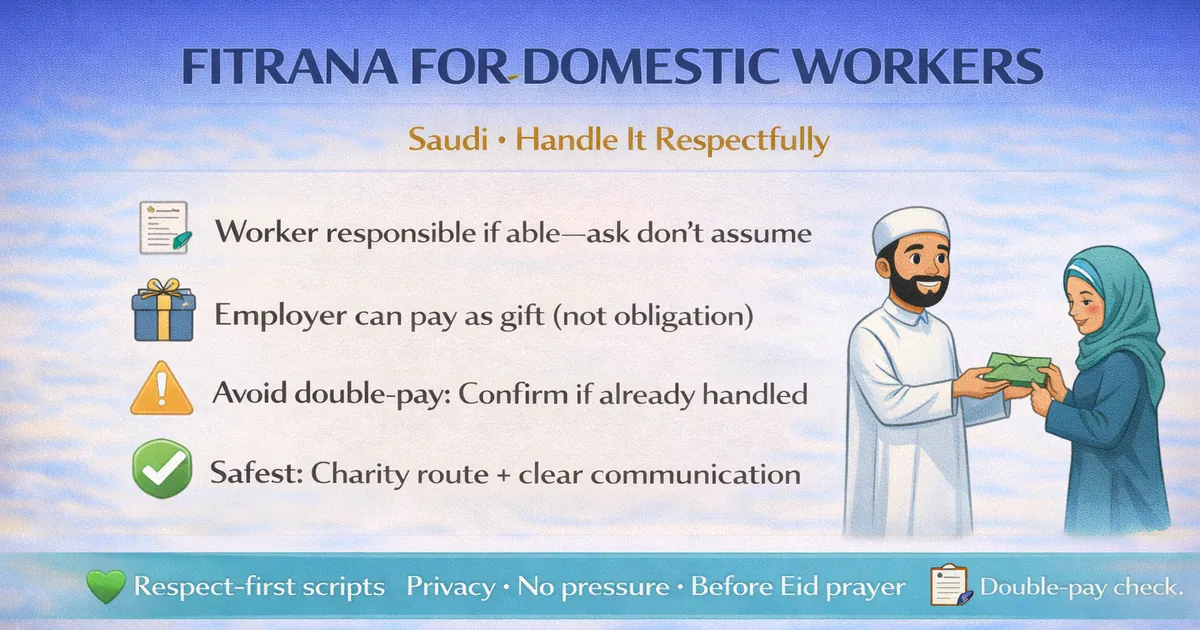
Domestic-worker Fitrana questions often get awkward because people confuse help with responsibility. The clean approach is respect and clarity: don’t assume; ask if they already handled it, avoid double-paying, and if you want to help, do it through a trusted charity route or an extra gift—without pressure—before Eid prayer.
If you need the general “who pays for whom” household logic first, use this once: pay Fitrana for family in Saudi.
And for the Saudi timing window, keep it simple and link once: Fitrana timing before Eid prayer.
the respectful baseline
The respectful baseline: treat your domestic worker like an adult with dignity. Don’t assume they can’t pay. Don’t assume they must pay. Ask once, politely, and then act in a way that protects their privacy, avoids pressure, and prevents double-payment risk.
Here’s the easiest way to think about it.
Fitrana is like a personal “Eid responsibility ticket.” Some people hold their own ticket. Some need help buying it. And sometimes, the person might actually qualify as someone who receives help rather than someone who pays.
That’s why assumptions cause trouble.
So instead of “I’ll decide for you,” use “I’ll support you if you want.”
One human detail: I’ve seen employers mean well, but the worker felt embarrassed because it was announced in front of family guests. Avoid that. Quiet help is real help.
If you’re unsure about who can receive Fitrana, don’t guess—use your internal page once: who can receive Fitrana.
common scenarios (who paid?)
Common scenarios: the “maid fitrana question” usually falls into one of these situations: the worker already paid, the worker wants help, the employer wants to pay as a gift, or nobody knows what happened and double-paying is about to happen. The fix is always the same: ask politely, decide clearly, and keep the receipt.
Below are the real cases I see in Saudi homes.
scenario 1: “she already paid for herself”
What if they already paid? Then don’t include them in your household payment count. Thank them for handling it and move on.
Micro-scenario: you paid for the whole house, then later she says she already paid. Next year, use the one-question check before you pay.
scenario 2: “she didn’t pay and feels shy”
This happens more than people admit. Not because of religion—because of money and embarrassment.
If you want to help, do it quietly and give them a simple choice: “Would you like me to handle it for you, or would you like to do it yourself?” That’s eligibility and consent in one sentence.
scenario 3: “employer pays fitrana” as a gift (with consent)
Does employer pay fitrana for maid in saudi? The worker is generally responsible for their own worship duties if they are able, but an employer pays fitrana on their behalf can be treated as a kindness when it’s done with consent and clarity.
Key word: consent.
Don’t “surprise pay” in a way that makes them feel owned.
scenario 4: “worker pays fitrana” but you also want to help
If the worker prefers to pay, respect that. If you still want to help, keep it separate: a small Eid gift, or extra charity through your chosen route—without mixing it into their obligation.
This is the clean line between gift vs obligation.
scenario 5: sponsored worker, confusion about who is responsible
Who is responsible sponsor or worker? Don’t turn this into a sponsor debate. The practical approach is: ask what they intend to do, and if you choose to help, help as a gift—without pressure and without public discussion.
If you want a dedicated page about paying on behalf of someone (without awkward wording), link once: pay Fitrana for someone else in Saudi.
scenario 6: “can i include them in my household count?”
Can i include them in my household count? Only do this when it’s clear you are paying on their behalf with consent and you’re not risking double payment. Otherwise, keep your household count to your family dependents and use a separate payment for them (or let them handle theirs).
Micro-scenario: your spouse already counted the worker. You count again. Now it’s paid twice and everyone feels uncomfortable. We’ll prevent that next section.
scenario 7: the worker may be eligible to receive Fitrana
This part needs extra respect. Some domestic workers may fall into need, meaning they could be eligible to receive help rather than being pushed to pay.
Don’t decide this for them in a loud family meeting.
Use a private, kind question and a safe charity route if you’re unsure.
If you want your readers to understand Fitrana basics without heavy language, link once to your kid-friendly explainer: explain Fitrana to kids.
how to help without pressure
How to help without pressure: offer a choice, keep it private, and separate “their obligation” from “your kindness.” If you’re unsure what’s best, the simplest option is to support through a trusted charity route and keep your worker’s decision private.
Here’s a respectful communication script you can use (short, simple, not weird):
🗣️ Respect-first script (copy/paste)
“Eid is coming. Have you already handled your Zakat al-Fitr, or would you like me to help you with it? Either way is okay. I just don’t want you to feel stressed.”
That one message does three things: it protects dignity, checks consent, and prevents double paying.
Now, if you’re helping through online payment and you want a clear route, send your readers here once: online Fitrana Saudi step-by-step.
And if someone worries about “cash vs food” details, keep it separate and link once: cash vs food Fitrana (Saudi).
Micro-scenario: you want to help, but the worker says “No.” Respect it. You can still give a separate Eid gift or donate through charity quietly.
Also: avoid mixing “help” with salary talk. “Fitrana for domestic workers in saudi salary” is a search people do, but salary-based assumptions can embarrass the person. Keep it about consent and timing, not interrogation.
avoid double-paying
Avoid double-paying: do a quick one-question check (“Did you already pay?”), don’t auto-add them into your household count, and save a receipt if you pay on their behalf. Double-paying is the #1 mistake because multiple adults in the home try to “be nice” separately.
Double-payment feels generous… until it feels messy.
Here’s the clean mini-plan I teach families:
✅ Domestic worker Fitrana checklist (no double-pay)
1) Ask privately: “Did you already pay?”
2) If yes: don’t include them in your count.
3) If no: offer help with consent (their choice).
4) If you pay: keep the receipt screenshot.
5) Finish timing before Eid so it’s not last-minute stress.
If someone made a last-day mistake (wrong count, wrong category, panic), point them once to your fix page: common Fitrana mistakes on the last day.
And if someone paid under the wrong donation type, send them here once: wrong donation category (Fitrana).
One-sentence reminder: respect first, clarity second, receipt third.
Now the longer story example (beginner mistake + fix). I’ve seen this exact situation in Saudi homes.
A family once told me, “We included our worker in the household payment count because we didn’t want her to worry.”
Sounds kind, right?
But later that night, the worker quietly said she had already paid with friends from her community.
Now everyone felt awkward, even though nobody had bad intentions.
Next year, they used one private question before paying, and it ended the problem completely.
The worker felt respected, and the family felt calm. That’s the win.
FAQs
📘 fitrana for domestic workers in saudi FAQs
does employer pay fitrana for maid in saudi?
Show Answer
A domestic worker is generally responsible for their own Fitrana if they can afford it. An employer can pay on their behalf as a kindness, but don’t assume—use consent and avoid double paying.
should domestic worker pay fitrana themselves?
Show Answer
If they are able, many will prefer to handle it themselves. If they need help, you can support them without pressure, ideally with clear consent and timing before Eid prayer.
can i include them in my household count?
Show Answer
Only include them when it’s clearly agreed that you are paying on their behalf and they have not already paid. Otherwise keep your household count separate to reduce double-payment risk.
what if they already paid?
Show Answer
Then don’t pay again and don’t include them in your count. A quick private question before you pay prevents this.
avoid double-paying domestic worker fitrana—what’s the simplest method?
Show Answer
Ask once privately, decide clearly, and keep a receipt if you pay on their behalf. Don’t “auto-add” them to the household count without consent.
can i give them fitrana directly?
Show Answer
This depends on eligibility and local practice, and it can get sensitive. If you’re unsure, the safest move is to use a trusted charity route and keep the worker’s privacy protected.
who is responsible—sponsor or worker?
Show Answer
In daily life, the easiest way is: ask what they plan to do, then support as a gift if needed. Don’t turn it into a public debate.
fitrana timing before eid prayer for domestic worker—same rule?
Show Answer
Yes, the practical timing goal is still before Eid prayer. For a simple timing guide, use: timing before Eid prayer.
what’s the most respectful way to discuss fitrana?
Show Answer
Ask privately, give options, avoid salary talk, and don’t announce the topic in front of others. Consent and privacy matter.
how much is the fitrana amount in saudi arabia?
Show Answer
Amounts change year to year. For the current Saudi number, use your updated page: Zakat al-Fitr 2026 amount.
(respect-first decision map)
Domestic worker Fitrana: what to do without awkwardness
| Situation | Respectful move | What to avoid |
|---|---|---|
| Worker already paid | Don’t include them; thank them quietly | Paying again “to be safe” |
| Worker wants help | Offer choice + consent; keep receipt | Public discussion in front of others |
| Employer wants to pay as gift | Ask first; pay clearly as Fitrana on their behalf | Assuming it’s your obligation automatically |
| Household count confusion | Decide who pays; don’t auto-add | Two adults paying separately |
| Unsure about eligibility | Use trusted charity route; protect privacy | Making salary-based assumptions |
If you want to show a calculator in this post, use your shortcode once where it helps readers: