
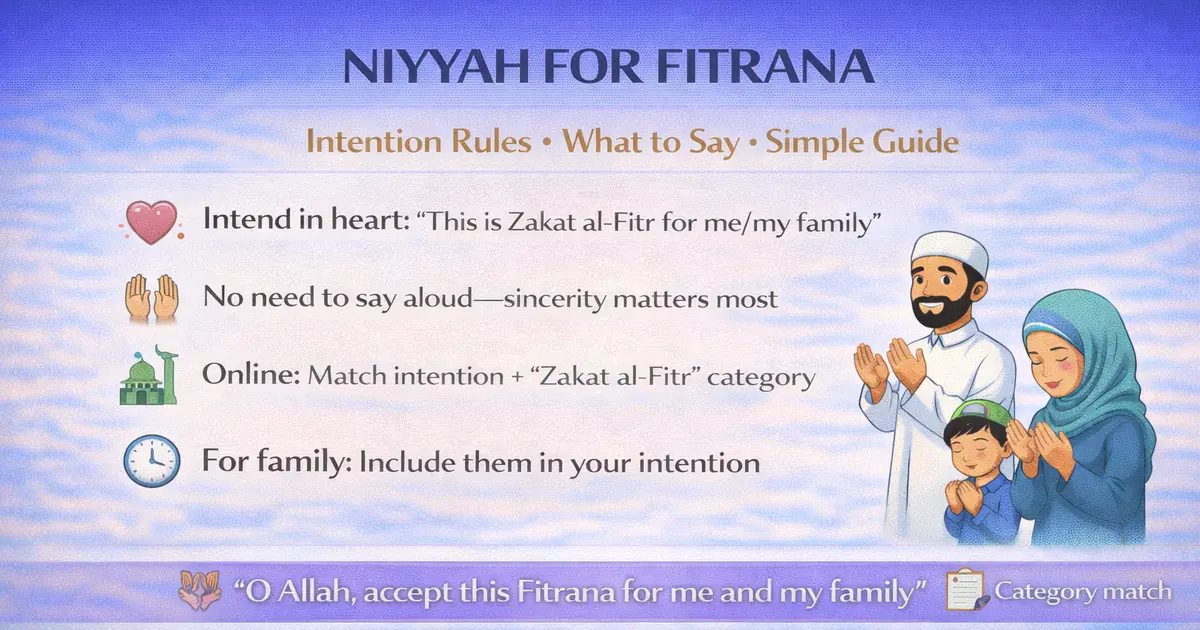
Zakat al Fitr intention guide with simple words, English and Arabic transliteration, intention in the heart vs saying aloud, online payment category selection, family and on behalf payments, household count notes, sincerity tips, and correction steps before Eid prayer deadline

Niyyah for Fitrana: Intention Rules + What to Say (Simple Guide)

Most people don’t struggle with paying.

They struggle with the “Did I do it right?” feeling after they pay.

And with niyyah for fitrana, that anxious feeling usually comes from one problem: people treat intention like a script… when it’s actually a decision in the heart.

So let’s make this easy. Calm. Beginner-safe. And Saudi-ready, especially for intention when paying online, where one wrong category click can mess with your clarity.

✅ TL;DR – niyyah for fitrana

Niyyah for fitrana is simple: in your intention in heart, decide “This payment is Zakat al-Fitr for me (and anyone I’m covering) for Allah’s acceptance.” You don’t need to say it aloud. Online, make sure the donation category is truly Zakat al-Fitr so your heart and the label match—especially before the Eid prayer deadline.

If you’re paying in Saudi and want the full payment flow, keep this open: online fitrana Saudi step-by-step.

What niyyah means (simple)

What is the niyyah for fitrana? It’s the quiet “yes” inside you that says: “I’m giving this as Fitrana / Zakat al-Fitr for Allah.” That’s it. No speech required. The point is that you know what you’re doing and why you’re doing it.

I explain niyyah like labeling a box before you store it. If you don’t label it, later you won’t know what it was meant for. Niyyah is that label—placed in the heart—so your act doesn’t get mixed with random charity.

That “label” also answers a common question: intention for zakat al fitr separates it from normal giving. Zakat al-Fitr has its own purpose and timing, and the intention keeps it in its correct lane.

Micro-scenario: You’re giving money on the last night of Ramadan and your cousin says, “Just click any charity option.” If you don’t select Zakat al-Fitr, your intention and the donation category can drift apart. Fixable, but avoidable.

If you want the “why” behind it, read this once and you’ll stop overthinking: purpose of fitrana.

Do you need to say it out loud?

Do I need to say niyyah aloud for zakat al fitr? No. For niyyah for fitrana, the core is the intention in heart. Saying something out loud can be a personal habit to help focus, but it isn’t required for the intention to exist.

Some people feel calmer by whispering a short sentence. Fine.

Some people feel calmer saying nothing at all. Also fine.

The mistake is thinking Allah needs “perfect wording.” He doesn’t. You need clarity.

🟦 Simple “what to think” wording (English)

Example (in your heart): “I intend this payment as Zakat al-Fitr / Fitrana for myself (and those I’m paying for), seeking Allah’s acceptance.”

Optional (quietly spoken): “O Allah, accept my Sadaqatul Fitr niyyah.”

Notice what I did there: I kept it short. Because that’s how real intention feels—simple and firm, not like a courtroom statement.

Quirky beginner mistake #1: Turning niyyah into a “magic sentence.” Quick fix: Stop chasing perfect words. Keep the decision clear.

If your family argues about this, you can keep peace with one line: “My intention is in my heart, and Allah knows.” Then move on.

Niyyah for yourself vs for family

Niyyah for fitrana for my family means you clearly include them in your intention when you pay. If you’re covering your household, your heart should know: “This is for me, and for the people I’m responsible for.” It doesn’t need drama. It needs correct counting and clear intent.

This is where people get tangled: they pay one amount, then later they wonder if it covered everyone. That’s not a faith problem. That’s a counting problem.

Micro-scenario: You’re paying for your household, but your older son is away at university and you forget him. You pay, then remember. Don’t panic. Pay the missing portion as soon as you can, and be clear who it’s for.

Quirky beginner mistake #2: “I paid, but I never decided who it was for.” Quick fix: Before you click pay, say in your head: “Me + my dependents.”

If you want the family rules side (Saudi-focused), use: pay fitrana for family Saudi.

And if you’re paying on behalf of someone else (not your dependents), make your intention specific: “This is fitrana for that person.” Clear target, clean heart.

For that scenario, keep this link: pay fitrana for someone else Saudi.

Quirky beginner mistake #3: Paying “for someone” without telling them and then bragging about it later. Quick fix: If it’s truly for Allah, you don’t need applause.

Niyyah when paying online (category match)

Niyyah for fitrana when paying online has one special rule: your heart must match the category you choose. Online systems label donations. If your intention is Zakat al-Fitr but you accidentally click general charity, your “label” got swapped at the checkout page.

This is the Saudi-ready filter I teach: heart + correct category + correct people count. If those three match, you’re on solid ground.

✅ Online intention alignment (30-second check)

Before you pay:

1) In your heart: “This is Zakat al-Fitr.”
2) On-screen: category selected = Zakat al-Fitr (not just “donation”).
3) People count: you know who you’re covering (household, or on behalf payment).

Keep the receipt. Not for showing off—just for your own calm.

Micro-scenario: You pay online at 2 a.m., half-asleep, and the website has multiple categories. You click the wrong one. You wake up and feel sick. Don’t freeze. Fix it (we’ll cover that next).

For the full Saudi method with screens and steps, use: fitrana Saudi payment guide.

If you want to calculate the amount fast while paying online, your tool page can be placed in the post using:

Fitrana / Zakat al-Fitr Calculator
Estimate an amount in Saudi Riyal based on household size and local prices.
Household count
Count all adults and children you intend to include.
Tip: Use the + / − buttons for quick changes.
Optional breakdown men / women / kids
Method and item
Choose a method and (if needed) a staple item.
You can switch anytime; the result updates instantly.
Prices vary by brand and market; enter what applies locally.
“Sa’” is approximate and can be adjusted below.
kg
Adjust if your preferred estimate differs.
SAR/kg
If you’re paying in food, you can still estimate using a local market price.
Result
This is an estimate based on your entries.
Total estimate
0.00 SAR
Note: This widget provides an estimate for planning. For official local guidance, refer to trusted announcements in your area.
' ].join('');var w = window.open('', '_blank', 'noopener,noreferrer,width=900,height=700'); if (!w){ toast(widgetEl, 'Popup blocked'); return; } w.document.open(); w.document.write(html); w.document.close(); }function escapeHtml(s){ return String(s) .replace(/&/g,'&') .replace(//g,'>') .replace(/"/g,'"') .replace(/'/g,'''); } function escapeHtmlAttr(s){ return escapeHtml(s).replace(/"/g,'"'); }function boot(){ var widgets = qsa(document, '.ft-widget[data-ft-widget="fitr-calculator"]'); widgets.forEach(function(w, i){ initWidget(w, i); }); }if (document.readyState === 'loading'){ document.addEventListener('DOMContentLoaded', boot, { once: true }); }else{ boot(); } })();

Or link the tool page once (cleanly): fitrana calculator.

Quirky beginner mistake #4: Clicking “general donation” and assuming it’s automatically fitrana. Quick fix: Always pick the fitrana category if it exists.

One more thing: online payments don’t change the core rule about timing. Your intention can be perfect and still miss the Eid target if you delay. Keep this nearby: fitrana timing before Eid prayer.

If you made a mistake (how to correct)

If I made a mistake with niyyah for fitrana, what should I do? First, don’t spiral. Most mistakes are fixable with two actions: clarify your intention now, and correct the practical issue (wrong category, wrong count, late timing) as soon as you can. Islam isn’t asking you to panic. It’s asking you to be honest and responsible.

Let’s break it into common “real-life” mistakes, not fantasy ones.

Mistake A: wrong donation category online.
If you intended fitrana but selected the wrong category by accident, try to correct it with the platform if possible, or give again correctly under Zakat al-Fitr if you can. Then stop torturing yourself. You acted sincerely and then fixed the label.

Use this if it happened to you: found wrong donation category (fitrana).

Mistake B: wrong people count.
You paid for yourself, then realized you didn’t include a dependent you normally cover. Pay the missing portion as soon as you remember and intend it for that person.

Mistake C: you paid after Eid prayer.
Give it anyway as soon as you remember. It’s still charity, but you missed the Eid-timed goal. Next year, pay earlier so the purpose lands properly.

If that’s your case, use: forgot fitrana after Eid prayer.

Quirky beginner mistake #5: “I’ll just not pay because I messed up.” Quick fix: That’s the worst option. Pay, then learn.

Short story (beginner mistake + simple fix):
A sister once told me she paid online, then read a message saying, “If you didn’t say the words, it doesn’t count.”
She panicked and wanted to pay again five times “just in case.”
I asked, “When you paid, did you know it was fitrana?”
She said yes—very clearly.
I said, “Then your niyyah was there. Now just check your category and people count.”
She checked. It was correct. And the worry finally left her face.

Quick FAQs

These are the questions people ask every Ramadan—especially with online payments, family payments, and the Eid prayer deadline. I’m keeping answers short, direct, and beginner-safe.

📘 niyyah for fitrana FAQs

what is the niyyah for fitrana (simple)?

Show Answer

In your intention in heart, decide: “This is Zakat al-Fitr for me (and anyone I’m covering) for Allah’s acceptance.” Short and clear is enough.

do i need to say niyyah aloud for zakat al fitr?

Show Answer

No. Niyyah is primarily the decision in the heart. Saying words can help focus, but it isn’t required.

what to say when giving fitrana?

Show Answer

You can say nothing. If you want simple words: “O Allah, accept my Fitrana.” The key is your intention in heart, not a long speech.

niyyah for fitrana when paying online (what matters most)?

Show Answer

Match your intention with the correct donation label. Select Zakat al-Fitr so your heart and the category align.

when should i make niyyah for fitrana?

Show Answer

Before or at the moment you set it aside or pay it. And for the Eid purpose, pay early enough that it reaches people before the Eid prayer deadline.

can i intend fitrana after paying?

Show Answer

Better to have the intention before or at payment. If you paid while knowing it was fitrana, your intention was already there. If you truly paid without knowing the category, correct it as soon as you can.

niyyah for yourself vs niyyah for family fitrana—what’s different?

Show Answer

For family, your intention includes them: “This is Zakat al-Fitr for me and my dependents.” The practical difference is correct household count.

niyyah if paying in food vs cash—does it change?

Show Answer

The intention doesn’t change: it’s still Zakat al-Fitr. What changes is the method (giving food or cash), depending on your trusted channel and local practice.

what are common niyyah mistakes people make?

Show Answer

The big ones are: treating niyyah like a magic script, forgetting who you’re paying for, clicking the wrong online category, delaying past Eid prayer, and mixing showing off with worship.

is there a fixed dua for fitrana?

Show Answer

There isn’t one required fixed script. Keep your dua for fitrana simple: ask Allah to accept it and to help the people receiving it.

how to keep intention sincere when paying online?

Show Answer

Pay quietly, avoid announcing it, and focus on Allah’s acceptance. Keep the receipt for your own records, not for status.

what if i paid after eid prayer—does my niyyah still help?

Show Answer

Your intention to do good still matters, and the giving can still help someone. But the Eid-timed purpose is missed, so pay as soon as you remember and plan earlier next year.

The One Table

📊 Niyyah for Fitrana: what to focus on (simple)

SituationWhat your niyyah should includeQuick fix if you’re unsure
Paying for yourself“This is Zakat al-Fitr for me for Allah.”Pause 3 seconds before paying, then click.
Paying for family“For me + those I’m covering.”Count your household first, then pay.
Paying onlineIntention + correct category labelSelect Zakat al-Fitr, keep the receipt.
Made a mistakeHonest intention + correction actionCorrect category/count ASAP; don’t freeze.
Farrukh Farooqi Author Photo
About the Author

Farrukh Farooqi has been living in Sharaya, Makkah, Saudi Arabia since 2010. With over 14 years of firsthand experience witnessing the sacred journey of millions of pilgrims, Farrukh specializes in providing practical, insider tips for Hajj and Umrah travelers. His work blends real-world observations, the latest Saudi updates, and essential crowd management strategies — helping pilgrims and worshippers plan smarter, stay safer, and experience a spiritually fulfilling journey across the Holy Cities.

Related Posts