
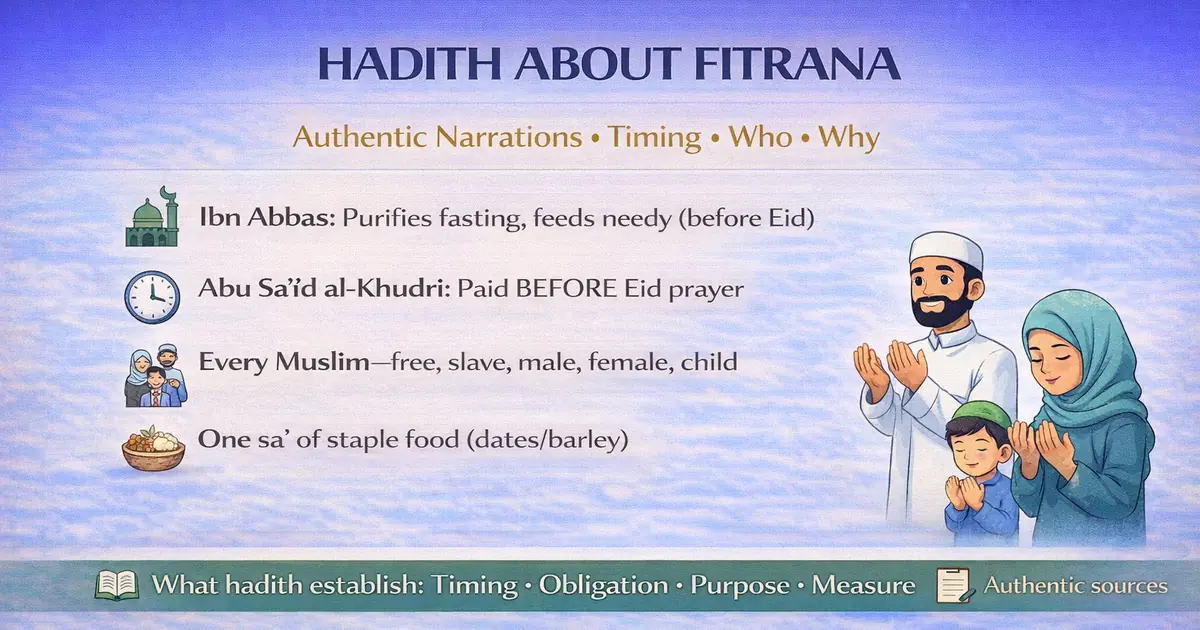
Hadith About Fitrana before Eid prayer: What Sahih narrations say
People ask for “the hadith.”
But what they really need is: “What does this hadith actually prove?”
Because hadith about fitrana isn’t meant to be a quote collection you forward on WhatsApp. It’s a set of clear boundaries: timing, who pays, why it exists, and the original form of giving as staple food.
My students always do the same thing at first: they memorize one line, then panic when they hear a second narration that sounds different. The calm solution is to learn each narration like a signboard on the road: this one shows the deadline, that one shows who is included, that one shows the purpose.
✅ TL;DR – hadith about fitrana
Authentic hadith fitrana establish three practical points: it’s a required Eid-time charity at the end of Ramadan, it should reach people in need before Eid prayer, and it was originally given as a measured amount of staple food for the household. Study it as “what each narration proves,” not as a quote dump.
If you want the Saudi “how to pay” side later, keep this open: Fitrana Saudi payment guide.
The Primary Hadith: Ibn Abbas on Purification and Food
What hadith says about zakat al fitr? The key narration from Ibn عباس (Ibn Abbas) is famous because it ties two ideas together in one place: purification for the fasting person and food support for people in need. It’s not only about “giving.” It’s about finishing Ramadan with clean worship and making Eid reachable for the needy.
Think of it like the final stamp on a document. You did the work (fasting), but the stamp makes it complete in the way it was meant to be completed. That’s the “feel” of this narration.
What this hadith proves about obligation
Fitrana obligation evidence is not built on vibes. This narration establishes that Zakat al-Fitr wasn’t introduced as optional Eid kindness only. It was presented as a defined act connected to the end of Ramadan with a clear purpose and clear timing—so scholars treat it with the seriousness of an obligation.
And yes, people ask: hadith evidence fitrana is wajib. The beginner-safe takeaway is this: the narrations treat it as an established duty tied to Eid, not a “nice extra.”
What this hadith proves about purpose
Fitrana purpose hadith teaches two “why” layers at once. First, it pushes the fasting person toward better speech and manners, because we all slip. Second, it makes sure the poor and needy can eat and prepare for Eid.
That’s why you’ll see both words show up in explanations: purification and community support. One is inside you. One is outside you.
Micro-scenario: Someone says, “I fasted, so I’m done.” Then they spend the last night backbiting relatives on the phone. This narration is a gentle correction: worship isn’t only hunger; it’s character too.
Timing: The Clear Hadith Deadline
Hadith about fitrana before Eid prayer is where the narrations get very practical. They separate “Zakat al-Fitr done properly” from “ordinary charity done late.” This is why fitrana distribution timing hadith matters so much: it protects the Eid purpose.
If you want the full timing breakdown in Saudi context, keep this for later: fitrana timing before Eid prayer.
Before Eid prayer: The accepted Zakat
Fitrana before Eid prayer hadith establishes the deadline logic: the payment is meant to land while it can still shape Eid morning for the needy. So paying before the prayer is treated as the proper fulfillment of Zakat al-Fitr.
It’s like delivering a gift before the event, not three days after. Same gift. Different meaning.
After Eid prayer: The ordinary Sadaqah
Hadith about paying fitrana late is often misunderstood. The narrations don’t say “late charity becomes useless.” They teach something more precise: after the Eid prayer, it no longer carries the label of Zakat al-Fitr in the same way—it becomes regular sadaqah.
So don’t do the “all or nothing” mistake. If you missed it, give anyway. But learn the lesson: the Eid-time goal was missed.
If that happened to you, you already have a dedicated page: forgot fitrana after Eid prayer.
Who Pays? The Household Hadith Logic
Hadith about who must pay fitrana builds a simple household picture: this isn’t only for the single adult who earns money. The narrations include the household in a broad way, so the Eid safety-net doesn’t skip children and dependents.
I used to overcomplicate this when I was learning: “Does the child pay? Does the mother pay? Who pays for who?” Then it clicked—this is a household responsibility, not a solo performance.
Every Muslim: Male, female, adult, child
Who must pay fitrana hadith commonly includes categories like male/female, free person/servant (in older contexts), adult/child. The point isn’t to drag old categories into modern life; it’s to show how wide the obligation was understood: Eid care should not exclude anyone in the home.
That directly answers a long-tail question people type: hadith about fitrana for children. The household count includes them when the household is able.
The head of household responsibility
Fitrana hadith explained often leads to this practical outcome: the person managing the household typically handles payment for dependents. It keeps things organized and prevents “everyone assumed someone else did it.”
For Saudi family rules and examples, use: pay fitrana for family Saudi.
Micro-scenario: Eid morning, the father says, “I thought you paid.” The mother says, “I thought you paid.” The kids are dressed, the prayer is in 40 minutes, and nobody knows what happened. This is why households should treat it like a checklist item, not a casual thought.
The Measure: One Sa’ of Staple Food
Fitrana staple food hadith is where people get distracted by modern weights. The hadith focus is simpler: the Prophet ﷺ set a known measure—one sa’—and linked it to common foods people actually ate, like dates and barley. The core lesson is “measured staple support,” not luxury giving.
If you need a Saudi-friendly explanation of common staples and how people think about them today, keep this: Saudi measure in kg staples guide.
Dates, barley, and local staples
Hadith on zakat al fitr show items like dates and barley because those were everyday staples for many people at that time. Scholars often explain the principle as giving from the local staple foods so the needy receive something useful and normal—not something odd that can’t be cooked.
In many places today, that means rice, flour, wheat, or other local staples. The hadith give the pattern; the community applies it responsibly.
The concept of excess food
Hadith about fitrana obligation rules connect to the idea of ability: a household that has enough for its basic needs is asked to participate, not a household that is itself in hardship. In plain language: you don’t starve your family to give fitrana. You give when you have room.
That also keeps the act sincere. Worship that breaks your home creates bitterness. This one is meant to create gratitude.
Food vs Cash: What Hadith Indicate
Food vs cash: what hadith indicate is one of the most searched topics because people want one sentence to end the debate. The honest answer is: the hadith show the original practice as measured food, and scholars discuss how cash fits today depending on need, system, and whether cash better fulfills the “Eid-time support” goal.
So the hadith are clear about the origin. The modern application has a known difference of opinion.
The original practice of giving food
Sadaqatul fitr hadith make the food element hard to miss. The Prophet ﷺ’s instruction is described in the form of measured staples. That’s why many scholars prefer food as the default expression of the Sunnah pattern.
If you want the Saudi-focused comparison page, use: cash vs food fitrana Saudi.
The scholarly view on cash today
Hadith about giving fitrana in food doesn’t automatically erase discussions of cash today, because the aim is also to help the needy in time for Eid. Scholars who allow cash often frame it as a way to reach that aim when it better serves the recipients, while scholars who prefer food emphasize staying closest to the original form.
Beginner-safe rule: follow a trusted local channel and choose what most reliably reaches the needy before Eid prayer without confusion.
And don’t mix it with other obligations in your head. This page helps keep categories clear: fitrana vs zakat difference.
Quick FAQs from Authentic Hadith
These questions come up every year. I’ll answer them as “what the narrations establish,” then keep the wording calm and beginner-friendly.
Can I pay 2-3 days early?
Can I pay 2-3 days early? Reports about early payment exist from the practice of some Companions, and many scholars allow paying a short time before Eid so distribution happens on time. The safe intention is always the same: get it to people in need before the Eid prayer window closes.
If you want a dedicated page for early timing, use: can you pay fitrana early.
Who are the recipients?
Hadith about fitrana recipients connect to helping the poor and needy for Eid. For a practical “who qualifies” breakdown, use: who can receive fitrana.
What if I pay late?
What if I pay late? The narrations separate the label: before Eid prayer it counts as Zakat al-Fitr, and after it becomes ordinary charity. Don’t turn that into hopelessness. Give as soon as you remember, then plan earlier next time.
One last helpful piece for your heart: intention matters. If you want a simple intention guide, use: niyyah for fitrana.
📊 hadith about fitrana: what each narration proves (simple)
Use this as your “study map.” Instead of memorizing random quotes, learn the practical proof: obligation, purpose, timing, who pays, and the sa’ measure.
🌙 Show Hadith Proof Table
| Hadith theme | What it establishes | Beginner-safe takeaway |
|---|---|---|
| Ibn Abbas narration | Purification + feeding the needy | Fitrana is worship with a social goal |
| Timing narrations | Before Eid prayer vs after Eid prayer | Don’t delay; Eid timing is the point |
| Household inclusion | Broad coverage across the home | Count dependents; avoid “someone else paid” |
| Sa’ measure | Measured staple food giving | Follow a trusted local method for today’s staples |
| Food vs cash discussion | Food is the original form; cash is discussed | Choose what reliably helps before Eid prayer |
📘 hadith about fitrana FAQs
what hadith says about zakat al fitr?
Show Answer
The core narrations establish: it’s linked to the end of Ramadan, it should reach the needy for Eid, and it was set with a measured giving tied to staple food.
hadith about fitrana before eid prayer (what does it prove)?
Show Answer
It proves the deadline logic: before Eid prayer it fulfills Zakat al-Fitr as intended, because it supports Eid needs on time.
is fitrana sunnah or wajib?
Show Answer
Most scholars treat it as required based on the way the narrations establish it as an enjoined Eid-time duty, not just optional giving.
hadith about who must pay fitrana (is it for children too)?
Show Answer
The household scope in the narrations is broad, so dependents like children are included when the household is able and responsible.
hadith about fitrana recipients—who should receive it?
Show Answer
The narrations connect it to feeding people in need for Eid. Practically, use a trusted channel that targets eligible needy recipients.
hadith about giving fitrana in food—does it have to be food?
Show Answer
The original practice in hadith is measured staple food. Scholars discuss cash today depending on what best fulfills the Eid-time need.
hadith about fitrana amount measure concept—what is one sa’?
Show Answer
One sa’ is a prophetic measure used to standardize giving. Modern weight equivalents vary by staple and standard, so follow reliable local guidance.
hadith about paying fitrana late—do i still give?
Show Answer
Yes, give as soon as you remember. The narrations teach that after Eid prayer it becomes ordinary charity, but it still helps someone.
are hadiths 100% correct?
Show Answer
Hadith have grades of authenticity. This article focuses on widely accepted, strong narrations used by scholars to establish the main rules of Zakat al-Fitr.
is fitrana mentioned in the Quran?
Show Answer
The detailed Eid-time rules for Zakat al-Fitr are established through Sunnah narrations, while the Qur’an establishes the broader principle of charity and purification.
what’s the simplest way to study authentic hadith fitrana without confusion?
Show Answer
Study it as “proof blocks”: one narration for purpose, one for timing, one for who is covered, and one for the sa’ measure. That keeps your learning clean and practical.

Farrukh Farooqi has been living in Sharaya, Makkah, Saudi Arabia since 2010. With over 14 years of firsthand experience witnessing the sacred journey of millions of pilgrims, Farrukh specializes in providing practical, insider tips for Hajj and Umrah travelers. His work blends real-world observations, the latest Saudi updates, and essential crowd management strategies — helping pilgrims and worshippers plan smarter, stay safer, and experience a spiritually fulfilling journey across the Holy Cities.


