
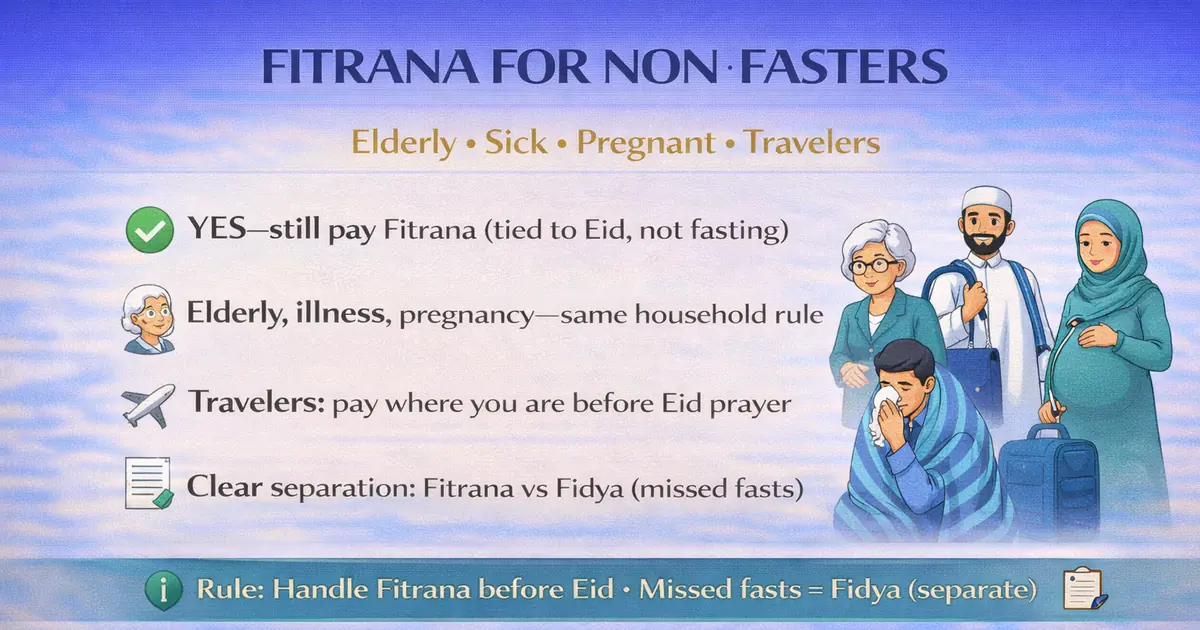
fitrana for non fasters: Elderly, Sick, Pregnant, Travelers (What Still Applies?)
Let’s clear the biggest misunderstanding first.
Fitrana isn’t a “reward for people who fasted perfectly.”
It’s an Eid-time obligation linked to the household and Eid deadline. That’s why fitrana for non fasters still comes up for the elderly, the sick, pregnant and breastfeeding women, and travelers.
I’ve seen good people panic in Ramadan because they missed fasts for valid reasons and then thought, “So maybe I don’t pay fitrana.” That panic is usually just one thing: mixing up fitrana vs fidya confusion (and sometimes kaffarah too).
✅ TL;DR – fitrana for non fasters
Even if someone didn’t fast due to illness, travel, pregnancy, or old age, fitrana for non fasters can still apply because it’s tied to Eid and the household, not “how many fasts you completed.” The common mistake is mixing it with fidya or kaffarah (separate topics). Pay fitrana before Eid prayer, then handle missed fast rules separately.
For Saudi payment steps (so you don’t guess), keep this open: Fitrana Saudi payment guide.
The Big Confusion: Fitrana vs Missed Fasts Explained
Do you pay fitrana if you did not fast? In general, yes—because Zakat al-Fitr is tied to Eid and the household, not a scoreboard of how many days you fasted. The clean way to think: fitrana is an Eid obligation; missed fasts are handled by make-up fasts (and sometimes fidya) depending on the case.
Think of Ramadan like school and Eid like graduation day. Fitrana is the “graduation day support” that makes sure the whole community can celebrate. It doesn’t only belong to the top students.
Fitrana is tied to Eid and household, not fasting
Fitrana obligation if not fasting sounds strange until you remember the purpose: Eid dignity, community care, and closing Ramadan with humility. A person can be excused from fasting yet still be part of a household that pays fitrana.
Micro-scenario: An elderly mother can’t fast anymore. Eid still arrives. The household still wants the needy to eat on Eid. That’s exactly the lane fitrana lives in.
Do you pay fitrana if you did not fast? Yes.
Do you pay fitrana if you did not fast (High)? Yes, in the common understanding of scholars, because fitrana is linked to Eid timing and household ability. Not fasting for a valid reason doesn’t cancel it. Not having means is a different issue.
One sentence to keep in your head: Fitrana is Eid-linked, not fast-count linked.
Fitrana vs fidya difference for non fasters
Fitrana vs fidya difference for non fasters (High) is the core separation that prevents 90% of mistakes. Fitrana is a once-per-person Eid payment. Fidya is tied to missed fasts in specific situations (mainly when fasting can’t be made up later). They are not the same thing.
If you want the detailed fidya rules (without mixing pages), use: fidya in Islam.
Fitrana for Elderly Who Cannot Fast
Fitrana for elderly who can’t fast often confuses families because they feel, “She didn’t fast, so why pay?” But the elderly still live inside the Eid household picture. If the household has ability beyond basic needs, fitrana can still be due for each person covered.
And yes—this includes someone with permanent inability. Permanent inability changes missed fast handling, not the Eid-linked fitrana idea.
Obligation remains even with permanent inability
Fitrana rules special cases are easier when you separate the topics: fitrana (Eid) still applies based on household ability; permanent inability affects whether missed fasts are made up later or handled another way.
My students always ask, “So do I pay twice?” No. You’re just dealing with two different responsibilities that sit in different boxes.
Can family pay fitrana for elderly members?
Can family pay fitrana for sick member or elderly member? Yes—households often pay on behalf of dependents. Just be clear in your heart who you’re covering. If you want the Saudi family payment page: pay fitrana for family Saudi.
Micro-scenario: Your grandmother is in another city. You can still include her in your fitrana if you normally cover her, then send it through a trusted channel that distributes properly.
Separate fidya for missed fasts still applies
This is the part families blur together: if the elderly person is permanently unable to fast and cannot make up days later, that’s where people ask about fidya. Keep it separate and read the fidya page calmly when you’re ready (already linked above).
Also keep kaffarah out of this section unless it truly applies. Kaffarah is not for “I was old” or “I was sick.” It’s a different lane.
Fitrana for Sick Persons
Do sick people pay fitrana? Yes, in the common understanding: sickness may excuse fasting, but it doesn’t automatically remove fitrana if the household has ability. The key is not to punish someone who is ill with stress. Keep the act simple: pay before Eid prayer through a trusted channel, then handle missed fasts later as needed.
Illness comes in two broad shapes: temporary and chronic. That difference matters for missed fasts. It usually doesn’t change the fitrana logic for the household.
Do sick people pay fitrana? Yes.
Do sick people pay fitrana gets answered the same way again and again: fitrana is Eid-linked. So if a person didn’t fast due to illness, fitrana can still apply.
Another one-sentence anchor: Not fasting isn’t the trigger. Eid is the trigger.
Fitrana obligation for sick person in hospital
Fitrana obligation for sick person in hospital worries families because the situation feels heavy. The practical answer is gentle: if the household is paying fitrana for its members, the hospitalized person is included like anyone else. You can pay on their behalf and keep the intention clean.
Micro-scenario: You’re at the hospital on the last day of Ramadan. Don’t try to “solve fiqh” in the corridor. Pay fitrana online early, keep the receipt, and breathe.
Temporary illness vs chronic illness rules
Temporary illness usually means missed fasts are made up later when health returns. Chronic illness may lead to a different handling for missed days. That’s a missed-fasts topic—separate from fitrana.
If you want to avoid mixing obligations, keep your reading separated: fitrana pages now, fidya page for missed days later.
Fitrana for Pregnant and Breastfeeding Women
Fitrana for pregnant and breastfeeding women is one of the most emotionally loaded topics because mothers already carry enough guilt. Let me say it clearly: if a woman didn’t fast due to pregnancy or breastfeeding concerns, that affects missed fast handling. It doesn’t automatically cancel fitrana if the household pays fitrana.
Don’t let guilt turn worship into pressure.
Fitrana for pregnant women: still required
Fitrana for pregnant women follows the same core logic: Eid-linked, household-linked. If the household has ability beyond basics, fitrana can still be due for her as one of the people covered.
Micro-scenario: A pregnant sister says, “I didn’t fast much, so I feel unworthy to pay fitrana.” This isn’t about worthiness. It’s about Eid care for the needy and a household closing Ramadan with gratitude.
Fitrana for breastfeeding mothers: same rule
Fitrana for breastfeeding mothers follows the same: not fasting for a valid reason doesn’t remove fitrana. Your fitrana is not a trophy. It’s a duty tied to Eid and community support.
Pregnancy and missed fasts: separate handling
Missed fasts and fitrana should not be merged. Missed fasts can be made up later in many cases. Sometimes scholars differ about details in specific circumstances. A beginner-safe approach is: keep fitrana on time before Eid prayer, then ask a trusted local scholar about your missed fast plan if you’re unsure.
If you want a clean “difference” page that keeps categories apart, use: fitrana vs zakat difference.
Fitrana for Travelers
Fitrana for travelers on Eid week usually turns into one question: “Where do I pay?” The safest beginner approach is to make sure your fitrana reaches needy recipients before Eid prayer, through a trusted channel, without delaying into the prayer time window.
Travel doesn’t delete Eid. It just changes logistics.
Fitrana for travelers on Eid week: where to pay
Fitrana for travelers on Eid week: where to pay can be handled in a simple way: pay through the place where you’re confident it will be distributed properly and on time. Many people pay where their family and dependents are, because it’s easier to manage the household count and distribution.
Micro-scenario: You’re landing in another country two days before Eid. Your brain is on baggage and hotels. Pay online early through a trusted channel and stop the last-minute stress.
Traveler obligation: based on location on Eid morning
People ask, “Is it based on where I am at Eid morning?” Scholars discuss practical details, but the beginner-safe principle stays steady: fitrana is meant to reach the needy before Eid prayer. So don’t play calendar games. Pay early enough that distribution timing is safe.
If your travel is inside Saudi and you want to keep your Ramadan rules straight too, you can read: Ramadan fasting rules for special cases.
Fitrana when traveling in Saudi or abroad
Fitrana when traveling in saudi is usually easier because online donation routes and household coordination are simpler. If you’re abroad, you can still pay in a way that supports needy recipients in time for Eid. The key is: don’t delay to “Eid morning” when you’re stuck in transit.
If you’re doing Umrah and want a dedicated page, use: fitrana for Umrah visitors Saudi.
Is Fitrana Linked to Wealth or Fasting?
Is fitrana linked to wealth or fasting? It’s linked to ability beyond basic need (often described as having enough for yourself and dependents) and it’s tied to Eid timing. It is not a payment that depends on “how many fasts you successfully completed.” That’s why is fitrana required even if fasting was missed is usually answered: yes.
So what triggers it? Household ability + Eid deadline.
Wealth-based: excess food triggers obligation
Obligation is tied to having enough beyond basic needs—often described through “excess food” language in classical discussions. In modern life, people usually pay through a trusted charity channel using the local equivalent, but the idea remains: you don’t pay by starving your own home.
If you want the Saudi year amount page (so you don’t guess), use: zakat al-fitr 2026.
Fasting status does not remove fitrana
If I couldn’t fast do I still pay zakat al fitr? In the common understanding, yes. The “non-fasting” reasons—illness, travel, pregnancy, old age—don’t automatically remove fitrana because fitrana is Eid-linked.
One sentence you can tell your family: “Fitrana is for Eid and the needy, not a scorecard.”
Does making up fasts remove fitrana? No.
Does making up fasts remove fitrana? No—because these are different obligations. Making up fasts is about missed Ramadan days. Fitrana is about Eid-time support and household responsibility.
That separation alone saves you from so many Ramadan arguments.
When to Read Fidya and Kaffarah Instead
Fitrana vs fidya vs kaffarah is the triangle that causes confusion. Here’s the clean separation: fitrana is Eid-time and per person; fidya is tied to missed fast days when someone can’t make them up; kaffarah is tied to intentionally breaking a fast in specific serious ways (not to valid excuses like illness or travel).
Three names. Three lanes. Don’t merge them.
Fitrana vs fidya: one Eid payment, one per missed day
Fitrana vs fidya: one Eid payment, one per missed day is the simplest memory hook. If you’re permanently unable to fast and cannot make up later, that’s where fidya discussions show up. But don’t guess amounts—use your fidya page and local guidance when needed.
Kaffarah only applies to intentional breakage
Kaffarah is not for “I was pregnant.” It’s not for “I was traveling.” It’s not for “I was sick.” It’s generally discussed for intentional breakage in certain cases, and it’s heavier. Keep it in its own box.
When you’re ready, read: kaffarah in Islam.
Clear separation: three different obligations
I tell beginners to picture three envelopes:
Envelope 1: Eid-time household giving = fitrana.
Envelope 2: Missed fast days you can’t make up = fidya (where applicable).
Envelope 3: Intentional breakage cases = kaffarah (where applicable).
Keep each obligation in the right envelope. Your heart will feel calmer.
Quick FAQs on Fitrana for Non-Fasters
These are the common questions families ask when someone didn’t fast. I’ll keep answers direct and beginner-safe, with the Eid deadline always in view.
📘 fitrana for non fasters FAQs
if i couldn’t fast, do i still pay zakat al fitr?
Show Answer
Yes, in the common understanding, because Zakat al-Fitr is tied to Eid and the household, not to how many fasts you completed.
fitrana deadline before eid prayer for special cases—does it change?
Show Answer
No. The safer approach is still to pay before Eid prayer so the needy receive support in time for Eid.
who pays fitrana for non fasting adults?
Show Answer
If they manage their own finances, they pay for themselves. If they are dependents, a family member may pay on their behalf as part of the household responsibility.
do sick people pay fitrana?
Show Answer
Yes, sickness may excuse fasting, but it doesn’t automatically remove fitrana if the household has ability.
fitrana obligation for sick person in hospital—what should we do?
Show Answer
You can pay on their behalf. Keep the intention clear and pay early enough for Eid distribution.
fitrana for elderly who can’t fast—still required?
Show Answer
Often yes, because it’s Eid-linked. Permanent inability changes missed fast handling, not the Eid-time fitrana principle.
fitrana for pregnant and breastfeeding women—same rule?
Show Answer
Yes. Not fasting for pregnancy or breastfeeding concerns doesn’t automatically cancel fitrana if the household pays fitrana.
fitrana for travelers on eid week—where should i pay?
Show Answer
Pay through the route you trust to distribute before Eid prayer—often where your household is managed, or a reliable channel where you are.
does making up fasts remove fitrana?
Show Answer
No. Make-up fasts are about missed days. Fitrana is about Eid-time support and household responsibility.
fitrana vs fidya difference for non fasters—one line?
Show Answer
Fitrana is once per person for Eid; fidya is tied to missed fast days when someone can’t make them up.
fitrana timing when traveling or sick—what’s the safest approach?
Show Answer
Pay early enough that it reaches needy recipients before Eid prayer. Delay is where most mistakes happen.
📊 fitrana for non fasters: Fitrana vs Fidya vs Kaffarah (don’t mix these)
This is the simple “separation map” so you don’t combine different obligations when someone didn’t fast.
🌙 Show Comparison Table
| Item | What it’s linked to | When it applies (simple) |
|---|---|---|
| Fitrana (Zakat al-Fitr) | Eid + household + distribution timing | Still applies even if someone didn’t fast for valid reasons, if the household has ability |
| Fidya | Missed fast days in specific cases | Discussed when someone can’t make up missed fasts later (read the fidya page for details) |
| Kaffarah | Serious intentional breakage cases | Not for valid excuses like illness, travel, pregnancy, or old age; read the kaffarah page if relevant |

Farrukh Farooqi has been living in Sharaya, Makkah, Saudi Arabia since 2010. With over 14 years of firsthand experience witnessing the sacred journey of millions of pilgrims, Farrukh specializes in providing practical, insider tips for Hajj and Umrah travelers. His work blends real-world observations, the latest Saudi updates, and essential crowd management strategies — helping pilgrims and worshippers plan smarter, stay safer, and experience a spiritually fulfilling journey across the Holy Cities.


