
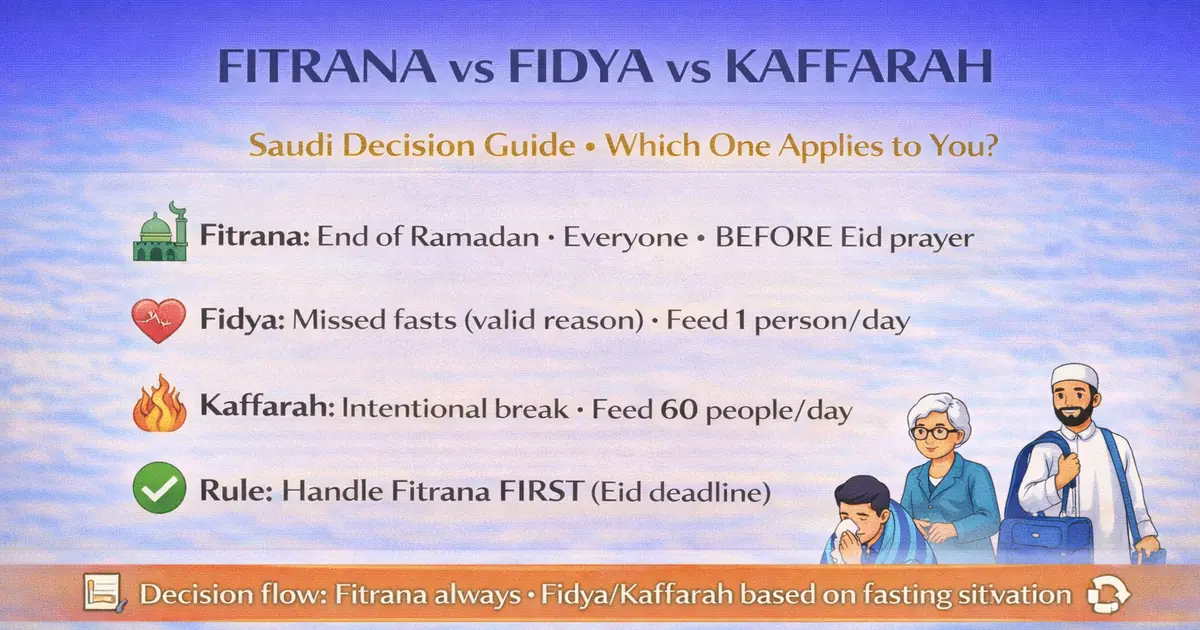
Fitrana Vs Fidya Vs Kaffarah: Which One Applies to You? (Saudi Decision Guide)
You’re not confused because you’re “bad at Islam.”
You’re confused because these three payments live in three different boxes, but online donation pages sometimes put them side by side like they’re cousins.
This guide fixes that. It’s not a lecture. It’s a decision guide you can use in 30 seconds—especially if you’re paying online in Saudi and you’re scared of clicking the wrong category.
✅ TL;DR – fitrana vs fidya vs kaffarah
Fitrana is the Eid-time charity and should be handled before Eid prayer for your household. Fidya and kaffarah are about missed or broken fasts and have different triggers. If you’re stuck: pay fitrana first (Eid deadline), then handle fidya/kaffarah based on your fasting situation separately.
If you want the Saudi payment steps and screens, use: Fitrana Saudi payment guide.
The 30-Second Difference: Fitrana vs Fidya vs Kaffarah
Fitrana vs fidya vs kaffarah difference simple (High): Fitrana is Eid-time giving for the household. Fidya is compensation tied to missed fasts in certain cases. Kaffarah is a serious penalty tied to intentionally breaking a fast. That’s why mixing them causes “non fasting rules confusion.”
Here’s a simple way to picture it: three keys on your keychain. They look similar. But each key opens a different door. If you force the wrong one, you only get frustration.
Fitrana: Eid charity for every Muslim (household count)
Fitrana obligation vs compensation starts here: fitrana is not a “punishment” for missed fasts. It’s an Eid obligation tied to the end of Ramadan, and it’s handled per person in the household. The big rule: it’s the one with the Eid prayer deadline.
Need the year amount page (no guessing): zakat al-fitr 2026.
Want to calculate the household quickly? Use: fitrana calculator (or embed it with ).
Fidya: Compensation for valid missed fasts (per day)
Difference between fitrana and fidya is simple: fidya is tied to missed fasts, and it’s counted per missed day in cases where fidya applies. It’s not an Eid-only payment. It’s a “missed fasts handling” payment in specific situations.
For the full fidya rules (so you don’t merge pages), use: fidya in Islam.
Kaffarah: Penalty for intentional fast breaking (60 days)
Difference between fitrana and kaffarah is even more separate. Kaffarah is discussed for intentionally breaking a fast without a valid excuse, and the classic description includes either fasting a long period or feeding many people. It’s not for “I was sick” or “I traveled.”
For your detailed kaffarah page, use: kaffarah in Islam.
Decision Guide: Which One Applies to You?
Which one should I pay? Use this rule: Pay fitrana for Eid first (household count, before Eid prayer). Then ask: did I miss fasts due to valid reasons, or did I break a fast intentionally? That decides fidya or kaffarah.
This is the part that saves people from paying the wrong category online.
Do I pay fitrana even if I pay fidya? Yes.
Do I pay fitrana even if I pay fidya (High)? Yes. Because they solve different problems. One is Eid-linked. One is missed-fasts linked. So yes, both can apply in the same Ramadan for the same person.
That sentence alone ends many Ramadan fights.
Fitrana vs fidya confusion: both can apply
Fitrana vs fidya confusion in Ramadan (High) happens when people treat fidya as “replacement for fitrana.” It isn’t. Fitrana is still due by the household if able. Fidya is about the fast-days situation.
Micro-scenario: An elderly father can’t fast anymore. The family pays fitrana for him (Eid). Separately, they learn whether fidya applies to his missed days. Two boxes.
Fitrana vs kaffarah confusion: completely separate
Fitrana vs kaffarah confusion explained in one line: fitrana is not a penalty. Kaffarah is the penalty discussion. Don’t swap labels on your worship.
Fitrana vs Fidya vs Kaffarah Difference Simple
This section is the “memory version.” If you forget everything else, remember these triggers.
Fitrana depends on Eid and household
Fitrana depends on Eid and household. It’s about the end of Ramadan and making Eid reachable for the needy. It’s tied to a deadline (before Eid prayer). It’s not tied to how many fasts you completed.
Timing help page: fitrana timing before Eid prayer.
Fidya depends on missed fasts (valid reason)
Which one depends on missed fasts? Fidya does (in cases where fidya applies). It’s a missed fasts topic. That’s why it shows up with illness, old age, pregnancy, breastfeeding, and other valid reasons—depending on the situation and scholarly details.
Kaffarah depends on intentional breakage
Missed fast penalty vs Eid charity is this difference: intentional breakage leads to kaffarah discussions; Eid charity leads to fitrana. Not the other way around.
I used to confuse “missed” with “broke” when I was learning. Many beginners do. “Missed” can mean valid excuses. “Broke intentionally” is a different story.
Scenario List: Which Payment Fits Your Situation
These are the real-life cases people Google at 2 a.m. Let’s match the situation to the right payment box.
Missed fasts due to illness: fitrana + fidya
I didn’t fast due to illness do I pay fitrana or fidya (High)? Often both can be relevant: fitrana for Eid (household count), and fidya depends on the illness details and whether make-up fasts are possible later. Don’t guess—read the fidya rules page for your specific type of illness.
Elderly unable to fast: fitrana + fidya
Elderly who can’t fast permanently often still fall under fitrana for Eid if the household is able. Fidya discussions often show up for missed days when fasting can’t be made up. Keep them separate.
Pregnancy or breastfeeding: fitrana + fidya
Pregnancy and breastfeeding may excuse fasting. Fitrana stays Eid-linked. Fidya depends on the missed fast handling in your situation. If you want a dedicated non-fasters page, you already have: fitrana for non fasters.
Travel during Ramadan: fitrana + make up fasts
Travel often leads to making up fasts later (a missed fasts topic). Fitrana remains Eid-linked. Don’t merge them.
Intentionally broke a fast: fitrana + kaffarah
I broke fast intentionally kaffarah or fidya? Kaffarah discussions are the usual lane for intentional breakage without valid excuse. Fidya is not the default “penalty” box. Fitrana is still a separate Eid obligation.
Broke fast unintentionally: fitrana + make up fasts
Unintentional breakage or valid excuses often lead to making up fasts, not kaffarah. Again, fitrana remains separate as Eid giving.
Which One Depends on Missed Fasts?
Which one depends on missed fasts? Fidya and kaffarah are fasting-related. Fitrana is not linked to fasting status—it’s linked to Eid and the household. That single line prevents paying the wrong one.
Fidya and kaffarah are fasting-related
Fidya is about missed fasts in cases where fidya applies. Kaffarah is about intentional breakage in cases where kaffarah applies. Different triggers, different seriousness.
Fitrana is not linked to fasting status
Do I pay fitrana even if I missed fasts? Yes. Missing fasts doesn’t automatically cancel Eid fitrana. Treat it as a separate “Eid payment category.”
I didn’t fast due to illness: do I pay fitrana or fidya? Both.
I didn’t fast due to illness: do I pay fitrana or fidya? Both can apply: fitrana for Eid, and fidya depends on the missed fast handling in your situation. If you’re unsure, use the fidya page and ask a trusted local scholar.
What to Pay First: The Eid Deadline Rule
Which one is before Eid prayer? Fitrana only. That’s why it should be handled first. Fidya and kaffarah can be paid later, but fitrana has an Eid clock on it.
Which one is before Eid prayer? Fitrana only.
That’s the clean rule. If you remember one thing from this page, remember that.
Fitrana must be paid before Eid prayer
This is why online category selection matters. Paying the right thing at the wrong time can still miss the Eid purpose.
Fidya and kaffarah can be paid after Ramadan
They relate to missed/broken fasts. People often handle them after Ramadan when they’ve calmed down and can calculate properly.
Online Category Mistakes: How to Avoid Paying the Wrong One
How to avoid paying the wrong category online (High)? Slow down at the donation page. Match three things: category label, your situation, and the timing. Most mistakes happen when someone is rushing on the last night and clicks the first “Ramadan donation” option they see.
Fitrana vs fidya vs kaffarah confusion explained
The confusion comes from online menus that list all three under “Ramadan.” But the triggers are not the same. Your job is to click the category that matches your real case.
Common error: mixing fitrana with fidya online
People pay fidya and think they “covered fitrana too.” Or they pay fitrana and think it “covers missed fasts.” Both are wrong category assumptions.
How to avoid paying the wrong category online
✅ 20-second online decision check (Saudi-friendly)
Step 1: Is it meant for Eid before prayer? → choose Fitrana (Zakat al-Fitr).
Step 2: Is it about missed fast days (valid reason)? → choose Fidya.
Step 3: Is it about intentional fast breaking (no excuse)? → choose Kaffarah.
Step 4: If you’re paying fitrana, count your household first.
If you accidentally chose the wrong category, use your correction page: found wrong donation category (fitrana).
Can I pay all three together? Yes, but know why.
Can I pay all three together? Yes, if more than one truly applies to you. But don’t mash them into one payment “just to feel safe.” Pay each with its own intention and correct label so you don’t create new confusion.
Quick FAQs: Fitrana vs Fidya vs Kaffarah
These are the PAA-style questions people ask. Short answers, no fluff.
📘 fitrana vs fidya vs kaffarah FAQs
difference between fitrana and fidya explained
Show Answer
Fitrana is Eid-time giving per person before Eid prayer. Fidya is missed-fast compensation in cases where fidya applies, counted per missed day.
difference between fitrana and kaffarah explained
Show Answer
Fitrana is an Eid obligation. Kaffarah is tied to intentionally breaking a fast without a valid excuse in cases where kaffarah applies.
which one applies if i missed fasts?
Show Answer
Pay fitrana for Eid if you’re able. Then handle missed fasts separately: often make-up fasts, and in some cases fidya depending on the situation.
missed fast penalty vs eid charity: what’s the difference?
Show Answer
Eid charity is fitrana. “Penalty” discussions are about kaffarah in relevant cases. Missed fasts with valid excuses usually lead to make-up fasts and sometimes fidya discussions.
how to avoid paying the wrong category online?
Show Answer
Match the category to your situation: Eid deadline → fitrana; missed fast days (valid) → fidya; intentional breakage → kaffarah. Don’t rush at checkout.
should i use a calculator for fidya or kaffarah?
Show Answer
For fitrana, a household calculator helps. For fidya/kaffarah, rates vary by place and charity, so first confirm the local rate through a trusted source, then calculate.
fitrana vs fidya vs kaffarah saudi guide—what do i do first?
Show Answer
Do fitrana first because it has the Eid prayer deadline. Then handle fidya/kaffarah after Ramadan once your missed fast situation is clear.
📊 fitrana vs fidya vs kaffarah: one-glance decision table
This table is your “don’t pay the wrong one” map. Read left to right: trigger → deadline → what it’s for.
🌙 Show Decision Table
| Payment | Triggered by | Main timing | Quick meaning |
|---|---|---|---|
| Fitrana | Eid + household ability | Before Eid prayer | Eid-time support for the needy |
| Fidya | Missed fasts (case-dependent) | Can be after Ramadan | Compensation linked to missed days |
| Kaffarah | Intentional fast breaking (case-dependent) | Handled after Ramadan | Serious penalty/repentance duty |

Farrukh Farooqi has been living in Sharaya, Makkah, Saudi Arabia since 2010. With over 14 years of firsthand experience witnessing the sacred journey of millions of pilgrims, Farrukh specializes in providing practical, insider tips for Hajj and Umrah travelers. His work blends real-world observations, the latest Saudi updates, and essential crowd management strategies — helping pilgrims and worshippers plan smarter, stay safer, and experience a spiritually fulfilling journey across the Holy Cities.


