
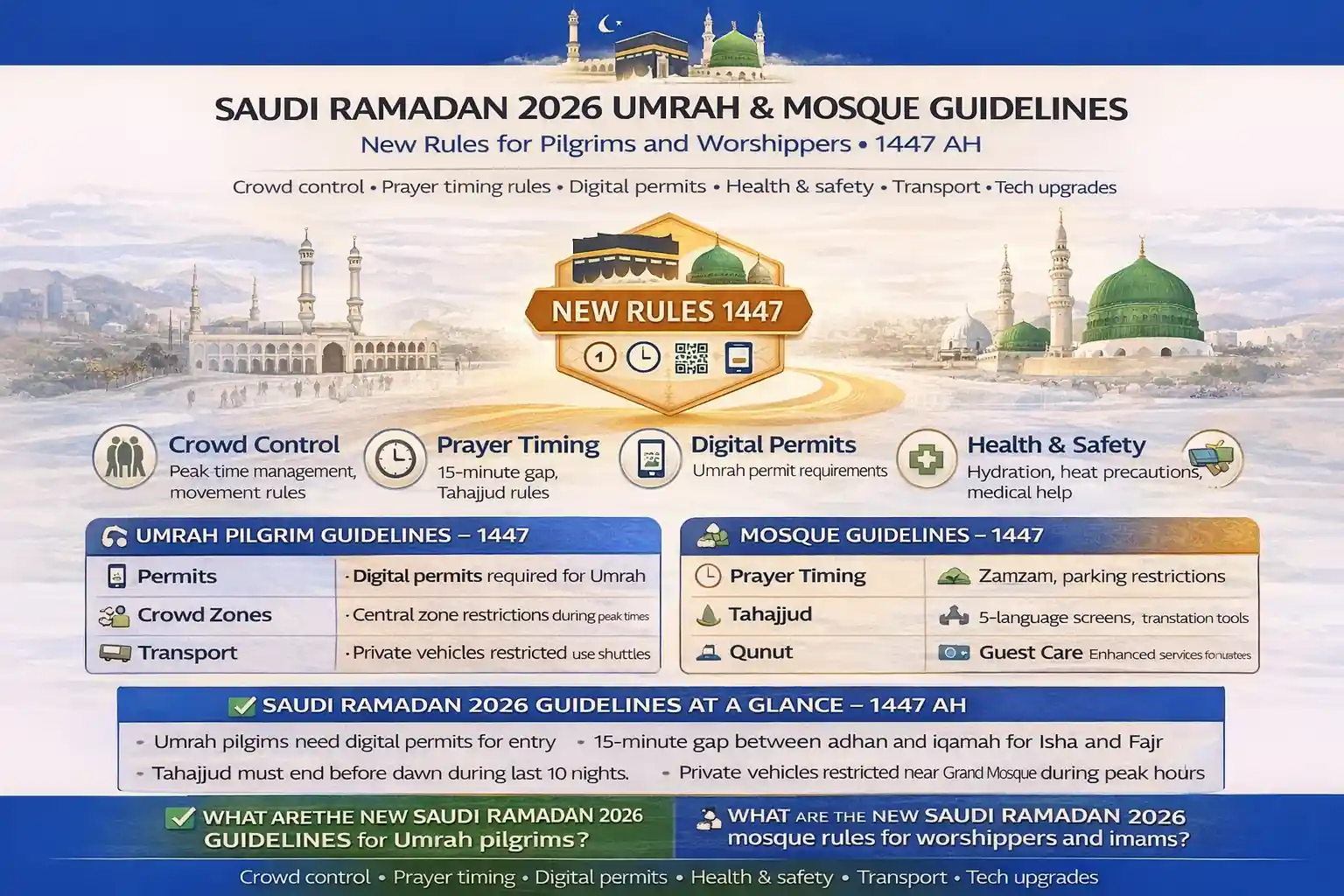
Saudi Ramadan 2026 Umrah & Mosque Guidelines: New Rules for Pilgrims and Worshippers
Ramadan in Makkah and Madinah is beautiful.
It is also crowded, emotional, and sometimes confusing for first-time pilgrims.
One announcement talks about mosque prayer timing. Another talks about crowd routes. Then someone in your hotel says, “No, no, today the rules changed again.”
That confusion is normal. I’ve seen it many times, especially with families coming for Umrah in Ramadan for the first time. People are sincere, but they mix mosque rules, transport rules, and rumor-messages from WhatsApp.
This guide puts it all in one place, in plain words: what the new Ramadan 1447 / 2026 rules mean, what to do before you leave for the mosque, and what mistakes cause trouble during peak crowds.
✅ TL;DR – Saudi Ramadan 2026 Umrah guidelines
Saudi Ramadan 2026 Umrah guidelines focus on safer movement, prayer timing discipline, and smoother worship. Pilgrims should follow digital signs, use public transport, keep valid permits, avoid crowded entry points, and respect mosque timing rules like the 15-minute gap for Isha and Fajr in mosques. The safest plan is simple: go early, follow signs, stay calm, and don’t improvise.
Saudi Ramadan 2026 guidelines at a glance (Quick summary)
Saudi Ramadan 2026 guidelines at a glance: Saudi authorities announced a combined set of steps for Ramadan 1447 to manage crowds, improve mosque order, and protect worshippers in Makkah and Madinah. The big themes are prayer timing discipline, traffic control, safer movement, family safety, and better on-site guidance tools.
- Mosques are told to follow Umm Al Qura prayer timing and keep a 15-minute gap between adhan and iqamah for Isha and Fajr.
- Tahajjud in the last 10 nights should finish before dawn without causing hardship.
- Grand Mosque crowd control uses signs, directed routes, and controlled entry to prayer areas.
- Transport rules push pilgrims toward buses, taxis, trains, and shuttle systems during peak congestion.
- Private vehicles face restrictions in central crowded zones during busy prayer windows.
- Safety rules include avoiding blocked corridors, emergency exits, and risky behavior in dense areas.
- Special support is available for elderly pilgrims, people with disabilities, and families.
Think of it like airport boarding mixed with worship etiquette. The goal is not to make worship harder. The goal is to stop chaos before it starts.
What are the new Saudi Ramadan 2026 guidelines for Umrah pilgrims?
The new Saudi Ramadan 2026 guidelines for Umrah pilgrims focus on crowd control, transport access, health precautions, permit compliance, and safe movement around the Grand Mosque. Pilgrims are asked to use designated routes, follow digital indicators, avoid blocked areas, and choose public transport during peak congestion periods.
Most people hear “guidelines” and think of paperwork. But this is more practical than that.
It’s really a movement plan: where to walk, how to enter, when to avoid certain zones, and what not to carry or do in packed spaces. During Ramadan, especially the last ten nights, the area around the Grand Mosque fills early and stays busy for hours around each prayer.
My students always ask about this part: “If I’m sincere, can’t I just go wherever there’s a gap?” In light crowds, maybe. In Ramadan crowds, that mindset creates jams, and jams become safety problems fast.
What are the new Saudi Ramadan 2026 mosque rules for worshippers and imams?
The Saudi Ramadan 2026 mosque rules cover both worshippers and mosque staff: prayer times must follow Umm Al Qura timing, Isha and Fajr need a 15-minute adhan-to-iqamah gap, Tahajjud should finish before dawn, and imams are advised to keep Qunut sincere and not overly long.
For worshippers, the message is simple: arrive on time, don’t pressure the imam to rush or delay, and follow local mosque organization.
For imams and mosque staff, the instructions are about consistency. Full attendance matters, mosque services should stay orderly, and the prayer environment should feel calm, not exhausting. A Ramadan mosque should feel like a place of mercy, not a place where people are pushed into confusion.
There are also practical mosque-management rules around iftar setup, donations, and i‘tikaaf registration in many locations. So if someone tells you “we always do it this way,” don’t assume old habits still apply this year.
Prayer timing rules in Saudi mosques during Ramadan 2026 (Umm Al Qura + 15-minute gap)
Prayer timing rules in Saudi mosques during Ramadan 2026 are built around the Umm Al Qura calendar, with a fixed 15-minute gap between adhan and iqamah for Isha and Fajr. The aim is to reduce confusion and make attendance easier for worshippers, especially in busy areas.
This rule sounds small.
It changes the whole evening flow.
When mosques use the same timing method and the same gap, people stop guessing. Families can leave home with a clearer plan. Drivers can manage drop-offs better. New visitors are less likely to miss jama‘ah because one mosque started much earlier than expected.
Isha and Fajr adhan-to-iqamah timing
The 15-minute rule means the adhan is called on time, then worshippers are given a fixed buffer before iqamah for Isha and Fajr. It is meant to help people arrive without panic and reduce the pressure that comes from random waiting times.
If you’re from another country, don’t compare it to your local masjid habit. Some places pray quickly after adhan, some wait longer. In Saudi Ramadan mosque rules for 2026, the point is consistency.
Micro-scenario: You hear the adhan while finishing wudu in a nearby building. Instead of sprinting and pushing through people, you know there is a set window. Walk with focus, not panic.
Tahajjud timing during the last 10 nights
During the last 10 nights, Tahajjud should finish before dawn in a way that does not cause hardship for worshippers. This protects people from exhaustion and helps them manage suhoor, rest, and Fajr without turning worship into physical strain.
This is one of the most balanced parts of the guidance. Ramadan nights are emotional. Some people want longer recitation, others are elderly, traveling, or with children.
So the rule is not “short worship.” It is “merciful worship.”
I used to mix this up when I was younger and thought “longer always means better.” It doesn’t. Better means sincere, present-hearted, and done in a way you can still stand for Fajr properly.
Qunut guidance for imams
Qunut guidance for imams emphasizes sincerity, prophetic manners, and moderation. The reminder is to avoid making Qunut excessively long or turning it into a performance with elaborate rhyming, especially when worshippers are tired or overcrowded.
This is a helpful correction, honestly.
People come to pray, not to watch a dramatic speech inside salah. A simple, heartfelt Qunut often lands deeper in the heart than a long one that leaves the back rows exhausted and distracted.
There is some difference of opinion in fiqh around Qunut details and occasions, and that’s normal. A beginner-safe approach is to follow the imam respectfully and avoid turning these differences into arguments.
Crowd control rules for Umrah pilgrims at the Grand Mosque
Crowd control rules at the Grand Mosque focus on guided movement, entry regulation, and preventing blockages in sensitive areas. Pilgrims are expected to follow security staff, keep moving with the flow, and avoid standing in entrances, corridors, and routes that others need for access and safety.
In plain words: don’t treat the Haram like an open field where everyone can stop anywhere.
It’s more like a river during Ramadan. If one group stops suddenly in the middle, everyone behind them gets stuck.
Peak-time congestion areas and movement rules
Congestion is highest before, during, and after prayer times, especially in central access roads, courtyards, and key movement corridors. Pilgrims are told to use designated pedestrian routes, follow directional signs, and leave completed prayer spaces so others can enter safely.
One thing beginners miss: “near” the mosque can still be a congestion zone. The crowd starts building well before you reach the main gates.
Micro-scenario: You finish prayer and stand near an exit to wait for your group. That spot feels harmless for two minutes. But behind you, hundreds of people are trying to pass. Better fix: move to an agreed meeting point away from the main stream.
How digital indicators help worshippers find prayer space
Digital indicators at mosque entrances help worshippers know where prayer space is available. A common system uses green to show open access and red to show full capacity, which helps reduce crowd surges and keeps people from pushing into already packed areas.
This is one of the best changes for beginners.
Before, many people followed the loudest crowd. Now, the signs help you make a cleaner decision. Green means go. Red means don’t force it. The sign is not “blocking your worship.” It is protecting your worship and everyone else’s.
And if staff direct you to another floor or courtyard, take it as a win. You are still in worship. You are not “missing out” because your spot is different.
Which behaviors are prohibited in central zones
Prohibited behaviors in central crowded zones include blocking movement, gathering in entrances, and bringing unauthorized vehicles into pedestrian areas. Reports also mention bans on motorcycles, bicycles, smoking, begging, unauthorized selling, and actions that interfere with safety or worship flow.
There’s a reason the rules sound strict. In a small crowd, one bad habit is annoying. In Ramadan crowd density, one bad habit can hurt people.
Five quirky beginner mistakes I keep seeing:
Mistake 1: Stopping in the doorway to “just wait for my cousin.” Quick fix: Step fully inside or fully outside. Never camp in the threshold.
Mistake 2: Bringing extra bags “just in case.” Quick fix: Carry less. Bulky items slow you and block others.
Mistake 3: Trying to argue with crowd staff. Quick fix: Ask once politely, then follow direction.
Mistake 4: Taking children into the most packed zone at peak time. Quick fix: Choose a safer prayer area or split responsibilities.
Mistake 5: Standing still to record video in a moving path. Quick fix: Move first, film later (or don’t film at all in crowded lanes).
Transport and entry guidance during Ramadan 1447
Transport and entry guidance during Ramadan 1447 pushes pilgrims toward organized public transport, designated parking, and shuttle systems. Central areas around the Grand Mosque become tightly controlled during peak periods, so relying on private cars is usually the hardest option, not the easiest.
Many first-timers assume a private car gives more freedom.
During Ramadan rush, it often gives you more delay.
Public transport options and central zone restrictions
Authorities direct pilgrims to buses, taxis, shuttle links, and train services to manage flow into Makkah’s central worship zones. Pedestrian routes take priority around peak prayer times, and vehicle movement near the Grand Mosque is heavily controlled for safety.
If you’re staying farther out, plan your transport like you would plan your prayer clothes the night before. Don’t “figure it out on the road.”
A quick practical tip: leave earlier than your comfort level suggests, not because the prayer itself is long, but because entry flow changes minute by minute in Ramadan.
Parking and shuttle guidance for peak hours
Parking and shuttle systems are used to keep private vehicles away from the densest zones while still moving pilgrims toward the Haram. This usually means parking farther out and completing the last part of the journey by shuttle, bus, or a controlled route.
Yes, it adds one more step.
But that extra step is what keeps the center from turning into a traffic wall.
Micro-scenario: A family insists on being dropped “as close as possible” right before Isha. They get stuck in traffic, arrive stressed, and miss the calm they wanted. Better plan: park earlier, shuttle in, walk the last part peacefully.
Why private vehicles are restricted in crowded areas
Private vehicles are restricted in crowded central areas because pedestrian safety becomes the priority during Ramadan peaks. Thousands move at once before and after prayers, and mixed traffic creates dangerous pressure points, especially near crossings, doors, and route merges.
It’s not just about traffic jams. It’s about human movement.
A car can wait. A tightly packed crowd has less room for mistakes.
So when you see restrictions, read them as a worship safety rule, not just a traffic rule.
Health and safety instructions for Umrah pilgrims
Health and safety instructions for Umrah pilgrims during Ramadan emphasize hydration, rest, heat awareness, and basic accommodation safety. Pilgrims are also advised to know emergency exits, avoid risky electrical use in rooms, and seek medical help early instead of waiting until symptoms become serious.
People usually prepare spiritually for Umrah. Good. Do that.
But your body is part of your worship too. A dehydrated pilgrim makes poorer decisions, gets tired faster, and struggles in crowds.
Hydration, rest, and heat precautions
Pilgrims should drink regularly, rest between heavy worship periods, and avoid heat stress, especially if walking long distances or fasting while traveling. Ramadan worship is not a race. Pacing yourself often helps you worship more consistently across the whole month.
This is where beginners get brave in the wrong way.
They think, “I can push through.” Then they crash before the prayers they cared about most.
Micro-scenario: You walked a lot after Asr, skipped proper water at iftar, then stood in a dense area for Isha and Taraweeh. You feel dizzy. Don’t “power through” to prove something. Step out, hydrate, rest, then return when safe.
Fire safety in hotels and accommodation
Fire safety advice includes knowing your hotel’s emergency exits, avoiding overloaded sockets, and keeping walkways clear in your room. In crowded seasons, small hotel habits matter because one mistake affects not just your room, but the whole floor.
Check your exit path the first day, not during an emergency.
And don’t treat chargers like decoration. Too many adapters and overloaded plugs are a common traveler mistake.
One more thing people forget: keep your essentials in one easy-to-grab pouch. If you ever need to leave quickly, you should not be searching for your phone, passport, and room key under shopping bags.
When to seek medical help
Seek medical help early if you feel severe dizziness, chest pain, breathing trouble, confusion, or unusual weakness. Waiting too long is a common pilgrim mistake, especially when people feel guilty about leaving a prayer area or interrupting their plans.
Don’t feel guilty.
Preserving your health is not “less spiritual.” It is part of being responsible in worship.
Special arrangements for elderly pilgrims, people with disabilities, and families
Special arrangements during Ramadan 1447 include designated support pathways, accessibility-focused prayer areas, and electric cart services in some zones. Families are also advised to avoid taking children into high-density crowd areas during peak prayer times when movement becomes harder and faster.
This section matters more than people think. Many Ramadan problems start with a good intention: “We all want to stay together.”
Sometimes the safer choice is to split roles and reunite later.
Priority pathways and electric carts
Elderly pilgrims and people with disabilities may be guided through priority pathways and supported with electric cart options in designated areas. These services help reduce pressure in dense zones and make movement safer during tawaf and prayer access periods.
If your parent needs help, ask early. Don’t wait until the crowd gets thick and everyone is already moving in one direction.
I’ve watched families lose a lot of energy just because they felt shy asking staff for directions. Ask. That’s what the staff are there for.
Family safety advice for crowded prayer times
Families should choose meeting points, keep phones charged, and avoid the densest entry windows if traveling with children or elders. Going a little earlier or praying in a less crowded designated area is often the smartest choice, not a “lesser” choice.
A simple family plan works wonders:
- Pick one meeting point outside the main flow.
- Share one backup plan if someone gets delayed.
- Decide in advance who stays with children if the crowd gets too dense.
That tiny plan saves a lot of panic.
Children in high-density zones
Children should not be taken into highly crowded zones during peak times because dense movement can separate families quickly and create safety risks. A calmer prayer area, a different timing, or one parent staying back can be the wiser option.
This is hard for parents. I know.
You came for a spiritual trip and want your child to feel the atmosphere. That’s beautiful. Just choose the right moment. A peaceful lesson in a manageable area is better than a frightening crowd memory.
New tech and service upgrades in the Two Holy Mosques for Ramadan 1447
Ramadan 1447 service upgrades in the Two Holy Mosques include digital maps, visitor counting tools, multilingual guidance screens, support teams, and service improvements for movement, cleaning, and worship support. The goal is better direction, faster response, and less crowd confusion.
Think of these upgrades like signposts on a mountain path. They don’t replace your intention. They help you not get lost while you’re carrying that intention.
Interactive 3D maps and smart crowd counting
Authorities introduced interactive 3D maps and smart visitor counting systems to help guide worshippers and monitor crowd density in real time. These tools support safer routing decisions and help staff react faster when one area fills up more quickly than expected.
In earlier years, people often relied on word-of-mouth directions only. Now, on-site digital tools make movement more predictable.
That matters a lot in Ramadan nights, when a few minutes can change the crowd pressure in one gate or courtyard.
Five-language guidance screens and translation tools
Guidance screens in the Grand Mosque now provide directions in multiple languages, and field teams use instant translation support. This helps international pilgrims understand route instructions quickly, which is a big deal when crowds are moving and decisions need to be made fast.
Language confusion causes delays. Delays cause bunching. Bunching causes pushing.
So this is not just a “nice feature.” It is a crowd-safety feature.
Zamzam, cleaning, gates, mobility carts, and guest care upgrades
Operational upgrades also include stronger cleaning programs, expanded Zamzam services, gate and restroom readiness, mobility support, and guest care improvements. These behind-the-scenes upgrades are easy to overlook, but they are part of why worship feels smoother during peak days.
Most pilgrims only notice service teams when something goes wrong.
In reality, a smooth Ramadan night usually means many things went right quietly: carpets, water, walkways, lighting, escalators, signs, and staff coordination.
There have also been wider digital-readiness efforts around the Holy Mosques, including stronger network support, which helps pilgrims use permits, maps, and messages when they need them most.
Do Umrah pilgrims need digital permits in Ramadan 2026?
Yes, Umrah pilgrims are generally expected to have official Umrah permits digitally and follow scheduling systems during Ramadan 2026. Permit checks and timing controls help manage crowd flow, especially in peak worship periods around the Grand Mosque.
If you are unsure, confirm your permit status before leaving your accommodation.
Don’t wait until you reach a checkpoint and discover a missing step.
Saudi Ramadan 2026 guidelines: What pilgrims should do before leaving for the mosque
Before leaving for the mosque, pilgrims should confirm permit status, choose transport, travel early, carry only essentials, and agree on a family meeting point. A 5-minute check before departure prevents the most common Ramadan crowd mistakes later.
This is the part most people skip because they’re excited. Then they pay for it outside the gate.
Use this quick checklist before every major prayer outing:
- Check your permit (and timing, if applicable).
- Choose your route (bus, shuttle, taxi, train, walking).
- Leave early for peak prayers, especially in the last 10 nights.
- Carry less (phone, ID, essentials only).
- Drink water and don’t start the trip already exhausted.
- Set a meeting point for family or group members.
- Follow signs and staff once you arrive, even if it changes your preferred path.
A short story from one beginner I taught: he was very organized about duas but not about logistics. On his first Ramadan Umrah night, he left late, had no clear transport plan, and carried too many bags for “just in case.” By the time he reached the central area, the crowd had already tightened, he got separated from his brother, and he spent half the evening searching instead of praying. The next night, we fixed only three things—leave early, carry less, choose one meeting point—and his whole experience changed. He told me, “I thought the problem was the crowd. It was my planning.”
Common mistakes pilgrims should avoid during Ramadan crowds
The most common Ramadan crowd mistakes are late arrival, overpacking, ignoring signs, choosing private cars at peak times, and stopping in movement lanes. These are not small mistakes in Makkah crowds—they can ruin your prayer experience and create stress for others too.
Here’s the thing: most crowd mistakes come from good intentions plus poor timing.
People want the closest gate, the best spot, the full family together, and one more photo. Then everything gets slower at once.
Quick fixes that really help:
Go earlier than you think you need. The crowd always arrives before the prayer line starts.
Take the “second-best” route gladly. A smooth route beats a famous route.
Don’t argue with the system. Signs, colors, barriers, and staff are there because somebody already saw the problem you are about to create.
Protect your energy for worship. If a less crowded area gets you more khushu‘, that is success.
FAQ: Saudi Ramadan 2026 Umrah and mosque guidelines
📘 Saudi Ramadan 2026 Umrah & mosque guidelines FAQs
What is the 15-minute rule for Isha and Fajr in Saudi mosques?
Show Answer
It means mosques call the adhan on time, then keep a fixed 15-minute gap before iqamah for Isha and Fajr. The goal is to make attendance easier and keep prayer timing more consistent across mosques.
Are private cars allowed near the Grand Mosque during peak hours?
Show Answer
Restrictions apply in crowded central zones during peak prayer periods. Authorities often direct pilgrims to parking areas, shuttles, public buses, taxis, or train routes to keep pedestrian movement safer.
Are children allowed in crowded prayer areas?
Show Answer
Families are advised not to take children into high-density zones during peak crowds. A calmer prayer area or different timing is usually safer and less stressful for both children and parents.
Do pilgrims need an Umrah permit during Ramadan 2026?
Show Answer
Yes, pilgrims are generally expected to have an official Umrah permit digitally and follow the scheduling rules. Check your permit before leaving your hotel so you don’t face delays at access points.
When should Tahajjud finish in the last 10 nights?
Show Answer
Guidance for mosques says Tahajjud should finish before dawn in a way that does not cause hardship for worshippers. The spirit of the rule is mercy, not unnecessary strain.
What items or actions are prohibited in central zones?
Show Answer
Reports mention bans on blocking movement, unauthorized selling, begging, smoking, and bringing unauthorized vehicles like motorcycles or bicycles into pedestrian areas. Luggage and unsafe behavior in crowded routes can also be restricted.
What do the green and red signs at entrances mean?
Show Answer
Green usually means space is available. Red means that area is full and entry is blocked for safety. Following the signs helps prevent pushing and keeps movement smoother.
Can I stay in a corridor or doorway to wait for family?
Show Answer
Don’t do that in crowded times. Corridors and doorways are movement lanes. Move to a pre-agreed meeting point away from entrances so you don’t block the flow.
Are there special services for elderly pilgrims and people with disabilities?
Show Answer
Yes, Ramadan readiness plans include accessibility support such as designated pathways and electric-cart support in some areas. Ask staff early instead of waiting until the crowd becomes heavy.
What is the safest one-line advice for first-time Ramadan Umrah pilgrims?
Show Answer
Go early, carry less, follow signs, follow staff, and choose safety over “perfect positioning.”
Do mosque rules also apply to imams and mosque workers?
Show Answer
Yes. The Ramadan mosque directives also cover mosque staff attendance, prayer timing discipline, Qunut moderation, and practical mosque management matters such as iftar setup and worshipper services.
What if I can’t reach the main prayer area because it is full?
Show Answer
Follow the directed route to available courtyards, floors, or nearby designated prayer spaces. In Ramadan, a safe and calm prayer spot is better than forcing your way into a full area.
📊 Saudi Ramadan 2026 Umrah & mosque guidelines: what to remember
Use this quick table as your “before you leave” memory card. It separates the main rule areas so beginners don’t mix transport rules, mosque timing rules, and crowd-safety rules.
🌙 Show Ramadan 1447 Guidelines Summary Table
| Rule Area | What it means | Beginner-safe action |
|---|---|---|
| Mosque prayer timing | Umm Al Qura timing + 15-minute adhan-to-iqamah gap for Isha/Fajr | Arrive calmly; don’t guess local timing |
| Tahajjud in last 10 nights | Should finish before dawn without hardship | Protect rest and Fajr; pace yourself |
| Crowd entry control | Follow signs, routes, and staff direction | Use available areas; avoid pushing toward full zones |
| Transport access | Public transport, parking + shuttle, train, taxis under control | Plan route early; expect central restrictions |
| Family/children safety | Avoid dense zones with children during peaks | Set a meeting point and choose safer timings |
| Permit & preparation | Digital permit and scheduling matter during Ramadan | Check permit before leaving your hotel |
You Can Also Check
You Can Also Read
- Suhoor and Iftar in Ramadan (Saudi): Rules, Meaning, Mistakes, Meals
- What is Suhoor?
- What is Iftar?
- Suhoor Vs Sehri vs Suhur vs Sahur
- Can I Eat During Fajr Adhan?
- Accidentally Ate After Fajr
- Missed Suhoor
- Suhoor Rules Checklist
- Suhoor Foods that Keep You Full

Farrukh Farooqi has been living in Sharaya, Makkah, Saudi Arabia since 2010. With over 14 years of firsthand experience witnessing the sacred journey of millions of pilgrims, Farrukh specializes in providing practical, insider tips for Hajj and Umrah travelers. His work blends real-world observations, the latest Saudi updates, and essential crowd management strategies — helping pilgrims and worshippers plan smarter, stay safer, and experience a spiritually fulfilling journey across the Holy Cities.


