
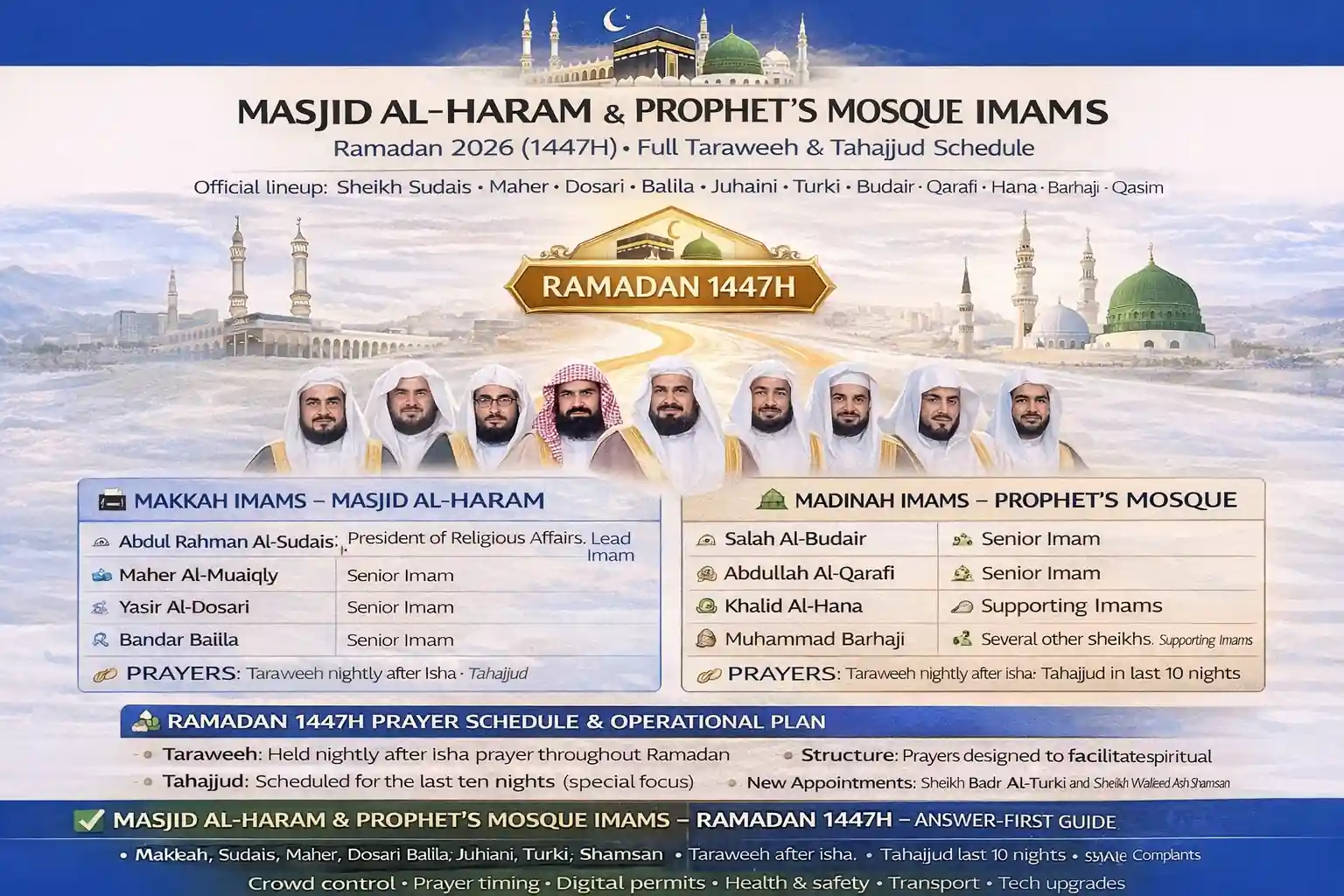
Ramadan 2026 Taraweeh & Tahajjud Imam Schedule at Makkah and Madinah (1447H)
If you’re planning Umrah in Ramadan, this is one of the first things you want to know: who will lead the prayers?
And not just out of curiosity.
The imam schedule helps you plan your night, your transport, your family timing, and honestly—your energy. In Ramadan crowds, a small plan saves a big headache.
I’ve seen pilgrims get stuck because they only checked the “imam names” and forgot the practical side: when to leave, where to pray if one area is full, and how Tahajjud changes the flow in the last ten nights.
So this page gives you both: the announced imam lineup for Ramadan 1447 / 2026, and the real-life planning tips that make your worship calmer.
✅ TL;DR – Ramadan 2026 Taraweeh imam schedule
Ramadan 2026 Taraweeh imam schedule for the Two Holy Mosques includes approved imam lineups for Makkah and Madinah. Taraweeh is prayed nightly after Isha, and Tahajjud is in the last 10 nights. Check the current night’s rotation, go early, and plan for heavy crowds.
Ramadan 2026 imam schedule at a glance (Quick summary)
Ramadan 2026 imam schedule at a glance: The Religious Affairs Presidency approved the imam lineup for Taraweeh and Tahajjud at the Two Holy Mosques for Ramadan 1447H. The announcement covers Makkah and Madinah, confirms night-prayer leadership, and sits within a wider Ramadan operational plan for worshipper services and crowd management.
- Taraweeh is held nightly after Isha during Ramadan.
- Tahajjud is held in the last ten nights.
- Masjid Al-Haram (Makkah) has an announced group of imams for special prayers.
- Prophet’s Mosque (Madinah) also has an approved imam rotation lineup.
- New Grand Mosque appointments from earlier official announcements matter for this year’s lineup context.
- Crowds are heavy, so the imam schedule is useful for planning, not just reading.
- Night-by-night leadership rotation can be shared separately, so always double-check the latest nightly post.
That last point matters a lot. People mix up the “approved imam group” with the exact “who leads tonight” breakdown.
Who are the imams leading Taraweeh and Tahajjud at Masjid Al-Haram in Ramadan 2026?
The announced Masjid Al-Haram imam lineup for Taraweeh and Tahajjud in Ramadan 2026 (1447H) includes Sheikh Abdul Rahman Al-Sudais, Sheikh Badr Al-Turki, Sheikh Abdullah Al-Juhaini, Sheikh Yasser Al-Dossary, and Sheikh Bandar Balila. The exact nightly rotation can vary, so pilgrims should check the latest nightly schedule update.
This is the main list most people are searching for.
And yes, names matter to people. Some love a certain recitation style. Some want to hear a familiar voice. Some are visiting with parents who feel more settled when they know who is leading.
Grand Mosque (Makkah) imam lineup for Ramadan 1447H
For Ramadan 1447H, the Grand Mosque in Makkah has an approved group of imams assigned to lead Taraweeh and Tahajjud across the month. Public reports list a core group including senior imams and newer names, with leadership shared across the Ramadan nights and the late-night prayers in the final ten days.
A useful way to think about it: this is like a trusted team roster, not one single person every night.
That team approach helps with consistency, recitation flow, and the physical demands of a full Ramadan schedule in front of massive crowds.
Also, pilgrims sometimes ask, “Will the same imam lead all rak‘ahs?” Not always. In many nights, leadership is divided by portions of the prayer, and Witr may also be led by a different imam depending on the schedule.
Newly appointed permanent imams and what changed this year
Recent official appointments brought new permanent imams into the Grand Mosque, and that shapes how many people read this year’s Ramadan lineup. For pilgrims, the practical takeaway is simple: expect familiar senior names plus newer appointed imams to appear in the Ramadan prayer schedule.
This is where people get confused online.
They see an old poster, a fan page image, and a recent news report—all with slightly different names—and then they assume one of them is “fake.” Sometimes it’s just different timing: one post is a permanent appointment announcement, another is the Ramadan approved list, and a third is a nightly rotation card.
So don’t panic if the wording changes. Just check whether you’re looking at: 1) appointment news, 2) the Ramadan approved imam group, or 3) tonight’s prayer rotation.
Taraweeh vs Tahajjud: who leads and when
Taraweeh is the nightly Ramadan prayer after Isha, while Tahajjud is the late-night prayer in the last ten nights. The same approved imam group may lead both across different nights, but the exact distribution of rak‘ahs and Witr can differ based on the nightly schedule.
Many first-time pilgrims think Tahajjud is just “late Taraweeh.”
Close, but not quite.
In practice, the atmosphere, timing, and crowd pattern can feel very different. Taraweeh often pulls a broad crowd every night. Tahajjud in the last ten nights brings a deeper late-night crowd, and movement can become intense in the hours before Fajr.
Micro-scenario: You attend Taraweeh comfortably on Night 12 and assume Night 27 Tahajjud will feel similar. It won’t. Plan earlier, rest more, and expect heavier pressure around entrances.
Who are the imams leading Taraweeh and Tahajjud at the Prophet’s Mosque in Ramadan 2026?
The announced Prophet’s Mosque (Madinah) imam lineup for Ramadan 2026 includes Sheikh Salah Al-Budair, Sheikh Abdullah Al-Qarafi, Sheikh Khalid Al-Hana, Sheikh Muhammad Barhaji, Sheikh Abdul Mohsen Al-Qasim, and other sheikhs in the approved rotation. Nightly leadership is shared through a structured schedule.
Madinah often feels calmer than Makkah to many visitors, but Ramadan nights are still busy, especially in the last ten nights.
And because some pilgrims split their trip between both cities, they need one guide that covers both. That’s exactly why this page matters.
Prophet’s Mosque (Madinah) imam lineup for Ramadan 1447H
The Prophet’s Mosque imam lineup for Ramadan 1447H includes a group of established and appointed sheikhs leading the night prayers across the month. Public reports list key names, while “and several other sheikhs” in official summaries means the full on-ground rotation can include additional leaders in the approved arrangement.
That “several other sheikhs” line is easy to miss, but it’s important. It means your prayer experience in Madinah may include more than the headline names people keep reposting.
That’s not a problem. It’s part of the organized rotation.
How the Madinah prayer leadership rotation works
Madinah’s Ramadan night-prayer leadership works as a rotation, with approved imams leading different nights or portions of the prayer. Pilgrims should treat the official imam list as the approved pool, and the nightly schedule card as the exact “who leads tonight” guide.
A lot of beginners make this mistake: they memorize names but never check the date-specific post.
Then they reach the mosque and ask everyone around them, “Who is leading today?” By then, they’re already distracted. Better to check before leaving your hotel.
What is the difference between Taraweeh and Tahajjud in Ramadan?
Taraweeh is the Ramadan night prayer prayed after Isha throughout the month, while Tahajjud is a late-night prayer commonly held in the last ten nights before Fajr. Both are deeply loved by worshippers, but Tahajjud usually brings heavier late-night crowd pressure in Makkah and Madinah.
Here’s the thing: both prayers can move your heart, but they ask different things from your body.
Taraweeh asks for evening energy. Tahajjud asks for night discipline—sleep, wake-up timing, and transport planning when most people are tired.
If you’re a beginner, don’t try to “win Ramadan” on Night 1 by doing everything at full speed. Build a rhythm you can actually keep.
When is Tahajjud held in Ramadan 2026 at the Two Holy Mosques?
Tahajjud at the Two Holy Mosques is held during the last ten nights of Ramadan 2026 (1447H). The exact start time and nightly imam rotation can vary by night and mosque schedule, so worshippers should check the official daily posting before leaving for the Haram.
This timing matters because the whole city rhythm changes in the last ten nights.
Roads get busier later. Families sleep in shifts. The “normal” evening planning you used for Taraweeh may stop working for Tahajjud.
One sentence to remember: the last ten nights are not just “more worship”—they are a different logistics game.
Why the imam schedule matters for Umrah pilgrims in Ramadan
The imam schedule matters because it helps Umrah pilgrims plan prayer timing, transport, family movement, and rest. In Ramadan crowd conditions, knowing the prayer pattern early can reduce stress, avoid rushed arrivals, and make the worship experience calmer and more focused.
Some people think following imam schedules is only for “fans” of certain reciters.
Not true. It’s a planning tool.
If you know you want to attend Tahajjud on a specific night, you can plan sleep, suhoor, and transport better. If you’re with elderly parents, you can choose a safer arrival time instead of landing in the tightest crowd wave.
Planning your prayer time in crowded nights
Use the imam schedule to plan your departure time, not just your prayer intention. In Ramadan, the crowd forms long before the first takbir, especially on famous nights and weekends, so timing your exit from the hotel is one of the biggest “hidden sunnah-like” practical wins.
I say that jokingly with students, but it’s true: good timing protects your khushu‘.
Arriving breathless, frustrated, and separated from your group doesn’t help anyone pray better.
Micro-scenario: You want to catch Tahajjud in Makkah on an odd night. Don’t leave when you “think it starts.” Leave with enough buffer for security flow, walking time, and route changes.
Best times to arrive before Taraweeh and Tahajjud
The best arrival time is earlier than most first-timers expect, especially in the last ten nights. For Taraweeh, build extra time before Isha. For Tahajjud, allow a bigger buffer because late-night crowd surges can be intense and less predictable.
No exact minute fits every night. Crowd pressure changes.
But a safe rule works almost every time: if you’re asking yourself, “Should we leave now or wait a little?” leave now.
Your future self will thank you.
What families and elderly pilgrims should keep in mind
Families and elderly pilgrims should treat the imam schedule as part of a safety plan. Pick your prayer target, agree on a meeting point, keep phones charged, and choose a realistic prayer location instead of forcing the most crowded spot on every night.
This one is hard because people want the “perfect” Ramadan memory.
But the best memory is often the calm one: everyone prayed, no one got lost, and no one was in tears outside a crowded gate.
New Ramadan 1447 operational plan updates linked to worshippers’ experience
The Ramadan 1447 operational plan for the Two Holy Mosques includes upgrades that directly affect the prayer experience: crowd guidance tools, accessibility support, multilingual direction screens, and expanded worshipper services. These are not separate from prayer—they help people reach prayer safely and smoothly.
This section is where many articles stop too early. They list imam names and finish.
But pilgrims need the full picture. The imam schedule lives inside a larger Ramadan system: movement, signs, routes, services, and support teams.
Prayer experience, guidance, and visitor services
Worshipper services this Ramadan include cleaner flow in prayer areas, stronger support for iftar arrangements, mobility assistance, and organized corridor movement. These updates matter because your prayer experience starts before salah—at the gate, in the courtyard, and in the path you walk.
I used to underestimate this when I was younger. I thought “real worship” starts only when the prayer starts.
No. Respecting pathways, following directions, and not blocking people is part of the adab of the place.
Technology and translation support inside the Two Holy Mosques
Ramadan 1447 upgrades include interactive maps, crowd-counting tools, multilingual guidance screens, and translation support for field teams. For international pilgrims, these tools make a huge difference because they reduce confusion during fast-moving crowd moments.
When signs are clear, people move better.
When people move better, the prayer atmosphere stays calmer.
That’s why these “tech updates” matter even if you’re not a tech person.
Spiritual programs and visitor support initiatives
The broader Ramadan plan also includes religious teaching, Qur’an and Sunnah learning support, translation services, and global outreach efforts connected to the Two Holy Mosques. The idea is not only crowd control, but also guidance, education, and a better spiritual experience for visitors.
That balance is important: order and mercy together.
Too much talk about logistics alone makes Ramadan sound like a traffic report. Too much talk about spirituality alone ignores the real pressure pilgrims face on the ground. The best guidance combines both.
Common mistakes people make when checking the Ramadan imam schedule
Common imam-schedule mistakes include relying on old posters, confusing the approved imam list with the nightly rotation, and not checking updates before leaving for the mosque. These small mistakes create unnecessary stress, especially in Ramadan crowds and late-night Tahajjud plans.
Let me save you from the usual confusion.
Here are five quirky beginner mistakes I see every year:
Mistake 1: Saving a social media image from last year and trusting it. Quick fix: Check the year (1447H / 2026) every single time.
Mistake 2: Reading the imam group list and assuming that’s tonight’s exact leader. Quick fix: Look for the date-specific nightly rotation post.
Mistake 3: Planning transport around the prayer start only. Quick fix: Plan around crowd buildup, not just salah time.
Mistake 4: Trying to hear a favorite imam at any cost. Quick fix: Choose a safe prayer spot and let your heart focus on worship, not chasing one gate.
Mistake 5: Going with family and no meeting point. Quick fix: Pick one simple location before you leave the hotel.
A short story from a beginner pilgrim I once helped: he was thrilled to hear a certain imam in Makkah and showed me a screenshot as proof of “tonight’s schedule.” It was real—but from a different night. He left late, took the wrong route, and reached a packed area already frustrated. The next evening, he checked the correct date, left earlier, and agreed on a meeting point with his brother. Same city, same crowds, completely different experience. He told me, “I thought I needed a better spot. I needed a better plan.”
FAQ: Ramadan 2026 Taraweeh and Tahajjud imam schedule (Makkah & Madinah)
📘 Ramadan 2026 imam schedule FAQs
Who are the imams for Taraweeh at Masjid Al-Haram in Ramadan 2026?
Show Answer
The announced Makkah lineup includes Sheikh Abdul Rahman Al-Sudais, Sheikh Badr Al-Turki, Sheikh Abdullah Al-Juhaini, Sheikh Yasser Al-Dossary, and Sheikh Bandar Balila in the approved Taraweeh/Tahajjud group for Ramadan 1447H.
Who are the imams for Taraweeh at the Prophet’s Mosque in Ramadan 2026?
Show Answer
The announced Madinah lineup includes Sheikh Salah Al-Budair, Sheikh Abdullah Al-Qarafi, Sheikh Khalid Al-Hana, Sheikh Muhammad Barhaji, Sheikh Abdul Mohsen Al-Qasim, and other sheikhs in the approved rotation.
When is Tahajjud prayed at the Two Holy Mosques in Ramadan 2026?
Show Answer
Tahajjud is held during the last ten nights of Ramadan. The exact nightly timing and imam rotation should be checked on the current official or trusted daily schedule update.
What is the difference between Taraweeh and Tahajjud?
Show Answer
Taraweeh is prayed after Isha every night in Ramadan. Tahajjud is the late-night prayer in the last ten nights, usually closer to Fajr and often with heavier crowd pressure.
Are the imam names the same every night?
Show Answer
No. The approved list shows the imam group for the month, but the exact nightly rotation can change by date and prayer segment. Always check the daily night-specific schedule.
Do newly appointed imams appear in the Ramadan 2026 schedule?
Show Answer
Recent official appointments to the Grand Mosque are part of the current Ramadan context, and newer appointed imams may appear within the approved prayer leadership arrangements.
Why should Umrah pilgrims care about the imam schedule?
Show Answer
Because it helps with planning: transport, arrival time, family safety, and managing energy. In Ramadan crowds, planning around prayer nights can make the whole trip smoother.
How early should I arrive for Taraweeh or Tahajjud?
Show Answer
Earlier than you think. Build extra time for walking, route controls, and crowd buildup. This matters even more in the last ten nights when Tahajjud crowds can surge quickly.
Is the Makkah schedule the same as the Madinah schedule?
Show Answer
No. Makkah and Madinah each have their own approved imam lineup and rotation. Many pilgrims visit both, so it helps to check each city’s schedule separately.
What if I can’t reach the main prayer hall in time?
Show Answer
Follow staff direction and use available courtyards or designated prayer areas. A safe, calm place to pray is better than forcing your way toward a full area.
Can the night-by-night imam schedule change?
Show Answer
Yes, updates can happen. That’s why it’s smart to check the latest official or trusted nightly schedule card on the same day before you leave for prayer.
What’s the safest one-line tip for first-time pilgrims?
Show Answer
Check tonight’s imam schedule, leave early, carry less, and choose a calm prayer spot over a crowded “perfect” spot.
📊 Ramadan 2026 imam schedule: what pilgrims actually need
Most people only check imam names. Use this table to plan the full night: prayer type, what to check, and the safest beginner move.
🌙 Show Makkah & Madinah Ramadan Prayer Planning Table
| What you’re checking | What it means | Beginner-safe move |
|---|---|---|
| Approved imam list | The imam group for Ramadan (Makkah/Madinah) | Use it to know the names, not the exact night |
| Nightly imam rotation | Date-specific “who leads tonight” schedule | Check it the same day before leaving |
| Taraweeh | Night prayer after Isha, all Ramadan | Leave early and expect pre-prayer crowd buildup |
| Tahajjud | Late-night prayer in the last 10 nights | Plan sleep + transport; crowds get heavier |
| Makkah vs Madinah | Separate imam lineups and rotations | Check each city separately if you travel between both |
| Family planning | Meeting point + route + phone battery | Decide before leaving, not outside the gate |
You Can Also Check
You Can Also Read
- Suhoor and Iftar in Ramadan (Saudi): Rules, Meaning, Mistakes, Meals
- What is Suhoor?
- What is Iftar?
- Suhoor Vs Sehri vs Suhur vs Sahur
- Can I Eat During Fajr Adhan?
- Accidentally Ate After Fajr
- Missed Suhoor
- Suhoor Rules Checklist
- Suhoor Foods that Keep You Full
- Saudi Ramadan 2026 Umrah & Mosque Guidelines

Farrukh Farooqi has been living in Sharaya, Makkah, Saudi Arabia since 2010. With over 14 years of firsthand experience witnessing the sacred journey of millions of pilgrims, Farrukh specializes in providing practical, insider tips for Hajj and Umrah travelers. His work blends real-world observations, the latest Saudi updates, and essential crowd management strategies — helping pilgrims and worshippers plan smarter, stay safer, and experience a spiritually fulfilling journey across the Holy Cities.


