
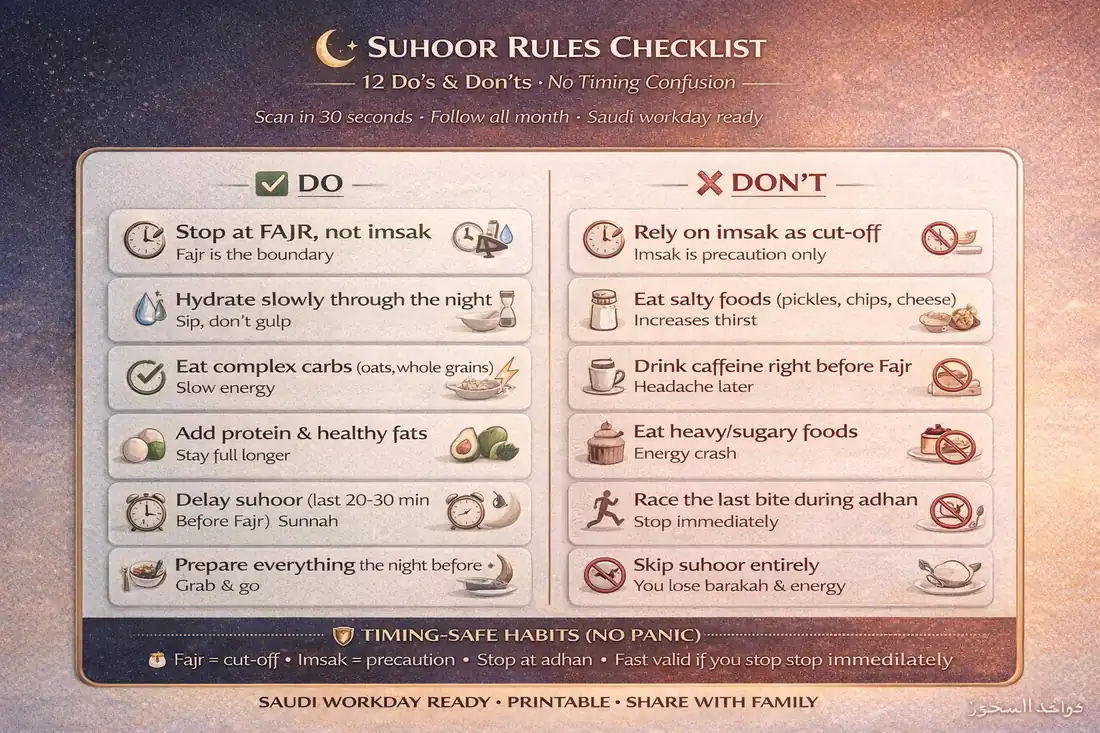
Suhoor Rules Checklist: 12 do’s & don’ts (No Timing Confusion)
Suhoor gets messy for one reason more than anything else: panic.
Not hunger. Not food. Panic.
One person is checking the clock. Another is asking, “Is it imsak vs fajr?” Someone else is still heating leftovers. Then the adhan confusion starts.
✅ TL;DR – suhoor rules
suhoor rules are easiest when you follow a checklist: prep the night before, eat simple food, hydrate steadily, and stop at Fajr without a last-second race. Most mistakes come from timing confusion (imsak vs fajr) and chaotic habits, not from “bad intentions.”
If you’re here, you probably want one thing: a clean rule set you can follow half-asleep.
Good. That’s exactly how this is written.
The 12-point checklist (Do/Don’t)
suhoor checklist Ramadan style works because it removes decision fatigue. On a sleepy morning, a checklist is better than a long lecture. Think of it like a seatbelt checklist before driving—simple, repeatable, and easy to trust.
My students always ask for a “printable version.” This is basically that, just on-screen.
- DO: Decide your Suhoor plan the night before. DON’T: wait until 4 AM to ask, “What should we eat?” (suhoor planning night before + meal prep)
- DO: Keep your cutoff tied to Fajr. DON’T: treat every imsak line as the same thing as the fasting start. (suhoor ends at fajr, imsak vs fajr)
- DO: Build a simple suhoor routine (water, food, cleanup, stop). DON’T: make it a daily emergency.
- DO: Eat calmly. DON’T: race the last bite while staring at the clock. This is how people create prevent last-minute panic problems for themselves.
- DO: Choose foods that hold you steady. DON’T: load up on extra salty food if it always increases thirst. (what not to eat at suhoor to avoid thirst, salty foods)
- DO: Drink water in a steady way after Iftar and before sleep. DON’T: rely on one huge chug at Suhoor. (suhoor hydration tips, hydration)
- DO: Watch suhoor caffeine timing. DON’T: overload coffee if it wrecks your sleep or causes later headaches. (caffeine timing)
- DO: Keep it digestible. DON’T: eat a heavy, spicy meal if it usually gives you heartburn. (avoid heartburn at suhoor)
- DO: Leave a tiny time cushion if you panic easily. DON’T: ask every day, “can you eat 5 minutes before fajr?” while chewing fast. Pick a calm rule and stick to it.
- DO: Have an alarm prep system (two alarms, two places). DON’T: trust one alarm under your pillow.
- DO: Make a simple version for children. DON’T: copy an adult schedule exactly for every kid. (kids routine, suhoor rules for kids)
- DO: Keep Suhoor connected to intention and calm worship. DON’T: turn it into a daily stress test. (late suhoor sunnah practical, suhoor etiquette)
Micro-scenario: You wake up late and the kitchen is dark. Don’t start a full cooking project. Grab your simple backup meal, drink water, and move through your checklist.
Micro-scenario: A family member shouts “Imsak! Stop now!” while your app shows Fajr is still a little later. Don’t argue at volume 100. Follow your trusted timetable and keep your manners.
Timing-safe habits (no panic)
when to stop eating before fajr is the biggest stress point, so keep this rule short: tie your fasting cutoff to the start of Fajr (true dawn), and treat imsak as a caution buffer if your timetable shows it. This solves most adhan confusion in one line.
Think of Imsak like a “wrap up” reminder. Think of Fajr like the actual door closing. That picture helps beginners more than technical wording.
what time do we stop eating in suhoor (concept)? At the fasting boundary for your location, which is tied to Fajr. That’s why city-based timing pages matter.
how many minutes before fajr should i stop eating? If you want a calm habit, leave yourself a small cushion. Not because Fajr “moves,” but because people move slowly when sleepy.
can i eat during fajr adhan is usually asked in panic mode. The safe habit is to stop by the start of Fajr on your trusted local timing source and not play “one last sip” games.
can i drink water right before fajr? If it is still before the Fajr boundary for your location, yes. The problem is not the water. The problem is guessing the time.
Micro-scenario: You’re brushing your teeth and someone in the house says Fajr started. Don’t panic-spit and start a debate. Check your local timing source, stop eating/drinking if Fajr has entered, and continue calmly.
If you want a clean city-based page to avoid timing confusion, use the iftar & suhoor timer and save your city once.
Food + water rules (thirst control)
suhoor for long fast is mostly about stable food and smart water habits, not “magic foods.” The biggest mistakes I see are too much salt, too much sugar, and too much caffeine too late. That trio causes thirst, a sugar spike crash, and bad sleep.
Here’s the part many forget: your hydration starts after Iftar, not only at Suhoor.
Food + water rules for a smoother fast:
Rule 1: Build around simple foods you already tolerate. This is not the time to test a trendy recipe.
Rule 2: Watch salty foods. They taste great. They also make people miserable by noon.
Rule 3: Don’t make Suhoor a dessert festival. A big sugar spike can leave you hungry earlier.
Rule 4: Be careful with suhoor caffeine timing. If coffee helps you and doesn’t ruin sleep, fine. If it leads to caffeine timing problems, headaches, or rebound tiredness, reduce it.
Rule 5: Choose water steadily between Maghrib and bedtime. People who “forget all night, then panic-drink” usually feel worse.
Rule 6: If you get heartburn, stop pretending spicy leftovers are “worth it.” Keep Suhoor boring and peaceful. Boring wins in Ramadan mornings.
One-sentence truth: your best Suhoor is the one that doesn’t fight you later.
If you want a quick planning helper for the month, the Imsakiyah generator is useful as a printable reference, and the Ramadan habit tracker helps you spot what food choices make your day easier.
Night-before prep
how to prep suhoor fast is really a “remove friction” job. Tired people don’t fail because they’re lazy. They fail because the path is too complicated at 4 AM.
Set up the night before like you’re helping sleepy future-you.
Step 1: Put your water where you can see it. Not hidden. Not in the back of the fridge.
Step 2: Do basic meal prep now. Even if it’s simple: wash fruit, prep oats, boil eggs, or portion leftovers.
Step 3: Set your alarm prep in two places. One close. One far enough that you must stand up.
Step 4: Write a tiny sticky note if you need it: “Water. Eat. Stop at Fajr.” It sounds silly. It works.
Step 5: If you have children, create a softer kids routine. Not every child needs the same food or wake-up style.
Step 6: For a Saudi workday, prep your morning clothes and bag too. A messy morning after Suhoor eats your patience before the day even starts.
I used to ignore this and tell myself, “I’ll remember.” I didn’t. The sticky note beat my memory every time.
Micro-scenario: You slept late after guests. Don’t aim for a perfect Suhoor. Aim for a successful one: simple food, water, no panic, stop on time.
Common mistakes
suhoor mistakes beginners make are usually small, but they repeat every day. Once you fix them, your whole month feels easier.
These are the quirky ones I hear again and again:
Mistake 1: Treating imsak vs fajr like the same label. Quick fix: Use one trusted local timing source and remember: fasting cutoff is tied to Fajr.
Mistake 2: Asking every morning, “can you eat 5 minutes before fajr?” while still deciding what to eat. Quick fix: Leave a small cushion and stop the clock-race habit.
Mistake 3: Eating super salty leftovers because they’re easy. Quick fix: Keep a few low-drama, lower-salt backup foods ready.
Mistake 4: Drinking almost no water all night, then trying to fix it in 90 seconds. Quick fix: Start hydration after Iftar and spread it out.
Mistake 5: Coffee too late, then poor sleep, then missed Suhoor, then blaming “Ramadan tiredness.” Quick fix: Adjust suhoor caffeine timing and sleep earlier when you can.
Mistake 6: Eating a heavy meal that causes heartburn, then spending the morning uncomfortable. Quick fix: Keep Suhoor lighter and more familiar.
Mistake 7: No backup plan for late nights. Quick fix: Keep a “2-minute Suhoor” option ready every night.
Mistake 8: Turning suhoor etiquette into a family argument. Quick fix: Lower your voice, keep your rule simple, and move on.
Mistake 9: Ignoring work routine realities. Quick fix: Prep clothes, bag, and morning steps before sleep.
Mistake 10: Overcomplicating late suhoor sunnah practical habits. Quick fix: Focus on calm, timing, and consistency.
a short story of a beginner mistake (and the simple fix)
A young brother once told me he kept missing the calm part of Suhoor, even when he woke up on time. I asked what he did first. He said, “I open three apps, compare screenshots, then ask my cousin what time Fajr is.”
By then, he was stressed, rushing, and barely eating.
So I gave him one rule: one trusted timing source, one backup meal, two alarms, and no app-hopping. The next week he messaged me, “I still wake up sleepy, but now I’m not panicking.”
That’s the win.
FAQs
📘 suhoor rules FAQs
when to stop eating before fajr?
Show Answer
Follow your local timing and stop at the start of Fajr. If your timetable shows imsak, treat it as a caution reminder, not the main fasting cutoff.
does suhoor end at fajr?
Show Answer
Yes, the fasting cutoff is tied to Fajr (true dawn). This is the simple rule behind suhoor ends at fajr.
imsak time vs fajr time difference — what should i follow?
Show Answer
imsak time vs fajr time difference is usually a caution buffer versus the actual fasting boundary. For fasting start, follow the Fajr entry time on your trusted local schedule.
can i eat during fajr adhan?
Show Answer
The safe habit is to stop by the start of Fajr according to your local timing source and avoid last-second guessing during the adhan.
can i drink water right before fajr?
Show Answer
If it is still before the Fajr cutoff for your location, yes. The key is not guessing the time—use a trusted city-based timing page.
how many minutes before fajr should i stop eating?
Show Answer
Many people leave a small cushion to avoid panic. The point is calm consistency, not a daily race with the clock.
what not to eat at suhoor to avoid thirst?
Show Answer
Foods that are very salty, very spicy, or very sugary often make thirst and energy swings worse for many people. Keep Suhoor simple and familiar.
what is the best suhoor caffeine timing?
Show Answer
It depends on your body, but the rule is practical: don’t let coffee wreck your sleep or cause a headache pattern. Adjust the amount and timing if needed.
late suhoor sunnah practical — what does that mean day to day?
Show Answer
It means don’t eat too early and then stay hungry for hours before Fajr. Keep Suhoor reasonably close to the fasting start while still leaving enough time to stop calmly.
suhoor rules for kids — should children follow the same checklist?
Show Answer
Children usually need a gentler version: simpler food, less pressure, and family guidance. The goal is a healthy routine, not a stressful one.
how to prep suhoor fast on a work night?
Show Answer
Do the basics before sleep: water ready, food ready, clothes ready, alarms ready. That one habit fixes most morning chaos.
📊 suhoor rules: quick “do / don’t” table
Use this as a fast daily check. It’s the same logic every morning: timing first, then calm food and water choices, then night-before prep.
🌙 Show Suhoor Rules Table
| Area | Do | Don’t |
|---|---|---|
| Timing | Use one trusted local Fajr time | App-hop and compare random screenshots |
| Imsak | Treat as a caution buffer if shown | Treat it as the fasting rule without checking |
| Food | Choose simple, familiar foods | Go heavy on salty/spicy foods |
| Water | Drink steadily from Iftar to sleep | Panic-drink only at the end |
| Caffeine | Adjust timing if sleep suffers | Ignore headache/sleep patterns |
| Prep | Set 2 alarms + prep food/water | Trust memory at 4 AM |
If you want a full Ramadan timing view, use the Imsakiyah generator. If your mornings are messy, the Ramadan habit tracker helps you see patterns. For prayer direction when traveling or at work, the Qibla Finder is a handy backup.
And if you’re planning dates for the month, the Hijri calendar guide is useful. I’m not stuffing links here—these are the ones people actually ask for when they’re trying to keep Ramadan mornings organized.
You Can Also Check
You Can Also Read
- Suhoor and Iftar in Ramadan (Saudi): Rules, Meaning, Mistakes, Meals
- What is Suhoor?
- What is Iftar?
- Suhoor Vs Sehri vs Suhur vs Sahur
- Can I Eat During Fajr Adhan?
- Accidentally Ate After Fajr
- Missed Suhoor

Farrukh Farooqi has been living in Sharaya, Makkah, Saudi Arabia since 2010. With over 14 years of firsthand experience witnessing the sacred journey of millions of pilgrims, Farrukh specializes in providing practical, insider tips for Hajj and Umrah travelers. His work blends real-world observations, the latest Saudi updates, and essential crowd management strategies — helping pilgrims and worshippers plan smarter, stay safer, and experience a spiritually fulfilling journey across the Holy Cities.


