
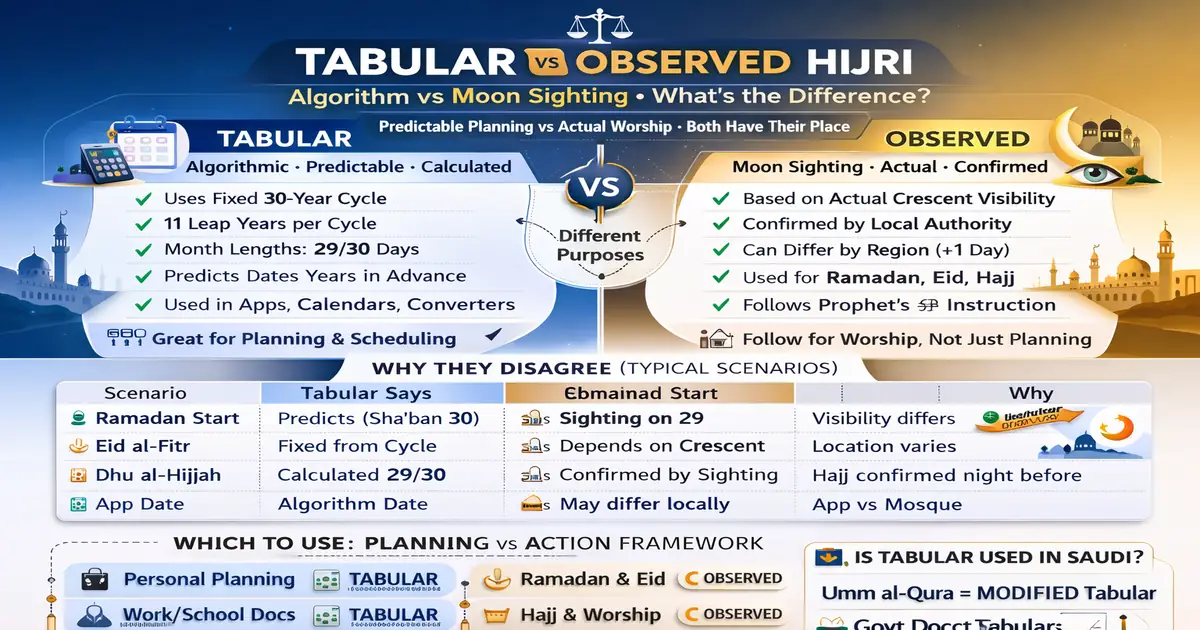
Tabular Islamic Calendar vs Observed Hijri: What’s the Difference?
tabular islamic calendar sounds technical, but the idea is simple.
One method follows a fixed pattern to estimate Hijri dates. The other follows crescent sighting and announcements.
That’s why two people can look at two apps on the same day and see different Hijri dates.
And both may still be using a real method.
If you’re trying to plan Ramadan content, travel, school notices, or just fix a confusing app setting, this page will help you understand the difference between an algorithmic hijri calendar and an observed hijri calendar without getting lost in heavy math.
✅ TL;DR – tabular islamic calendar
A tabular islamic calendar is a rule-based Hijri system that uses fixed month patterns and leap years (often a 30 year cycle hijri) for predictable dates. Observed Hijri depends on crescent sighting/announcements. Use tabular for planning, but confirm observed/official dates before action (fasting, Eid, travel, forms).
If you want a live date line on the page, you can place this naturally near the top:
Today is 10 Jumada al-Thani 1448 AH (21 October 2026)
Tabular in one paragraph
What is tabular islamic calendar? It is a rule-based Hijri calendar (also called arithmetic hijri calendar or algorithmic hijri calendar) that uses a repeating month-length pattern and leap-year pattern to estimate Hijri dates in advance.
Think of it like a train timetable.
The train (the moon) is real, but this version runs on a printed schedule. That printed schedule is what makes tabular hijri conversion useful for software, archives, and planning pages.
In many tabular systems, months are arranged in a predictable pattern of 29 and 30 days, and a leap day is added in certain years of a 30 year cycle hijri. That extra day usually lands in Dhu al-Hijjah, making the year 355 days instead of 354.
This is why people search for terms like islamic calendar algorithm, predictable hijri calendar, and hijri converter accuracy. They’re trying to understand why a digital date feels “fixed” in one tool and “shifts” in another.
I used to mix this up too when I first started explaining Hijri tools to beginners. I thought “algorithmic” meant “fake.” It doesn’t. It just means the date is being generated by rules instead of waiting for a fresh sighting report.
Observed Hijri in one paragraph
Observed hijri calendar means the month starts are confirmed through crescent sighting and official/community announcements, not only by a fixed calculation pattern. That is why a month can be 29 days in one place and 30 in another, depending on visibility and local decisions.
This is the “look at the sky, then decide” path.
In real life, many Muslims experience Hijri dates this way: the month begins when the crescent is confirmed, and local or national announcements matter. This is especially visible around Ramadan, Shawwal (Eid), and Dhu al-Hijjah.
That’s also why tabular vs moon sighting becomes a big topic every year. People are not arguing only about “dates.” They are often mixing two different systems without realizing it.
If your readers are new, a helpful line is this: tabular is a map, observed is the road sign. The map helps you plan. The road sign tells you what to do right now.
Why they disagree (typical scenarios)
Why my hijri date differs by 1 day is one of the most common questions, and the answer is usually boring (in a good way): different method, different setting, or different announcement source.
Here are the most common mismatch situations.
- Scenario 1: App vs local announcement — Your app uses a tabular islamic calendar, while your country/community follows observed moon sighting. A one-day difference is common.
- Scenario 2: Two apps, two methods — One app uses an algorithmic hijri calendar; another uses a Saudi-style table or regional setting (for example, an Umm al-Qura-based option).
- Scenario 3: Device setting problem — Your phone or computer has a Hijri adjustment setting or a region setting that shifts the displayed date.
- Scenario 4: Month-boundary confusion — Near the end of a Hijri month, small method differences become visible and people think the app “jumped.”
Most “date mismatch panic” happens near month changes.
Not in the middle of the month.
There’s also a practical point many people miss: some systems are built for predictability, others for observation. Predictability is great for school letters, content planning, and calendar printing. Observation is what matters when a community is waiting for an actual month-start announcement.
And yes, this is where users ask about microsoft hijri algorithm. Microsoft systems have long supported Hijri calendar handling and adjustment behavior in software settings, which is exactly why device settings can affect what people see on screen.
Common beginner mistakes (and quick fixes)
Mistake 1: Assuming every Hijri app uses the same method. Quick fix: Check the app’s calendar method or region setting first.
Mistake 2: Using a planning calendar as a worship-decision source. Quick fix: Plan with it, then confirm official/local announcements before action.
Mistake 3: Calling one method “wrong” without checking context. Quick fix: Ask: is this for planning, paperwork, or worship timing?
Mistake 4: Forgetting device adjustments. Quick fix: Check system Hijri adjustment/region options.
Mistake 5: Thinking a one-day mismatch means broken software. Quick fix: A one-day difference is often normal between methods.
Which to use (planning vs action)
Which is better: tabular vs moon sighting? The better question is: better for what?
Use tabular for planning, confirm for action.
That one line will save your readers a lot of stress.
If you are creating schedules, content clusters, or internal office templates, a predictable hijri calendar is useful because it gives stable dates to work with. If you are about to fast, celebrate Eid, or publish a worship-sensitive notice, confirm with the official/local announcement used by your audience.
For Saudi-focused readers, this is where you can naturally point them to your broader Hijri education pages and country-specific references. A user checking date differences may also need Discovering the Hijri Calendar for basics, or a live tool context like the iftar & suhoor timer when planning fasting days. If they’re preparing Ramadan worship routines, a gentle next step is your Ramadan duas page (anchor only, no shortcode needed here).
And if someone is comparing dates on a family WhatsApp screenshot, remind them to compare like with like: same method, same region, same source type. That alone solves half the confusion.
The part most people miss
tabular hijri conversion is not “bad.” It is a tool.
Observed hijri calendar is not “messy.” It follows a different purpose.
They disagree because they are built to solve different real-world problems.
Decision matrix (planning vs action)
🌙 Show tabular vs observed quick-use table
| Use case | Best default | Why |
|---|---|---|
| Content planning / editorial calendar | Tabular / predictable calendar | Stable dates help you plan pages and drafts early |
| Ramadan/Eid action dates | Observed / official announcement | Month starts may depend on sighting/announcement |
| School letters / admin drafts | Tabular for draft, confirm before final | Good for planning, but final date should match local policy |
| Device widget / phone display | Method depends on settings | Apps/devices may use different algorithms or adjustments |
| Travel planning | Tabular first, local confirm later | Good for rough planning; confirm local dates near travel |
FAQs
📘 tabular islamic calendar FAQs
what is tabular islamic calendar?
Show Answer
A tabular islamic calendar is a rule-based Hijri system that uses a fixed month pattern and leap-year cycle to estimate dates. It is built for predictable planning and date conversion.
what is observed hijri calendar?
Show Answer
An observed hijri calendar starts months through crescent sighting and official/community announcements. This can cause one-country or one-community differences around month starts.
tabular vs moon sighting which is correct?
Show Answer
They serve different purposes. Tabular is useful for planning and conversion. Moon sighting/announcements are what many communities use for worship-related month starts.
is tabular hijri accurate?
Show Answer
It is accurate as a rule-based approximation and planning system, but it may not match observed or official announcements every month. A one-day mismatch is common in some cases.
why converters use tabular hijri?
Show Answer
Because it is predictable and easy for software to calculate. That makes tabular hijri conversion practical for apps, archives, and date tools.
what is the 30-year cycle?
Show Answer
In many tabular systems, Hijri dates follow a repeating 30 year cycle hijri with 11 leap years and 19 common years.
why my hijri date differs by 1 day?
Show Answer
Usually because one source uses a tabular/algorithmic method and another uses observed or official dates, or because your device has a Hijri adjustment setting.
does windows use an islamic algorithm?
Show Answer
Windows and Microsoft platforms support Hijri calendars and date adjustments in system/software settings. That is one reason users may see differences across devices or apps if settings don’t match.
is tabular used in saudi?
Show Answer
For Saudi-focused dates, don’t assume a generic tabular converter matches what your audience uses. Check the Saudi-specific method or source (often discussed as Umm al-Qura) when accuracy matters.
can tabular predict ramadan?
Show Answer
It can estimate dates for planning, which is useful for drafts and prep. But for action dates, many people still confirm with local or official announcements.
what to do for documents?
Show Answer
Use the date format required by the document or office. If needed, write both Hijri and Gregorian (dual date) and match the source your institution expects.
how to tell what method an app uses?
Show Answer
Check the app settings/help page for words like Umm al-Qura, Hijri adjustment, calculation, or tabular. If the app allows ±1 or ±2 day adjustment, that’s a strong clue.
Related Articles
- Umm al-Qura Hijri Calendar in KSA
- Today’s Hijri Date in Saudi Arabia
- Umm al-Qura vs Moon Sighting
- Why Hijri Dates Differ Between Countries
- Hijri Leap Years Explained
- Discovering the Hijri Calendar
- Qibla Finder

Farrukh Farooqi has been living in Sharaya, Makkah, Saudi Arabia since 2010. With over 14 years of firsthand experience witnessing the sacred journey of millions of pilgrims, Farrukh specializes in providing practical, insider tips for Hajj and Umrah travelers. His work blends real-world observations, the latest Saudi updates, and essential crowd management strategies — helping pilgrims and worshippers plan smarter, stay safer, and experience a spiritually fulfilling journey across the Holy Cities.


