
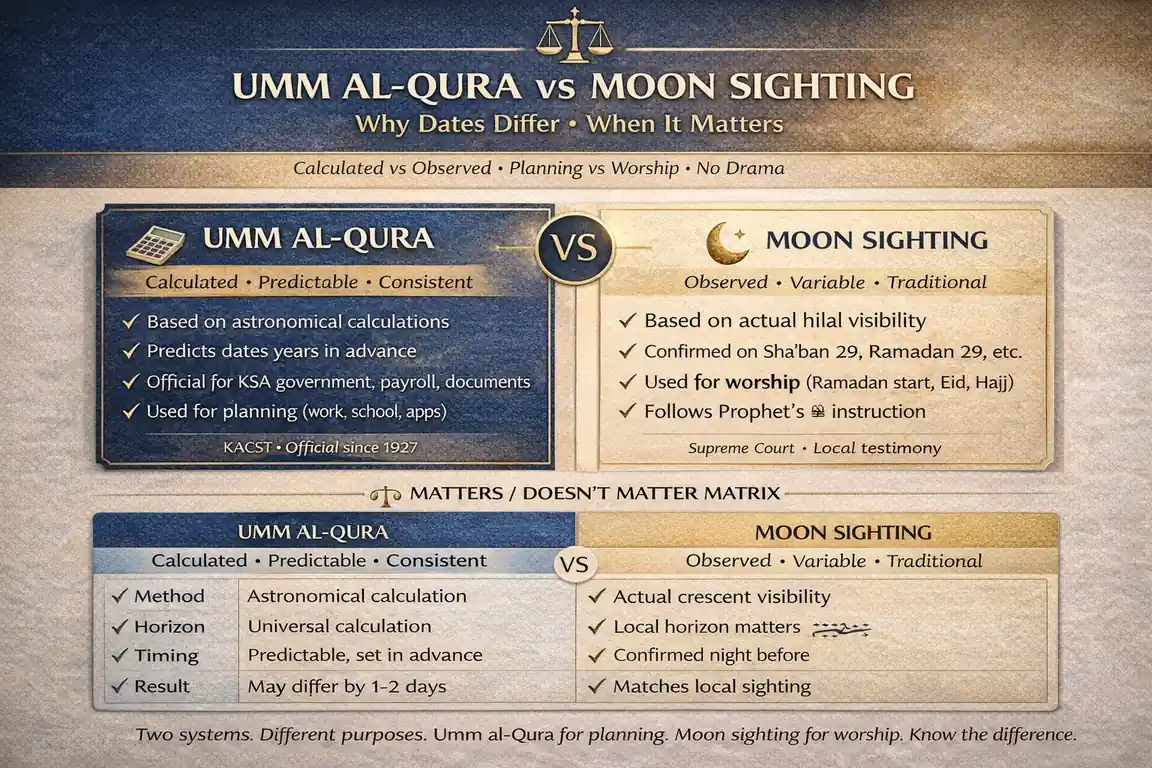
Umm al qura vs Moon sighting: Why Dates Differ (and When It Matters)
Umm al Qura vs moon sighting confuses people because both sound “Islamic,” but they answer different needs.
One helps with planning.
The other is about observing the crescent.
So when your app shows one date and your family group says another, it does not always mean someone is “wrong.” It usually means they are using different methods for different purposes. That’s the real issue behind most hijri date difference reasons.
I used to see this every year in Ramadan planning. One person would send a calendar screenshot, another would send a mosque announcement, and the group would turn into a courtroom. The fix was always the same: first ask, “Is this for planning, paperwork, or worship timing?” Once that was clear, the argument usually died in one minute.
✅ TL;DR – umm al qura vs moon sighting
Umm al-Qura is a calculated Hijri system used widely for Saudi schedules and official date handling, while moon sighting is an observational method used by many communities for month starts. Dates differ because the method and criteria differ—especially in Ramadan, Shawwal, and Dhu al-Hijjah. The calm way: use the right date for the right purpose.
If you want to show the current date on-page in WordPress, you can place this line naturally:
Today is 10 Jumada al-Thani 1448 AH (21 October 2026)
The simple difference (calculated vs observed)
Umm al Qura vs moon sighting in plain words: Umm al-Qura is like a planned train timetable, while moon sighting is like looking outside to confirm the train has actually arrived. Both are about the same journey. They just work differently.
Umm al qura calculation means a Hijri calendar date is set through a calculation-based system used for scheduling and consistency. This is why many Saudi calendars and official workflows can print dates ahead of time.
Moon sighting Saudi (and in many other countries) means the start of a month may be tied to a crescent observation and an official announcement. That is why people sometimes wait for the final call for key months.
The quick mental model:
- Calculated Hijri calendar = predictable for planning, printing, and scheduling
- Moon sighting = observation-based month start confirmation in many communities
- Crescent visibility = where the real disagreements usually begin
And yes, both can exist in the same country conversation at the same time.
That’s why your official hijri ksa calendar screen and a local mosque talk may not sound identical in wording, especially near month transitions.
If a reader is new to this topic, it helps to link a simple explainer like Discovering the Hijri Calendar so they understand why the Hijri month is sometimes 29 and sometimes 30 days.
Why disagreements cluster around 3 months
Why Ramadan differs by a day, why Eid differs by a day, and dhul hijjah hajj date difference questions all show up for the same reason: these months matter a lot, so everyone pays attention.
Most people don’t fight over an ordinary mid-year date. They fight over dates that affect fasting, Eid, and Hajj plans.
The three most sensitive months are:
1) Ramadan
This is where ramadan start difference becomes a big issue. Families want to know when fasting starts. Mosques want to announce clearly. Apps and calendars get compared nonstop.
2) Shawwal
This is the famous shawwal eid difference moment. People want to know Eid day, prayer timing, travel timing, and school leave timing. Even one-day differences feel huge because Eid is a shared public day.
3) Dhu al-Hijjah
This month affects Hajj, Eid al-Adha, and the Day of ‘Arafah timing in people’s minds. So dhul hijjah hajj date difference questions become emotional very fast.
But here’s what many forget: disagreement usually clusters around the start of the month, not the whole month. Once the start date is settled for a community, the rest of the dates usually become clear inside that community’s system.
Micro-scenario: Your cousin in Jeddah follows a KSA calendar update, and your cousin abroad follows a local announcement. Both share screenshots. They differ by one day. That is a method difference, not proof that Islam is “broken.”
Micro-scenario: An app predicts the date early, but an announcement comes later. People say, “The app was wrong.” Sometimes the app was showing a calculated schedule, while the public announcement was about official observance wording.
My students always ask about this part, especially before Eid.
What “official in KSA” really means
What does “official in KSA” mean? It usually means the date system used for state paperwork, schedules, and practical public handling is tied to Umm al-Qura for many civil uses. That official use matters for forms, deadlines, and planning.
This does not mean every conversation about moon sighting disappears. It means you should not mix up two separate questions:
- What date system is used for official scheduling and documents?
- What announcement is being followed for worship-related month starts in a given community?
Those are related questions, but they are not identical.
In Saudi daily life, the official date framework matters in practical places like:
- government paperwork and date entries
- legal timelines and deadlines
- printed calendars and institutional schedules
- school notices and office planning
That is why people search does ksa always use umm al qura. The honest beginner-safe answer is: for many official and civil date uses, Umm al-Qura is the main reference; for major month observance conversations, people still pay attention to official crescent announcements.
Use both ideas in the right place and your confusion drops a lot.
If your page cluster also covers “today’s Hijri date,” this is a smart internal link spot to your hijri date today saudi page, where users can do a quick “source + phone” check. For broader daily Islamic setup, a natural mention of Qibla Finder also fits here without stuffing.
When to follow which date (decision tree)
Which is correct hijri date? The practical answer is: use the date that matches your purpose. This is where people finally relax, because they stop trying to make one screen solve every situation.
Think of this as a simple decision tree:
If it’s paperwork, planning, or schedules in KSA → use the Saudi official date handling (Umm al-Qura-based reference).
If it’s a local worship announcement question → follow your local authority/community guidance for that observance.
If it’s personal app confusion → fix your app setting first, then compare.
That’s the whole method.
Matters / Doesn’t matter rule (the part most people miss):
It matters a lot for:
- Ramadan start and fasting schedules
- Shawwal and Eid planning
- Dhu al-Hijjah / Hajj-related planning
- forms, court dates, official documents, travel deadlines
It usually does not matter much for:
- general reminders posted early (“Ramadan is coming soon”)
- draft planning lists (shopping, leave planning, meal prep)
- non-legal social messages (as long as you avoid certainty claims)
What to write on plans if unsure: use a soft line like, “Expected date (subject to official announcement).” This one sentence can save a lot of family drama.
Micro-scenario: You’re making a family Eid trip plan. Book flexible timing if possible, and label the message “expected date” until the announcement is clear. People feel respected, and nobody feels tricked.
Micro-scenario: You’re filling a form in KSA and need a Hijri date today. Use the official-style date reference for the form, then add Gregorian beside it. Simple and clean.
Common myths that create drama
This section is the “argument killer.” A lot of tension comes from myths, not from the actual calendar issue.
Myth 1: “If two dates differ, one side is fake.”
Not true. Local sighting vs global sighting methods, app settings, and calendar systems can produce different results. Date difference does not automatically mean bad intent.
Myth 2: “Umm al-Qura is just random guessing.”
No. It is a calculated Hijri system used for consistency and planning. People may discuss methods, but “random” is not an honest description.
Myth 3: “Moon sighting means no planning is possible.”
Also false. You can plan with expected windows and then confirm at announcement time. That is how many communities handle sensitive months.
Myth 4: “Apps are always right.”
Apps are only as good as their settings and method choices. This is why why apps disagree is one of the most common questions.
Myth 5: “One calendar screenshot should settle every worship issue.”
No. Screenshots rarely show the method clearly. They also don’t replace local announcements.
Myth 6: “If the family disagrees, someone has to ‘win.’”
Usually not. Most family arguments are really about tone, not evidence. You can say, “Let’s check the method and follow the right source for this specific issue.”
One sentence that helps a lot: “This one is a planning date; for worship announcements, we’ll follow the official/local call.”
Calm words beat long debates.
FAQs
📘 umm al qura vs moon sighting FAQs
is umm al qura based on sighting?
Show Answer
Umm al-Qura is a calculated Hijri calendar used widely for Saudi scheduling and official date handling. It is not the same thing as local visual moon observation.
why saudi hijri differs from my country?
Show Answer
Because methods can differ: Umm al-Qura calculation, local sighting rules, app settings, and regional criteria can all shift the displayed Hijri date by a day.
does moon sighting override calendar?
Show Answer
It depends on the question. For worship-related month starts in a community, people often follow official/local announcements. For civil scheduling and paperwork in KSA, the official date system used for documents still matters.
why eid differs by a day?
Show Answer
Shawwal Eid difference usually happens because communities follow different moon sighting criteria, authorities, or calendar methods to confirm the start of the month.
why ramadan differs by a day?
Show Answer
Ramadan start difference is common when one place follows a local crescent announcement and another uses a different authority or method.
which is correct hijri date?
Show Answer
Use the date that matches your purpose. For KSA paperwork and civil use, use the Saudi official date handling. For local worship observance, follow your local authority/community guidance.
should i follow local sighting?
Show Answer
For worship observance questions, people usually follow their local recognized authority or community guidance. For forms and schedules, use the official date system required by your context.
does umm al qura predict months?
Show Answer
It provides a calculated Hijri calendar framework for planning and consistency. That’s why people can print schedules and prepare dates in advance.
what causes last-minute changes?
Show Answer
Most last-minute changes happen around crescent announcements for key months, or because people were sharing “expected” dates as if they were final.
can calculations be wrong?
Show Answer
The practical issue for most users is not “wrong vs right” math—it’s mixing different methods. The safer habit is to check the method and use the right source for your purpose.
does ksa always use umm al qura?
Show Answer
For many official/civil date uses in Saudi Arabia, Umm al-Qura is the main reference. For sensitive worship months, people also watch official crescent-related announcements.
how to handle disagreements in family?
Show Answer
Don’t start with “you’re wrong.” Start with: “Is this for planning, paperwork, or worship?” Then choose the right source. This lowers drama fast.
what to write on plans if unsure?
Show Answer
Write: “Expected date (subject to official announcement)”. This is clear, honest, and avoids last-minute confusion.
📊 Matters / Doesn’t Matter Matrix (planning vs worship vs paperwork)
Use this table when people mix up planning dates, worship announcements, and official paperwork dates.
🗓️ Show Umm al-Qura vs Moon Sighting matrix
| Situation | What matters most | Best beginner-safe move |
|---|---|---|
| KSA forms / legal dates | Official date handling | Use Umm al-Qura-based date + add Gregorian |
| Ramadan / Eid / Hajj observance | Official/local announcement | Follow your recognized authority/community guidance |
| Family planning message | Clarity + flexibility | Write “expected date, subject to announcement” |
| App mismatch | Method setting | Check if app uses Umm al-Qura or another method |
| Printed calendar planning | Consistency | Use one method consistently and label it clearly |
You Can Also Read

Farrukh Farooqi has been living in Sharaya, Makkah, Saudi Arabia since 2010. With over 14 years of firsthand experience witnessing the sacred journey of millions of pilgrims, Farrukh specializes in providing practical, insider tips for Hajj and Umrah travelers. His work blends real-world observations, the latest Saudi updates, and essential crowd management strategies — helping pilgrims and worshippers plan smarter, stay safer, and experience a spiritually fulfilling journey across the Holy Cities.


