
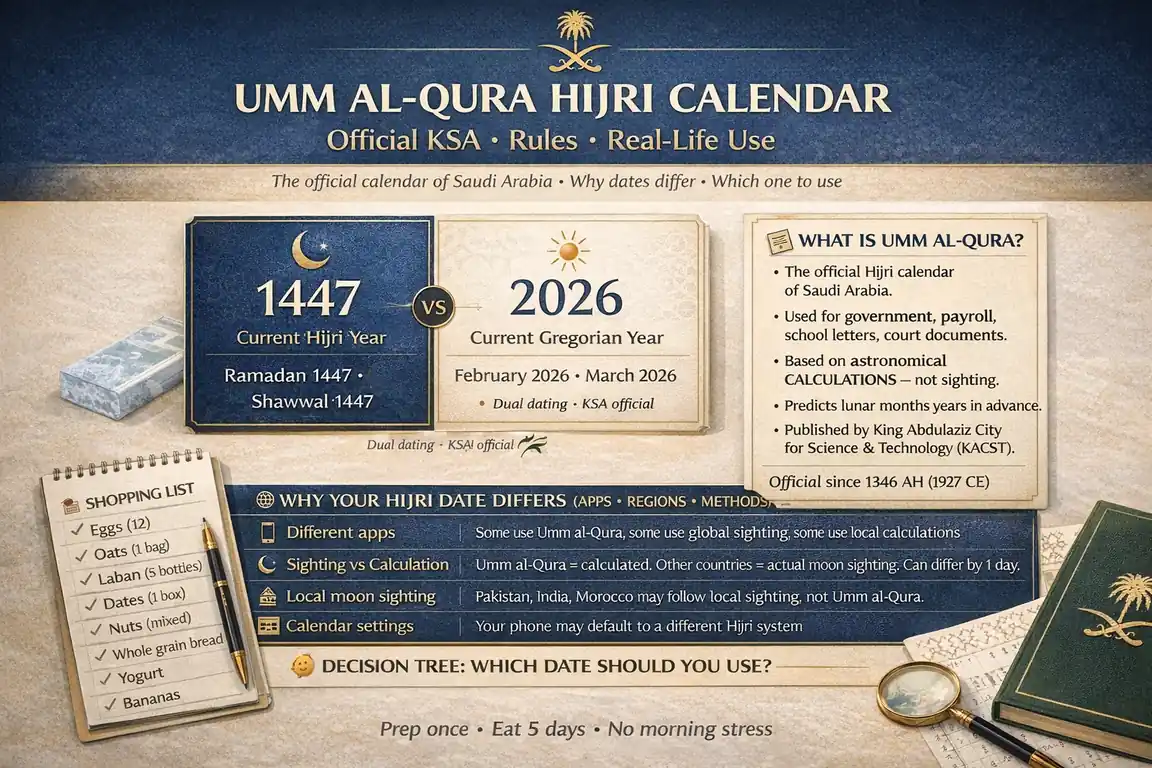
Today’s Umm al-Qura Hijri date is 13 Jumada al-Awwal 1448 AH (24 September 2026).
Umm al-Qura Hijri Calendar in KSA: Official Dates, Rules, and Real-Life Use
Umm al-Qura calendar is the date system many people in Saudi Arabia use every day without even thinking about it—until a date mismatch shows up on a phone, school letter, or Ramadan announcement.
That’s when the confusion starts.
One app says one Hijri date. Another app shows a different one. A friend abroad sends a screenshot, and now everyone in the family WhatsApp group is arguing.
If you’re in Saudi Arabia, the easiest way to stay calm is to know one simple thing: there is an official Hijri date reference used in KSA for many public and practical uses, and that is the Umm al-Qura calendar.
I used to mix this up with “moon sighting only” vs “calendar only” when I first started teaching beginners. Most people do.
✅ TL;DR – umm al-qura calendar
Umm al-Qura calendar is the official Hijri date reference used in Saudi Arabia for many public schedules and documents. It is a calculated Hijri system, so your app or another country may show a different Hijri date. In KSA daily life, use Umm al-Qura for official paperwork and schedules, and follow official announcements for major months and Eid-related dates.
This guide is for real life in Saudi Arabia: school forms, office deadlines, travel plans, family planning, Ramadan prep, and those “which date is correct?” moments.
What Umm al-Qura is (in plain terms)
Umm al-Qura calendar is a Hijri calendar system used in Saudi Arabia as an official date reference. Think of it like the Kingdom’s “shared wall calendar” for public use: everyone can look at the same date and stay in sync for schedules, documents, and daily planning.
It helps solve a practical problem. The Hijri calendar is lunar, and lunar dates can differ by method and place. So for daily admin life, people need one agreed date system.
That agreed system in KSA is Umm al-Qura.
Another easy way to picture it: if moon sighting is like looking outside to check the weather yourself, Umm al-Qura calendar is the official forecast everyone uses to plan the week. Both matter, but they are not always the same kind of tool.
Important beginner point: this does not mean every religious question is handled the same way as office paperwork. That’s where many people get confused, especially in Ramadan, Shawwal, and Dhu al-Hijjah.
What “official” means in KSA day-to-day
Official in Saudi daily life usually means: this is the date system used for formal references, schedules, and many government-linked workflows. If you’re writing, filing, or checking a date in a Saudi context, the safe default is the Umm al-Qura calendar date.
That matters more than people think.
For example, a court-related document, a school notice, a university schedule, or a date conversion in an app can all become messy if people mix methods without saying so.
Here are common places where Saudi Hijri calendar consistency matters:
- School letters and parent notices (Hijri + Gregorian together)
- Office memos and internal schedules
- Court and legal paperwork where date wording matters
- University calendars and term planning
- Printed calendars used in homes, shops, and offices
In practice, many Saudi users do dual dating: they write Hijri first, then Gregorian. That’s not “extra.” It’s actually a very smart habit because it reduces mistakes fast.
If you work with invoices or pricing sheets, this same dual-date habit helps when you also track exchange values or imported items. That’s one reason some people keep a currency converter tab open next to their date tools.
Why your Hijri date differs (apps, regions, methods)
Why does my Hijri date differ from Saudi? The short answer: different apps and countries may use different methods or settings. Some use Umm al-Qura calendar, some use local moon sighting, and some use another calculated method.
This is the most common source of confusion for beginners.
People assume “Hijri is one date everywhere.” In real life, date display can shift by method, region, and app settings. So when your phone shows a different date than a Saudi website, that does not automatically mean someone is wrong. It often means the systems are not the same.
Here’s a simple breakdown of why mismatches happen:
1) Different calendar setting in the app
Some apps have a Hijri setting hidden inside date options. If it is not set to Umm al-Qura, the app may show a different result.
2) Different country method
A user in another country may follow local announcements or local moon sighting practice, especially for major Islamic months.
3) Time zone / day rollover confusion
Late-night checks can confuse people. A date can look “off” if one person checked before midnight and another checked after.
4) Generic converters
Some online converters are useful, but they don’t always tell you which Hijri method they are using. That’s where date mismatch starts.
My students always ask this part: “So which one is the real one?” The better question is: real for what use? Official KSA paperwork? Use Umm al-Qura calendar. Local religious announcement in another country? Follow your local authority.
Months that cause the most confusion (Ramadan/Shawwal/Dhul Hijjah)
Ramadan, Shawwal, and Dhu al-Hijjah are where the confusion gets loud, because these months affect fasting, Eid, and Hajj-related dates. In Saudi Arabia, people often use the Umm al-Qura calendar for planning, but official public announcements around crescent sighting still matter a lot.
That’s the key balance.
Use the calendar to plan. Watch official announcements for the big moments.
This is why you’ll sometimes hear two things at once:
• “The Saudi Hijri calendar shows X.”
• “Wait for the official announcement.”
Both can be true in context.
A beginner-friendly rule:
For planning: use Umm al-Qura calendar.
For major month starts and Eid dates: follow the official Saudi announcement.
That keeps your planning practical and your worship calm.
If you’re building a Ramadan routine, this is also why people use tools in layers: a date reference, then city prayer times, then habit tracking. For example, many families pair the Hijri calendar guide with a daily prayer or fasting tool so they don’t mix the date question with the time question.
Decision tree: which date should you use?
Which Hijri date should you use? Use this simple rule: if the task is official or document-related in Saudi Arabia, use the Umm al-Qura calendar. If the task is a local religious announcement, follow the official announcement for that place.
Here’s the practical decision tree most people need:
- Is this for a Saudi document, form, school letter, or office schedule?
Use the Umm al-Qura calendar date. - Is this for Ramadan/Eid planning in Saudi Arabia?
Use Umm al-Qura for planning, then confirm with official announcements for major month starts and Eid. - Is this for a friend or family member outside KSA?
Ask which method/local authority they follow before comparing dates. - Is this a phone widget or random converter mismatch?
Check the app calendar setting first. Don’t argue before checking settings. - Is the date legally sensitive (contract, court, official submission)?
Write Hijri + Gregorian together if possible, and use the Saudi reference date.
One-sentence lifesaver: When in doubt, write both dates.
And if the issue is worship timing rather than date labeling—like Ramadan fasting start/end times—use your city prayer timetable separately. Date confusion and prayer-time confusion are two different problems. For Qibla and prayer-related setup, a simple tool like Qibla Finder can help keep your basics organized in one place.
Documents & dual-dating rules of thumb
Documents & dual-dating are where this topic becomes practical fast. The safe habit in KSA is to use the Hijri date today Saudi format from the official reference and add the Gregorian date beside it when the situation needs clarity.
Think of dual-dating like putting both Arabic and English labels on a box. You reduce mistakes for everyone who reads it later.
Use these rules of thumb in everyday work:
Rule 1: Put Hijri first in Saudi-facing documents
This fits how many official and formal workflows are handled in the Kingdom.
Rule 2: Add Gregorian in brackets or after a dash
Especially useful for schools, HR, clinics, shipping, and mixed teams.
Rule 3: Don’t “guess-convert” manually
If the date matters, check a trusted Saudi source/app. A one-day mistake can break a deadline.
Rule 4: If the date is unclear, label the method
For example: “Hijri date (Umm al-Qura).” This avoids pointless arguments.
Rule 5: Keep one standard inside your team
If one person uses app A and another uses app B, confusion repeats every month.
Micro-scenario: a school admin writes a parent circular with only one date, and parents read it differently. Add both dates next time. Problem gone.
Micro-scenario: a small business owner sends a due-date message in Hijri only to an overseas supplier. They reply with the wrong day. Add Gregorian too. Much cleaner.
Micro-scenario: a family is planning Fitrana and Eid shopping. One person follows a social-media image, another follows a Saudi app. Keep one shared reference and then use the right tools for each task, like a Fitrana calculator for amount planning and a prayer time tool for exact city timings.
Phone/computer setup quick links (to cluster pages)
How to set Umm al-Qura on phone depends on your device and app, but the simple idea is the same: check your calendar or regional date setting and make sure the Hijri method is set to Umm al-Qura if you want Saudi-aligned Hijri dates.
This is where most date mismatch problems are fixed in under two minutes.
Use these quick actions:
- Check your phone calendar settings (look for Hijri calendar method options)
- Check your Islamic app settings (some apps let you switch Hijri method)
- Use one Saudi-based date source for everyday checking
- Save your “date + prayer” tools together so you don’t mix date and timing tasks
For your site cluster, this is a good place to naturally link supporting pages users already need:
• Need a simple date background first? Read Discovering the Hijri Calendar.
• Need prayer direction while setting up Ramadan tools? Open Qibla Finder.
• Need a clean date + fasting workflow? Pair this page with your local Ramadan timing pages.
• Need practical planning pages for families? Even non-religious tools like the pregnancy week calculator show why dual-date clarity matters in appointments and records.
If you want a printable Hijri reference, some people still prefer a paper calendar on the wall or desk. That habit is old-school, but honestly, it saves mistakes.
FAQs
📘 umm al-qura calendar FAQs
what is umm al-qura calendar?
Show Answer
Umm al-Qura calendar is the official Hijri date reference used in Saudi Arabia for many public schedules and daily practical uses. It helps people use one shared Hijri date system for planning and paperwork.
is umm al-qura official in saudi arabia?
Show Answer
Yes, Umm al-Qura is the official Hijri reference used in Saudi Arabia for many public and document-related uses. In daily life, it is the safest default for Saudi-facing dates.
is umm al-qura based on moon sighting?
Show Answer
Umm al-Qura calendar is a calculated Hijri system used for official date reference. But for major religious month announcements in Saudi Arabia, official crescent announcements still matter and should be followed.
why my hijri date differs from saudi?
Show Answer
Usually because your app is using a different Hijri method, your region follows a different local practice, or the app setting is not on Umm al-Qura.
how to know today hijri date in saudi?
Show Answer
Use a Saudi official source or an app that clearly states it uses the Umm al-Qura calendar. Avoid random converters that don’t show which Hijri method they use.
why converters give different hijri dates?
Show Answer
Different converters may use different calculation methods or regional assumptions. That’s why one converter can be one day ahead or behind another.
which hijri date should i use for legal documents in ksa?
Show Answer
For Saudi-facing legal or official documents, use the Umm al-Qura calendar date and add the Gregorian date as well when possible. Dual-dating avoids confusion later.
does umm al-qura predict ramadan?
Show Answer
It gives a practical date framework for planning, but for major month starts and Eid-related dates in Saudi Arabia, people should still follow the official public announcement.
does ksa use hijri for salary and office work?
Show Answer
Many Saudi offices and public-facing systems still use Hijri dates regularly, often alongside Gregorian dates. The exact format depends on the organization, so dual-dating is the safest habit.
how to set umm al-qura on phone?
Show Answer
Open your calendar or Islamic app settings and look for Hijri calendar method options. Choose Umm al-Qura if available. Then recheck the date on a Saudi source.
printable umm al-qura calendar pdf or paper copies—where to get them?
Show Answer
Many people use official or authorized printed copies sold through known bookstores and distributors in Saudi Arabia. Paper copies are still useful in shops, schools, and offices.
what if my family follows another country’s date while i live in saudi?
Show Answer
Use Umm al-Qura calendar for your Saudi paperwork and local scheduling. For family conversations, ask what method they follow before comparing dates. Different methods are the usual reason for mismatch.
📊 Umm al-Qura calendar: what to use, when
Use this table as a quick decision helper so you don’t mix official date use, planning use, and announcement-based dates.
📅 Show Umm al-Qura use-case table
| Situation | Best date reference | Practical tip |
|---|---|---|
| Saudi documents / forms | Umm al-Qura calendar | Write Hijri + Gregorian together |
| School / office schedules | Umm al-Qura | Keep one team standard |
| Ramadan / Eid planning | Umm al-Qura for planning | Then confirm official announcements |
| Random online converter | Use with caution | Check which Hijri method it uses |
| Family abroad comparison | Depends on local method | Ask method before comparing |
| Phone app mismatch | App setting check first | Switch to Umm al-Qura if needed |
The part most people miss
A beginner once told me, “I stopped trusting all Hijri apps because every one gives a different date.”
He had three screenshots and one headache.
When we checked together, one app was set to a non-Saudi method, one was using a different regional setting, and one was actually correct for his Saudi use but he didn’t know what “Umm al-Qura” meant. We changed one setting, compared it with a Saudi reference, and the confusion disappeared in two minutes. The date didn’t become “magical.” It just became clear. That’s the whole point of this page.
Keep your method clear, and your dates stop fighting each other.
If you’re building a Ramadan prep stack for your family, pair this page with practical tools naturally—like a city fasting timetable, a Ramadan iftar & suhoor timer, and even a simple planning page such as a pregnancy week calculator if your household tracks appointments and due dates in both Hijri and Gregorian. It sounds unrelated, but date clarity helps everywhere.

Farrukh Farooqi has been living in Sharaya, Makkah, Saudi Arabia since 2010. With over 14 years of firsthand experience witnessing the sacred journey of millions of pilgrims, Farrukh specializes in providing practical, insider tips for Hajj and Umrah travelers. His work blends real-world observations, the latest Saudi updates, and essential crowd management strategies — helping pilgrims and worshippers plan smarter, stay safer, and experience a spiritually fulfilling journey across the Holy Cities.


