
Hijri Date Different Countries: Why Hijri Dates Differ Between Countries (Even on the Same Day)
Hijri date different countries is one of those topics that looks confusing at first, then suddenly becomes very simple once you know the 3 real causes.
It’s not always a mistake.
And it’s not always an app problem either.
Most of the confusion comes from mixing different methods, different locations, and different announcements into one conversation. So this page gives you a clean, beginner-safe way to understand why hijri date different and what to do when your family, your app, and another country all show different dates.
✅ TL;DR – hijri date different countries
Hijri dates differ between countries because people may use different methods (local moon sighting, global moon sighting, or calculation hijri), and the crescent may not be seen at the same time in every location. Time zones and app settings add more confusion. The easy rule: follow the recognized source for your place, and don’t compare random screenshots without checking the method.
If you want to show today’s Hijri date on the page, you can place this line naturally:
Today is 10 Jumada al-Thani 1448 AH (21 October 2026)
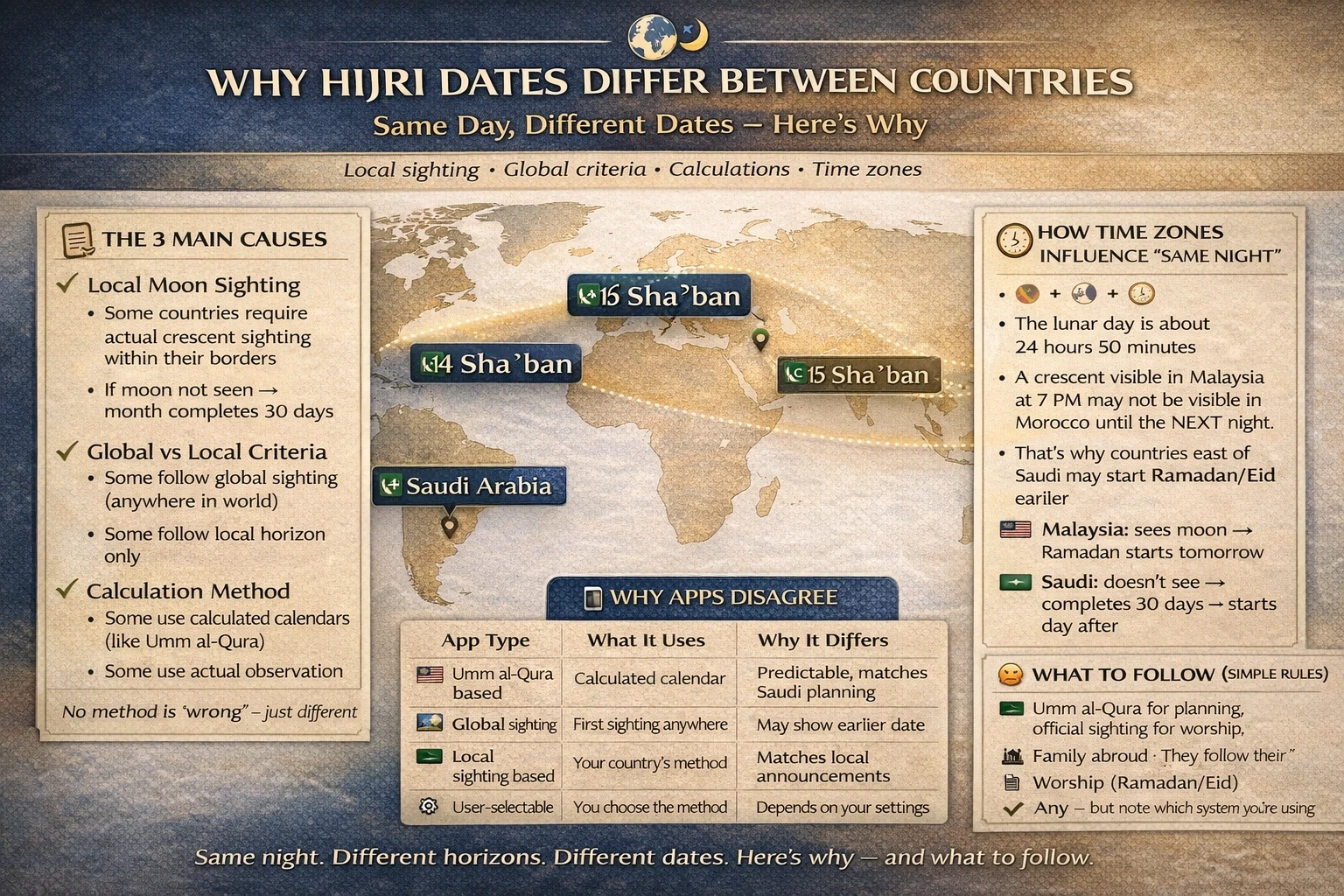
The 3 main causes (no jargon)
Why is hijri date different in saudi and my country? The short answer is: people may be using different methods, in different places, with different authorities. That’s the whole issue.
Think of it like prayer timetables. If two people use different cities, they won’t get the same Maghrib time. Hijri dates can be similar: method + location + authority can change the result.
Here are the 3 main causes:
- Different month-start method
Some communities follow local moon sighting. Some use broader criteria (often called global moon sighting). Some follow a calculation hijri calendar for planning and consistency. That alone can create a one-day difference. - Different location (crescent visibility)
The crescent is not equally visible everywhere at the same moment. Horizon conditions, visibility, and local observation conditions matter. So does hijri date depend on location? In many real-life cases, yes. - Different announcement authority
Two places can use similar ideas but still follow different regional authorities or official announcements. That is why eid different day and ramadan different day questions show up every year.
This is why hijri date difference saudi vs another country often comes down to “same religion, different system for confirming the month start.”
If you want a simple background page for readers who are new to this, add a natural internal link to Discovering the Hijri Calendar. It helps them understand why lunar months are 29 or 30 days and why the conversation gets intense near month-end.
Micro-scenario: Your cousin in KSA shares one date, and your cousin in another country shares another. Before saying “someone is wrong,” ask one question: “What method are you following?” That single question saves a lot of arguments.
How time zones influence “same night” confusion
Does time zone change hijri date? It can definitely change what people see on their phones at a given moment. This is where the “same night, different date” confusion gets messy.
The moon issue is already one layer. Time zones add another layer.
Here’s the practical problem: one person checks late at night in one country, another checks after midnight in another country, and now both are comparing screenshots from different local dates. People think it is a religion problem. Sometimes it is just a clock problem.
hijri date time zones confusion usually happens in these moments:
- Late-night checks (close to midnight)
- Travel days (especially flights across regions)
- Phone auto-timezone errors
- Apps set to one region, phone set to another
Micro-scenario: A student in Jeddah checks the date at 11:50 PM. Her brother abroad checks at what is already after midnight there. They compare “today,” but they are not comparing the same local day anymore.
Micro-scenario: Someone lands from travel and the phone stays on the old time zone for a while. The widget shows a date that looks “wrong,” but the real issue is the phone setting.
I used to mix this up all the time when I was learning this topic. I thought every mismatch meant a moon issue. Half the time it was just time settings.
So yes, same night different date can happen in people’s screens even before you get into moon sighting details.
Why apps disagree
Why apps show different hijri date is the most common question now, especially because people trust screenshots too fast. Apps disagree mainly because they use different methods, different default settings, or different regions.
An app is not a scholar, and it is not an official announcement by itself. It is a tool. Tools only work well when the settings match your purpose.
Common reasons app hijri date wrong happens:
1) Different Hijri method selected
One app may use a calculation-based system. Another may show a different regional method. If users don’t check the settings, they assume the app is “broken.”
2) Region or device calendar setting mismatch
Your phone’s region may be set to one country while your app is set to another. That creates mixed results.
3) Cached widget / delayed sync
Sometimes the app updates but the widget stays old for a while. This creates panic for no reason.
4) People compare apps that serve different goals
One app is better for prayer times. Another is better for date display. Users compare them like they are supposed to match perfectly on every setting.
5) Method not clearly shown
The screenshot does not show the method, so family groups compare dates with no context.
The easiest habit for users: pick one main source for your local date context, then use one app and check its settings once. Don’t compare five apps every month-end.
For KSA readers who also track fasting times, a natural next step is your iftar & suhoor timer page. Date confusion and timing confusion often happen together, but they should be checked separately.
What to follow (simple rules)
Which hijri is correct? The practical answer is: follow the recognized source for your situation. People get peace when they stop trying to make one app solve every country, every method, and every authority issue at once.
This is the easiest rule set I teach beginners:
Rule 1: For daily life, follow your local recognized source
If you live in a country and your mosque/community or official channel follows a certain method, use that for local worship timing and month starts.
Rule 2: For KSA official/civil date needs, use the Saudi-aligned date system
If the issue is paperwork, office planning, forms, or Saudi date use, follow the KSA date reference your context requires (many users pair this with Umm al-Qura-based displays).
Rule 3: For travel, confirm before you move
If you’re traveling near Ramadan or Eid, check the destination’s practice in advance. Don’t assume your home-country app setting will match what the local community follows.
Rule 4: When family has two dates, don’t start with “wrong”
Start with “Which method/source are you using?” This changes the tone immediately.
Rule 5: If you’re posting a plan, label it clearly
Write: “Expected date (subject to local/official announcement)” when needed. This is especially helpful before Eid.
Travel + family split playbook (quick version):
Traveling soon? Check destination practice before departure.
Family group split? Ask method first, not “who is right.”
Form deadline? Use the date system required by that form and add Gregorian too.
App mismatch? Fix app and phone settings before comparing screenshots.
Micro-scenario: Your family has two dates for Eid planning. The calm message is: “Let’s keep travel flexible until the announcement. I’ll send the final timing once confirmed.” That keeps everyone together, even if methods differ.
If your users are planning travel or expenses around Ramadan/Eid dates, it can also be natural to mention tools like currency converters for travel budgets or your Fitrana calculator for Ramadan prep. Those links fit when you mention travel and family planning—not randomly.
FAQs
📘 hijri date different countries FAQs
why is hijri date different in saudi and my country?
Show Answer
Usually because the month start is being confirmed by a different method or authority, and sometimes because the crescent visibility and local timing are different too.
does hijri date depend on location?
Show Answer
Yes, it can. Local moon sighting and crescent visibility conditions can differ by location, which may lead to different Hijri dates between countries.
does time zone change hijri date?
Show Answer
Time zones can change what your device shows at a given moment, especially near midnight. This creates “same night, different date” confusion on screens.
do all countries use moon sighting?
Show Answer
No. Countries and communities may use local moon sighting, broader criteria, or calculation-based Hijri calendars for planning and date display.
what is global sighting?
Show Answer
It usually means people follow a broader moon-sighting approach that is not limited only to their local city or country. Communities define it differently, so check your local guidance.
what is local sighting?
Show Answer
It means the month start is tied to local or regional crescent observation and the authority your community follows for announcements.
why apps show different hijri date?
Show Answer
Apps may use different methods, region settings, or time zones. Many mismatches come from settings, not from the phone being “bad.”
which hijri is correct?
Show Answer
Use the recognized source for your situation: local authority/community for local observance, and the required date system for official forms or schedules.
what to do while traveling?
Show Answer
Check the destination’s practice before travel, especially near Ramadan and Eid. Don’t assume your home app settings will match the local community.
why my family has two dates?
Show Answer
Usually because family members follow different countries, communities, or apps. Ask which method/source each person is using before arguing.
can two hijri dates be both valid?
Show Answer
In real life, different communities may follow different recognized methods or authorities. That’s why two dates can appear in parallel across countries.
should i change my calendar settings?
Show Answer
Yes, if your app settings do not match the source you actually follow. Set one clear method and region, then stop comparing random screenshots daily.
how to explain to kids why Eid is different?
Show Answer
Tell them simply: Muslims in different places may confirm the new month in different ways, so dates can differ by a day. It’s a method difference, not a faith problem.
📊 Why Hijri dates differ: quick comparison table
Use this to explain the issue calmly when someone sends a screenshot and says, “Why is this different?”
🌙 Show country-difference table
| Cause | What it means | What to do |
|---|---|---|
| Different method | Local sighting, global criteria, or calculation-based calendar | Check which method the source/app uses |
| Different location | Crescent visibility and local horizon can differ | Don’t assume two countries must match |
| Different authority | Communities follow different announcements | Follow the recognized source for your place |
| Time zone confusion | Same “night” but different local day on screens | Check time zone before comparing screenshots |
| App setting mismatch | Phone/app method or region is set wrong | Fix settings once, then use one main source |
You Can Also Read

Farrukh Farooqi has been living in Sharaya, Makkah, Saudi Arabia since 2010. With over 14 years of firsthand experience witnessing the sacred journey of millions of pilgrims, Farrukh specializes in providing practical, insider tips for Hajj and Umrah travelers. His work blends real-world observations, the latest Saudi updates, and essential crowd management strategies — helping pilgrims and worshippers plan smarter, stay safer, and experience a spiritually fulfilling journey across the Holy Cities.


