
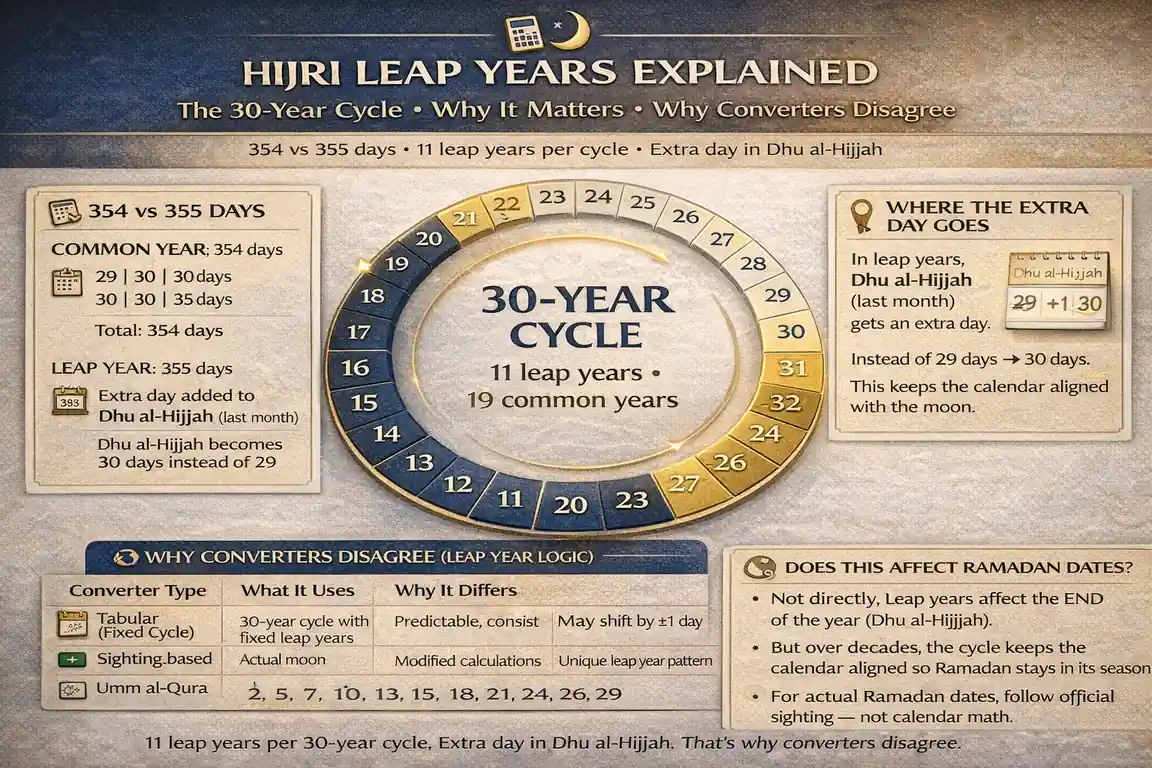
Hijri Leap Year: Hijri Leap Years Explained: The 30-Year Cycle and Why It Matters
Hijri leap year sounds like a scary math topic, but it’s actually simple.
In plain words: some Hijri years have 354 days, and some have 355 days. That extra day helps a rule-based Hijri calendar stay close to the moon cycle when dates are calculated in advance.
Most people only notice this when a converter gives a different answer than another converter.
That’s the moment this topic matters.
If you’ve ever asked, “Why are these two apps showing different dates?” or “What is a hijri 355 days year?”, this page is for you. I’ll keep it simple, human, and useful—especially if you’re building date pages, checking forms, or trying to understand hijri calendar math without a headache.
✅ TL;DR – hijri leap year
A hijri leap year is a 355-day year in a rule-based Hijri system, while a common year has 354 days. In many tabular islamic calendar methods, leap years happen 11 times in a 30-year cycle, and the extra day is added to Dhu al-Hijjah. This is a big reason conversion accuracy varies between Hijri converters.
If you want to show the current date on this page, use this naturally in the intro or sidebar:
Today is 10 Jumada al-Thani 1448 AH (21 October 2026)
The simple definition (354 vs 355)
What is a hijri leap year? The quick answer is: a year with one extra day added at the end of the Hijri year in a rule-based calendar system. So instead of hijri 354 days, that year becomes hijri 355 days.
Think of it like this: a rule-based Hijri calendar is trying to stay close to a moving target (the real moon cycle) using a repeating pattern. Most years are 354 days. Every now and then, one extra day is added so the pattern doesn’t drift too fast.
That extra day is not random.
It follows a cycle in tabular calendar methods.
This is why you’ll also hear terms like islamic leap year, arithmetic calendar, and tabular islamic calendar. They all point to the same basic idea: dates are worked out by a rule, not only by direct moon observation.
Important beginner note: this is not the same as saying “all Muslims use leap years for worship dates.” Many religious month starts are tied to moon sighting/announcements. The leap-year topic mostly matters when you’re dealing with predictable hijri dates, converters, software, or printed calendars.
Quick checklist (so you don’t mix things up)
- Traditional moon sighting: month start depends on observation/announcement.
- Tabular / algorithmic system: month lengths follow a fixed rule pattern.
- Leap year in Hijri math: means 355 days, not 354.
- Converter mismatch: often comes from different methods, not “wrong Islam.”
The 30-year cycle (without heavy math)
How many leap years in 30 year hijri cycle? In the most common 30 year cycle hijri pattern used in tabular systems, there are 11 leap years and 19 common years.
That’s the core fact most people need.
The cycle repeats, so software and printed tables can predict dates more easily. This is one reason developers and old calendar systems like this style of calendar algorithms: it is clean, repeatable, and easy to code.
In the common pattern, the leap years in each 30-year block are usually listed as:
2, 5, 7, 10, 13, 16, 18, 21, 24, 26, 29
Some communities and systems use a slightly different leap-year distribution. That small detail matters more than people realize. Two converters can both be “rule-based” and still disagree because they are using different versions of the cycle.
My students always ask about this part: “So which list is the real one?” The honest answer is that there are multiple tabular variants. The most common list above is widely used in explanations, but not every app uses the same one.
One table: the 30-year cycle at a glance
🌙 Show Hijri 30-year cycle summary
| Item | Common tabular rule | Why it matters |
|---|---|---|
| Total years in cycle | 30 years | Cycle repeats, so dates are predictable |
| Common years | 19 years × 354 days | Most Hijri years in the cycle |
| Leap years | 11 years × 355 days | Adds a day to reduce drift |
| Common leap-year positions | 2, 5, 7, 10, 13, 16, 18, 21, 24, 26, 29 | Useful for understanding converter logic |
| Extra day location | End of Dhu al-Hijjah | Changes year length from 354 to 355 |
Does leap year affect Ramadan date? Not in the way many beginners imagine. It does not “add a day to Ramadan.” The extra day is tied to the end of the Hijri year, but the overall cycle can affect how converter outputs line up over time.
Where the extra day goes
Where does the leap day go? In the common tabular islamic calendar rule, the extra day is added to the final month, Dhu al-Hijjah. That is why you may see this explained as leap day dhu al hijjah.
So in a common year, Dhu al-Hijjah ends at 29 days. In a leap year, it becomes 30 days in the tabular system.
This is the detail that helps people finally “see” the concept. The leap day is not floating around the calendar. It has a home.
And that home is the end of the year.
Another thing people ask: why hijri months 29 or 30 in the first place? Because a lunar month is based on the moon cycle, which does not fit neatly into a fixed 30-day box every time. In real observation-based practice, months can be 29 or 30 depending on moon sighting. In rule-based systems, the month lengths follow a fixed pattern to make planning easier.
Beginner mistake I see a lot: people hear “leap year” and assume it works like the Gregorian calendar where a day is added in February. Different calendar, different logic. Here, the extra day is at the end of the Hijri year in Dhu al-Hijjah (for tabular systems).
A short story of a converter mistake (and the fix)
A brother once messaged me in panic because his app showed one Hijri date, but a website converter showed another. He thought one of them had “wrong Ramadan dates” built into it. After a quick check, the issue was simpler: one tool was using a tabular calendar style conversion, and the other followed a different method setting.
He was comparing outputs without checking the method.
We changed one setting, refreshed the page, and the dates lined up much closer. He laughed and said, “So it was not a religion fight. It was a settings fight.” Exactly.
That’s why this page matters.
How this affects converters
Why converters differ is the real-world reason people search this topic. The short answer: converters are not all using the same method, and hijri leap year logic is one part of that.
Here’s the part many people miss: a converter must choose a system. It cannot magically guess which method you want. Some tools use a tabular islamic calendar rule. Some use a country-specific setting. Some follow a different algorithm. Some let you adjust manually.
That is why what if app uses different algorithm is a very good question.
It means the app may still be working fine—it is just working from a different rule set.
Common converter differences (and what they usually mean)
1) Rule-based vs observation-based display
A converter built for predictable date conversion often uses arithmetic rules. A religious calendar app may be closer to local practice or a selected regional calendar.
2) Different tabular variant
Even within tabular islamic calendar methods, the leap-year distribution can differ slightly. That can shift outputs in some years.
3) Country-specific settings
Some users ask, is tabular calendar used in ksa or does umm al qura use this cycle. The practical answer is: Saudi date usage (including Umm al-Qura contexts) should be checked with Saudi-aligned sources/settings, not assumed to be the same as a generic tabular converter.
4) Edge cases around month boundaries
The date mismatch usually appears near the end/start of a month. This is where edge cases show up and people start sharing screenshots.
5) Time zone and device settings
A converter can show a different date if the device region/time setting is off. I know this sounds basic, but it causes so many false alarms.
Common mistakes + quick fixes
Mistake 1: Assuming every Hijri converter uses the same math. Quick fix: Check the method or settings first.
Mistake 2: Thinking a hijri leap year adds a day to Ramadan. Quick fix: The extra day is tied to Dhu al-Hijjah in tabular systems.
Mistake 3: Comparing a Saudi-focused date source with a generic converter and calling one “wrong.” Quick fix: Compare like with like (same region/method).
Mistake 4: Ignoring time zone settings. Quick fix: Check phone region and time first.
Mistake 5: Using one converter output for legal or official forms without checking the required date format. Quick fix: Use the date system requested by the form, and add Gregorian if needed.
If your readers use your site tools, this is a good place to link naturally to Discovering the Hijri Calendar for the basics, then to Qibla Finder and Fitrana Calculator as examples of pages where date clarity matters in Ramadan planning. For practical life tasks, even tools like Currency Converters and Pregnancy Week Calculator remind users of the same lesson: always check which system and settings a tool is using before trusting the output.
FAQs
📘 hijri leap year FAQs
is there a leap year in hijri calendar?
Show Answer
In the traditional observation-based Hijri calendar, people usually don’t talk about “leap years” the same way. In rule-based/tabular systems, yes—some years are 355 days and are called hijri leap year years.
how many leap years in 30 year hijri cycle?
Show Answer
In the common tabular pattern, there are 11 leap years in a 30 year cycle hijri system.
which hijri years are leap years?
Show Answer
In the common tabular version, leap-year positions are 2, 5, 7, 10, 13, 16, 18, 21, 24, 26, and 29 in each 30-year cycle. Some variants use slightly different positions.
why dhu al hijjah becomes 30 days?
Show Answer
In a tabular islamic leap year, the extra day is added to Dhu al-Hijjah, so it becomes 30 days instead of 29.
does leap year affect ramadan date?
Show Answer
Not by adding a day inside Ramadan. It affects the calendar pattern and can influence converter outputs over time, especially when different systems are compared.
what is tabular islamic calendar?
Show Answer
A tabular islamic calendar is a rule-based Hijri calendar that uses fixed month-length rules and a repeating leap-year cycle to make dates predictable.
why converters differ?
Show Answer
Because converters may use different methods: tabular rules, country-specific settings, different algorithms, or different time-zone/device settings.
is tabular calendar used in ksa?
Show Answer
For Saudi-specific date use, don’t assume a generic tabular converter matches KSA practice. Use Saudi-aligned sources/settings (often tied to Umm al-Qura contexts) when the page or form is KSA-specific.
does umm al qura use this cycle?
Show Answer
Don’t assume Umm al-Qura is the same as a simple generic 30-year tabular converter. For KSA pages, always use a Saudi-aligned source or setting instead of guessing.
how to check if this hijri year is leap?
Show Answer
In a tabular system, you check the year’s position inside the 30-year cycle. If it matches a leap-year position in that method, it is a 355-day year.
what is common year hijri?
Show Answer
A common Hijri year in tabular math is a 354-day year (no extra day added).
is leap year based on sighting?
Show Answer
The “leap year” idea belongs to rule-based/tabular Hijri systems. Moon-sighting calendars work by observation and announcements, not by a fixed leap-year cycle.
You Can Also Read
- Umm al-Qura Hijri Calendar in KSA
- Hijri Date Today saudi
- Umm al qura vs Moon sighting
- Hijri Date Different Countries

Farrukh Farooqi has been living in Sharaya, Makkah, Saudi Arabia since 2010. With over 14 years of firsthand experience witnessing the sacred journey of millions of pilgrims, Farrukh specializes in providing practical, insider tips for Hajj and Umrah travelers. His work blends real-world observations, the latest Saudi updates, and essential crowd management strategies — helping pilgrims and worshippers plan smarter, stay safer, and experience a spiritually fulfilling journey across the Holy Cities.


