
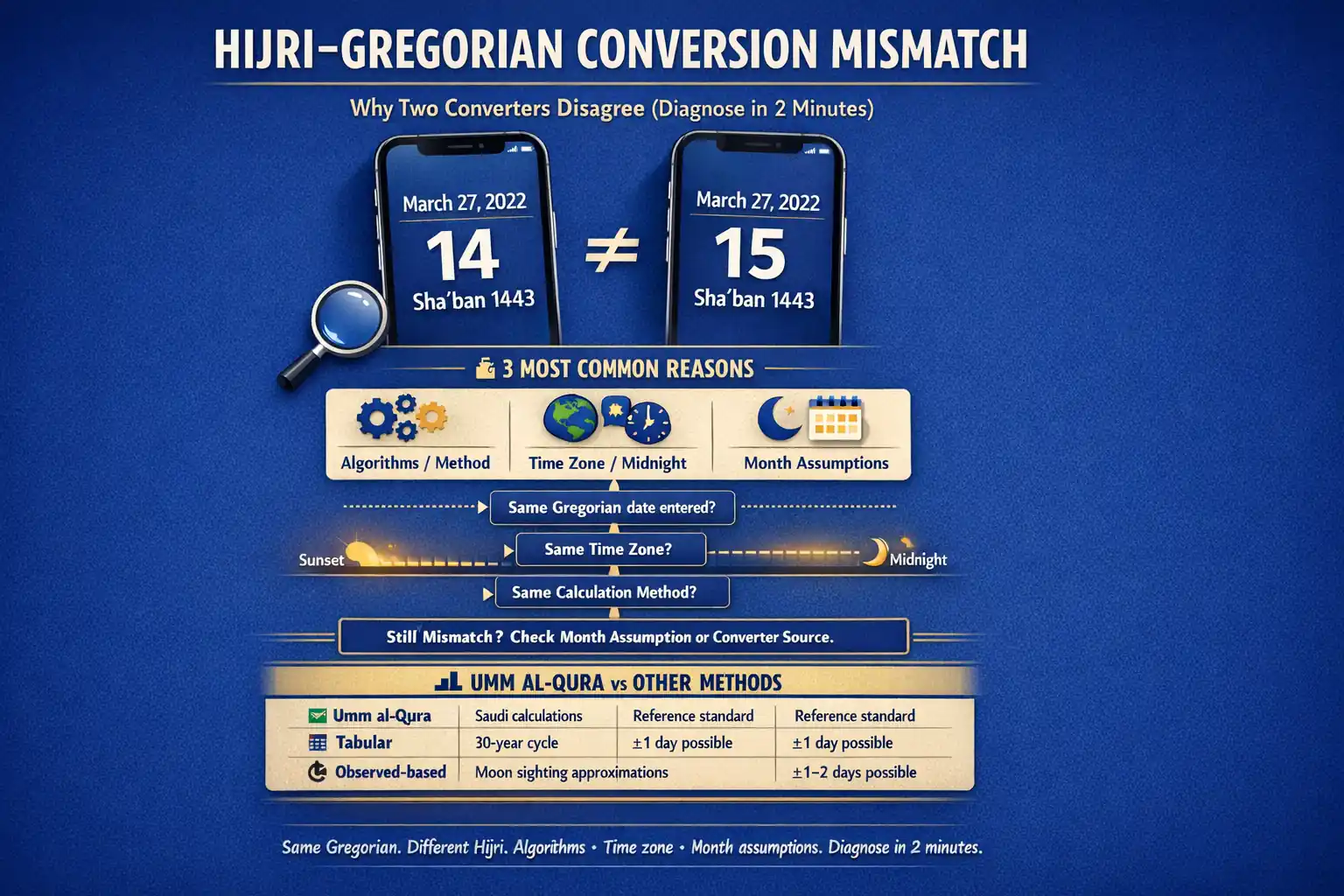
Hijri Gregorian Conversion Mismatch: why two converters disagree
hijri gregorian conversion mismatch is one of those problems that looks scary, but the cause is usually simple.
Two converters are often not using the same calendar method.
Or the same time zone.
Or even the same “day boundary.”
If you’ve ever seen hijri converter different results and thought one site must be broken, slow down for two minutes. In most cases, both tools are working—but they are answering slightly different questions.
✅ TL;DR – hijri gregorian conversion mismatch
Hijri–Gregorian conversion mismatches usually happen for 3 reasons: different calendar methods (tabular vs observed conversion or umm al qura converter vs others), different time zone conversion hijri settings, or different app/region defaults. Use one method consistently, check time zone, and dual-date important documents.
A quick on-page date check can also help users confirm what your site is showing right now:
Today is 10 Jumada al-Thani 1448 AH (21 October 2026)
The 3 most common mismatch reasons
Why two hijri converters give different dates usually comes down to method, settings, or source assumptions. That’s the core issue.
Think of it like weighing food on two scales: both can be real scales, but if one is set to grams and the other is set to ounces, the numbers won’t match.
Here are the three big reasons behind a hijri date conversion error or a “my gregorian to hijri wrong result” complaint:
- Different calendar method: One tool may use a hijri calendar algorithm (tabular/rule-based), while another follows umm al qura converter vs others logic or observed-month assumptions.
- Different region/locale defaults: Some tools quietly use device region or language settings. That can change results without warning.
- Different source timing: One site may refresh after an announcement or date boundary, while another still shows the older value for a while.
This is why people see hijri date one day off or even hijri date two days off near sensitive months like Ramadan, Shawwal, and Dhu al-Hijjah.
My students always ask the same question here: “So which one is wrong?”
Most of the time, the better question is: Which one matches my use case?
Time zone + midnight boundary issues
Does time zone affect hijri conversion? Yes, it can—especially when a converter is tied to a date-time value, not just a plain date. This is one of the most overlooked reasons behind online calendars disagree moments.
Here’s the simple version: if one converter reads the date in Riyadh time and another reads it in UTC (or your browser’s local time), the same moment can land on different calendar dates.
That creates the “same screenshot, different answer” problem.
And it gets worse near midnight.
For example, someone checks a converter late at night, then checks another after midnight, and thinks the hijri date changed overnight “randomly.” In reality, one tool may have crossed into a new date boundary first.
This matters even more if users are comparing results across countries or using VPNs. A tool can show a different result simply because it thinks the user is in a different region.
A 2-minute mismatch diagnosis flow (simple)
The quick answer is: check these in order before trusting any screenshot.
- Check the time zone (Riyadh vs device local vs UTC).
- Check the method (tabular/algorithmic, Umm al-Qura, or observed-based source).
- Check the date input format (day/month can get swapped in some tools).
- Check region/locale settings (Saudi Arabia vs global/default).
- Check when the tool last refreshed (especially near month boundaries).
If you’re teaching this to beginners, say it this way: same date, same time zone, same method. If one of those changes, the answer can change too.
Umm al-Qura vs other methods
Should I use umm al qura converter? If your audience is Saudi-focused or your document/workflow expects Saudi-style official dating, an Umm al-Qura-based source is usually the safer default for consistency.
But here’s the part many people miss.
Umm al-Qura and generic tabular vs observed conversion tools are not always the same thing. A generic converter may use a standard arithmetic pattern, while another tool may use a Saudi table-based method or a different regional rule set.
So when users search which hijri converter is correct for saudi, the right answer is not “pick any converter.” It’s “pick a converter that matches the Saudi method you actually need.”
This is also why conversion mismatch around ramadan, conversion mismatch around shawwal, and conversion mismatch around dhul hijjah are so common. These are the months when people compare dates more closely, and method differences become visible fast.
If you want to help users understand the bigger picture, link them naturally to Discovering the Hijri Calendar. If they are planning Ramadan routines and want timing context next, your iftar & suhoor timer is a good follow-up. And if they are checking Eid prep, a natural next click is Eid prayer times in KSA.
Small note, but helpful: don’t compare one “official-style” source with a random converter screenshot and expect perfect matching every time. Compare like with like.
What to use for documents
What if my document needs a hijri date? Use the date format and source expected by the office, school, or company receiving it. This is the safest rule for hijri conversion for documents.
If you are not 100% sure, use dual dating.
That means writing both Hijri and Gregorian on the same line.
This avoids problems when someone later says, “Your Hijri date is different from ours.” Your Gregorian date still anchors the record clearly.
Best practice for dual dating (especially for forms, PDFs, and screenshots):
- Write both dates (Hijri + Gregorian) on the same line.
- Keep the source consistent across the whole document.
- Add a short note if needed: “Hijri date shown per app/source setting.”
- Save a screenshot for important submissions.
Can hijri date change after printing? The printed document won’t change, but later checks in another converter may show a different Hijri result. That’s exactly why dual dating and screenshots help.
What to do if you already submitted wrong hijri date? Don’t panic. Send a correction note with the Gregorian date, the updated Hijri date, and a clear mention that different converters can differ. In most admin cases, clarity fixes the issue.
If your users are handling forms during Ramadan and also need practical tools, you can mention related pages naturally (without stuffing): fitrana calculator, qibla finder, or even currency converters for travel paperwork contexts. It sounds random, but this is real life—people often need all of these on the same day.
Mismatch quick-reference table
🔎 Show mismatch diagnosis table
| What you see | Likely cause | What to do |
|---|---|---|
| Hijri is one day off | Different method (tabular vs Umm al-Qura vs observed-style) | Match the converter to your purpose (Saudi, local, or planning) |
| Hijri is two days off | Method + time zone/region mismatch together | Check time zone first, then calendar method |
| Date changed after midnight | Midnight boundary or server/browser time zone | Re-check using Riyadh time (or your target time zone) |
| Phone and website disagree | Device region/locale or Hijri adjustment setting | Align device settings and compare again |
| Document date questioned later | Different office/source expectation | Use dual dating and keep a source screenshot |
FAQs
📘 hijri gregorian conversion mismatch FAQs
why two hijri converters give different dates?
Show Answer
Usually because they use different methods (hijri calendar algorithm, Umm al-Qura, or observed assumptions), different time zones, or different region settings.
which hijri converter is correct for saudi?
Show Answer
Use a converter or source that matches Saudi usage (often Umm al-Qura-based) when your audience or document is Saudi-focused. Don’t compare it to a random global converter and expect the same answer.
why hijri is off by one day?
Show Answer
A one-day difference is the most common mismatch and usually comes from method differences or time zone settings.
does time zone affect hijri conversion?
Show Answer
Yes. If the converter uses date-time values, the same moment can display as different calendar dates in different time zones, especially near midnight.
what is the midnight boundary problem?
Show Answer
One tool may switch to the next date earlier because it uses a different server or browser time zone. Users think the Hijri date “jumped,” but it’s often just a time boundary issue.
should i use umm al qura converter?
Show Answer
If you need Saudi consistency, yes, that is usually the better choice. For general planning, other converters may still be useful, but they may not match Saudi-focused expectations.
is tabular conversion the reason two tools disagree?
Show Answer
Often, yes. A tabular vs observed conversion mismatch is one of the biggest reasons for different Hijri results.
what if my document needs a hijri date?
Show Answer
Use the source expected by the receiving office and write both Hijri and Gregorian dates if possible. This is the safest hijri conversion for documents approach.
can hijri date change after printing?
Show Answer
The printed text won’t change, but another converter checked later may show a different Hijri date. That’s why dual dating and screenshots help.
what to do if i already submitted the wrong hijri date?
Show Answer
Send a short correction with the Gregorian date, updated Hijri date, and a note that converters can differ by method/settings. Be clear and calm.
how to verify hijri date today quickly?
Show Answer
Use a trusted source that matches your region/method, then compare with your device settings. On your page, you can also show 10 Jumada al-Thani 1448 AH (21 October 2026) so users see the live site value.
Related Articles
- Umm al-Qura Hijri Calendar in KSA
- Today’s Hijri Date in Saudi Arabia
- Umm al-Qura vs Moon Sighting
- Why Hijri Dates Differ Between Countries
- Tabular Islamic Calendar vs Observed Hijri
- Hijri Leap Years Explained
- Pregnancy Week Calculator

Farrukh Farooqi has been living in Sharaya, Makkah, Saudi Arabia since 2010. With over 14 years of firsthand experience witnessing the sacred journey of millions of pilgrims, Farrukh specializes in providing practical, insider tips for Hajj and Umrah travelers. His work blends real-world observations, the latest Saudi updates, and essential crowd management strategies — helping pilgrims and worshippers plan smarter, stay safer, and experience a spiritually fulfilling journey across the Holy Cities.


