
Pregnant Breastfeeding Fasting Ramadan Ruling: 7 Truths (2026)
Pregnancy and breastfeeding can turn Ramadan into a quiet, private struggle.
You want the reward. You also want your baby safe. And sometimes your body says, “Not today.”
Islam didn’t ignore that reality.
✅ TL;DR – pregnant breastfeeding fasting Ramadan ruling (2026)
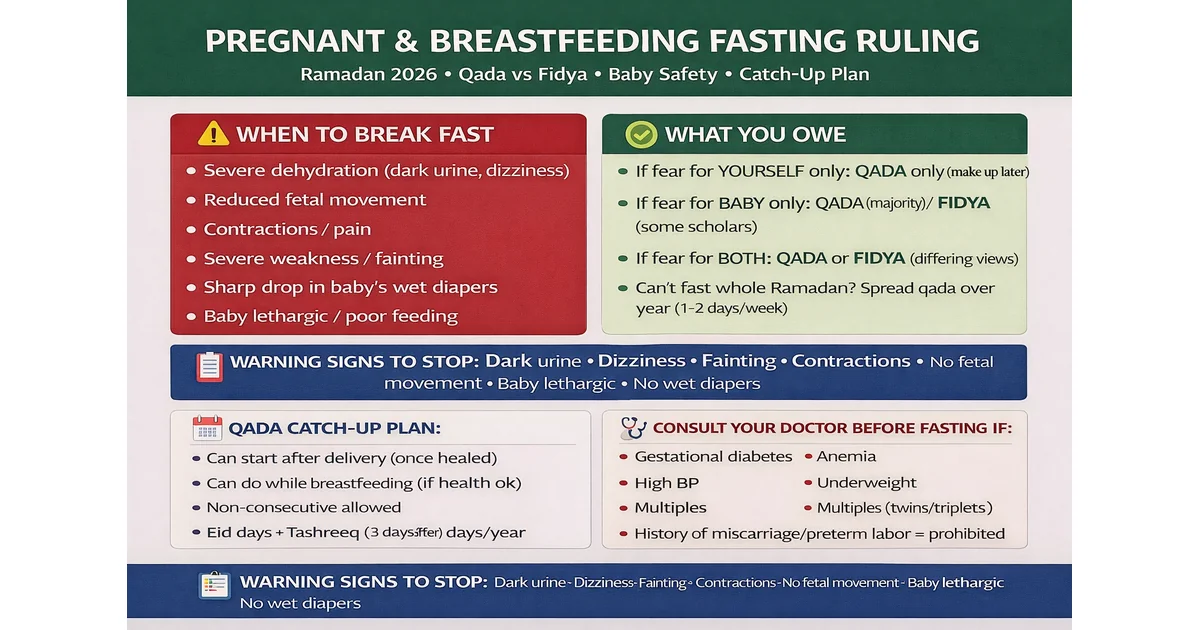
If fasting is likely to harm you or your baby, you may break the fast (or not fast) and make it up later as qada when you can. If fasting is safe and your doctor agrees, you may fast with a careful plan. Scholars differ on when fidya is added (some say qada only, others mention qada + fidya in certain “fear for baby” cases). The safest path: choose health first, then follow a trusted local ruling for what you owe.
🌙 Qur’an reminder (ease, not harm)
يُرِيدُ ٱللَّهُ بِكُمُ ٱلْيُسْرَ وَلَا يُرِيدُ بِكُمُ ٱلْعُسْرَ
Transliteration: Yurīdu Allāhu bikumu al-yusr wa lā yurīdu bikumu al-‘usr.
Meaning: “Allah intends ease for you, and does not intend hardship for you.”
Pregnant breastfeeding fasting Ramadan ruling (2026) — Quick Answer
Pregnant breastfeeding fasting Ramadan ruling (2026): if fasting is likely to cause harm to the mother, the baby, or both, Islam allows you to not fast (or to break the fast) and make up missed days later. If fasting is safe and manageable, you may fast. What you owe afterward is usually qada, with a known difference of opinion about fidya in some cases.
Can pregnant women fast in Ramadan? (1-sentence ruling)
Yes, a pregnant woman may fast if it’s safe, but she may skip or break the fast if she reasonably fears harm to herself or the baby.
Can breastfeeding mothers fast in Ramadan? (1-sentence ruling)
Yes, a breastfeeding mother may fast if she and the baby are doing well, but she may skip or break the fast if fasting threatens her health or the baby’s feeding and hydration.
What you owe if you don’t fast: qada vs fidya (1-minute summary)
Most commonly, missed days are made up later as qada (one missed day = one make-up day). Some scholars also mention fidya in certain situations (often discussed as “fear for baby only” cases). Because opinions differ, pick one trusted local path and stay consistent.
The core Islamic principle (why Islam gives an exemption)
Here’s the heart of it: Islam doesn’t want you to turn worship into harm. Pregnancy and breastfeeding aren’t “normal days.” Your body is doing double work—sometimes triple if you’re running after toddlers too.
“Fear of harm” for mother vs baby vs both (simple framework)
Think of it like three traffic lights:
Mother harm: you’re getting weak, dizzy, dehydrated, your condition worsens.
Baby harm: baby shows dehydration signs, feeding drops sharply, diapers drop, baby becomes unusually sleepy.
Both: you’re struggling and baby is affected too.
If any light turns “red,” you don’t push through for pride. You protect life and health.
Is it haram to break the fast if you feel harm? (direct answer)
No. If harm is likely, breaking the fast is allowed. In some situations, continuing when harm is likely can be the wrong choice, because Islam doesn’t praise self-harm.
One sentence that helps many mothers: “Allah doesn’t need me to suffer to love me.”
Do you need “certainty” of harm or “reasonable fear”? (practical clarity)
Reasonable fear is enough. You don’t need to collapse first. If you know your body, you know your history, and your doctor says you’re high-risk, that’s not “guessing.” That’s responsible judgment.
Pregnancy fasting in Ramadan by trimester (real-life scenarios)
Pregnancy changes week by week. So the ruling feels the same, but the body’s reality changes.
Can I fast in the 1st trimester? (nausea + low intake risks)
First trimester fasting is often the hardest because nausea, vomiting, food aversions, and low appetite are common. If fasting makes you unable to keep fluids down, or you’re losing weight fast, it’s usually not the time to “force it.”
Micro-scenario: you wake up for suhoor, take two bites, feel sick, then spend the morning dry-heaving. That’s not a “normal fast.” That’s your body asking for a pause.
Can I fast in the 2nd trimester? (energy + growth phase)
Many women feel more stable in the second trimester. If hydration, food intake, and energy are okay, and your doctor is comfortable, some women manage fasting better here. Still, the day can surprise you—especially in heat or long work hours.
Can I fast in the 3rd trimester? (late pregnancy + higher strain)
Third trimester can bring higher strain: heavier body load, swelling, fatigue, and more need for steady fluids. If you get dizzy, faint, or notice reduced fetal movement, don’t debate. Break the fast and get medical advice.
High-risk pregnancy cases where fasting is discouraged (quick list)
- Gestational diabetes or unstable blood sugar
- High blood pressure or preeclampsia risk
- Anemia with symptoms (weakness, breathlessness, faint feeling)
- History of preterm labor or current contractions concerns
- Multiple pregnancy (twins/triplets) with medical caution
- Any condition where your clinician says “don’t fast”
Breastfeeding fasting in Ramadan by baby age (what changes)
Breastfeeding is not one thing. A newborn is not the same as a 10-month-old who eats solids and drinks water.
Newborn / exclusive breastfeeding: can I fast? (risk-first answer)
If your baby is newborn or exclusively breastfeeding, the risk is higher. If fasting causes dehydration or a sharp drop in supply, the baby can feel it quickly. Many mothers in this stage choose not to fast, and that choice can be the wiser one.
Older baby + solids: when fasting is usually easier
If baby is older and regularly taking solids, and breastfeeding is more “support” than “only food,” some mothers find fasting easier. Still, milk supply and hydration can change day to day.
Does fasting reduce milk supply? (what to watch for)
It can. Not always, but it can—especially if you don’t drink enough between iftar and suhoor. Watch for: breasts feeling unusually “empty,” baby frustrated at the breast, fewer wet diapers, and baby feeding for long but not seeming satisfied.
Weaning during Ramadan: should you plan it or delay it?
Ramadan is already a shift in sleep, food, and routine. Weaning on top of that can make stress worse for both mother and baby. If you can delay weaning to a calmer month, many families find that easier.
Medical safety first (Saudi-friendly decision process)
Here’s a simple way to decide without panic.
Should you consult a doctor before fasting? (who must)
If you have any medical condition, a high-risk pregnancy, anemia symptoms, diabetes risk, blood pressure problems, or a history of complications, speak to your doctor or midwife first. If you’re healthy and low-risk, a check-in is still smart—especially if you want to fast many days.
Conditions that make fasting risky (gestational diabetes, anemia, BP)
These three show up a lot in real life: gestational diabetes, anemia, and blood pressure issues. They can turn fasting from “manageable” into “unsafe” quickly, especially in heat or long work shifts.
“Stop fasting” warning signs for pregnant women (clear checklist)
Use the table below. Don’t negotiate with warning signs.
“Stop fasting” warning signs for breastfeeding moms (milk + baby signs)
Same rule: your baby can’t tell you clearly with words, so you watch the signs.
When to break your fast immediately (no guilt section)
This part is for the mother who whispers, “What if I’m sinning?”
You’re not.
Dehydration signs: dark urine, dizziness, fainting (fast rule)
If you’re dizzy, close to fainting, or your urine is very dark and you feel dry and weak, break the fast. Rehydration isn’t optional during pregnancy and nursing.
Pregnancy red flags: reduced fetal movement, contractions, severe weakness
Reduced fetal movement is not the time to “wait it out.” Break your fast and contact your healthcare provider.
Breastfeeding red flags: sharp drop in wet diapers, poor feeding, lethargy
If wet diapers drop sharply, baby feeds poorly, or baby is unusually sleepy and weak, treat it seriously. Break the fast, hydrate, and seek medical advice if concerns continue.
What to do after breaking the fast (fluids + food + monitoring)
Start with water and something gentle. Rest. Keep monitoring symptoms. If warning signs don’t improve, seek medical care.
📊 Stop-fasting guide: pregnancy vs breastfeeding (quick reference)
One table only, because you need clarity fast.
| Situation | Stop-fasting signs | What to do right away |
|---|---|---|
| Any fasting mother | Dark urine, dizziness, faint feeling, severe headache, confusion | Break fast, drink water, rest, monitor |
| Pregnancy | Reduced fetal movement, contractions concerns, severe weakness, vomiting that prevents fluids | Break fast, hydrate, contact your clinician if concern persists |
| Breastfeeding | Sharp drop in wet diapers, baby feeding poorly, baby unusually sleepy/lethargic, supply drops suddenly | Break fast, hydrate, feed baby, monitor diapers/feeds |
What you owe after Ramadan (qada/fidya frameworks in 2026)
This is the part that creates family arguments.
So let’s keep it calm: scholars have known differences here, and the safest way is choosing one reliable path and sticking to it.
Majority view: qada only (when you can make up later)
The most common approach is qada only when you’re able. One missed day is made up by fasting one day later. Many women do qada after pregnancy or when breastfeeding becomes easier.
Fidya opinion: when scholars mention fidya (and why)
Some scholars mention fidya in certain situations—often discussed when the mother fears for the baby and delays fasting. Other scholars keep it to qada only. Because people follow different schools, you’ll hear different answers. Don’t let that turn your Ramadan into stress.
Fear for baby only vs fear for mother (how views differ)
This is where you’ll see the difference most often in explanations. Some scholars treat “fear for baby” differently from “fear for mother.” If you’re confused, pick a trusted local scholar or madhhab-based answer and stay consistent.
If you missed fasts for multiple Ramadans (what to do now)
First: don’t panic. Write down what you reasonably believe you missed (best estimate), then start making up gradually when you’re able. If you need a fidya-based plan in your madhhab, get a local scholar’s guidance so you don’t keep changing your approach every year.
Fidyah + Kaffarah Calculator (Simple, User-Inputs Cost)
How to make up missed fasts (qada) after pregnancy/breastfeeding
Qada is not meant to crush you. It’s meant to be doable.
When can you start qada after delivery?
When you’re medically stable, your recovery is okay, and your day-to-day routine can handle it. Some women start weeks later, some months later. The key is safety and sustainability.
Can you make up fasts while still breastfeeding?
Yes, many women do—especially once baby is older and feeding is stable. But if qada fasting affects milk supply or the baby’s hydration, you pause and continue later.
Can qada be non-consecutive? (yes/no + best practice)
Yes, qada can be non-consecutive. Many mothers find it easier to do one day here and there rather than forcing a long streak.
Simple catch-up schedule (1–2 days/week plan)
A gentle plan many mothers use: fast one day per week (or two if it’s easy) until the number is cleared. Keep a small note on your phone so you don’t lose count.
Practical fasting plan (if your doctor says “okay”)
If your doctor says you can fast, don’t fast like you’re trying to win a contest.
Fast like a careful mother who wants worship and safety together.
Best suhoor foods (slow energy + hydration strategy)
Build suhoor like a slow-burning candle: steady, not flashy. Go for slow carbs + protein + healthy fat, and don’t skip water.
Best iftar foods (gentle recovery + avoid sugar crash)
Start gentle. Water first. A small balanced plate next. If you begin with heavy sugar, you may crash hard—especially when pregnant or nursing.
How much water between iftar and suhoor (easy method)
A simple method used in Saudi health guidance is spreading water through the night and aiming for around 10 cups between iftar and suhoor. Don’t chug all at once. Sip steadily.
Heat + work + Taraweeh: how to reduce strain
Reduce walking in daytime heat. Take rest breaks. If Taraweeh drains you, pray what you can without collapsing your body. Worship isn’t only long standing; it’s sincerity.
“Intermittent fasting” vs Ramadan fasting (don’t mix goals)
Ramadan fasting is worship. Intermittent fasting is usually a body goal.
When you’re pregnant or breastfeeding, the body-goal approach can be a bad idea.
Can a pregnant woman do intermittent fasting? (direct answer)
Generally, it’s not a smart plan during pregnancy. Pregnancy needs steady nutrition and hydration. If a doctor gives a very specific plan for a medical reason, that’s a different case—but “weight loss fasting” is not the goal in pregnancy.
Can a breastfeeding mother do intermittent fasting? (direct answer)
Breastfeeding already increases your energy needs. Long fasting windows can leave you drained and can affect hydration and supply for some mothers. If your aim is weight loss, slow and steady is safer than fasting windows.
Weight loss intention vs worship fast (why it matters)
Ramadan is not a crash diet. Keeping the intention clean protects your heart from turning worship into a scale obsession—especially in a sensitive season like motherhood.
Common misconceptions (what competitors usually miss)
My students always ask these, so let’s kill them gently.
“You must fast no matter what” (why that’s wrong)
Wrong. Islam gives exemptions for harm and hardship. Pregnancy and breastfeeding can fall into that, depending on the case.
“Fidya is always required” (not always—explain)
Not always. Many scholars focus on qada. Others mention fidya in certain cases. If you don’t know your school’s view, don’t invent a rule. Ask once, then follow it.
“One day won’t affect milk” (why it depends on you)
It depends on the mother, the baby, hydration, sleep, heat, and how established supply is. Some mothers feel fine. Some notice a sharp drop. Your body is the real test.
“If you started the day, you can’t break it” (you can if harm)
If harm appears, you can break the fast. Don’t wait until the situation becomes unsafe just to “finish the day.”
Five quirky mistakes I see again and again:
Mistake 1: skipping suhoor “to sleep more.” Fix: even a small suhoor helps stability.
Mistake 2: drinking almost nothing all night. Fix: spread water steadily.
Mistake 3: eating a sugar bomb at iftar, then crashing. Fix: start gentle, then balanced food.
Mistake 4: ignoring diaper counts because “baby seems fine.” Fix: diapers are your data.
Mistake 5: pushing through dizziness out of guilt. Fix: mercy is part of worship.
FAQ
Do pregnant women have to fast in Ramadan in Islam?
No, not if fasting risks harm. If fasting is safe, they may fast. If not, they can skip and make up later.
Do breastfeeding mothers pay fidya or just qada?
Many follow qada only. Some scholars mention qada plus fidya in certain cases. Choose one trusted ruling and stay consistent.
What if the baby is affected—what do I owe?
If baby shows harm signs and you break the fast, you usually owe qada later. Fidya depends on the scholarly view you follow in that case.
Can I fast at 4 weeks / 12 weeks pregnant?
It depends on your symptoms and risk factors. Early pregnancy often brings nausea and low intake. If fasting worsens that or prevents hydration, don’t fast and speak with your clinician.
How long can I fast while breastfeeding?
There’s no single number for every mother. If your baby is exclusively breastfeeding and your supply drops or diapers drop, stop. If baby is older and stable on solids, some mothers manage better.
Does fasting dry up breast milk?
It can reduce supply for some mothers, especially with poor hydration and low calories. Watch baby’s feeding, wet diapers, and your own hydration signs.
Can I pray Taraweeh if I didn’t fast due to pregnancy?
Yes. Taraweeh is separate worship. Missing a fast for a valid reason doesn’t block you from prayer.
Is there any adhan/announcement for exemptions? (no—practical note)
No special announcement is needed. This is a personal ruling based on your health and situation. You don’t have to “prove” your exemption to people.
Intimacy while fasting: what breaks the fast for spouses? (safe, non-graphic)
Affection that stays safe and controlled doesn’t automatically break the fast, but anything that leads to a clear fast-breaker does. If you’re worried, keep it simple during fasting hours and focus on worship.
What are the forbidden days to fast (Eid + Tashreeq) and why it matters for qada planning?
You can’t fast on Eid al-Fitr, Eid al-Adha, and the days of Tashreeq. So when you plan qada, avoid those days and pick regular weekdays that fit your energy and baby schedule.
You can also read these articles
- Ramadan exemptions (sick, traveler, elderly) explained simply
- Fidya in Islam (rules and who pays)
- Kaffarah in Islam (when it applies)
- Fidya & kaffarah calculator (quick estimate tool)
- Ramadan guide for Muslim patients (doctor-friendly)
- Suhoor dua (authentic) for calm mornings
- Authentic iftar dua (short and easy)
- Traveler fasting Ramadan rules (distance, flights, qada)
🩺 Medical Disclaimer
Medical note: This article is for general information only and does not replace medical advice. If you’re pregnant or breastfeeding, speak to your doctor or midwife for guidance based on your health.

Farrukh Farooqi has been living in Sharaya, Makkah, Saudi Arabia since 2010. With over 14 years of firsthand experience witnessing the sacred journey of millions of pilgrims, Farrukh specializes in providing practical, insider tips for Hajj and Umrah travelers. His work blends real-world observations, the latest Saudi updates, and essential crowd management strategies — helping pilgrims and worshippers plan smarter, stay safer, and experience a spiritually fulfilling journey across the Holy Cities.


