
Who Is Exempt from Fasting in Ramadan? Sick, Elderly, Travelers, and Long-Term Conditions (Qada vs Fidya)
Ramadan fasting is a huge act of worship. But Islam is not a “break your body to prove faith” religion.
If fasting causes real harm, you don’t fast.
I’ve taught this topic to beginners for years, and the same confusion shows up every Ramadan: people mix up Qada, Fidya, and Kaffarah, then they panic and overpay or overburden themselves.
✅ TL;DR – Ramadan exemptions sick traveler elderly
Ramadan exemptions fall into 2 buckets: temporary exemption (you miss the fast and do Qada later) and permanent exemption (you can’t safely fast long-term, so Fidya applies). If fasting causes real harm—illness worsens, recovery slows, dehydration risk, collapse risk—you don’t fast. Travelers may break and make up later. Frail elderly and chronic illness often follow the Fidya path.
Who is exempt from fasting in Ramadan? (Quick Answer)
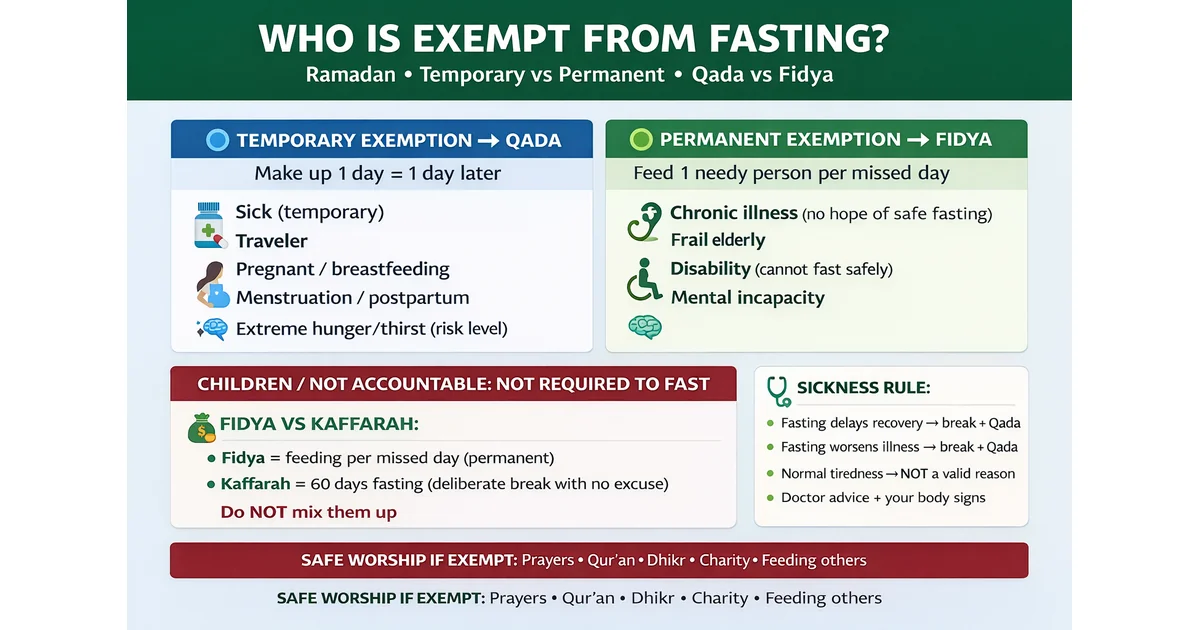
Who is exempt from fasting in Ramadan? People who would be harmed by fasting, or who are not accountable, are exempt. The easiest way to remember it: temporary situations usually require Qada later, and permanent/long-term inability is where Fidya applies.
The 2 buckets: temporary exemption (Qada) vs permanent exemption (Fidya)
Temporary exemption means: “I can’t fast now, but I can fast later.” You miss the day, then do Qada later.
Permanent exemption means: “I can’t safely fast at all, even later.” That’s where Fidya comes in (feeding a needy person per missed day).
“Exempt” vs “allowed to break sometimes” (same idea, different wording)
People use different words: “exempt,” “allowed to skip,” “can break the fast.” In practice, it’s the same question: are you allowed not to fast today for a valid reason? If yes, you follow the right duty afterward: Qada or Fidya.
The harm rule: if fasting causes real harm, you don’t fast
This is the backbone rule. If fasting is likely to cause real harm—worsen illness, delay recovery, cause dangerous dehydration, make you collapse—then you don’t fast. Islam doesn’t ask you to gamble with your health.
Exemptions in one table (Qada vs Fidya) — fastest way to understand
This table is the “family argument stopper.” Put it on your fridge if you want.
Who makes up later (Qada)
Most short-term cases are Qada: temporary sickness, travel, pregnancy/breastfeeding when harm is feared, and women’s bleeding days.
Who pays Fidya instead (chronic / frail elderly)
If there’s no realistic hope of safe fasting later (chronic illness, frail elderly), then Fidya applies.
Who is not required at all (child / not accountable)
Children before puberty and a person with loss of sanity are not held to fasting in the same way, because accountability isn’t there.
Exemptions summary: Qada vs Fidya
| Case | Allowed to miss fast? | What you do after | Quick note |
|---|---|---|---|
| Temporary sickness | Yes, if fasting worsens it / delays recovery | Qada (1 missed day = 1 make-up day) | Normal tiredness isn’t enough |
| Chronic illness | Yes, if no safe ability to fast | Fidya (per missed day) | Use doctor advice + body signs |
| Frail elderly | Yes, if fasting is unreasonably hard daily | Fidya (per missed day) | Frailty matters, not age number |
| Travel (musafir) | Yes | Qada | Commuting usually not travel |
| Pregnancy / breastfeeding | Yes, if fear of harm (mother/baby) | Qada later | Some scholars mention extra feeding in some cases |
| Menstruation / nifas | Yes (fasting not allowed during bleeding) | Qada later | No Qada for missed prayers |
| Child (pre-puberty) | Not required | No Qada / no Fidya | Training is optional, not obligation |
| Loss of sanity | Not required | No Qada / no Fidya | Families should remove guilt |
Temporary sickness: when you can skip fasting (and what you must do)
Temporary sickness fasting is about harm, not comfort. If you’re ill and fasting will likely worsen symptoms or slow recovery, you can skip fasting and do Qada later.
“Sick can skip fasting Ramadan” — what counts as valid sickness
Valid sickness is the kind where fasting realistically makes it worse, or where you need medication/fluids during the day. Fever, infection, severe migraines, stomach illness, dehydration risk—these are common real-life examples.
If fasting delays recovery or worsens symptoms (clear rule)
If fasting delays recovery or worsens symptoms, you don’t fast. Then you make up the day later as Qada. Simple.
If it’s just normal tiredness (not a valid reason)
Normal tiredness happens to healthy people too. That alone isn’t a valid reason to skip. Otherwise, nobody would fast on busy days.
What to do: break the fast + make up later (Qada)
If you’re temporarily sick, the duty later is Qada: one missed day equals one make-up day.
Chronic illness (long-term conditions): when Fidya applies
Chronic illness fasting ruling is for people who genuinely cannot fast safely—now or later. In that case, Fidya replaces Qada.
Chronic illness fasting ruling: “no hope of safe fasting”
Think of chronic illness like a broken phone charger that never works reliably. You can keep trying every day, but it keeps failing. If fasting is medically unsafe long-term, Islam gives you a different door: Fidya.
Diabetes/kidney/heart conditions (how to decide safely)
These conditions can be high risk with dehydration, blood sugar crashes, or medication timing. The decision should be based on safety. If fasting is unsafe, you don’t do it.
Doctor advice + your body signs (dehydration, collapse risk)
Use doctor advice and your body’s warnings. Signs like repeated dizziness, near-collapse, confusion, severe dehydration symptoms—don’t ignore them.
What to do: Fidya per missed day (instead of Qada)
For long-term inability, Fidya is feeding a needy person for each missed day. For a deeper explanation (and to avoid mixing it with other payments), read Fidya in Islam.
Elderly exemption: who pays Fidya and who still fasts
Elderly fasting Fidya isn’t about turning 60 or 70. It’s about frailty—when fasting is unreasonably hard every day, or risky.
Elderly fasting Fidya: frailty is the key, not age number
One elder is strong and active. Another is fragile and weak. Islam looks at ability, not the birthday.
If fasting becomes unreasonably hard every day (Fidya pathway)
If an elderly person is consistently harmed by fasting or cannot cope safely, the Fidya path applies.
If an elderly person can fast safely (fasting is still better)
If they can fast safely without harm, fasting remains a beautiful act of worship. Nobody should shame them either way.
Travel exemption (Musafir): when it applies in real life
Traveler exemption is real, but it’s also often misunderstood. If you qualify as a traveler, you may break the fast and then do Qada later.
Traveler exemption summary: you may break and make up later
Travelers may break the fast and make up later. It’s allowed—not mandatory—so you choose based on hardship and safety.
Travel distance and “real travel” vs daily commuting (simple rule)
Daily commuting usually doesn’t count as travel. Real travel is the kind where people say “you’re traveling,” not “you drove across town.”
Leaving before Fajr vs traveling during the day (what changes)
Timing can change details. The safe habit: don’t break while still at home. If hardship hits during travel, take the concession.
If travel becomes “residency” (when the concession ends)
If you settle somewhere like a resident (long stay with stable accommodation), traveler rulings can end. Different scholars have different thresholds, so follow one trusted approach consistently.
If you want the travel side explained with flight examples, read Traveler fasting Ramadan rules.
Pregnancy and breastfeeding exemption (high-intent)
Pregnancy exemption and breastfeeding exemption are based on fear of harm to mother or baby. This isn’t “being lazy.” It’s protection.
Pregnancy exemption: when fear of harm makes you eligible
If fasting risks the mother’s health or the baby’s health, she may break the fast and do Qada later.
Breastfeeding exemption: low milk / dehydration / baby risk
If fasting causes low milk, dehydration, or risk to the baby, she may break and do Qada later.
What to do: Qada later (and when some scholars mention extra feeding)
The common duty is Qada later. Some scholars mention extra feeding in certain situations—so it’s best to follow trusted local guidance rather than mixing opinions randomly.
Menstruation and postpartum bleeding (women’s exemptions — clear and short)
Menstruation exemption is clear: fasting is not allowed during menstruation. Same for postpartum bleeding (nifas).
Menstruation exemption: fasting is not allowed (must break)
A woman does not fast during menstruation. After Ramadan, she makes up missed days as Qada.
Postpartum exemption (nifas): same ruling as menstruation
Same ruling: no fasting during nifas, then Qada later.
What to do: make up missed days after Ramadan (Qada)
Qada is required for missed fast days in these cases. (Not for missed prayers.)
Disability and mental incapacity (accountability rules)
Disability fasting ruling is about safety and accountability. If a person physically cannot safely fast, or cannot understand the obligation due to loss of sanity, fasting is not required in that state.
Disability fasting ruling: when you physically cannot safely fast
If fasting creates real danger or the body cannot handle it safely, the person doesn’t fast. The follow-up depends on whether the condition is temporary (Qada) or permanent (Fidya).
Mental illness / loss of sanity: when fasting is not required
If someone is not accountable due to loss of sanity, fasting is not required.
Caregiver guidance: how families should handle this (no guilt)
Families should remove guilt and avoid harsh pressure. Your job is mercy: protect the person, keep worship gentle, and avoid turning Ramadan into a trauma month.
Extreme hunger or thirst at risk level (rare but searched)
This isn’t “I’m hungry.” This is danger-level: collapse risk, medical harm, or a real emergency.
If you fear real harm (collapse / medical danger): you break
If you fear real harm, you break the fast. Islam doesn’t ask you to faint to prove sincerity.
What to do that day: take only what you need + Qada later
Take what you need to remove danger, then stop. You make the day up later as Qada.
Qada vs Fidya (the exact confusion people have)
This is where people mess up and double-pay. Don’t.
Qada meaning: “make up 1 missed day = 1 day later”
Qada is simply making up missed fasts later, one for one.
Fidya meaning: feeding a needy person per missed day
Fidya is feeding a needy person for each missed day when you cannot fast long-term. Details vary by local practice and trusted charities.
Can you do both? (when people mistakenly double-pay)
Most people should not do both. If you’re temporary (you can fast later), do Qada. If you’re permanent (you can’t safely fast), Fidya applies. Don’t double-burden yourself unless a trusted scholar told you your case requires it.
Fidya vs Kaffarah (don’t mix these up)
Kaffarah is a separate penalty topic and not the same as Fidya. If you want the clean difference, read Kaffarah in Islam.
Safe worship alternatives if you’re exempt (Discover-friendly)
If you’re exempt, you’re not “outside Ramadan.” You’re still in it—just using a different door to worship.
If you can’t fast: prayers, Qur’an, dhikr, charity, feeding others
- Prayer (especially on time)
- Qur’an (small daily portion is fine)
- Dhikr and sincere dua
- Charity and feeding others
- Helping at home so the fasting people don’t burn out
Ramadan planning for families with mixed cases (kids/elderly/sick)
Mixed families need a plan: kids can practice gently, the elderly can do what they can, and sick family members should not be shamed for taking the exemption. Ramadan should feel like mercy in the home, not a courtroom.
Quick FAQ
Who doesn’t have to fast in Ramadan?
People who would be harmed by fasting (temporary sickness, travel, pregnancy/breastfeeding when harm is feared, menstruation/nifas) may miss fasts with the correct follow-up. Children before puberty and a person with loss of sanity are not required in that state.
Do elderly pay Fidya in Ramadan?
Frail elderly who cannot fast safely or find it unreasonably hard every day generally follow the Fidya path. If an elderly person can fast safely, fasting can still be done.
If I’m sick, can I skip fasting Ramadan?
Yes—if fasting worsens your illness or delays recovery. Then you do Qada later when you’re able.
What about chronic illness: Qada or Fidya?
If you can’t safely fast long-term with no realistic hope of safe fasting later, Fidya applies. If it’s temporary and you can fast later, it’s Qada.
Can a traveler fast or should they break?
A traveler may fast or may break. If it’s easy and safe, many people fast. If it’s hard or risky, breaking is better, and you make it up later (Qada).
Can I break my fast if I feel weak or dehydrated?
If weakness or dehydration becomes dangerous—collapse risk, medical harm—you break. Take what you need, then make the day up later as Qada.
If I missed fasts for a valid reason, when should I make them up?
Make them up when you’re able, outside Ramadan. Many people spread Qada days out so it’s manageable.
Can I pay Fidya money instead of food? (common question)
Different scholars and charities handle this differently based on local practice and what reaches the needy properly. The safest approach is using a trusted local charity method for feeding (or its approved equivalent).
What if I don’t know whether I’m “temporary” or “chronic”? (decision rule)
Ask: “Is there a realistic hope I can safely fast later?” If yes, think Qada. If no, think Fidya. If you’re unsure, consult a trusted doctor for safety and a trusted scholar for the worship ruling—then stick to one clear plan.
You can also read these articles
- Guide to dua (when you’re exempt but want Ramadan worship)
- Ramadan duas (simple daily list)
- Dua before iftar (accepted times explained)
- Daily Islamic duas (for families)

Farrukh Farooqi has been living in Sharaya, Makkah, Saudi Arabia since 2010. With over 14 years of firsthand experience witnessing the sacred journey of millions of pilgrims, Farrukh specializes in providing practical, insider tips for Hajj and Umrah travelers. His work blends real-world observations, the latest Saudi updates, and essential crowd management strategies — helping pilgrims and worshippers plan smarter, stay safer, and experience a spiritually fulfilling journey across the Holy Cities.


