
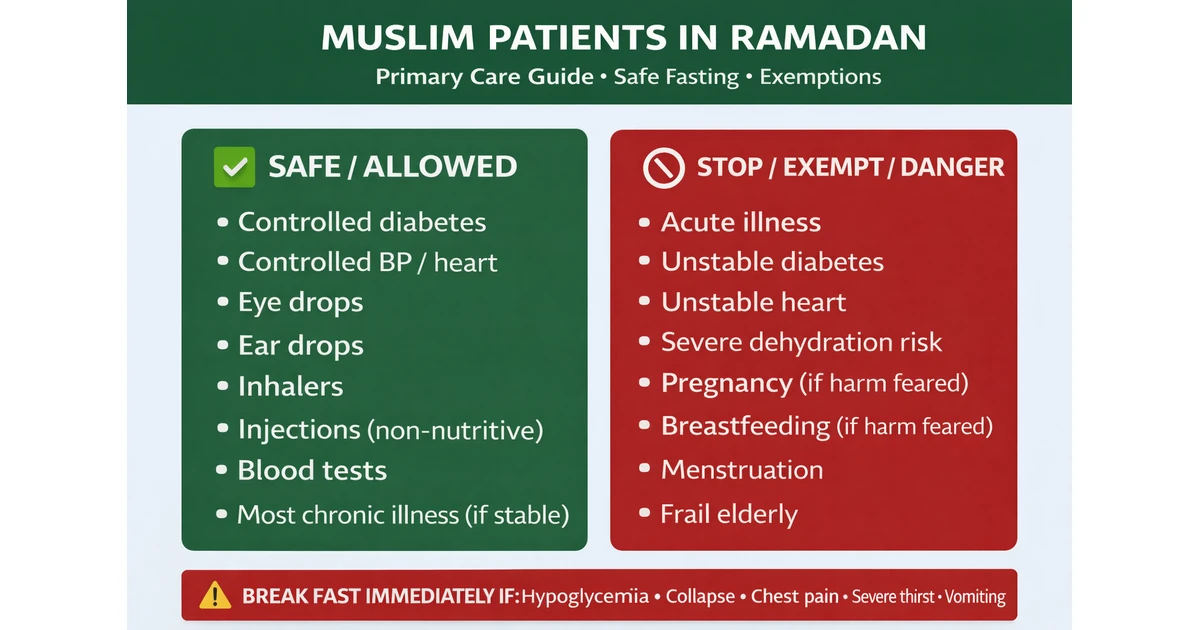
Muslim Patients in Ramadan: Primary Care Guide to Safe Fasting, Exemptions, Medications, and Chronic Disease Management
Ramadan fasting changes medication timing, meals, sleep, and hydration. In primary care, the safest approach is simple: risk-stratify early, adjust meds, and give patients clear “break-the-fast” safety triggers.
✅ TL;DR – Muslim patients in Ramadan (primary care)
Clinicians should assume many patients will fast even when exempt. Do a 2–6 week pre-Ramadan assessment, adjust medications to iftar/suhoor where safe, document shared decisions, and teach danger signs. For diabetes, advise immediate break if BG <70 mg/dL or >300 mg/dL or symptoms occur. When uncertain about “does this break the fast,” schedule procedures outside fasting hours when possible and respect differing opinions.
📌 Faith basis clinicians can quote (with respect)
Qur’an (permission for the sick and traveler):
فَمَن كَانَ مِنكُم مَّرِيضًا أَوْ عَلَىٰ سَفَرٍ فَعِدَّةٌ مِّنْ أَيَّامٍ أُخَرَ
Transliteration: Fa-man kāna minkum marīḍan aw ‘alā safarin fa-‘iddatun min ayyāmin ukhar.
Translation (meaning): If any of you is ill or on a journey, then (let them fast) a number of other days (later).
Hadith (hardship principle clinicians can use):
Arabic: لَيْسَ مِنَ الْبِرِّ الصِّيَامُ فِي السَّفَرِ
Transliteration: Laysa mina al-birri as-siyāmu fī as-safar.
Translation (meaning): It is not righteousness to fast while traveling (when it causes harm/hardship).
Ramadan Fasting Basics for Clinicians (Quick Answer)
Ramadan fasting basics for clinicians: patients avoid food, drink, and usually smoking from dawn (Fajr) to sunset (Maghrib). They shift to two main meals—suhoor (pre-dawn) and iftar (sunset)—which changes medication timing, sleep, and glucose/BP patterns in vulnerable groups.
What is Ramadan fasting (Sawm) and what patients avoid from dawn to sunset
Sawm means abstaining from eating, drinking, and marital relations during fasting hours. Many patients also avoid smoking and may avoid oral medications because they believe it invalidates fasting.
What changes in Ramadan routines (iftar, suhoor, sleep, activity)
Common shifts: later bedtime, shorter nighttime sleep blocks, heavier evening meals, reduced daytime activity, and altered clinic attendance. These changes can worsen symptoms in patients with diabetes, CKD, heart failure, and GERD.
Why Ramadan can affect medication adherence and outcomes
Some patients skip daytime doses, split tablets incorrectly, or delay critical therapies because they fear “breaking the fast.” That can trigger hypoglycemia, hyperglycemia, dehydration, hypertensive instability, and avoidable complications.
Who Is Exempt from Fasting in Ramadan? (Medical + Islamic Summary)
Who is exempt from fasting is both a medical safety question and a religious one. Patients commonly exempt include children (pre-puberty), menstruation/postpartum bleeding, and those at risk of harm from fasting. Many exempt patients still choose to fast, so counseling must be practical and respectful.
Who is not required to fast (child, menstruation/postpartum, etc.)
Common exemptions include prepubertal children, menstruation, postpartum bleeding, and those unable to fast safely due to illness.
Who may skip fasting due to harm (acute illness, chronic disease flare)
If fasting is likely to worsen illness or cause harm—acute infections with dehydration risk, unstable chronic disease, severe frailty—patients should be counseled that not fasting is a valid, safety-first choice.
Pregnant/breastfeeding, elderly, travelers: how to counsel safely
Use shared decision-making: discuss hydration risk, nutrition needs, symptom monitoring, and when to stop. If a patient is traveling, a simple patient-facing explanation is often helpful—see traveler fasting Ramadan rules.
Patients who insist on fasting despite exemption (shared decision approach)
Don’t lecture. Document the discussion, agree on a safety plan, define “must break fast” triggers, and set follow-up. For a patient-friendly overview of exemptions, you can share Ramadan exemptions (sick, traveler, elderly).
📚 You Can Also Read: Guide to dua (for patients seeking spiritual coping)
Pre-Ramadan Assessment (What PCPs Should Do 2–6 Weeks Before)
Pre-Ramadan assessment works best 2–6 weeks before Ramadan. The aim is risk stratification, medication timing planning, patient education, and a written plan. This prevents last-night changes and unsafe “DIY dosing.”
Risk stratification: who should not fast vs may fast with monitoring
Sort patients into “should not fast,” “may fast with close monitoring,” and “lower risk.” High-risk examples: recurrent severe hypoglycemia, brittle diabetes, decompensated HF, unstable angina, advanced CKD with instability, acute illness with dehydration.
Medication review: timing changes (iftar/suhoor) and high-risk drugs
Focus on once-daily vs multiple dosing, hypoglycemia risk meds, diuretics, anticoagulants, insulin regimens, and adherence barriers. When possible, shift dosing to iftar/suhoor with safety monitoring.
Patient education: when to break the fast (danger signs)
Give a short safety script: “If you feel signs of hypoglycemia, severe weakness, confusion, fainting, chest pain, or dehydration—break the fast and treat immediately.” Put thresholds in the plan for diabetics (below).
Written plan: monitoring schedule + follow-up during Ramadan
Provide a one-page plan: meds schedule, monitoring times, emergency triggers, and follow-up timing (week 1 check-in is often enough for moderate risk).
🗂️ “Pre-Ramadan Visit” mini plan (copy/paste into EMR)
1) Confirm fasting intention. 2) Assign risk level. 3) Adjust meds to iftar/suhoor where safe. 4) Teach “break-fast triggers.” 5) Set monitoring schedule. 6) Arrange follow-up and document shared decision.
Does This Break the Fast? Medications & Procedures (Most Asked)
Does this break the fast? The most useful clinical stance is respectful practicality: oral intake that reaches the stomach clearly breaks fasting, but many non-oral routes are treated differently across scholarly opinions. If possible, schedule discretionary treatments outside fasting hours and give patients options.
What clearly invalidates fasting (food/drink, oral meds reaching stomach, etc.)
Patients usually accept that food, drink, and oral medications that reach the stomach break the fast. If a medication is essential, counsel exemption and medical safety first.
Eye drops, injections, inhalers: what patients commonly misunderstand
Common misunderstandings include avoiding eye drops, injections, or inhalers out of fear. Tell patients: scholarly opinions differ in details; many councils state certain drops/injections do not break fasting if nothing is swallowed, but if the patient is anxious, schedule after iftar when clinically safe.
Procedures with different scholarly opinions (how to handle respectfully)
Some procedures (e.g., certain drops/sprays, suppositories, IV fluids) have differing views. Offer choices, document the discussion, and avoid forcing a single “religious answer” in clinic.
Best practice: schedule treatments outside fasting hours when possible
When clinically appropriate, schedule elective procedures and new meds after iftar. For urgent care, treat first—then guide religiously through the harm rule and exemption principle.
📚 You Can Also Read: Dua before iftar (for patients who break for safety)
General Safety Advice for All Fasting Patients
General safety advice should be written in plain language: hydration between iftar and suhoor, smart carbohydrates, salt reduction, safe exercise timing, and prevention of rebound weight gain after Ramadan.
Hydration plan between iftar and suhoor (especially hot seasons)
Encourage a structured fluid plan after iftar through bedtime and at suhoor, especially in hot seasons and in patients at dehydration risk (diuretics, CKD, elderly).
Diet advice for Ramadan (fiber, low salt, low glycemic index)
Push simple patterns: fiber at suhoor, lower salt, and lower glycemic index carbohydrates. Encourage smaller portions at iftar rather than one heavy meal.
Exercise timing: when it’s safest to work out
For most patients, exercise is safer after iftar. High-intensity daytime exercise increases dehydration and hypoglycemia risk in vulnerable patients.
Post-Ramadan rebound weight gain: how to prevent it
Plan week-1 post-Ramadan: maintain meal structure, avoid nightly desserts as routine, and keep walking habits. A short follow-up visit helps prevent rebound.
Diabetes and Ramadan (Primary Care High-Risk Topic)
Diabetes and Ramadan is high risk because many patients fast anyway. The clinician job is risk category counseling, glucose monitoring, clear “break-fast” thresholds, and safe medication timing principles.
How common fasting is in diabetes (why many patients fast anyway)
Many Muslims with diabetes still fast for at least part of Ramadan, even when clinicians advise against it. Expect “I will fast” conversations—plan for safety rather than surprise.
Risk categories: very high vs high vs moderate/low risk (who should not fast)
Very high risk patients should not fast. High risk patients are strongly advised not to fast. Moderate/low risk may fast with monitoring if controlled and educated. Document shared decision when a high-risk patient insists on fasting.
Glucose monitoring during fasting (how often and when)
Advise monitoring based on risk: pre-suhoor, mid-day, mid-afternoon, and whenever symptoms occur. Reassure patients: checking glucose does not invalidate fasting in many scholarly opinions.
When to break the fast (hypoglycemia/hyperglycemia thresholds + symptoms)
Give a simple safety rule for diabetics: break the fast if BG <70 mg/dL or BG >300 mg/dL, or if symptoms of hypo/hyperglycemia, dehydration, or acute illness appear.
Medication adjustments overview (non-insulin and insulin timing principles)
Keep principles high-level in general clinic content: move dosing to iftar/suhoor where appropriate, reduce hypoglycemia-risk agents if needed, and individualize insulin regimens with a clear monitoring plan.
Cardiovascular Disease and Ramadan
Cardiovascular disease and Ramadan counseling depends on stability. Controlled hypertension is often manageable with long-acting dosing and hydration plans. Unstable disease requires a clear “do not fast” recommendation.
Controlled hypertension: when fasting is generally safe
Controlled hypertension can often fast with a medication timing plan and salt reduction, assuming no other high-risk comorbidities.
Best BP med strategy in Ramadan (long-acting, iftar/suhoor dosing)
Long-acting agents and consistent dosing at iftar or suhoor (depending on regimen) are commonly used approaches. Avoid last-minute regimen chaos without monitoring.
When patients should not fast (unstable angina, decompensated HF, recent MI)
Patients with unstable angina, decompensated heart failure, or recent MI or recent major intervention should be counseled not to fast and given a documented safety plan.
Anticoagulants (warfarin): practical counseling during Ramadan
Warfarin requires stable intake patterns and INR monitoring. Counsel adherence, consistent dosing time, and clear follow-up. If a patient is unstable or nonadherent, fasting increases risk indirectly.
Gastrointestinal Conditions During Ramadan
GI conditions during Ramadan often worsen due to meal size and timing. The clinician win is prevention: portion control at iftar, trigger avoidance, and correct PPI timing for appropriate patients.
Dyspepsia/heartburn in fasting patients: common triggers and fixes
Common triggers: large iftar, spicy/fatty foods, late-night eating, and dehydration. Fixes: smaller iftar, avoid triggers, don’t lie down right after eating.
Peptic ulcer disease: who should not fast vs who may fast with PPI
Active or complicated ulcer disease should not fast. Stable cases may fast with careful management and appropriate PPI timing if advised by the clinician.
IBD and chronic hepatitis: when fasting may be acceptable
Stable IBD/chronic hepatitis may be able to fast with monitoring and stable meds. Any flare or dehydration risk shifts the decision toward exemption.
Renal Disease and Ramadan (Dehydration Risk)
Renal disease and Ramadan is mainly a dehydration and instability issue. CKD patients need individualized assessment and monitoring, especially in hot seasons or if on diuretics.
CKD: when fasting may worsen kidney function (monitoring plan)
If fasting is associated with worsening kidney function, symptoms, or high dehydration risk, counsel exemption. If fasting is attempted, schedule monitoring and clear “stop fasting” triggers.
Kidney stones/renal colic: hydration targets between iftar and suhoor
Patients with stone history should be advised to hydrate aggressively between iftar and suhoor and avoid excess salt. Hot seasons increase risk.
Renal transplant patients: when fasting can be considered + dosing split
Some stable transplant patients may fast under specialist/PCP oversight with split dosing of immunosuppressants at suhoor and iftar, plus close monitoring.
Communication Skills for Culturally Competent Ramadan Care
Culturally competent Ramadan care is about asking well, not assuming. Patients respond better to “Let’s plan safety” than “You shouldn’t fast.”
How to ask about fasting intentions without judgment
Try: “Are you planning to fast this Ramadan? If yes, let’s plan it safely.” That one line prevents medication nonadherence secrets.
How to explain “harm rule” + safety triggers in patient-friendly language
Use plain language: “Your faith does not require harm. If your body shows danger signs, you should stop fasting and treat.” Give them written triggers.
Handling differing religious opinions (document options, respect patient choice)
Acknowledge differences without debating: “There are different opinions. If you want the safest route, we can schedule after iftar. If it’s urgent, we treat now and you can follow the harm-exemption principle.” Document the plan.
Quick FAQs for Clinics
Can diabetic patients fast in Ramadan safely?
Some can, depending on risk category and control. Very high-risk patients should not fast. If a patient fasts, they need a monitoring plan and clear break-fast thresholds.
Does checking blood sugar break the fast?
Many patients accept that fingerstick glucose checks do not break the fast. Encourage monitoring; it prevents emergencies.
Do injections or IV fluids break the fast?
Patients often fear injections. Scholarly opinions vary by substance and route (nutrition vs non-nutrition). For non-urgent care, schedule after iftar when possible; for urgent care, treat first and counsel using the harm rule.
Do eye/ear/nose drops break the fast?
There are differences of opinion. Some councils state eye/ear drops and nasal sprays do not break the fast if nothing is swallowed. When feasible, schedule routine dosing after iftar; when not feasible, discuss options and document patient preference.
What symptoms mean the patient must stop fasting immediately?
Red flags: confusion, fainting, severe weakness, chest pain, severe dehydration symptoms, persistent vomiting, severe hypoglycemia/hyperglycemia symptoms, or concerning dyspnea. For diabetics, add the written glucose thresholds and insist on breaking the fast for safety.
You can also read these articles
- Ramadan duas (patient-friendly spiritual support)
- Daily Islamic duas (for stress and coping)
- Best duas for the last 10 days of Ramadan

Farrukh Farooqi has been living in Sharaya, Makkah, Saudi Arabia since 2010. With over 14 years of firsthand experience witnessing the sacred journey of millions of pilgrims, Farrukh specializes in providing practical, insider tips for Hajj and Umrah travelers. His work blends real-world observations, the latest Saudi updates, and essential crowd management strategies — helping pilgrims and worshippers plan smarter, stay safer, and experience a spiritually fulfilling journey across the Holy Cities.


