
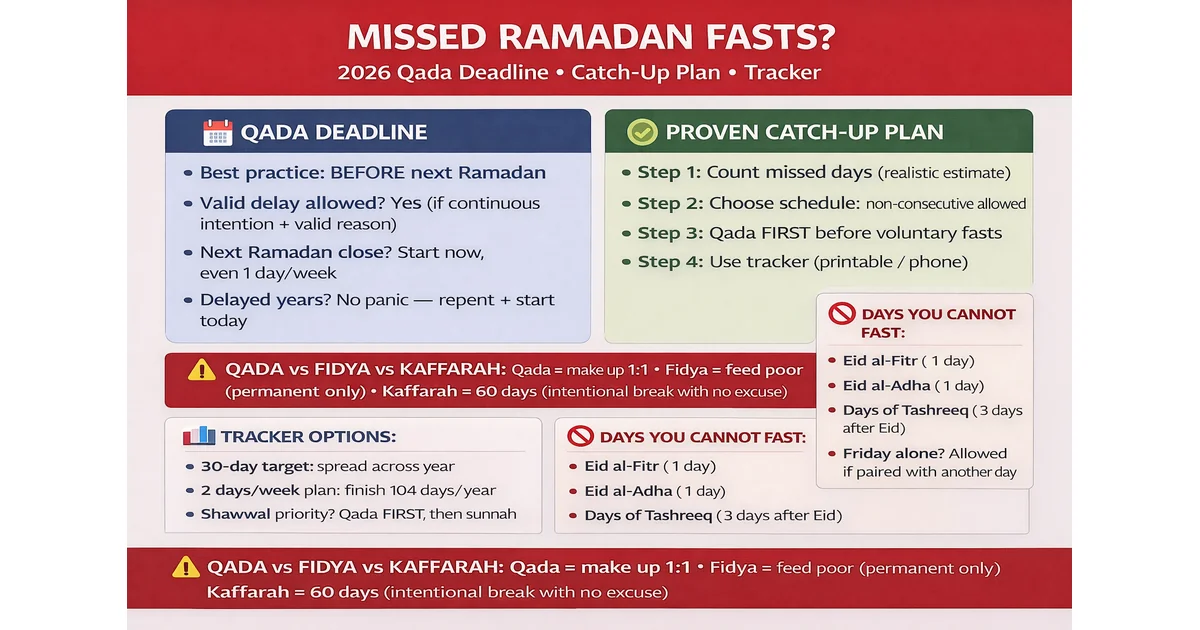
Making Up Missed Fasts (Qada) 2026: Deadline, Rules, Fidya vs Kaffarah + Catch-Up Plan
Making Up Missed Ramadan Fasts (Qada) — Quick Answer (2026)
If you missed Ramadan fasts, the basic rule is simple: one missed day = one qada day later. Islam gives mercy for real reasons (illness, travel, menstruation), but it also gives responsibility: don’t leave it forever.
📌 Qur’an foundation for qada (Arabic + transliteration + meaning)
فَمَن كَانَ مِنكُم مَّرِيضًا أَوْ عَلَىٰ سَفَرٍ فَعِدَّةٌ مِّنْ أَيَّامٍ أُخَرَ
Transliteration: fa-man kāna minkum marīḍan aw ‘alā safarin fa-‘iddatun min ayyāmin ukhar
Meaning: If you are ill or traveling, then make up the same number of days later (qada).
What is qada fasting (missed Ramadan fasts) in one sentence
Qada fasting is fasting later to replace a Ramadan fast you missed—day for day—once you’re able.
Do you have to make up missed fasts? (short ruling + who is exempt)
Yes, if you were required to fast but missed days for a valid reason, you do qada. If you are permanently unable (chronic illness or very old age), the route is usually fidya instead of fasting.
📚 You Can Also Read: Ramadan exemptions (sick, traveler, elderly): who fasts and who doesn’t
Who Must Do Qada (and Who Doesn’t)
This is where people get stuck: they mix up qada, fidya, and kaffarah and end up doing nothing. Let’s fix that.
Missed fasts due to menstruation/postpartum: what’s required
If you missed fasts due to menstruation or postpartum bleeding, you don’t “pay it off.” You do qada later—one day for one day—when you’re able.
Missed fasts due to sickness (temporary vs permanent): qada vs fidya
Temporary sickness (you expect recovery): you do qada when you’re well.
Permanent inability (no realistic ability to fast): this is where fidya is commonly discussed—feeding a needy person for each missed day.
📚 You Can Also Read: Muslim patients + Ramadan guide (health-first decisions)
Missed fasts due to travel: when and how to make them up
If you missed fasts due to travel, you do qada later. Travel is one of the classic exemptions—mercy with responsibility after.
📚 You Can Also Read: Traveler fasting Ramadan rules (distance, hardship, flights, qada)
Pregnancy/breastfeeding: when to do qada (and what to avoid)
If a woman misses fasts due to pregnancy/breastfeeding because fasting may harm her or the baby, she does qada later when safe and stable. Don’t rush into “hero mode.” Your health matters, and Islam doesn’t ask you to break yourself.
Missed fasts intentionally: qada + repentance + when kaffarah applies
If someone intentionally breaks a Ramadan fast without a valid excuse, they must do qada and also make sincere repentance. Kaffarah is a separate heavy expiation discussed in fiqh for specific deliberate violations (people often hear “60 days” in this context). If you’re unsure which category your case falls into, don’t guess—get a scholar you trust to classify your situation correctly.
📚 You Can Also Read: Kaffarah in Islam (what it is, when it applies, and common confusion)
Qada Deadline: Do You Have to Finish Before Next Ramadan?
People search this because they’re anxious—and honestly, that anxiety can be a gift if it pushes you to act.
“Qada before next Ramadan” — what’s the best practice vs strict deadline
Best practice: finish qada before next Ramadan if you can. It keeps your worship clean and your mind calm.
Strict deadline talk: scholars discuss blameworthiness/sin if you delay without excuse until the next Ramadan arrives, and some discuss whether fidya is owed for delay. The safe path is simple: don’t test the edge.
Can you delay qada if you have a valid reason? (examples)
Yes—valid reasons can include ongoing illness, pregnancy recovery, postpartum recovery, or unstable health. A valid reason is not “I got busy and forgot for 11 months.”
What if next Ramadan is close and you still have many days left?
Don’t panic-sprint. Make a realistic plan. Even 2 days per week is powerful. What ruins people is making a plan that looks impressive, then quitting.
The Fastest Way to Calculate Your Missed Fasts (Without Guessing)
This section saves you from “I think it was around…” and then you stop because you don’t feel sure.
If you missed specific days: simple count method
Open your calendar, mark the exact dates you missed, count them. Done. No drama.
If you missed “a lot” or multiple Ramadans: realistic estimation method
If you genuinely don’t know exact days, use a careful estimate based on what you’re confident about. Don’t undercount to make yourself feel better. Also don’t overcount so much that you give up. Be honest, then move forward.
Missed fasts for years: do you make up all days or only what you’re sure of?
People differ on how to handle uncertainty. The practical “no-stuck” method is: make a sincere estimate, commit to it, and finish. Endless uncertainty is how shaytan keeps people frozen.
How to Make Up Qada Fasts (Step-by-Step How-To)
Now the part that actually changes your life: a plan you can do with your work schedule, family, and energy.
Qada intention (niyyah): when to make it and simple wording
Make the intention in your heart for qada. Simple wording you can say to yourself: “I intend to fast tomorrow as qada for a missed Ramadan fast.” You don’t need a complicated script.
Can qada be non-consecutive? (spread out vs back-to-back)
Yes, qada can be non-consecutive for most cases. You can spread it out across weeks. What matters is finishing.
Can you do qada on weekends only? (a scheduling approach)
Yes—and this is one of the best “real life” plans for busy people. Two weekend fasts per week can quietly erase a big backlog over a few months.
✅ Catch-Up Plans (pick ONE and stick to it)
Plan A: 2 days/week (Sat + Mon) — steady, low stress
Plan B: 3 days/week (Mon + Thu + Sat) — faster, still realistic
Plan C: 10-day sprint (only if your work/health allows) — don’t overpromise
Qada vs Voluntary Fasts (Shawwal, Mondays/Thursdays, Arafah, Ashura)
This is where people lose momentum: “Should I do Shawwal first?” “Can I combine?” Let’s make it clear without fighting.
Should you do qada before Shawwal 6 fasts? (priority rules)
Many scholars advise qada first because it’s an obligation. Some people still do Shawwal while owing qada, but the safest priority is: clear the debt first, then add sunnah.
Can you combine qada + voluntary fast in one day? (why people ask; scholarly difference)
There is scholarly discussion here. Some allow combining intentions in certain cases; others prefer separating. If you want the safest path for your conscience: do separate qada days first, then do sunnah fasts later.
If you have qada, can you still fast Arafah/Ashura? (safe approach)
Safe approach: if you have heavy qada, focus on qada. If you have only a small number of qada days and you strongly want Arafah/Ashura, follow trusted scholarship and keep your plan consistent.
Best order plan: qada first, then sunnah fasts (simple calendar logic)
Calendar logic: obligations first. Then sunnah fasts become sweet, not stressful.
📚 You Can Also Read: Fitrana vs zakat difference (quick, beginner-friendly)
Days You’re NOT Allowed to Fast (Common Qada Mistake)
Yes, you can fast most days. But not all days.
Eid days: which days are prohibited to fast
Fasting is prohibited on Eid al-Fitr and Eid al-Adha.
The “Days of Tashreeq” (after Eid al-Adha): can you do qada then?
These days are also generally treated as prohibited fasting days. Don’t schedule qada there.
Friday alone / Saturday alone: what people get wrong (quick clarity)
Some people think Friday alone or Saturday alone is always “haram to fast.” In reality, scholars discuss these issues with details. The practical safe habit: if you fast Friday, pair it with Thursday or Saturday. If you’re unsure, don’t make your qada plan depend on disputed fine points—pick a clear day like Monday/Thursday.
If You Delayed Qada for Years — What Now? (No Panic Plan)
Here’s the honest truth: shame won’t fix it. A plan fixes it.
Step 1: repent and reset (for intentional delay)
If you delayed without excuse, repent sincerely. Then stop replaying the past every night. Start moving.
Step 2: make a catch-up target (weekly plan)
Pick a weekly target you can keep for 12 weeks without breaking: 2 days/week is a strong start.
Step 3: fidya confusion: when it applies and when it does NOT
Fidya is mainly discussed for someone who cannot fast permanently. If you are healthy and able, fidya is not your “shortcut.” Your path is qada.
📚 You Can Also Read: Fidya in Islam (who pays it, when it applies)
Do you owe extra (fidya) for delaying qada? (where scholars differ, explained simply)
Some scholars say extra fidya may apply if you delayed without excuse until the next Ramadan arrives; others do not require that extra payment. If you want a clean, safe path: make qada as soon as possible, and if you’re uncertain about fidya for delay, ask a trusted scholar in your community to apply the ruling to your exact situation.
Qada Tracker (Printable + Phone Notes) — Finish Before Next Ramadan
This is the part that actually gets people across the finish line.
30-day tracker method (small daily target)
Write 1–30 in your phone notes. Each qada day, mark one number. That’s it. No fancy app needed.
“2-days per week” plan (low-stress schedule)
Pick two fixed days. Example: Monday + Thursday, or Saturday + Monday. Keep them consistent.
Family reminders + accountability tips (real life)
Tell one person you trust: “Check on me weekly.” Not to shame you—just to keep you steady.
🧾 Qada Tracker (copy/paste into Notes)
Missed days: ___ | Completed: ___ | Remaining: ___
Week plan: □ Mon □ Thu □ Sat □ Sun (circle your two)
Done dates: _____________________________
📚 You Can Also Read: Fidya + kaffarah calculator (if you’re unsure what applies)
Common Mistakes That Keep People Stuck
Mixing up fidya vs kaffarah vs qada
Qada = make up missed days. Fidya = for permanent inability (commonly). Kaffarah = heavy expiation discussed for certain deliberate violations. When you mix them, you freeze.
Waiting for “perfect time” (why it backfires)
The perfect time doesn’t come. Your body and your schedule will always have “something.” Start small and consistent.
Not matching your plan to your health/work routine
If you work long shifts, choose weekend-only. If you’re steady weekdays, choose Mon/Thu. A plan that fits your life is the one you finish.
Overpromising (60-day sprint) then quitting
Big promises feel good for one night. Then you crash. Choose a plan you can keep, not a plan that looks impressive.
FAQs
When should I make up missed fasts?
As soon as you reasonably can, and ideally before the next Ramadan. A small weekly plan beats waiting all year.
Can I delay qada until the next Ramadan?
Delaying without a valid excuse is not a good habit. If you have a valid reason, you may delay. If you delayed without excuse, repent and start a plan now.
How many days do I need to fast for qada?
Count your missed Ramadan fasts. Then fast the same number as qada: one day for one day.
Can qada be non-consecutive?
Yes in most cases. You can spread it across weeks. Consistency is the key.
Can I do qada before voluntary fasts or must qada come first?
Safe priority: qada first, then voluntary fasts. If you’re unsure, stick to this safe order.
Can I do qada in Shawwal?
Yes. Shawwal is often a practical month because you’re still in the fasting rhythm after Ramadan.
What if I missed fasts due to menstruation — is it compulsory to make them up?
Yes, the missed days are made up as qada later.
What if I missed fasts for years and don’t remember the exact number?
Make a careful estimate based on what you’re confident about, then commit to finishing that number. Don’t stay trapped in uncertainty.
Can I give fidya instead of fasting even if I’m healthy?
Generally, if you are healthy and able, your duty is qada, not fidya as a shortcut. If you have a specific medical case, ask a trusted scholar with your details.
What’s the difference between fidya and kaffarah for missed fasts?
Fidya is commonly discussed for people who cannot fast permanently. Kaffarah is a heavy expiation discussed for certain deliberate violations. Qada is making up missed days.
You can also read these articles
- Kaffarah in Islam (rules, who pays, common confusion)
- Fidya in Islam (who is eligible and how it works)
- Traveler fasting Ramadan rules (when breaking is allowed)
- Ramadan health guide for Muslim patients (safe fasting choices)

Farrukh Farooqi has been living in Sharaya, Makkah, Saudi Arabia since 2010. With over 14 years of firsthand experience witnessing the sacred journey of millions of pilgrims, Farrukh specializes in providing practical, insider tips for Hajj and Umrah travelers. His work blends real-world observations, the latest Saudi updates, and essential crowd management strategies — helping pilgrims and worshippers plan smarter, stay safer, and experience a spiritually fulfilling journey across the Holy Cities.


