
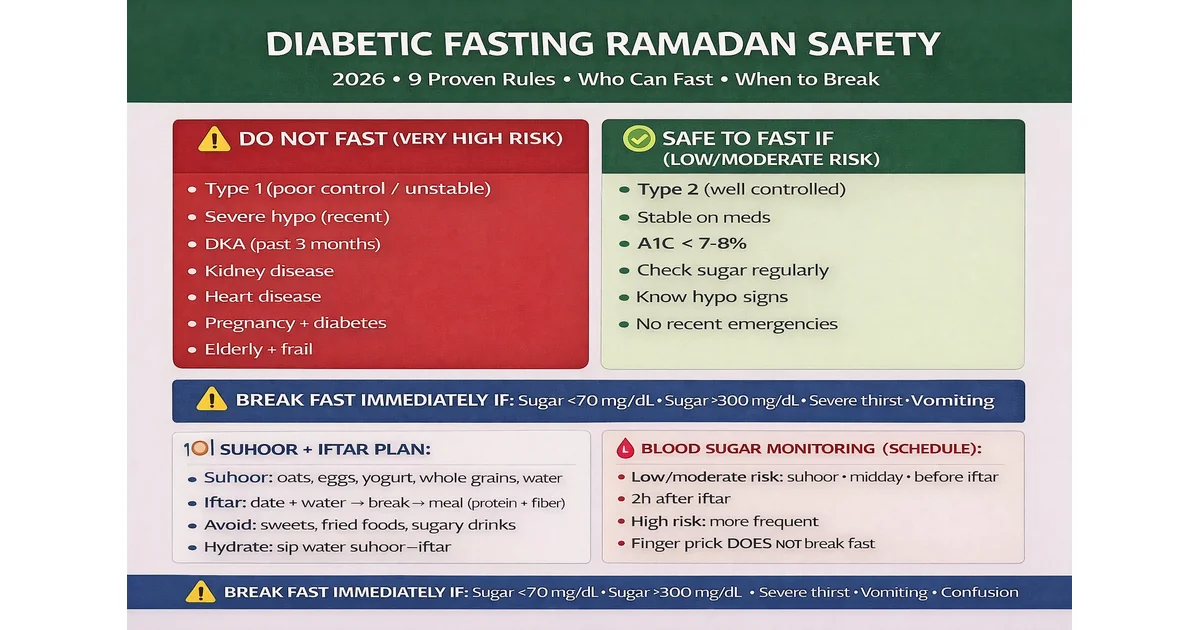
Diabetic fasting Ramadan safety: 9 Proven Rules Now (2026)
Ramadan fasting with diabetes isn’t a “yes or no” question.
It’s a safety decision.
If you’re living with diabetes, the most caring thing you can do is treat fasting like you’d treat driving in heavy rain: you don’t rely on hope. You rely on checks, clear rules, and knowing when to stop.
✅ TL;DR – Diabetic fasting Ramadan safety
Diabetic fasting Ramadan safety means: know your risk level, test sugar regularly (it doesn’t break the fast), and break the fast immediately if <70 mg/dL or >300 mg/dL or you feel unwell. Plan Suhoor/Iftar to avoid spikes, don’t change medicines alone, and talk to your doctor before Ramadan.
If you want a doctor-facing guide to discuss with your clinic, you can use this once: Muslim patients Ramadan primary care guide.
Diabetic fasting Ramadan safety (2026) — Quick Answer
Diabetic fasting Ramadan safety comes down to three rules: (1) don’t fast if you’re very high risk, (2) test your glucose often, and (3) break the fast the moment numbers or symptoms cross danger lines. A “strong will” doesn’t stop hypoglycemia, hyperglycemia, dehydration, or ketones.
Can diabetics fast in Ramadan safely? (1-sentence rule)
Can diabetics fast in Ramadan safely? Some people with well-controlled diabetes can fast with a clear plan and monitoring, but anyone at very high risk should not fast—and must put health first.
Who should NOT fast (very-high risk list)
Who should NOT fast? If you match any “very high risk” situation below, fasting is unsafe in most cases and you should speak to your doctor about not fasting and using the valid exemptions.
Examples of very high risk red flags include: recent severe hypoglycemia, recent DKA, unstable control, advanced kidney disease, unstable heart disease, pregnancy with diabetes, or severe frailty.
If you need the Islamic exemptions explained clearly, use this once: Ramadan exemptions for sick, traveler, elderly.
When you MUST break the fast (cut-off numbers + symptoms)
When you MUST break the fast: break immediately if glucose is <70 mg/dL or >300 mg/dL, or if you have symptoms of severe low/high sugar, dehydration, vomiting/diarrhea, fever, confusion, or chest pain. It’s not “weak faith.” It’s basic safety.
Is fasting in Ramadan safe for Type 1 vs Type 2 diabetes?
Type 1 vs Type 2 matters because the risk profile is different. Type 1 carries higher risk of severe lows and ketones, especially if insulin dosing isn’t handled carefully. Many people with Type 2 may fast safely if control is stable and medicines are adjusted by a clinician.
Type 1 diabetes: when fasting is unsafe (plain checklist)
Type 1 diabetes fasting is often unsafe if there’s unstable control, frequent lows, poor awareness of hypoglycemia, recent DKA, or difficulty monitoring. Even people with good control may be advised not to fast depending on history and access to monitoring.
A quick reality check: in Type 1, you can “feel fine” and still be drifting into danger. That’s why monitoring is not optional.
Type 2 diabetes: who can fast with a plan (low/moderate risk)
Type 2 diabetes fasting may be possible if glucose is reasonably controlled, there are no recent severe lows, and the person can test, hydrate well between Maghrib and Fajr, and follow a food + medicine plan agreed with a doctor.
But here’s what many forget: the biggest spikes often happen at Iftar, not during the day.
Prediabetes / insulin resistance: what changes during fasting
With prediabetes or insulin resistance, fasting may reduce snacking and may improve control for some people, but the danger is still real if you overeat at Iftar, sleep all day, and then eat heavy late-night meals. Your “pattern” can get worse even if you’re not on medications.
Ramadan diabetes risk levels (simple self-check before you decide)
Ramadan diabetes risk levels help you decide before the first day of fasting. Don’t decide based on guilt. Decide based on your history, medicines, complications, and your ability to test and respond.
Very high risk (do not fast)
Very high risk usually includes: Type 1 with unstable control, recent severe hypoglycemia, recent DKA, advanced kidney disease, unstable heart disease, pregnancy with diabetes, or inability to monitor safely.
High risk (usually advised not to fast)
High risk often includes: poor control, frequent lows (even if not “severe”), significant kidney disease, elderly/frail with falls risk, or taking medicines with high low-sugar risk without close supervision.
Moderate/low risk (may fast with monitoring)
Moderate/low risk often includes: stable Type 2, predictable sugars, good awareness of symptoms, ability to test, and a doctor-approved plan for medicines, meals, and activity.
Red flags: recent severe hypo, DKA, kidney/heart disease, pregnancy
Red flags that should stop you in your tracks: a severe low recently, DKA history, kidney disease, heart disease, pregnancy, or repeated “I fainted / I fell / I got confused” episodes. Don’t bargain with these.
Does checking blood sugar break the fast? (Clear Islamic + practical answer)
Does checking blood sugar break the fast? No. Checking glucose is a safety action, and most scholars do not treat finger-prick testing or CGM readings as something that breaks fasting. Practically, it’s one of the best protections you have during Ramadan.
Finger-prick glucose test: does it invalidate fasting?
Finger-prick glucose testing does not invalidate the fast according to widely accepted scholarly views. It’s a small sample, not nourishment.
Micro-scenario: your hands are sweaty, your heart is racing, and you’re thinking, “Maybe it’s nothing.” Test anyway. Numbers calm panic. Or they save you.
CGM sensor/reader: does it break the fast?
CGM (continuous glucose monitor) readings do not break the fast. The sensor is monitoring, not feeding. Use it often, especially mid-afternoon when lows can sneak up.
Insulin injection while fasting: does it break the fast? (short answer)
Insulin injection is generally treated as medication, not food or drink, so it does not break the fast in common scholarly discussions. Still—never adjust doses on your own without medical guidance.
Blood sugar monitoring schedule in Ramadan (exact times people search)
Blood sugar monitoring schedule in Ramadan depends on risk and medications. If you’re on insulin or sulfonylureas, you generally need more checks. If you’re low/moderate risk, fewer checks may still be enough—but only if you stay consistent.
If you want to quickly see fasting length where you live, you can use this once: Ramadan fasting hours calculator (widget below).
Ramadan Fasting Hours Calculator (Month Table)
Day Gregorian Date Hijri Date Fajr Maghrib Fasting Duration (HH:MM) —
Low/moderate risk: how many times per day
For low/moderate risk, many people do well with 1–2 checks daily plus symptom-based checks (immediately if you feel unwell).
High risk: how many times per day
For high risk, you may need 3–4 checks daily (or more if you’re on insulin and your doctor advises it).
Best times to check: suhoor, midday, afternoon, before iftar, 2h after iftar
Most searched testing times (and honestly, the most useful ones): at Suhoor, midday, mid-afternoon, before Iftar, and 1–2 hours after Iftar.
Check immediately if you feel “off” (symptom-based testing)
If you feel shaky, sweaty, dizzy, unusually irritable, weak, confused, extremely thirsty, or nauseated—test immediately. Don’t “wait until Maghrib.”
Ramadan blood sugar targets (2026 quick guide)
Ramadan blood sugar targets vary by person, age, and medications. The ranges below are commonly used targets for many non-pregnant adults, but your doctor may set different goals for you. During fasting, safety is more important than “perfect numbers.”
Pre-meal target range (simple)
A commonly used pre-meal target is 80–130 mg/dL.
1–2 hours after meals target (simple)
A commonly used post-meal target (1–2 hours after eating) is <180 mg/dL.
A1C goal: what it usually means for fasting readiness
A1C is a long-term average marker. Many people aim around ~7% (individual targets differ). For fasting readiness, what matters is not only A1C—it’s whether you’ve had lows, severe highs, or emergencies recently.
Low blood sugar in Ramadan (hypoglycemia): signs + 15-15-15 treatment
Hypoglycemia during Ramadan is one of the biggest dangers, especially if you use insulin or sulfonylureas. Know the symptoms and treat fast. Delaying treatment is how mild lows become emergencies.
Hypoglycemia symptoms during fasting (fast checklist)
Common low-sugar signs: shaking, sweating, fast heartbeat, anxiety, dizziness, mood change, confusion, tingling lips, sudden hunger, or unusual weakness.
70 mg/dL rule: when to treat immediately
If glucose is 70 mg/dL or less, treat immediately. Don’t negotiate with it.
15-15-15 method: exactly what to take
15-15-15 means: take 15g fast carbs, wait 15 minutes, recheck. Examples of ~15g fast carbs: about half a cup of juice, or glucose tablets as directed on the label. Avoid chocolate for treatment—fat slows absorption.
If unconscious: glucagon + emergency steps (what NOT to do)
If the person is unconscious or cannot swallow safely: use glucagon if available and call emergency help. Do not pour drinks into the mouth. Choking risk is real.
High blood sugar in Ramadan (hyperglycemia): signs + what to do
Hyperglycemia can rise after Iftar, or during the day if you’re dehydrated or ill. The danger is higher if ketones appear, especially for Type 1 diabetes.
Hyperglycemia symptoms (quick checklist)
Common high-sugar signs: intense thirst, frequent urination, blurred vision, headache, fatigue, nausea, vomiting, abdominal pain, fruity breath odor, or deep rapid breathing (emergency warning).
240 mg/dL: when to check ketones (and when NOT to exercise)
If glucose is >240 mg/dL, check ketones if you have Type 1 diabetes or if your clinician advised it. If ketones are present, avoid exercise—exercise can worsen the situation.
300 mg/dL rule: when you must break the fast
If glucose is >300 mg/dL, break the fast and treat as instructed by your doctor. Continuing to fast at very high glucose raises risk of dehydration and emergencies.
When to seek urgent care (danger signs)
Seek urgent care if you have vomiting, severe weakness, confusion, fainting, chest pain, signs of severe dehydration, or suspected DKA (especially with ketones and high glucose).
When exactly should a diabetic break the fast? (Numbers + symptoms)
When should a diabetic break the fast? Break immediately for low sugar below a hard line, for rising danger highs, and for illness or dehydration symptoms. This is the safety rule that protects life and prevents complications.
If glucose drops below 70 mg/dL
Break the fast and treat at <70 mg/dL.
If glucose is 70–90 mg/dL and trending down after recheck
If glucose is 70–90 mg/dL and trending down after recheck (especially with symptoms), break the fast. Don’t wait for it to become a severe low.
If glucose goes above 300 mg/dL
Break the fast at >300 mg/dL and treat safely.
If dehydration/fever/vomiting/diarrhea or severe weakness occurs
If you’re dehydrated or sick—fever, vomiting, diarrhea—or severely weak, break the fast and seek medical advice. Illness plus fasting can push glucose and ketones into dangerous territory.
Suhoor and Iftar plan for diabetics (stop spikes + crashes)
Suhoor and Iftar are where most Ramadan glucose problems are made or prevented. The goal is steady energy—not a sugar roller coaster.
Best suhoor foods (slow carbs + protein + fiber)
Build Suhoor around slow carbs, protein, and fiber: oats, whole grains, beans/lentils, eggs, yogurt, nuts (portion-controlled), and vegetables. Delay Suhoor closer to Fajr if your doctor agrees—it shortens the fasting window.
Best iftar strategy (don’t “shock” the sugar)
At Iftar, don’t shock your system. Start with water, then a small balanced bite, then pray, then eat a measured meal. This reduces the “Iftar spike” that many people see after a long fast.
Foods to limit at iftar (sweet drinks, fried, huge portions)
Limit sweet drinks, deep fried foods, and huge portions. They can cause a rapid spike, then a crash later—especially if you over-correct with medication.
Hydration between iftar and suhoor (simple plan)
Hydrate steadily between Maghrib and Fajr. Small frequent water intake beats “chugging” right before sleep. In Saudi/Gulf heat, dehydration risk is higher, and high glucose worsens dehydration too.
Exercise and Taraweeh with diabetes in Ramadan
Exercise and Taraweeh can be healthy—but timing decides whether it helps or harms. Fasting plus activity can trigger lows, especially late afternoon or after a light Iftar.
Best time to exercise (and worst time)
Best time: after Iftar, once you’ve eaten and hydrated. Worst time for hard exercise: late afternoon while fasting, when lows and dehydration are more likely.
Taraweeh counts as activity: how to prevent lows
Taraweeh is real activity—standing, bowing, prostration. If you’re prone to lows, test before and after, keep fast carbs available, and don’t ignore symptoms just because you’re in the masjid.
Working outdoors/heat in Ramadan (Saudi/Gulf safety tips)
If you work outdoors in heat, your risk rises: dehydration, dizziness, and lows can come faster. Talk to your supervisor about safer timing, shade breaks, and emergency steps. Your health is not a small thing.
Diabetes medicines in Ramadan (safe discussion guide for your doctor)
Diabetes medicines in Ramadan must be handled with your clinician. Fasting changes meal timing, sleep, activity, and hydration—so the “same dose, same time” approach can become unsafe.
What must NEVER be self-changed (golden rule)
Golden rule: never self-change insulin or high-risk medicines just because “it worked last year.” Even small changes can cause severe lows.
Metformin timing idea (questions to ask your doctor)
Ask your doctor how to time metformin around Iftar and Suhoor, especially if you get stomach upset or late-night lows. Don’t decide the schedule alone.
Sulfonylureas and insulin: why lows are more likely (what to ask)
Sulfonylureas and insulin can raise low-sugar risk during fasting hours. Ask: “Should dose timing change?” “Do I need extra checks?” “What is my exact break-the-fast plan?”
What to do if you miss a dose or feel unwell
If you miss a dose or feel unwell, don’t “double up” without medical advice. Check your glucose, treat symptoms, and use your doctor’s sick-day plan.
“I felt fine at Suhoor, then crashed later” — common Ramadan mistakes
This happens a lot. People judge safety by how they felt at Suhoor. But your risk often shows up mid-afternoon or after a heavy Iftar.
Skipping suhoor
Skipping Suhoor makes the fasting window longer and raises the chance of low sugar and dehydration. If you struggle to wake up, prepare something simple the night before.
Overeating sweets at iftar
Overeating sweets at Iftar can spike glucose quickly, then you feel exhausted and thirsty all night. It’s a pattern that repeats daily unless you break it.
Sleeping all day + heavy night meals
Sleeping all day and eating heavy at night can wreck glucose rhythm. Your body wants steadiness, not extremes.
Not testing sugar because “it breaks the fast” myth
This myth is dangerous. Testing is a safety tool and helps you fast responsibly when you are allowed to fast.
Ramadan diabetes safety checklist (printable-style)
This is the part people save. Use it like a fridge note, not a “nice idea.”
7-day pre-Ramadan prep checklist
Book a pre-Ramadan medical visit, review your medicines, confirm your break-fast numbers, prepare fast carbs, and decide your monitoring plan. If you have complications, don’t delay the consult.
Daily Ramadan checklist (tests, meals, water, symptoms)
Test at planned times, eat balanced Suhoor, avoid Iftar overload, hydrate between Maghrib and Fajr, and test immediately if symptoms appear.
Emergency kit checklist (glucometer, fast carbs, glucagon, meds)
Keep a kit: glucometer/strips (or CGM supplies), fast carbs (not chocolate), water, your medicines, and glucagon if prescribed.
FAQs
These are the exact questions people ask during Ramadan. Read them like a safety script.
Can a diabetic fast in Ramadan?
Some can, with a doctor-approved plan and regular monitoring. People at very high risk should not fast and should use valid exemptions.
Does checking blood sugar break the fast?
No. Finger-prick testing and CGM readings are widely treated as not breaking the fast. Testing helps prevent emergencies.
How many times should I check sugar in Ramadan?
Low/moderate risk may check 1–2 times daily plus symptom-based checks. High risk often needs 3–4 checks daily (or more if advised), especially before Iftar and mid-afternoon.
What is the best diet plan for diabetics in Ramadan?
Balanced Suhoor (slow carbs + protein + fiber), measured Iftar (don’t overload), limit sweet drinks and fried foods, and hydrate steadily between Maghrib and Fajr.
Can I inject insulin while fasting Ramadan?
Insulin injections are generally treated as medication and do not break the fast in common scholarly views, but dosing must be guided by your doctor.
When should I break my fast due to low/high sugar?
Break immediately at <70 mg/dL or >300 mg/dL, or if you’re sick, dehydrated, vomiting, confused, or severely weak.
Is fasting good for type 2 diabetes or risky?
It can be safe for some with stable control and proper planning, but it can be risky if medicines cause lows, if Iftar becomes binge eating, or if dehydration is likely.
Can I fast 16 hours if I have diabetes?
Long fasting hours increase risk, especially for people on insulin or medicines that lower sugar. Don’t decide based on the clock—decide based on your risk category and monitoring ability.
What are the danger signs of diabetic emergency while fasting?
Confusion, fainting, severe sweating/shaking, persistent vomiting, severe weakness, chest pain, fruity breath, deep rapid breathing, or extreme thirst with very high glucose. Break the fast and seek urgent care.
📊 Diabetic fasting Ramadan safety: numbers that decide “break the fast”
Use this table as your simple decision tool. If you hit these numbers or danger symptoms, don’t delay.
| Situation | Number / sign | What to do |
|---|---|---|
| Low sugar | <70 mg/dL | Break fast, treat with fast carbs, recheck |
| Borderline low | 70–90 mg/dL trending down | Recheck soon; break fast if dropping/symptoms |
| High sugar | >300 mg/dL | Break fast, treat as instructed; consider urgent care |
| Ketone risk | >240 mg/dL + ketones (if applicable) | Avoid exercise; follow medical plan; seek help if unwell |
| Illness / dehydration | Fever, vomiting, diarrhea, severe weakness, confusion | Break fast and seek medical advice urgently |
⚠️ Medical Disclaimer (Read Before Fasting)
This content is for general education only and is not medical advice. Diabetes is different for every person, and fasting can be risky—especially if you use insulin or medicines that can cause low blood sugar.
Always speak to your doctor (or diabetes clinic) before Ramadan to confirm whether fasting is safe for you and to agree on your medication plan, glucose testing schedule, and clear “break the fast” rules.
If you develop symptoms of severe low/high blood sugar, dehydration, vomiting, confusion, chest pain, or feel seriously unwell, break the fast immediately and seek urgent medical care.

Farrukh Farooqi has been living in Sharaya, Makkah, Saudi Arabia since 2010. With over 14 years of firsthand experience witnessing the sacred journey of millions of pilgrims, Farrukh specializes in providing practical, insider tips for Hajj and Umrah travelers. His work blends real-world observations, the latest Saudi updates, and essential crowd management strategies — helping pilgrims and worshippers plan smarter, stay safer, and experience a spiritually fulfilling journey across the Holy Cities.


