
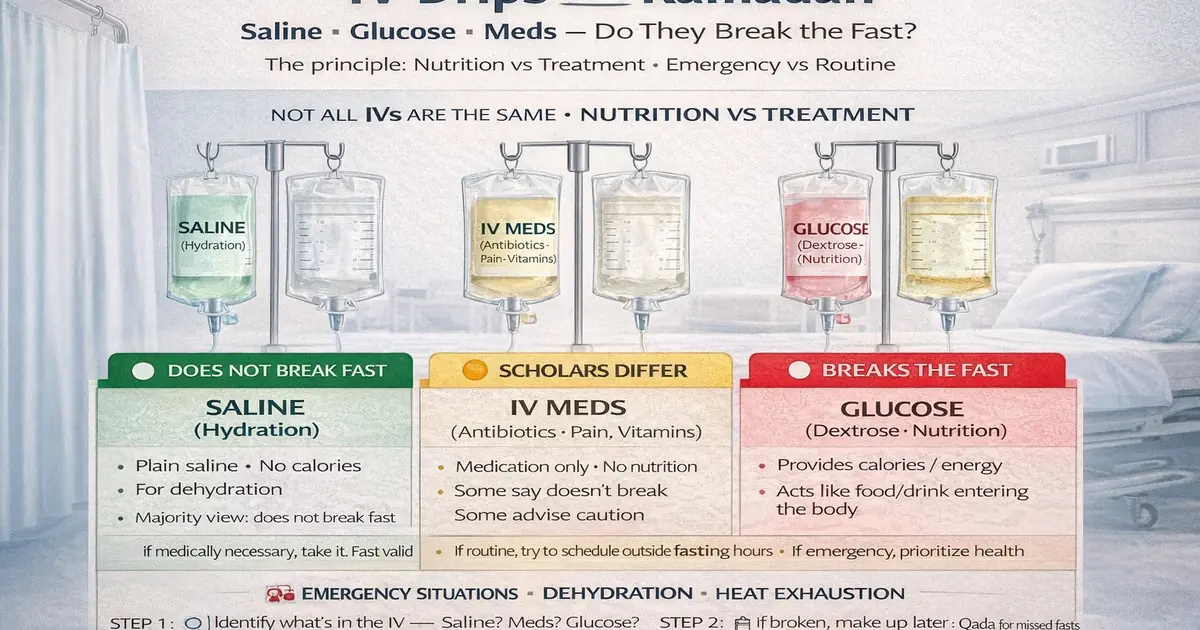
Does IV drip break fast Ramadan: IV Drips in Ramadan: Fluids, Glucose, Saline, and Medication — Do They Break the Fast?
Hospitals don’t pause for Ramadan.
Neither do dehydration, migraines, infections, or sudden weakness.
So the real question isn’t “Are IVs a big deal?” It’s: what kind of IV was it, and what do I do now without panic?
✅ TL;DR – does IV drip break fast Ramadan
does IV drip break fast Ramadan often depends on whether the drip is nutritive infusion breaks fast (like glucose feeding the body) or non-nutritive IV ruling (treatment/medicine). Many scholars treat glucose-like IV nutrition as breaking the fast, while saline or IV medication is discussed differently. If it was urgent, protect health first, then make up the day.
the principle: nutrition vs treatment
Answer-first: The simple idea many scholars use is this: fasting isn’t only “no eating.” It’s also avoiding what feeds the body in a way similar to food and drink. So they often separate IVs into “nutrition” versus “treatment.” That’s the core behind does IV drip break fast Ramadan.
Think of your fast like closing the kitchen door for the day. Treatment is like fixing a leaking tap in the bathroom. Nutrition is like secretly sliding a meal through a window. Same house. Very different actions.
My students always ask, “But it’s not going through the mouth—so why does it matter?” That’s the exact reason scholars talk about nutritive infusion breaks fast vs non-nutritive IV ruling.
Quick checklist (beginner-safe):
- If the IV is meant to nourish (like glucose/dextrose feeding energy), many consider it like “eating,” so it breaks the fast.
- If the IV is medicine-only, opinions can differ; many still advise making make up fast for safety and peace of mind.
- If you’re seriously unwell, medical necessity comes first—Islam doesn’t ask you to harm yourself.
saline: why it’s discussed
Answer-first: saline IV fasting gets discussed because saline feels like “water,” and fasting is closely tied to avoiding drinking. Some scholars see saline as body support similar to hydration, while others focus on whether it’s true nourishment. That’s why you’ll see different answers on saline drip fasting.
Here’s the part many people miss: in real clinics, saline is often given for hydration and support when you’re drained, not to “feed calories.” Still, it can remove thirst and weakness fast—so the question becomes: does that count like drinking?
Micro-scenario: you’re fasting, you feel dizzy, and a doctor suggests a saline drip for dehydration drip Ramadan. If it’s needed to keep you safe, you take it. Then you deal with the fast calmly afterward.
Neutral note (differences of opinion): scholars may differ here, especially in how they treat “IV hydration” compared to “IV feeding.” A safe path for beginners is to treat a saline drip as something you don’t schedule while fasting unless needed, and if you receive it, plan qada after IV.
glucose/dextrose: why it’s treated differently
Answer-first: glucose drip fasting (or dextrose) is commonly treated differently because it provides energy to the body like food does. Many scholars describe this as clear “nutritional support,” so it falls under nutritive infusion breaks fast.
This is why people ask, “Is glucose drip different?” Yes, it’s often discussed as different from plain medication, because it’s doing the job of feeding—especially when someone can’t eat.
A longer real-life picture: A man once told me he was fasting in the heat, pushing through work, and then fainted. In the ER, they gave him glucose. He woke up embarrassed and kept saying, “I ruined my Ramadan.” I told him, “No—you protected your life.” He made make up fast later and learned a better lesson: don’t turn worship into self-harm.
IV antibiotics/vitamins
Answer-first: IV antibiotics fasting is usually treatment, not feeding. IV vitamins fasting is trickier because vitamins can be “supplement-like,” and sometimes are given with fluids meant to strengthen the body. So the ruling discussion often returns to: is it nourishment, or medicine-only?
Micro-scenario: you have a scheduled clinic visit and the nurse offers a vitamin drip “to boost energy.” That’s a hint it’s not urgent treatment—and it may be closer to “body support.” A beginner-safe move is: delay it to after iftar if possible.
Another micro-scenario: you have an infection, fever, and the doctor says antibiotics can’t wait. In that case, you take treatment, and you sort out qada after IV later.
One simple rule that saves headaches: if it can wait until night, wait. If it can’t, don’t play hero.
dehydration and heat exhaustion
Answer-first: If you’re facing heat exhaustion, severe dizziness, or signs of dangerous dehydration, you treat it as urgent. Islam doesn’t ask you to keep fasting if it’s likely to harm you. That’s where emergency IV Ramadan becomes a health-first decision.
It’s easy to confuse “normal fasting tiredness” with real danger. The body can feel weak in Ramadan—especially with long days and heavy work. But when there’s strong risk (fainting, confusion, uncontrollable vomiting, medical warning signs), it’s no longer a “willpower test.” It’s a safety issue.
Micro-scenario: you’re on the road, you break into cold sweat, your vision narrows, and you can’t stand. That’s not the time to debate WhatsApp fatwas. You get help. You can make up a day. You can’t replace your health if you break it.
if you received an IV—what now?
Answer-first: If you already received hospital drip Ramadan care, don’t spiral. First, find out what was in the drip (saline, glucose, vitamins, antibiotics). Then follow a calm plan: treat the day as broken if it was nutritive, and in many cases plan qada after IV to be safe—especially if you’re unsure.
Here’s a practical “do this next” path:
- Ask the clinic: was it saline IV fasting, glucose drip fasting, IV vitamins fasting, or IV antibiotics fasting?
- If it was glucose/dextrose (nutrition), treat it as breaking the fast and plan make up fast.
- If it was saline/medicine-only, and you’re unsure, choose the safer route: plan qada after IV.
- If this is recurring due to illness, speak to a trusted scholar locally about your case (and follow medical advice for safety).
And yes—people do confuse IV drips with injections. They’re related questions, but not the same situation. (I used to mix these up too when I was younger.)
quick FAQ hub (links to scenario pages)
Answer-first: Most questions around IVs fall into a few repeat scenarios: saline for dehydration, glucose for energy, antibiotics for infection, vitamins for “boosting,” and emergency ER treatment. Use the FAQs below to pick your case fast, then keep worship simple and safe.
If you want more practical Ramadan planning, you can link tools like an iftar-suhoor timer or an fidya-kaffarah calculator for people who have long-term cases.
📊 does IV drip break fast Ramadan: common drips and the beginner-safe approach
This table keeps it simple: what the drip is meant to do, and the safest next step if you want to avoid mistakes.
💧 Show IV Drip Summary Table
| IV type | What it usually does | Beginner-safe stance |
|---|---|---|
| glucose drip fasting | Energy / nutrition support | nutritive infusion breaks fast (plan qada after IV) |
| saline IV fasting | Hydration / support | Discussed; safest is qada after IV if received while fasting |
| IV antibiotics fasting | Treatment for infection | Take if needed; often make make up fast to be safe |
| IV vitamins fasting | Body support; sometimes “boost” | If non-urgent, do at night; if taken while fasting, plan qada after IV |
| dehydration drip Ramadan | Urgent hydration/support | Health first (emergency IV Ramadan), then make up later |
FAQs
📘 does IV drip break fast Ramadan FAQs
does IV fluids break the fast?
Show Answer
It depends on the fluid. Many scholars separate nutritive infusion breaks fast from treatment-only drips. If you’re unsure, the safe move is qada after IV.
what if it’s just saline?
Show Answer
saline drip fasting is discussed because it supports hydration. If you received it while fasting, many people choose qada after IV for safety and peace of mind.
is glucose drip different?
Show Answer
Yes. glucose drip fasting is widely treated as nutrition support, so it often falls under nutritive infusion breaks fast.
do IV vitamins break the fast?
Show Answer
IV vitamins fasting can feel like “boosting” the body. If it’s not urgent, do it after iftar. If taken while fasting, many choose qada after IV.
do IV antibiotics break the fast?
Show Answer
IV antibiotics fasting is usually treatment. If it’s needed, take it. Then plan make up fast to be safe, especially if you’re unsure.
what if i got an IV for dehydration in Ramadan?
Show Answer
dehydration drip Ramadan is often urgent support. Health comes first. Afterward, plan qada after IV.
what if it was an emergency IV in the ER?
Show Answer
ER Ramadan situations are not the time to delay care. Take treatment, then make up the day later.
how do i know what was in my drip?
Show Answer
Ask the nurse or check your discharge notes: saline, glucose/dextrose, vitamins, or antibiotics. That single detail changes the answer.
do i need kaffarah after an IV?
Show Answer
Kaffarah is not treated like a “default penalty” for medical necessity. Most people in medical cases focus on make up fast (qada). If you have a complex case, ask a trusted scholar locally.
what if i have chronic dehydration or ongoing treatment?
Show Answer
If fasting is consistently unsafe due to a condition, speak to your doctor and a trusted scholar about exemptions and long-term options like fidya where it applies.
can i schedule IV treatment at night to avoid the issue?
Show Answer
Yes—if it’s not urgent, night scheduling removes most confusion. Many people do this for clinic visits.
Related Articles
- Ramadan fasting rules for special cases:
- Does injection break fast Ramadan:
- Asthma inhaler break fast Ramadan:

Farrukh Farooqi has been living in Sharaya, Makkah, Saudi Arabia since 2010. With over 14 years of firsthand experience witnessing the sacred journey of millions of pilgrims, Farrukh specializes in providing practical, insider tips for Hajj and Umrah travelers. His work blends real-world observations, the latest Saudi updates, and essential crowd management strategies — helping pilgrims and worshippers plan smarter, stay safer, and experience a spiritually fulfilling journey across the Holy Cities.


