
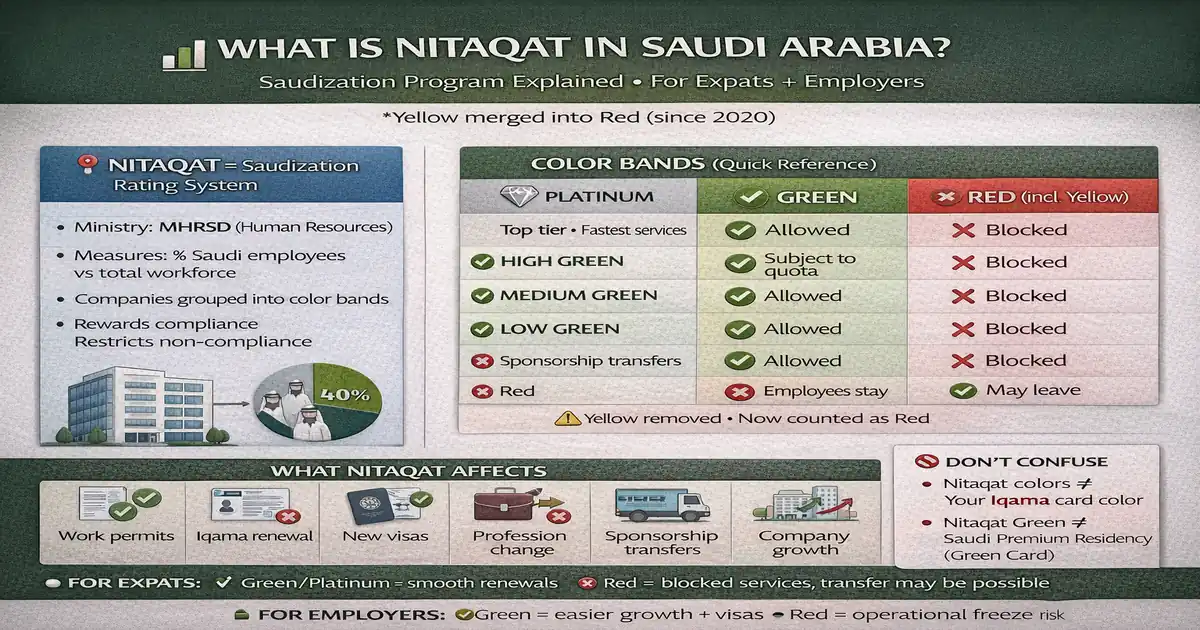
What Is Nitaqat in Saudi Arabia? (Saudization Program Explained for Expats + Employers)
You don’t feel Nitaqat on a normal day.
You feel it when something stops working.
If you’re an expat, it usually shows up as a renewal problem. If you’re an employer, it shows up as “why can’t we request visas / renew permits / process HR services?” That’s why people keep searching what is nitaqat in saudi arabia—they want the quick truth and the practical impact.
✅ TL;DR – What is Nitaqat
Nitaqat is Saudi Arabia’s private-sector Saudization rating that classifies companies by compliance. It measures the share of Saudi employees and places establishments into bands like Platinum, Green levels, and Red. Your employer’s band can affect work permits, Iqama renewals, new visas, and transfers. Check the official status early, not at expiry time.
What is Nitaqat? (Quick Answer)
What is Nitaqat? Nitaqat is Saudi Arabia’s private-sector Saudization rating for companies. It’s a system that classifies establishments into levels (like Platinum, High Green, Mid Green, Low Green, Red) based on their nationalization rate—basically how many Saudi nationals are employed compared to the total workforce, using the government’s counting rules.
Nitaqat meaning: Saudi “Saudization” rating for private companies
Think of it like a “traffic light dashboard” for employers. When the company is in a strong band, doors stay open. When the company drops, the system starts closing doors—often fast.
Who runs it: Ministry of Human Resources (MHRSD)
The program sits under the Ministry responsible for labor and workforce regulation (MHRSD). That’s why you see Nitaqat mentioned together with labor services, permits, and compliance.
What it measures: % of Saudi employees vs total workforce
At a high level it’s the share of Saudi nationals in the workforce. But the detail matters: counting rules can include wage thresholds and sector rules. So employers don’t just “hire one person and fix it forever.” Status can change as numbers shift.
Why does Nitaqat exist? (Purpose in one glance)
Why does Nitaqat exist? It exists to move more Saudi nationals into private-sector jobs, reduce long-term reliance on expat labor in sectors where local hiring is expected, and push companies to comply using a mix of benefits (for compliant bands) and restrictions (for non-compliant bands).
Goal 1: increase Saudi hiring in the private sector
Saudi employment targets are a national priority. Nitaqat is the “measuring stick” used to enforce it in the private sector.
Goal 2: reduce reliance on expat labor (by sector targets)
Targets differ by industry because some sectors can localize faster than others. That’s why two companies of the same size can have different Saudization expectations depending on activity.
Goal 3: push compliance through rewards + restrictions
Compliance bands don’t just sit there as labels. They change what services the company can access and how smooth their processing becomes.
How Nitaqat works (Simple explanation)
How Nitaqat works is simpler than people think: the system checks your establishment’s nationalization rate using government data, places you into a band, then allows or restricts services based on that band. The “hard part” is that the band can change when workforce numbers change.
Companies are placed into color bands based on Saudization
This is where people talk about “Green company” or “Red company.” They’re talking about the employer’s band, not the employee’s.
Targets differ by industry + company size (not one rule for all)
Big companies and small companies don’t get the same targets. Also, industries differ. So copying a friend’s “rules” from another sector can mislead you.
Status can change when workforce numbers change
Micro-scenario: A company loses a few Saudi employees and doesn’t replace them quickly. The status can drop. Expats feel it later—usually at renewal time—when services slow down or stop.
Nitaqat colors explained (What each color means)
Nitaqat colors explained in plain language: higher tiers mean better compliance and easier access to labor services; lower tiers mean restrictions. Current official tiers are typically: Platinum, High Green, Medium (Mid) Green, Low Green, and Red. People still search “Yellow,” but that’s an old category.
Platinum: highest compliance (fastest access to services)
Platinum is the top band—think “best standing.” Employers usually get smoother access and faster processing for many labor services.
High Green: strong compliance
High Green is solid compliance. For many employers, it’s the “healthy and stable” zone.
Medium Green: compliant but closer to minimum
Medium Green is still compliant, but closer to the line. Employers may feel more pressure to keep their ratios stable.
Low Green: barely compliant (some limits may apply)
Low Green is the “don’t relax” zone. The company meets minimum compliance, but it can slip into trouble if workforce numbers change.
Red: non-compliant (many services blocked)
Red is the lowest tier. This is where companies often face restricted access to key services, and where expats start searching “why is my renewal failing?”
Yellow: removed/merged into Red (why people still search it)
Yellow was removed and companies in that band were moved into Red. People still search it because old guides and screenshots keep circulating. If you want the quick expat comparison, use yellow vs red vs green nitaqat.
What Nitaqat affects (The services people care about)
What Nitaqat affects is the reason it matters. It can change whether the employer can process key actions, especially around permits, renewals, visas, and transfers.
Work permit services (Maktab Amal / renewals)
Work permit services can become difficult or blocked for low tiers. Expats often confuse this with a personal issue, but it’s frequently employer-side.
Iqama renewal ability for expat employees
If the employer’s services are restricted, Iqama renewal can be delayed or blocked even if the employee did nothing wrong.
New visa issuance and hiring foreign workers
Lower tiers can face restrictions on issuing new visas and hiring. Employers feel it immediately; expats feel it when staffing and HR processes freeze.
Profession change / job title updates
Job title changes can also be restricted in lower tiers, depending on the service and conditions.
Sponsorship transfers (who can receive workers)
Compliance level affects which companies can receive workers more smoothly. This is why expats prefer joining stronger tier employers.
Nitaqat impact for expats (Real-life effects)
Nitaqat impact for expats is mostly about stability: renewals, transfers, and whether the sponsor can process essential steps when you need them.
If your employer is Green/Platinum: renewals usually go smoothly
In Green or Platinum, renewals generally go smoother—assuming fees and prerequisites are clear. For a deeper “what Green allows” view, see green Nitaqat status: what it allows.
If your employer is Red: renewals/visas may get blocked
In Red, employers can hit “service stopped” barriers. For a clean list of what commonly freezes, see red Nitaqat status: blocked services.
Why expats check Nitaqat before joining a company
Micro-scenario: Two job offers. Same salary. One company is stable Green, the other is shaky. The “shaky” one can cost you months of stress later. This is why experienced expats ask about Nitaqat before signing.
My students always ask, “How do I ask HR without sounding rude?” Simple: “What is the establishment’s current Nitaqat tier?” That’s it.
Nitaqat impact for employers (Business consequences)
Nitaqat impact for employers is about whether the business can function normally. Higher tiers keep services flowing. Lower tiers can create operational freezes.
Green/Platinum: easier growth (visas + services keep working)
In higher tiers, employers usually have smoother access to labor services and more flexibility to manage workforce needs.
Red: operational freeze risk (blocked services + hiring limits)
Red can lock important actions, especially those tied to permits, renewals, and new hires. This is where companies scramble to fix compliance quickly.
Reputation/tenders: why “Green” can matter for contracts
Some partners and projects prefer working with compliant companies. So “Green” can act like a trust signal in the market.
How to check Nitaqat status (Official ways)
How to check Nitaqat status online? Use official channels and keep proof. Don’t trust random screenshots without a date.
Check company status on Qiwa (establishment profile)
Qiwa is the common official place to view establishment status and Nitaqat tier. If you want the step path expat-friendly, use how to check iqama red green status.
Check via MHRSD/MoL inquiry (employee/establishment inquiry pages)
MHRSD inquiry pages can also show relevant status information depending on the service. Use the exact service field the page asks for (don’t “try random numbers”).
What to use: Iqama number vs border number vs passport number
This depends on the inquiry service you’re using. If you’re confused about IDs, this quick guide helps: border vs iqama vs visa (difference).
Common confusions (High-CTR clarifications)
These confusions waste hours. Kill them now.
Nitaqat colors ≠ your Iqama card color
Nitaqat is employer compliance. Your Iqama is your residency ID. Different things.
“Saudi Green Card (Premium Residency)” ≠ Nitaqat Green
Premium Residency is a separate program. It has nothing to do with your employer’s Nitaqat tier.
Red/Green is employer compliance, not nationality
It’s not about your passport. It’s about the employer’s compliance level and what services are allowed.
FAQs (People Also Ask)
📘 Nitaqat FAQs
What is Nitaqat in Saudi Arabia?
Show Answer
Nitaqat is the Saudization compliance rating that classifies private companies into tiers (Platinum/Green levels/Red) based on nationalization rules. It affects labor services, permits, visas, and renewals.
What are the levels of Nitaqat?
Show Answer
Commonly: Platinum, High Green, Medium (Mid) Green, Low Green, and Red. “Yellow” is not a current tier.
What does Green Nitaqat mean for expats?
Show Answer
It usually means the employer is compliant enough that key services work more smoothly, so Iqama renewal and HR actions are less likely to hit employer-side blocks.
What happens if a company is Red Nitaqat?
Show Answer
Red can bring serious restrictions: work permit steps and renewals may be blocked, new visa requests can stop, and other labor services can freeze until compliance improves.
Is Yellow Nitaqat still active?
Show Answer
No. Yellow was removed and merged into Red. People still search it because older screenshots and guides use the old label.
How to check Nitaqat status online?
Show Answer
Check the establishment profile on Qiwa or use relevant MHRSD inquiry services. Always save proof showing status + company name + date.
📊 Nitaqat colors: one-table summary
This is the fast “what each band usually means” view for expats and employers.
| Tier | Simple meaning | What usually happens |
|---|---|---|
| Platinum | Top compliance | Fast/smooth access to many services |
| High Green | Strong compliance | Services generally work smoothly |
| Medium Green | Compliant, closer to minimum | Works, but keep ratios stable |
| Low Green | Barely compliant | Higher risk of slipping if staffing changes |
| Red | Non-compliant | Many labor services can be restricted/blocked |
You can also read these articles
- Iqama red/green meaning in Saudi Arabia (Nitaqat impact guide)
- Check border number in Saudi Arabia (2026)
- Where to find border number (passport/visa pages)
- Border number not found: fixes before you panic

Farrukh Farooqi has been living in Sharaya, Makkah, Saudi Arabia since 2010. With over 14 years of firsthand experience witnessing the sacred journey of millions of pilgrims, Farrukh specializes in providing practical, insider tips for Hajj and Umrah travelers. His work blends real-world observations, the latest Saudi updates, and essential crowd management strategies — helping pilgrims and worshippers plan smarter, stay safer, and experience a spiritually fulfilling journey across the Holy Cities.


