
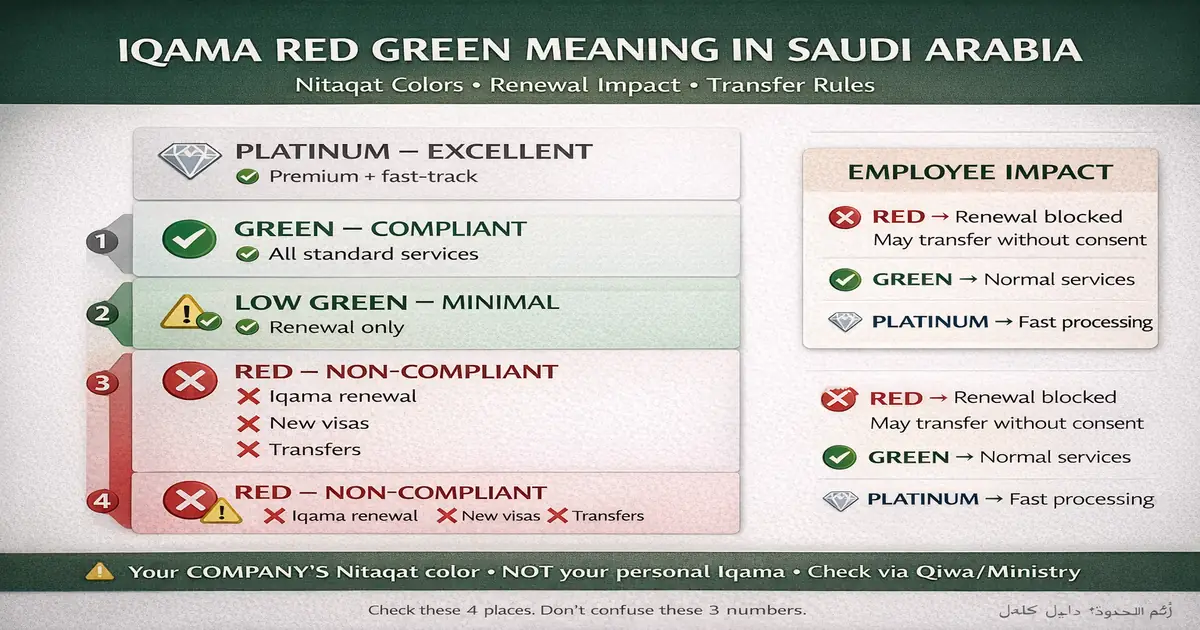
Iqama Red Green Meaning saudi arabia: What Each Nitaqat Color Means (and How It Affects Renewal & Transfers)
That “red/green” panic usually starts the same way.
Your renewal fails. HR goes quiet. Someone sends a WhatsApp voice note saying, “Company is red.”
Here’s the truth in plain words: iqama red green meaning saudi arabia is about your employer’s Nitaqat (Saudization compliance), not a color printed on your personal Iqama card. And yes—this status can affect renewals, visas, transfers, and Ministry services.
✅ TL;DR – iqama red green meaning saudi arabia
Iqama red/green usually means your company’s Nitaqat level. Green/Platinum generally means compliance and services keep working. Red generally means restrictions—renewals and key labor services may be blocked or delayed. First step: confirm the establishment status in official channels, then follow the right action plan for renewal or transfer.
What does “Iqama red/green” mean in Saudi Arabia? (Quick Answer)
What does “Iqama red/green” mean in Saudi Arabia? It usually refers to your employer’s Nitaqat classification under Saudization rules. It’s not your personal Iqama “color.” The color reflects how compliant the establishment is, and that can affect what services the company can use—like iqama renewal, visas, transfers, and other Ministry actions.
It’s your employer’s Nitaqat (Saudization) compliance status, not your personal Iqama color
This is the biggest misunderstanding. People say “my iqama status red” when they really mean the sponsor/company is in a red category. Your Iqama is your residency ID. Nitaqat is the employer’s compliance rating.
Green/Platinum = compliant; Red = non-compliant (services restricted)
Iqama status green (or Platinum) generally signals better compliance and smoother access to services. Iqama status red usually signals non-compliance and service restrictions. That’s why you see “service stopped” messages during renewal time.
Why it matters: renewals, visas, transfers, and Ministry services
Because many employer-side services depend on compliance level: renewal ability, work permit actions, visa requests, and some transfer functions. When a company falls into red category company saudi, the system can restrict what they’re allowed to do until they improve.
Nitaqat Colors Explained (Red vs Green vs Platinum)
Nitaqat colors meaning is basically a traffic-light system for employers—except it has levels inside green. Your daily life changes based on what the system allows your sponsor to process.
Green status meaning (low/medium/high green — what changes)
Green category saudi meaning can vary by level: Low Green, Mid/Medium Green, and High Green. In simple terms, higher green usually means fewer restrictions and smoother access to services. Low Green can still be “okay,” but it may be closer to the edge—meaning the company has less room for mistakes before restrictions hit.
People also ask about yellow. In practice, some older explanations mention Yellow, but official category sets are commonly explained as five levels (Platinum, High/Mid/Low Green, Red). If you see Yellow mentioned somewhere, treat it as “a warning zone explanation” and confirm your employer’s actual level in the official status screen.
Platinum status meaning (top compliance level)
Platinum is the top compliance level. In real life, that usually means the company can access more services smoothly and handle workforce processes with fewer blocks.
Red status meaning (lowest level + blocked services)
Red is the lowest level. This is where people feel the pain: blocked or delayed services, especially around renewals and work permit-related steps. It doesn’t mean “you personally did something wrong.” It means your employer’s compliance is below the required level.
What happens if your company is Green/Platinum?
What happens if your company is Green/Platinum? Usually, employer services stay available, so common processes like iqama renewal and work permit actions can move forward normally—assuming fees and requirements are also clear.
Iqama renewal: usually smooth and allowed
If you’re asking “can renew iqama red” — you’re already in the worry zone. In Green or Platinum, renewals are generally allowed when other conditions are met (valid documents, fees cleared, and no separate blocks).
Work permit + visa services: available
When the company is compliant, employer services tied to work permit and visa processes are generally available. This is why “green” employers can usually keep normal operations going.
Profession change and HR services: generally permitted
Many HR services are easier when the company is in a compliant range. Still, each service can have its own conditions, so don’t treat green like “everything is always allowed.” Treat it like “the doors are open more often.”
Hiring and transfers: easier processing (company can receive workers)
Companies with better status often find it easier to receive workers through transfers and handle recruitment services. That’s why people chase “green/platinum sponsors” when they’re stuck.
What happens if your company is Red? (The real consequences)
What happens if your company is Red? This is where expat iqama renewal issues explode. Many employer-side services can be blocked or restricted—so renewals can fail, new visas can stop, and HR processes can freeze until compliance improves.
Iqama renewal blocked or delayed: what “service stopped” means
Iqama renewal blocked red status often shows up as “service not available” or “service stopped.” It usually means the employer can’t complete required steps due to compliance restrictions or related blocks tied to the establishment.
One-sentence reality: your renewal can be “your problem” even when the cause is the employer’s status.
New visas blocked: why hiring stops
Red status impact on new visa is a common issue because recruitment quotas and visa services often depend on compliance level. When status drops, hiring can slow down or stop.
Transfers impacted: what employees can/can’t do
Transfer iqama red status questions are tricky because transfer rules depend on the employee’s case and the service path used. Some situations may allow transfers, some may block them, and some require specific conditions. The safe move is: confirm your status, keep documentation, and check your options through official channels rather than rumors.
Risk to your legal stay: why people panic during renewal time
The panic is understandable. If renewal is delayed and expiry is close, people fear falling out of legal status. That’s why you should track dates and keep a paper trail early—not two days before expiry.
Can you transfer sponsorship if your company is Red?
Can I transfer if my company is Red? Sometimes it may be possible depending on your situation, your contract status, and what the official systems allow at that moment. But in many cases, the process becomes harder, slower, or blocked—especially if employer services are restricted.
Transfer rules depend on your case (when transfer may be possible)
There isn’t one rule that fits everyone. Your ability to transfer can depend on factors like whether renewals are blocked, whether the employer is taking corrective steps, and whether you have a documented issue. Don’t accept “always yes” or “always no” answers.
When transfers are blocked: common situations
Transfers often become difficult when the employer cannot complete required system actions due to restrictions. In that case, you may see delays, rejections, or “service unavailable” barriers.
What to ask HR immediately (paper trail checklist)
Ask these, calmly, and keep screenshots/receipts. This is not drama—this is survival.
- What is our current Nitaqat level (red/low green/mid/high/platinum) and the date it was checked?
- Is my work permit step clear, or is it blocked?
- What is the employer’s red zone fix plan and timeline?
- Will you provide written confirmation of renewal progress?
How to check your company’s Nitaqat status (Qiwa / Ministry)
How to check nitaqat color is about checking the establishment status in official systems. Don’t trust “my friend checked your iqama is red” messages. Confirm it yourself or through a proper HR screenshot from the official page.
Check via Qiwa: where the “establishment status” appears
In Qiwa, employers and authorized users can view the establishment info and see the Nitaqat level/status for that establishment. The wording often looks like “establishment status” or “Nitaqat level.”
Check via Ministry portal: what number to use (Iqama / border / etc.)
Some Ministry services allow inquiries using identifiers like iqama or related employee/establishment details. The exact input fields can vary by service, so the safe habit is: use the service’s required field exactly—don’t “try random numbers” until something works.
What to screenshot: status + company name + date (proof)
Screenshot the status screen with company name, the status level (Red/Green/Platinum), and the date/time. If a dispute happens later, this proof matters.
Why your Iqama renewal is failing (Top reasons tied to Red status)
Why is my renewal failing? When a company is in a restricted level, you’ll often see system messages that look like your personal problem—but the real cause is employer-side service blocks, work permit issues, or requirements not cleared.
“Service not available” messages (what they usually mean)
These messages often mean the system cannot process the step because the employer’s services are restricted—or because a required prerequisite (fees, work permit status, approvals) isn’t clear.
Work permit (Maktab Amal) issues vs Nitaqat issues (don’t mix)
This is a common confusion: you might have a work permit issue even if the company is not red, or you might have a Nitaqat restriction even if your personal details are fine. Treat them as two separate checks so you don’t chase the wrong fix.
Fees and requirements: what must be cleared before renewal
Even in Green, renewals can fail if required steps are not complete. In Red, the same “normal” requirements still matter—but you may also face employer service blocks on top.
What to do if your company is Red (Action plan)
What to do if company is Red? Follow a two-track approach: (1) confirm facts officially, (2) protect yourself with dates and proof while HR fixes compliance. Don’t run on rumors.
Step 1: confirm status officially (don’t trust WhatsApp rumors)
Confirm through the official status screen (Qiwa/Ministry portal view). If HR refuses to show it, that’s a signal by itself.
Step 2: ask HR for renewal timeline and Nitaqat fix plan
Ask for a timeline, not promises. “Soon, inshaAllah” is not a timeline. Get dates, steps, and who is responsible.
Step 3: track expiry dates + keep receipts and screenshots
Keep a folder: expiry date, renewal attempts, receipts, screenshots, and any HR messages. This is your protection if the situation escalates.
Step 4: escalate if needed (formal complaint paths / support channels)
If you are at risk due to repeated blocks and no real progress, you may need official support channels. Do this with proof and calm language. Emotional calls don’t help; documentation helps.
📊 Red vs Green vs Platinum: what changes for employees
This table is a quick “what changes” view. Real outcomes still depend on your case and required prerequisites.
✅ Show Nitaqat comparison table
| Status | Simple meaning | What employees often feel |
|---|---|---|
| Platinum | Top compliance level | Fewer blocks; smoother HR services |
| Green (Low/Mid/High) | Compliant range (levels vary) | Renewals usually work if prerequisites are clear |
| Red | Non-compliant / restricted | Renewal delays/blocks; service restrictions; stress |
Red/Green FAQs
📘 iqama red green meaning saudi arabia FAQs
What is red green Iqama status?
Show Answer
Red/green iqama status usually means your employer’s Nitaqat level (Saudization compliance). It’s about the company/establishment, not a color printed on your personal Iqama.
Does Red status stop Iqama renewal?
Show Answer
It can. Iqama renewal blocked red status often happens because employer services are restricted. Sometimes renewals are delayed; sometimes the system blocks the step until compliance improves and prerequisites are cleared.
How to check Iqama red or green online?
Show Answer
Check the employer establishment status via official channels like Qiwa or the Ministry portal view used for establishment/employee services. Ask HR for a screenshot showing status + company name + date.
What’s the difference between Green and Platinum Nitaqat?
Show Answer
Platinum is the top compliance level. Green is also compliant but has levels (low/mid/high). Higher levels generally mean fewer restrictions and smoother access to services.
Can I transfer if my company is Red?
Show Answer
Sometimes it may be possible depending on your case and what the official system allows at that time. But transfer iqama red status situations often become slower or blocked. Confirm your options officially and keep proof of delays/blocks.
Is this “Iqama color” on Absher or Qiwa?
Show Answer
People usually mean the employer’s Nitaqat level, which is commonly checked through official labor platforms and employer views (often associated with Qiwa / Ministry services), not a “color” stamped on your Iqama card.
What is yellow in Nitaqat?
Show Answer
Some older explanations mention yellow as a warning zone. Many official explainers describe five levels: Platinum, High/Mid/Low Green, and Red. If you see “yellow” online, confirm your actual level in the official status screen.
How long to fix Red status?
Show Answer
There’s no single time. It depends on what compliance gap caused the downgrade and how quickly the employer corrects it. Your safest move is tracking expiry dates and pushing for a written employer plan.
What should I do if my renewal is failing but HR says “it’s fine”?
Show Answer
Ask for proof: status screenshot with date, and written confirmation of the renewal timeline. Keep receipts and screenshots. Don’t wait until the last week before expiry.
Can renew iqama red if I already paid fees?
Show Answer
Payment alone may not fix a restricted status block. If the employer’s services are limited, the system can still stop the renewal step. Confirm what exact block is showing and get HR’s written plan.
Common Confusions to Kill (High-CTR)
This section saves you from wasting hours on the wrong idea. Most confusion comes from mixing “dots,” “cards,” and “colors” that are totally different programs.
“Iqama has a red dot” vs “company Nitaqat is Red” (not the same)
Some people say “red dot” when they mean a separate issue (like a message, a requirement, or an app indicator). That is not automatically the same as company Nitaqat is Red. Confirm the establishment status before you panic.
Saudi Premium Residency “Green Card” vs Nitaqat Green (totally different)
Saudi Premium Residency is a separate residency path. It is not the same thing as Nitaqat green. Don’t let someone confuse you with “green card” talk when you’re asking about employer compliance.
Red/Green here is compliance status, not nationality/visa type
This is not about your nationality and not about your visa type. It’s about employer compliance and what employer-side services are allowed right now.
You can also read these articles
- Check Border Number in Saudi Arabia (2026)
- Border number vs visa vs iqama (quick difference)
- Where to find your border number (passport + visa)
- Border number not found: 9 fixes before you panic

Farrukh Farooqi has been living in Sharaya, Makkah, Saudi Arabia since 2010. With over 14 years of firsthand experience witnessing the sacred journey of millions of pilgrims, Farrukh specializes in providing practical, insider tips for Hajj and Umrah travelers. His work blends real-world observations, the latest Saudi updates, and essential crowd management strategies — helping pilgrims and worshippers plan smarter, stay safer, and experience a spiritually fulfilling journey across the Holy Cities.


