
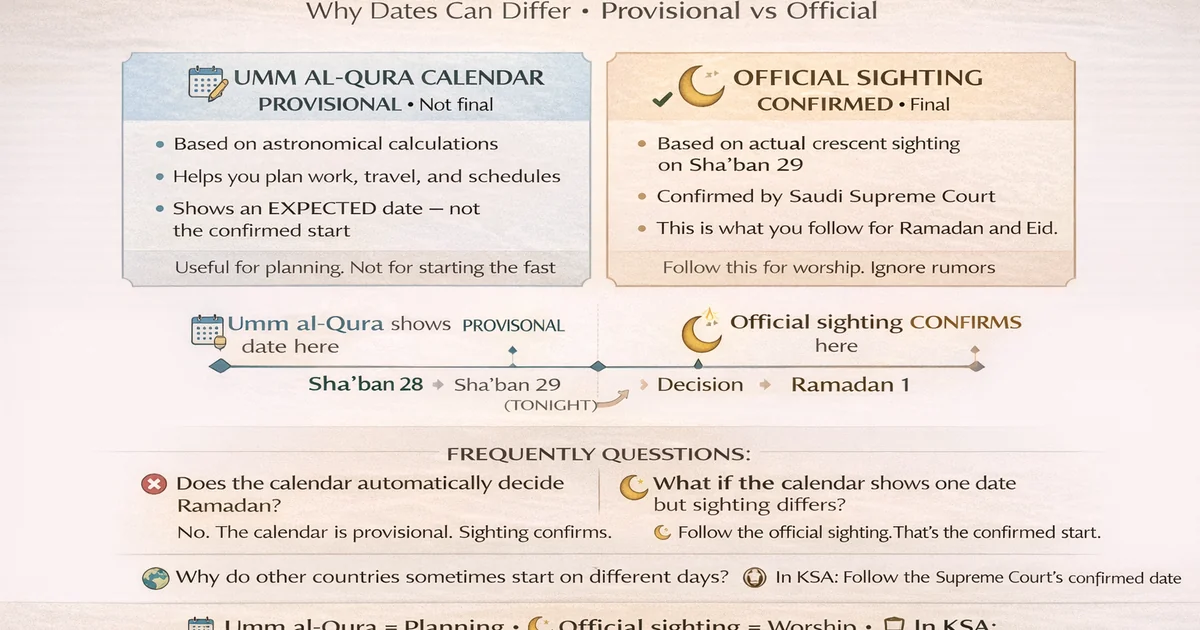
Sha’ban 29 1447 ah ramadan sighting: Ramadan Moon Sighting Tonight Checklist + Decision Tree
Tonight in KSA, the process is simple… and the WhatsApp noise is not.
This page is your calm guide for sha’ban 29 1447 ah ramadan sighting: what to do before sunset, where to look after sunset, and how the final decision works.
Don’t chase screenshots.
✅ TL;DR – sha’ban 29 1447 ah ramadan sighting
On shaban 29 moon sighting in Saudi Arabia, do three things: prepare before sunset, look toward the western horizon crescent after sunset, then wait for the official decision. If accepted, Ramadan starts the next day; if not, complete 30 days shaban and Ramadan begins the day after. Ignore rumors until official confirmation.
Differentiation Hook: a one-screen “Tonight Decision Tree” built for KSA.
Before sunset checklist
Answer-first: Before sunset, set your expectations and your plan. This isn’t a “party night.” It’s a decision night. The clean prep is: know the timing, know the direction, and know that saudi ramadan moon sighting 2026 is confirmed only by the official decision—not by posts.
- tonight in KSA: decide now—will you look yourself, or just wait for the official decision?
- before sunset prep: charge your phone, pick a clear spot, and keep it calm (no crowd drama).
- official announcement time: expect the result after the sighting window, not at a fixed minute.
If you want a simple timing helper for your city while you wait, use this: Iftar & Suhoor Timer.
After sunset: where to look (simple)
Answer-first: Look after sunset, low in the sky, toward the الأفق الغربي (western horizon). People often ask what time to look for ramadan crescent moon and where to look for the crescent moon ramadan. Keep it simple: after sunset, near the horizon, with an open view.
Yes, people say moon sighting after iftar or after maghrib. In practice, it’s the same idea: after sunset, the search begins.
moon sighting after maghrib doesn’t mean “the second Maghrib starts, you must see it.” It means: that’s when the window opens.
And if you’re using help, telescope binoculars moon sighting can be discussed in the community—still, the final acceptance is official.
Decision tree (seen / not seen / rumors)
Answer-first: Tonight ends in one of three lanes: seen and accepted, not seen (or not accepted), or rumors with no official acceptance. The key question people ask is what happens if moon not sighted. The standard outcome is: complete 30 days shaban, then Ramadan begins the day after.
Also common: moon sets after sunset condition and crescent not visible prediction. These are visibility discussions. They don’t replace the official decision.
Here’s the one-screen decision table.
🌙 Show Tonight Decision Tree (KSA)
| What you hear | What it might mean | What you do in KSA |
|---|---|---|
| “Seen!” (social posts) | A claim (may be true, may be wrong) | Wait for the official decision; ignore conflicting claims |
| Official statement: accepted | ثبوت دخول رمضان confirmed | Ramadan starts the next day |
| Official statement: not accepted | what if the moon is not sighted for ramadan → Sha’ban completes 30 | Follow: complete 30 days shaban, Ramadan begins the day after |
| Clouds / haze | Visibility may be harder | does cloudy weather change start of ramadan? It can affect visibility—official decision decides |
If you saw it: what to do in Saudi
Answer-first: If you think you saw the crescent, don’t “confirm it” on WhatsApp first. In Saudi Arabia, the correct path is reporting so your testimony can be recorded (شهادة الرؤية). People search what to do if i see the crescent in saudi and report crescent to nearest court saudi for a reason: reporting is part of the process.
In simple words: contact the proper channel through your area—often described as أقرب محكمة (nearest court) or أقرب مركز (nearest center) to help you reach the court.
Keep it respectful. Keep it factual. No exaggeration.
Common mistakes (too early, wrong direction)
Answer-first: Most moon-sighting “fails” are not spiritual failures. They’re practical mistakes: looking too early, looking in the wrong direction, or expecting a bright moon. The first crescent can be crescent thin—easy to miss.
- too early: staring before sunset and calling that “sighting.”
- wrong direction: not facing the الأفق الغربي.
- too high: the crescent is low near the horizon at first.
- camera-trap: trusting phone zoom more than your actual eyes.
- panic sharing: spreading claims before the official decision (this creates fitnah fast).
One more mistake: mixing “prediction” with “decision.” They’re not the same thing.
FAQs
📘 sha’ban 29 1447 ah ramadan sighting FAQs
what does sha’ban 29 mean for moon sighting?
Show Answer
It’s the official “search night” for the new month. People look after sunset. Then everyone waits for the official acceptance or rejection decision.
moon sighting after iftar or after maghrib?
Show Answer
After sunset. In common speech, people say “after Maghrib.” The idea is: once the sun sets, the sighting window begins.
which horizon to look at for crescent moon?
Show Answer
The western horizon after sunset. A clear, open view helps a lot.
what if moon sets before the sun?
Show Answer
That situation is discussed under visibility factors. For the public, the practical rule stays: wait for the official decision on acceptance or rejection.
does cloudy weather change start of ramadan?
Show Answer
Clouds can make seeing harder. If there’s no accepted sighting, the outcome is usually completing Sha’ban as 30 days, then starting Ramadan the day after.
can families do moon sighting at home?
Show Answer
Families can look for personal interest, but the start date people follow in KSA is the official decision after the accepted process.
how thin is the crescent on first night?
Show Answer
Often very thin and low near the horizon, which is why many people miss it even when they try sincerely.
Is Ramadan 2026 confirmed tonight?
Show Answer
It becomes “confirmed” only when the official decision is released. Before that, it’s just claims, predictions, and chatter.
ramadan moon sighting 2026 dates and moonsighting Ramadan 1447—why do people argue?
Show Answer
Because some people share predicted dates like final results. In KSA, unity comes from following the official decision after the sighting process.
Helpful links (KSA cluster)
You Ca Also Read
- How to report moon sighting testimony in Saudi Arabia.
- Crescent Not Visible Prediction
- Why Countries Start Ramadan on different days
- Saudi ramadan moon sighting 2026
- Saudi supreme court ramadan crescent announcement 2026

Farrukh Farooqi has been living in Sharaya, Makkah, Saudi Arabia since 2010. With over 14 years of firsthand experience witnessing the sacred journey of millions of pilgrims, Farrukh specializes in providing practical, insider tips for Hajj and Umrah travelers. His work blends real-world observations, the latest Saudi updates, and essential crowd management strategies — helping pilgrims and worshippers plan smarter, stay safer, and experience a spiritually fulfilling journey across the Holy Cities.


