
Why Countries Start Ramadan on different days: If Your Country Starts Ramadan on a Different Day Than Saudi: What to Do (KSA-first)
It feels awkward, doesn’t it?
You’re in Saudi. Your cousin in Pakistan is sending “First Taraweeh tonight!” And your friend in another country is still saying, “We’re waiting.”
This is exactly why people search why countries start ramadan on different days. It’s not always drama. A lot of it is method, geography, and which official decision you follow.
One sentence can save your mood: different doesn’t always mean wrong.
✅ TL;DR – why countries start ramadan on different days
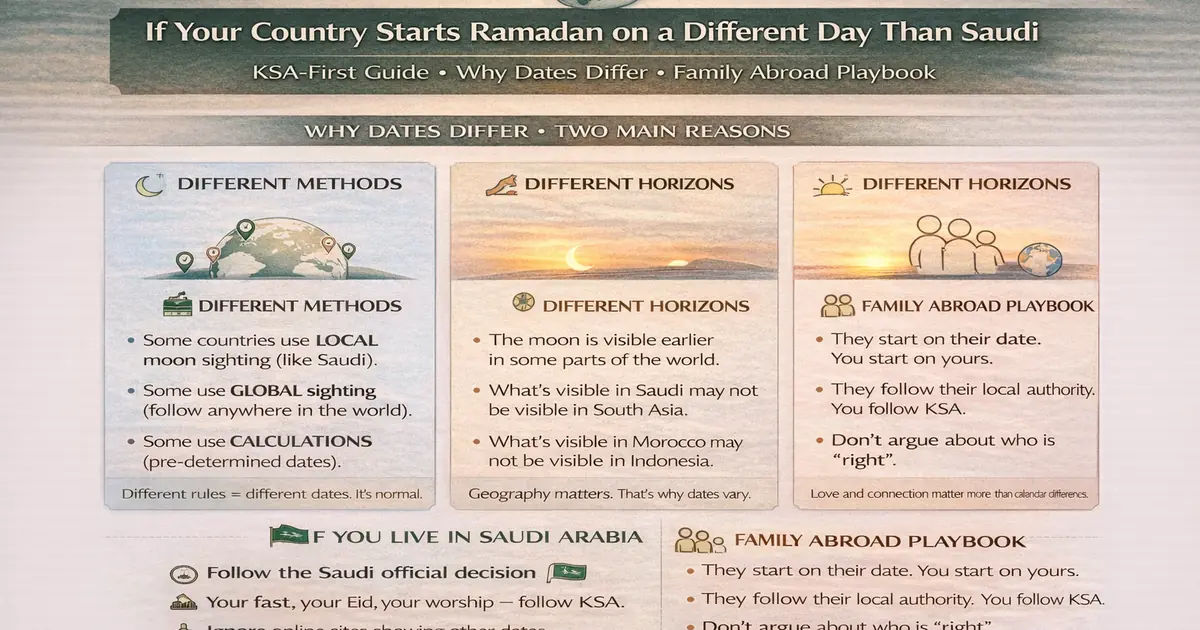
Countries differ because they use different methods (calculation vs sighting, local sighting, or broader sighting) and they have different visibility horizons (اختلاف المطالع). If you live in KSA, follow the official saudi decision for Ramadan and Eid even if online sites list another date. For family abroad, follow their local mosque announcement or local authority, then coordinate calmly for calls and greetings.
the KSA resident rule (the part that ends 90% of arguments)
Answer-first: If you live in Saudi Arabia, the practical rule is simple: follow the official saudi decision and the official confirmation chain for fasting and shawwal crescent and eid date. This answers the common question: if I live in KSA do I follow Saudi announcement? Yes—public worship follows the official decision where you live.
So if your feed shows a different date, don’t panic. This is normal in ramadan start date may differ by country years.
One-sentence reminder: your Ramadan doesn’t start from a screenshot.
why countries differ (9 reasons in plain words)
Answer-first: People ask why countries start ramadan on different days because they assume there is “one global switch.” In real life, countries differ due to method, horizon, and which authority they trust. That’s the clean answer, without blaming anyone.
- reason 1: method choice — difference between calculation and sighting matters because some communities plan by calculations while others rely on accepted sighting reports.
- reason 2: local vs global approach — some follow “local sighting,” others consider sighting from elsewhere.
- reason 3: horizons — اختلاف المطالع meaning is basically: the moon’s visibility differs by location and horizon.
- reason 4: weather and haze — a clear horizon in one place can be cloudy in another.
- reason 5: acceptance rules — a sighting claim is not always accepted the same way everywhere.
- reason 6: official timing — different official bodies announce at different times; “late” doesn’t mean “wrong.”
- reason 7: unity policies — some countries prioritize a single national decision; others allow region-based calls.
- reason 8: calendar planning vs confirmation — expected dates can differ from confirmed decisions (the “expected vs confirmed” confusion).
- reason 9: Eid is confirmed separately — does eid date get confirmed the same way? In practice, yes: هلال شوال confirmation sets عيد الفطر.
That’s the whole story: method + horizon + authority.
saudi vs other countries ramadan start (what to do without fighting)
Answer-first: When you face saudi vs other countries ramadan start differences, don’t argue “who is more Muslim.” Do this instead: follow your local official decision for your worship, respect the other country’s local authority, and keep family peace.
Micro-scenario: your family group chat says “Saudi is always early.” Reply: “I’m following the official decision where I live. Allah accepts from all.” Then stop typing.
family abroad playbook (practical, not emotional)
Answer-first: If you worry what if my family abroad starts different, treat it like time zones: you can still coordinate love without forcing one date on everyone. Here’s a simple playbook.
Step 1: Ask which authority they follow (their local council or local mosque announcement).
Step 2: Agree on “no mocking, no guilt.”
Step 3: Plan the practical stuff: family call time, du‘a requests, and Eid greetings once each side confirms.
Two one-liners that work in real families:
“We’ll follow our local decision and still make du‘a for each other.”
“Let’s not turn Ramadan into a debate tournament.”
traveling between countries (the easy rule most people miss)
Answer-first: If you travel, follow the public Ramadan and Eid practice of the place you are in. That’s the practical “unity vs local authority” reality for normal people, and it reduces confusion fast.
Micro-scenario: you start fasting in KSA, then fly to another country that began a day later. Don’t try to create your own private calendar in the airport. Follow the practice of where you are, and ask a local scholar if you’re genuinely stuck.
GCC comparison block (without pretending it’s a guarantee)
Answer-first: People ask gcc countries ramadan start and do saudi and uae usually start same day. Sometimes they do, sometimes they don’t. Similar geography and coordination can make it common, but you should never treat it like a permanent rule.
So if someone says, “It must match Saudi,” that’s not a safe assumption.
Umm al-Qura context (why your app date can differ)
Answer-first: Apps may show expected dates because of planning calendars like تقويم أم القرى. That doesn’t replace the إعلان رسمي and the confirmed decision night outcome. This is the “Umm al-Qura context” that stops a lot of confusion.
what not to argue about (save your energy)
Answer-first: The biggest mistake is turning this into a personal attack. Don’t argue about “who is strict,” “who is modern,” or “who is following Sunnah more” based only on dates.
Argue less. Worship more. Sleep enough for Fajr.
FAQs
📘 why countries start ramadan on different days FAQs
what if my country starts different from Saudi?
Show Answer
If you live in Saudi Arabia, follow the official saudi decision. If your family is abroad, they should follow their local authority, then you coordinate calmly for calls and greetings.
if I live in KSA do I follow Saudi announcement?
Show Answer
Yes. Public worship practice follows the official confirmation where you live, even if online sources list another date.
why countries start ramadan on different days?
Show Answer
Because countries use different methods (local sighting, wider sighting, or calculations) and they have different visibility horizons (اختلاف المطالع) plus different official acceptance rules.
difference between calculation and sighting?
Show Answer
Calculations help predict visibility and plan schedules. Sighting-based methods focus on accepted reports. Communities choose which method their authority follows.
اختلاف المطالع meaning?
Show Answer
It refers to different horizons/locations having different visibility conditions. A crescent visible in one place may not be visible in another.
do Saudi and UAE usually start same day?
Show Answer
Sometimes they do, sometimes they don’t. Don’t treat matching as guaranteed—follow the official announcement where you are.
what to follow if online sites show different dates?
Show Answer
Follow your local official authority. In KSA, follow the official Saudi confirmation for Ramadan and Eid.
does eid date get confirmed the same way?
Show Answer
Yes, Eid depends on confirmation of the Shawwal crescent (هلال شوال), so “expected Eid date” can shift by one day.
ramadan 2026 date in saudi arabia vs pakistan—why might it differ?
Show Answer
Different national authorities may use different methods and local visibility. If you are in KSA, follow KSA; if family is in Pakistan, they follow their local authority.
moonsighting ramadan 2026 pakistan / philippines / south africa / mauritius—does it affect me in KSA?
Show Answer
If you live in KSA, you follow the official Saudi confirmation for your worship start. Other countries’ dates matter for your family there, not for your local start in Saudi.
moon sighting ramadan 2026 dates: is different always a problem?
Show Answer
Not always. Differences often come from method and visibility. The key is to follow your local authority and keep unity in your community.
moonsighting Ramadan 1447—what should I focus on?
Show Answer
Focus on worship, family peace, and following the official decision where you live. Don’t let online arguments steal the spirit of Ramadan.
You Ca Also Read

Farrukh Farooqi has been living in Sharaya, Makkah, Saudi Arabia since 2010. With over 14 years of firsthand experience witnessing the sacred journey of millions of pilgrims, Farrukh specializes in providing practical, insider tips for Hajj and Umrah travelers. His work blends real-world observations, the latest Saudi updates, and essential crowd management strategies — helping pilgrims and worshippers plan smarter, stay safer, and experience a spiritually fulfilling journey across the Holy Cities.


