
Crescent Not Visible Prediction: Why the Ramadan Crescent May Be “Not Visible” in Saudi (Moonset, Sunset, Lag Time)
You hear it every year: “Not visible tonight.”
Some people take that as an attack on moon sighting. Others take it as a guarantee the month can’t start.
Both reactions are usually driven by confusion, not knowledge. This page explains crescent not visible prediction in plain language, then gives you calm “so what” steps for Saudi.
Because the goal isn’t to win an argument.
It’s to start worship the right way, with less noise.
✅ TL;DR – crescent not visible prediction
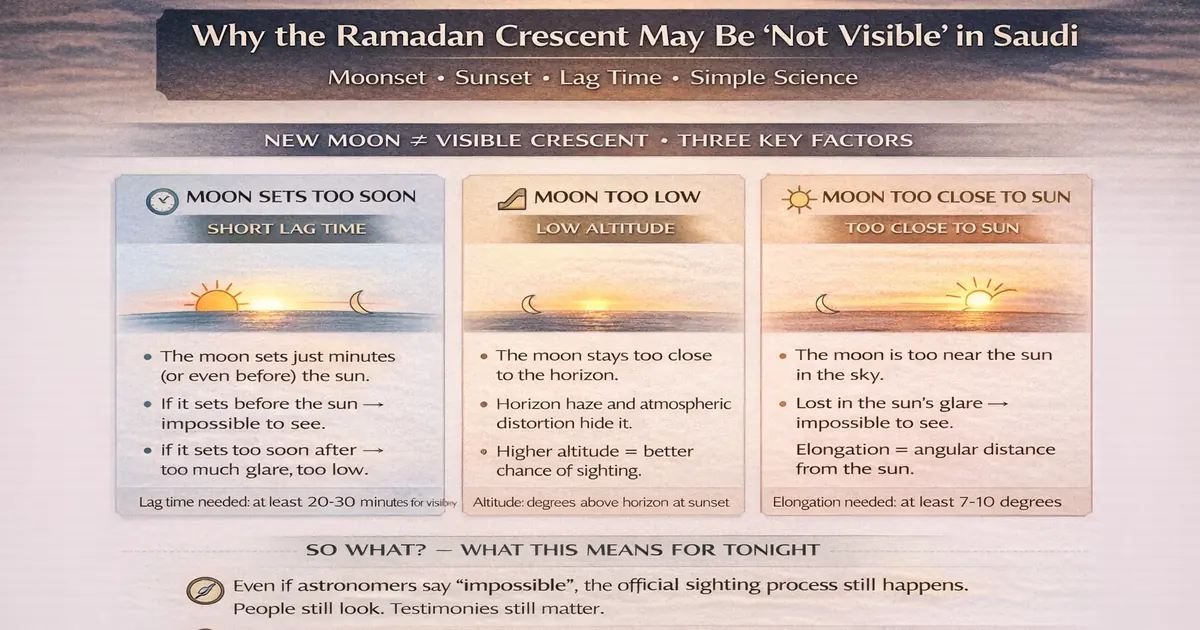
A crescent can be “not visible” when it sets too soon after sunset, stays too low behind horizon haze, or sits too close to the sun’s glare. That’s why “new moon” isn’t the same as a visible conjunction vs crescent outcome. In Saudi, these discussions help expectations, but the confirmed start follows the official decision on shaban 29 moon sighting.
the simple science box (one idea that removes 80% of confusion)
Answer-first: The easiest way to understand crescent not visible prediction is this: the first crescent is like a thin hairline of light, low near the horizon, competing with bright sunset glow. Even if the moon is “there,” it may not be “seeable.” That gap between “exists” and “visible” explains most “impossible” talk.
My students used to mix this up all the time: “If it’s born, we should see it.” Not always.
This is your simple science box: visibility needs time, angle, and a clear horizon—not just a calendar moment.
moonset + sunset: why a short window can kill visibility
Answer-first: One major reason for a crescent not visible prediction is a short viewing window after sunset. If the moon sets very soon after the sun, you get a tiny chance to spot a very faint crescent in bright twilight. That’s the core of the moon sets after sunset condition discussion.
People search what if moon sets before the sun because it sounds dramatic. The practical meaning is simple: if the moon is already gone (or almost gone) near sunset, your chance drops sharply.
Micro-scenario: you arrive late, the sky is still bright, and the horizon is dusty. You’re not “spiritually failing.” You’re dealing with physics and visibility.
lag time minutes after sunset: how much time helps (without fake numbers)
Answer-first: The phrase lag time minutes after sunset means: how long the moon stays above the horizon after sunset. More time usually means the sky gets darker, and the crescent has a better chance to show. Less time means it’s fighting glare the whole time.
People often ask how many minutes after sunset is needed to see crescent. There isn’t one magic number you can safely apply everywhere, because haze, altitude, and glare change the result. The safe takeaway is: a short lag time makes visibility harder, and a longer one makes it easier.
And yes, this is also part of timing window talk.
moon age hours visibility: “new” doesn’t mean “visible”
Answer-first: moon age hours visibility is about how long it has been since the moon’s “birth moment” (conjunction). A very young crescent is often too thin and too close to the sun’s glare to see, even if you know exactly where to look.
That’s why people ask what does moon age mean for visibility. Think of it like bread dough: it exists right away, but it hasn’t “risen” enough to be noticeable from far away. The crescent can be there, but it’s still a whisper of light.
Yes, you might hear why astronomers say crescent not visible tonight. Often, they’re talking about conditions that make that whisper even harder to catch.
elongation degrees visibility + altitude degrees visibility (two angles that matter)
Answer-first: Two technical words come up in visibility talk: elongation degrees visibility (how far the moon is from the sun in the sky) and altitude degrees visibility (how high the moon is above the horizon). Bigger separation and higher altitude usually make the crescent easier to see.
People ask what is elongation in moon sighting and what does altitude mean for crescent visibility because it sounds complicated. Here’s the friendly version: if the moon is too close to the sun, the glare washes it out; if it’s too low, the haze hides it.
That’s where thin crescent plus haze becomes a tough combination.
conjunction vs crescent: the “born” moon is not the hilal you’re looking for
Answer-first: conjunction vs crescent is the difference between an astronomical event (new moon moment) and an observable crescent (hilal). Conjunction can happen, yet the crescent still may not be visible the same evening.
If someone says, “Conjunction happened, so it must be Ramadan,” that’s a misunderstanding of what people mean by “visible crescent.”
And if someone says, “Astronomers said impossible, so sighting is fake,” that can also be an overreach. The safest stance is: visibility talk helps expectations; the official decision is what people follow publicly in Saudi.
clouds visibility + horizon haze: the boring reasons that cause most “not visible” nights
Answer-first: The most common real-world killers are not fancy terms. They’re clouds visibility problems and horizon haze. Even a “good” crescent can disappear behind dust, humidity, thin clouds, or city glow near the horizon.
That’s why people ask does cloudy weather change start of ramadan. Cloudy weather can reduce visibility. Then the community waits for the official outcome.
Micro-scenario: your family is on a rooftop, but your skyline is full of lights and haze. Move to a cleaner horizon if you’re serious. Or skip the stress and wait for the official decision.
telescope binoculars moon sighting: can optics help, and what should you do?
Answer-first: telescope binoculars moon sighting can help you spot a very thin crescent because optics make faint light easier to notice. That’s why people ask can binoculars help moon sighting. If you used optics, the honest move is simply to say so when reporting—don’t pretend it was naked-eye if it wasn’t.
This is also where the phrase why astronomers say impossible shows up. Sometimes “impossible” means “unlikely with naked eye under common conditions,” not “the moon does not exist.”
My small aside: I used to think binoculars were “cheating.” Then I realized—reporting truthfully is what matters, not the ego of how you saw it.
so what guidance (KSA-ready): expectations, rumors, and the official path
Answer-first: Here’s the practical part. crescent not visible prediction is an expectations tool, not a replacement for the official chain. In Saudi, the public start is tied to the official decision process on shaban 29 moon sighting. This is the KSA process still decides point.
So when you see hot takes online, remember: why rumors happen is simple—people confuse “prediction,” “claim,” and “official decision.”
This also helps you understand expected vs confirmed. A calendar can show an expected start. The confirmed start follows the official announcement after decision night.
One-sentence rule: don’t let screenshots start your Ramadan.
common beginner mistakes (and quick fixes)
Answer-first: Most confusion comes from the same five habits. Fix these, and you’ll feel calmer every year—especially when “not visible” starts trending.
- Mistake 1: Looking in the wrong direction. Fix: keep to the west direction after sunset.
- Mistake 2: Expecting a bright moon. Fix: expect a thin crescent low near the horizon.
- Mistake 3: Starting too early. Fix: wait for the actual timing window after sunset.
- Mistake 4: Trusting phone zoom as proof. Fix: use your eyes and honest reporting, not “camera certainty.”
- Mistake 5: Treating predictions as decisions. Fix: keep expected vs confirmed separate in your mind.
a short story: how one message turns into a fake “confirmation”
One year, a brother messaged me, “It’s confirmed—my cousin saw it.” He wasn’t trying to lie. He was just excited. Then the cousin’s friend reposted it with more confidence, and suddenly it became “official” in three different WhatsApp groups. Later, the official result didn’t match the rumor, and people felt embarrassed and angry. The next year, the same brother did something smarter: he waited, followed the official result, and the night stayed peaceful.
glossary (plain meanings, not textbook words)
Answer-first: If technical terms make you freeze, use this glossary. It’s built for normal readers: the word, the plain meaning, and the “so what” step.
📊 Show Visibility Glossary Table
| Term | Plain meaning | “So what” guidance |
|---|---|---|
| moonset before sun | Moon is already below horizon near sunset | Visibility becomes very hard; wait for official outcome |
| lag time minutes after sunset | How long moon stays up after sunset | Short lag time makes sighting harder |
| moon age hours visibility | How “young” the crescent is since conjunction | Very young crescents are often too faint |
| elongation degrees visibility | Moon–sun separation in the sky | Too close to the sun → glare hides the crescent |
| altitude degrees visibility | How high the moon is above the horizon | Too low → haze and buildings block it |
| conjunction vs crescent | “Born” moon moment vs visible hilal | Don’t treat conjunction as automatic sighting |
FAQs
📘 crescent not visible prediction FAQs
why astronomers say crescent not visible tonight?
Show Answer
Often because the crescent may be too low, too faint, too close to sunset glare, or the viewing window is too short. It’s a visibility expectation, not an official decision.
what if moon sets before the sun?
Show Answer
If the moon is already below the horizon near sunset, spotting a crescent becomes extremely difficult. In KSA, people still follow the official outcome for the start.
why is the crescent impossible to see if it sets right after sunset?
Show Answer
Because the sky is still bright, the crescent is extremely faint, and the viewing window is tiny. Glare plus haze can hide it.
what does moon age mean for visibility?
Show Answer
It means how long it’s been since conjunction. Very young crescents are often too thin and too close to glare to spot.
how many minutes after sunset is needed to see crescent?
Show Answer
There isn’t one universal number that works everywhere. The safer takeaway is: more time above the horizon usually helps, and a short window makes it harder.
what is elongation in moon sighting?
Show Answer
It’s how far the moon appears from the sun in the sky. If it’s too close, the sun’s glare can wash out the crescent.
what does altitude mean for crescent visibility?
Show Answer
It’s how high the moon is above the horizon. Higher usually helps; very low crescents can disappear into haze and buildings.
can binoculars help moon sighting?
Show Answer
They can help you notice faint light. If you used optics, report honestly that you used them, and avoid turning it into a social media “confirmation.”
does Saudi rely on calculations or sightings?
Show Answer
People discuss calculations for expectations and planning, but the public worship start follows the official decision chain on decision night.
Is Ramadan 2026 confirmed?
Show Answer
Treat it as confirmed only after the official announcement following the decision night process.
Is Ramadan 2026 moon sighted in Saudi Arabia?
Show Answer
It becomes a “yes” only when the official decision accepts the sighting and announces the start. Before that, it’s not final.
moon sighting ramadan 2026 islamic calendar: why can “expected” differ from “confirmed”?
Show Answer
Because calendars help planning, while the confirmed start follows the decision night outcome. That’s the expected vs confirmed difference.
why countries differ start date?
Show Answer
Different countries may follow different official methods and horizons. Inside KSA, the public follows the KSA official result.
moonsighting Ramadan 1447: does “not visible” mean nobody can see it anywhere?
Show Answer
“Not visible” is usually about expected difficulty under certain conditions. Final public practice still depends on the official decision in the place you live.
You Ca Also Read

Farrukh Farooqi has been living in Sharaya, Makkah, Saudi Arabia since 2010. With over 14 years of firsthand experience witnessing the sacred journey of millions of pilgrims, Farrukh specializes in providing practical, insider tips for Hajj and Umrah travelers. His work blends real-world observations, the latest Saudi updates, and essential crowd management strategies — helping pilgrims and worshippers plan smarter, stay safer, and experience a spiritually fulfilling journey across the Holy Cities.


