
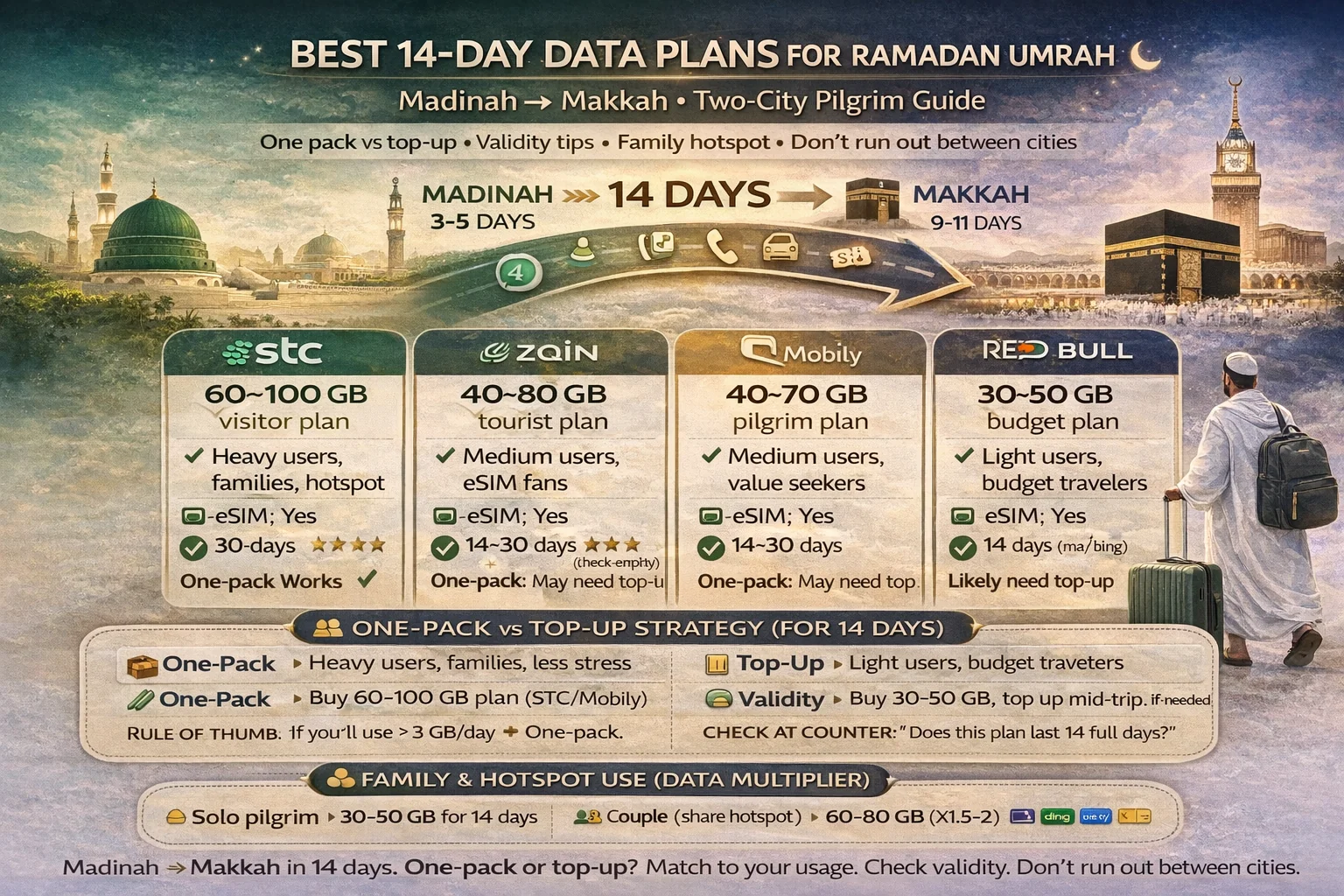
Best 14 day data plans for ramadan umrah saudi
A 14-day Umrah trip changes your phone needs.
It’s not a quick airport-to-hotel setup anymore.
It’s a living setup.
This guide on best 14 day data plans for ramadan umrah saudi is for real two-city pilgrim travel in Makkah and Madinah. Longer stays mean more app use, more family messages, more route checks, and more chances to run out at the worst time.
For a 2-week trip, your data plan is like travel food. One small snack won’t carry you all day. But buying too much “just in case” also wastes money. The smart move is a plan with enough base data and a simple backup top-up path.
✅ TL;DR – best 14 day data plans for ramadan umrah saudi
For 14-day Umrah trips, the best setup is usually a plan with enough base data plus a simple top-up path. Pilgrims often underbuy and recharge repeatedly, which creates stress. Choosing a package with clear validity and easy top-up options matters more than chasing the cheapest starting price.
14-day traveler profile
14-day traveler profile: A 14 day umrah sim package should be chosen differently from a short 7-day trip. A two-week pilgrim usually uses more data over time, not because of one big day, but because small daily use adds up.
That’s the part many people miss.
On a 14-day trip, your phone becomes part guide, part family line, part travel helper. You use Nusuk, maps, ride apps, WhatsApp, hotel contacts, and sometimes hotspot for another phone. Each task looks small. Together, they drain data steadily.
If you’re searching best 14 day data package for umrah in saudi or best plan for 10 to 14 day pilgrimage in ramadan, start by identifying your travel pattern:
- Madinah first, then Makkah (more movement, more maps use)
- Makkah only (more stable routine, data use may be lower)
- Family group (shared decisions and higher chance of hotspot use)
- Elderly + helper setup (simplicity matters more than package size)
This is why a two week umrah data plan should be chosen by travel routine, not only by a package name.
A lot of official visitor plans in Saudi are built around 14-day, 21-day, or 28-day windows. That’s useful for Umrah visitors because your validity often already matches or exceeds your trip. You just need to choose the right data level.
And if you’re comparing local sim vs roaming for two week umrah, local Saudi visitor plans usually make trip management easier for most pilgrims because recharge and support are simpler inside the country.
one-pack vs top-up strategy
One-pack vs top-up strategy: This is the biggest decision for a pilgrim internet package 2 weeks. Should you buy one bigger plan from day one, or buy a smaller one and top up later?
Both can work.
But one is usually calmer.
If you’re asking should i buy one package or top up weekly for umrah, the safer answer for most pilgrims is: buy a solid base plan first, then keep one backup top-up path ready. Don’t build your whole trip around repeated recharges.
Why? Because repeated top-ups create friction. You need time, app access, balance checks, and sometimes card/payment success. During Ramadan travel, that’s not always the moment you want to be troubleshooting.
Here’s a simple way to choose:
Choose one-pack first if you want less stress, you use your phone often, or you’re managing a family trip.
Choose smaller pack + top-up plan if you’re a light user, comfortable with telecom apps, and okay managing balance checks.
Micro-scenario: A pilgrim buys a small starter plan to “save money,” then tops up three times over 10 days. By the end, the cost is higher, and he spent more time checking data than needed. The issue wasn’t the network. It was the strategy.
If your question is can i extend visitor package during umrah stay, many Saudi telecoms offer recharge or add-on paths through apps and prepaid bundles, but the exact method depends on the carrier and package type. That’s why your backup setup matters on day one.
Don’t wait until you’re almost out.
📦 Package Strategy Box (Best for 14-Day Pilgrims)
Comfort setup: Buy one strong visitor plan + save one top-up method.
Budget setup: Buy a mid plan + check data halfway + top up only if needed.
Avoid: tiny starter pack + repeated random top-ups during travel days.
data planning by usage
Data planning by usage: The best saudi sim 14 days umrah setup depends on how you actually use your phone. Two people on the same trip can have very different data needs.
Use style beats package hype.
For a ramadan umrah two week package, use this simple model:
Light use (low stress setup):
Mostly WhatsApp messages, Nusuk, maps, and occasional browsing. You use hotel wifi at night. A smaller or mid visitor plan can work if you keep a top-up backup ready.
Medium use (most pilgrims):
Daily maps, ride apps, regular family updates, photo sharing, and some calls. This is the common 14-day pilgrim profile. A mid-to-strong plan is usually the best fit.
Heavy use (frequent video/hotspot):
Regular video calls, file sharing, or hotspot use for family members. This group should start with a stronger base package or expect a planned top-up.
If you’re searching how much data for maps and video calls over two weeks, the honest answer is that maps and WhatsApp alone are usually manageable, but frequent video calls and hotspot sharing quickly push you into a heavy-use setup.
One beginner thing I used to mix up early on: “I only use my phone for family.” Then you check, and “family” means daily video calls, live location, and photos all day. That’s heavy use, not light.
For umrah visitor data plan comparison, this is the real comparison that matters: your habits, not just plan names.
family and hotspot use
Family and hotspot use: A family umrah two week mobile data setup needs planning from the first day. Two weeks is long enough for small mistakes to become daily problems.
Hotspot is helpful.
Hotspot also drains data fast.
If you’re asking hotspot data needs for two week umrah family, the key is not to run the whole family on one weak line unless you truly planned for it.
Better family setup options:
- Main organizer phone: stronger plan (maps, bookings, coordination)
- Second adult or helper phone: backup line with basic data/calls
- Elderly phone: simple call+data setup, not a complicated app-only setup
This setup feels boring.
That’s why it works.
If you’re searching 14 day data plan for elderly and helper phones, choose simplicity first. A familiar physical sim and clear call+data line is often easier than trying to make everyone use one shared hotspot.
Quirky beginner mistake #1: family shares one line, then complains by day 5 that the network is “eating data.” Quick fix: split the load across at least two phones.
Quirky beginner mistake #2: elderly parent gets a data-only setup and can’t place direct calls. Quick fix: give them a line with calls + data.
Quirky beginner mistake #3: nobody labels which phone uses eSIM and which uses physical sim. Quick fix: write it down in notes on the organizer phone.
Quirky beginner mistake #4: family assumes hotel wifi will carry the whole trip. Quick fix: treat hotel Wi-Fi as backup, not the main plan.
Quirky beginner mistake #5: helper phone has no data, so the group gets stuck when separated. Quick fix: keep a basic backup line active.
A short story from a real travel pattern: one family stayed 13 days, moved from Madinah to Makkah, and used one phone as the “main internet.” It worked for three days, then everything became stressful—ride booking, hotel messages, and live location all depended on one tired phone battery and low data. The fix was simple: move the helper phone to a basic local plan and stop using hotspot for everything.
👨👩👧👦 Family Plan Box (Two-Week Umrah)
Main phone: stronger data plan for maps, Nusuk, rides, and hotel contact.
Backup phone: basic data/call line for separation days and emergencies.
Elderly phone: simple setup, easy calling, no complicated sharing.
validity pitfalls
Validity pitfalls: The most expensive data mistake is not usually “buying the wrong brand.” It’s ignoring validity. A plan can look perfect on price and data, then expire before your return flight.
This happens a lot.
If you’re asking what if package expires before return flight, the answer is simple: check the exact validity on day one and set a reminder before it ends. Don’t rely on memory during travel.
For a makkah madinah 14 day sim setup, watch for these validity traps:
- Buying a short plan by mistake when your trip is longer
- Assuming “14-day trip” means your travel time fits exactly inside plan validity
- Forgetting late-night arrival and late return still count
- Confusing package validity with line validity
That last one is important. Your line may still work, but your package data may be gone. Then apps stop, and it feels like the SIM died.
If you are comparing visitor package 14 days saudi choices, always screenshot the package details after activation. It sounds small, but it saves arguments later when you can’t remember what you bought.
And yes, a lot of pilgrims remember to check data size but forget to check the clock.
recharge timing
Recharge timing: A good saudi weekly recharge umrah plan is not “top up whenever it stops.” The better method is to top up at a calm moment, before the problem starts.
Timing matters more on long trips.
If you’re searching recharge timing for 14 day umrah trip, use this simple rule: check your balance around the middle of the trip, then again 2–3 days before your return. Those are the two safest checkpoints.
Best times to handle top-up:
- At the hotel on stable wifi
- When your battery is charged
- When you are not rushing to prayer or transport
Bad times to handle top-up:
- while trying to book a taxi
- right before checkout
- during low battery panic
If you’re using eSIM, the app path is especially important. Keep the telecom app installed and logged in. If you’re using physical sim, still keep the app if possible because it makes checks and recharge much easier.
Another small tip that saves people: keep one screenshot of your number and one screenshot of your package. My students always ask for the number at the worst time, and nobody remembers it.
final recommendations
Final recommendations: If you want the simplest answer for best 14 day data plans for ramadan umrah saudi, use plan type + backup method, not random package hunting.
Here’s the easy framework.
Best default for most pilgrims (10–14 days):
Choose a mid-to-strong local visitor package with clear validity, then save one top-up method. This is the safest answer for two week umrah sim package with enough data.
Best budget-comfort balance:
Choose a mid plan, use hotel wifi at night, and check data halfway through. This works well for budget vs comfort package for pilgrims 14 days.
Best for families:
Use one stronger organizer line + one backup line. Avoid a one-phone-only setup if your family moves around.
Best for heavy app/video use:
Start bigger or plan a top-up in advance. Don’t pretend a heavy-use trip will behave like a light-use trip.
Best for elderly travelers:
Keep it simple. A straightforward call+data setup usually beats app-only complexity.
Best for low-stress travel:
Pick the carrier and plan you can actually manage easily for recharge, app checks, and support. Ease is part of the value.
If you searched best network for 14 day makkah madinah trip, the honest answer is that STC, Zain, and Mobily all have official visitor options, and some pilgrims also consider Red Bull Mobile. The better choice is usually the one with the right plan fit, easy setup, and easy top-up for your trip style.
Set it up once, set a backup, and stop thinking about it. That’s the goal.
📊 best 14-day Umrah data plan setup table (comfort vs budget)
Use this table to choose the best 14 day data plans for ramadan umrah saudi by travel style, validity, and top-up comfort. This helps with two week umrah data plan and umrah visitor data plan comparison.
📶 Show 14-Day Pilgrim Plan Comparison Table
| Traveler type | Best plan style | Backup plan |
|---|---|---|
| Light-use solo | Mid visitor plan + hotel wifi | One saved top-up path |
| Medium-use pilgrim | Mid-to-strong visitor plan (best default) | Check balance mid-trip |
| Heavy-use / video calls | Strong base plan | Planned top-up before low balance |
| Family organizer | Stronger line for maps, Nusuk, rides | Second backup line in group |
| Elderly traveler | Simple call+data setup (often physical sim) | Helper phone with basic data |
FAQs
📘 best 14 day data plans for ramadan umrah saudi FAQs
what is the best 14 day data package for umrah in saudi?
Show Answer
For most pilgrims, a mid-to-strong local visitor package with clear validity plus an easy top-up option is the best setup for a 14-day trip.
two week umrah sim package with enough data: what should i pick?
Show Answer
Pick a package by your use style (light, medium, heavy). Most pilgrims do best with a mid-range or stronger visitor plan and one backup top-up path.
should i buy one package or top up weekly for umrah?
Show Answer
Usually one solid base package is calmer than repeated weekly top-ups. Then keep one top-up method ready in case your use is higher than expected.
best plan for 10 to 14 day pilgrimage in ramadan?
Show Answer
Choose a plan with clear validity that covers the full trip, then match data size to your use. Don’t choose by price alone.
family umrah two week mobile data setup: what works best?
Show Answer
Use one stronger organizer line and one backup line if possible. Avoid depending on a single hotspot for the whole family.
can i extend visitor package during umrah stay?
Show Answer
Many Saudi telecoms provide add-ons or recharge paths for visitor lines, but the exact method depends on the carrier and plan. Set this up early so you can top up easily if needed.
best network for 14 day makkah madinah trip?
Show Answer
STC, Zain, and Mobily all offer official visitor options, and some travelers also consider Red Bull Mobile. Choose by plan fit, setup ease, and top-up comfort.
hotspot data needs for two week umrah family?
Show Answer
Hotspot use can drain data quickly over two weeks. If one phone will share data, start with a stronger plan or keep a planned top-up ready.
esim package for 14 day saudi visitor: good option or not?
Show Answer
eSIM is a good option if your phone supports it and you’re comfortable with app-based setup. For some travelers, physical sim still feels simpler.
local sim vs roaming for two week umrah?
Show Answer
For most pilgrims, a local Saudi visitor SIM is easier to manage for recharge, support, and daily app use during a 14-day stay.
what if package expires before return flight?
Show Answer
Check your package validity on day one and set a reminder. If it’s close to expiring, top up before your return travel day.
recharge timing for 14 day umrah trip: when should i do it?
Show Answer
Check your balance around the middle of the trip, then again 2–3 days before your return. Handle top-up at the hotel on stable wifi, not during rush moments.
how much data for maps and video calls over two weeks?
Show Answer
Maps and messaging alone are usually manageable, but regular video calls and hotspot sharing push you into a heavier-use setup quickly.
budget vs comfort package for pilgrims 14 days: what is smarter?
Show Answer
Comfort usually means a stronger base plan plus a backup top-up. Budget works too, but only if you’re disciplined with hotel wifi and balance checks.
14 day data plan for elderly and helper phones: what is safest?
Show Answer
A simple call+data setup for the elderly phone plus a basic backup line for the helper is usually the safest and least stressful setup.
You Can Also Read
- Stc Vs Zain Vs Mobily vs Red Bull for ramadan umrah
- Best Sim For Umrah Visitors in ramadan saudi
- eSIM vs Physical Sim for Umrah in Ramadan
- jeddah airport sim buying guide
- Madinah airport sim setup umrah arrivals
- Nusuk Otp Not coming
- Best 7 day data plans for ramadan umrah saudi

Farrukh Farooqi has been living in Sharaya, Makkah, Saudi Arabia since 2010. With over 14 years of firsthand experience witnessing the sacred journey of millions of pilgrims, Farrukh specializes in providing practical, insider tips for Hajj and Umrah travelers. His work blends real-world observations, the latest Saudi updates, and essential crowd management strategies — helping pilgrims and worshippers plan smarter, stay safer, and experience a spiritually fulfilling journey across the Holy Cities.


