
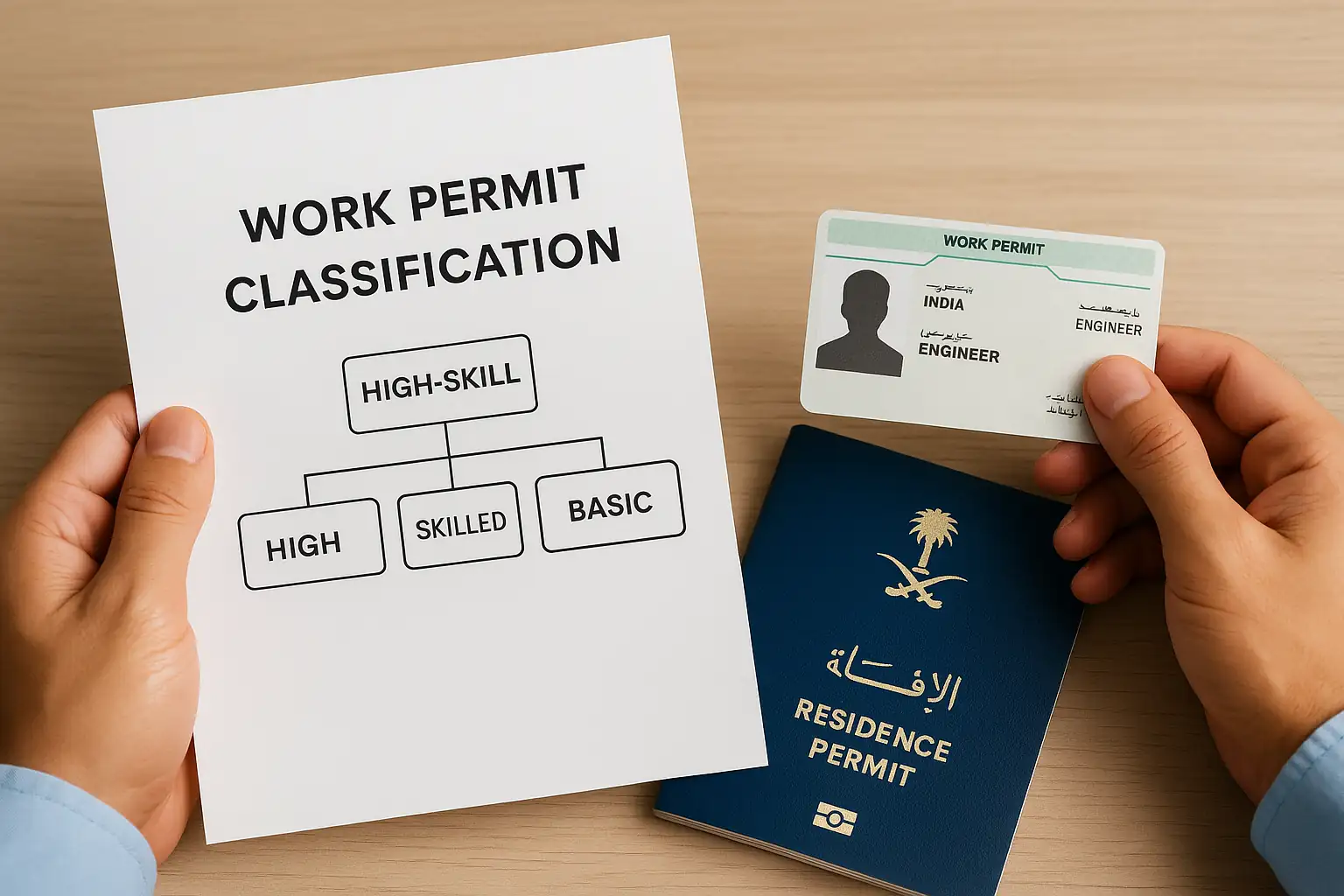
Saudi Arabia Work Permit Classification 2025: Full Guide to Expat Skill Tiers & Iqama Matching
This classification system may evolve. We update this guide monthly.
Ever felt stuck in a job that doesn’t match your skills, just because of a wrong job title on your Iqama?
Omar did. A certified engineer earning a technician’s wage, simply because his work permit didn’t reflect his real qualifications. That’s now changing.
✅ TL;DR – Saudi Arabia Work Permit Classification 2025
Saudi Arabia’s new skill-based work permit system classifies foreign workers into high-skill, skilled, and basic tiers. Reclassification for existing expats began on June 18, 2025, and for newcomers on July 1, 2025. Your category affects your salary, visa status, and eligibility to work in the Kingdom.
If your Iqama profession code doesn’t match your real qualifications, you can now fix it via the Qiwa platform. This change supports Saudi Vision 2030 and is designed to bring in top talent, boost efficiency, and remove mismatches in the labor market.
👉 Download the Quick PDF:
📥 Saudi Work Permit Classification 2025 – Tier Guide for Expats
Get the full breakdown of categories, salary thresholds, and upgrade steps in one printable PDF.
Why Did Saudi Arabia Change the Work Permit System?
Let’s be honest, the old system was messy.
Everyone, from a university graduate to a labourer, had the same permit style. Employers could assign any job title on the Iqama, even if it didn’t reflect actual skills.
That created chaos. People were overqualified, underpaid, and often stuck in roles that blocked career growth.
To fix that, the Ministry of Human Resources and Social Development (HRSD) launched this skill-based classification system.
It’s part of the wider Vision 2030 plan, which aims to:
- Build a smarter, competitive labour market
- Encourage the hiring of qualified workers
- Support giga-projects like NEOM, Qiddiya, and Diriyah
- Cut dependence on low-skilled labour
- Make job roles and salaries fairer
Saudi Arabia’s New Expat Work Permit Categories Explained
The new system classifies workers into three levels:
High-Skill
- Group codes: 1 to 3
- Requires a degree, a technical certificate, a high salary, and passing a points-based test
- Applies to doctors, engineers, IT professionals, consultants, etc.
Skilled
- Groups 4 to 8
- Requires experience, vocational training, and a minimum wage threshold
- Covers technicians, supervisors, drivers, and mid-level professionals
Basic
- Group 9
- Requires only skill accreditation
- The age limit is capped at 60 years
- Covers labourers, domestic workers, and non-certified support roles
Your permit now reflects your true skill tier, not just a random title on paper.
Expat Work Permit Classification Tiers – Full Comparison (2025)
📋 Saudi Arabia Work Permit Tiers – Qiwa 2025 Table
Saudi Arabia’s new work permit system classifies expats into high-skill, skilled, and basic tiers based on qualifications, salary, and job type. Each tier has its own Iqama profession codes, wage requirements, and upgrade paths. The higher the tier, the better the opportunities, including visa eligibility, job mobility, and access to promotions via Qiwa.
Click to View Full Tier Comparison Table
| Category Tier | Skill Code Group | Required Qualifications | Salary Threshold | Iqama Profession Examples | Upgrade Path |
|---|---|---|---|---|---|
| High-Skill | Groups 1–3 | Bachelor’s degree or above, technical license, professional accreditation | 12,000+ SAR/month | Doctor, Engineer, Software Developer | Pass Qiwa evaluation, submit certificates |
| Skilled | Groups 4–8 | Vocational diploma, 5+ years experience, accredited training | 5,000+ SAR/month | Technician, Supervisor, Licensed Driver | Add experience, increase salary, training docs |
| Basic | Group 9 | Accredited skills only, physical exam, no degree needed | 2,500–3,000 SAR | Labourer, Cleaner, Warehouse Helper | Apply for skill test, build documented history |
How to Check Your Iqama Profession Code & Skill Category
Checking your classification is simple. Here are the real working methods:
Method 1 – Absher App
- Log in and head to “My Services”
- Tap on “Employment Details”
- You’ll see your profession code
Method 2 – Qiwa Platform
- Visit Qiwa.sa and sign in
- Go to “Workforce” then “Employee Profile”
- You’ll see your skill level, linked to job group and classification
Method 3 – Iqama Card
Look at your Iqama card (front side). Your profession in Arabic is listed; compare it with the new Unified Saudi Classification of Professions
If it’s outdated or doesn’t match your real job, you may request a reclassification
Real Impact on Expats and Employers in 2025
This isn’t just policy on paper. It’s affecting real people in real time.
What Expats Must Know
- Your job role, visa renewal, and even family visa eligibility may now depend on the correct skill tier
- If you’re misclassified, you might earn less or face issues switching jobs
- You can now request a reassessment; experience counts even if you lack a formal degree
What Employers Must Do
- Review and update employee roles
- Use the Qiwa dashboard to align each staff member’s permit with their actual skills
- Failure to comply may result in permit rejection or fines
This makes hiring more transparent for both sides and helps the right people get the right jobs.
How to Upgrade Your Classification (Step-by-Step)
Worried your permit doesn’t reflect your real skills? Here’s what to do:
Step 1 – Gather Documents
Prepare your certificates, diplomas, and proof of experience
Step 2 – Apply via Qiwa
Log in and choose “Request Reclassification”
Step 3 – Accreditation
You may need to go through the Professional Accreditation Program
This includes uploading certificates and possibly passing a technical test
Step 4 – Points-Based Evaluation
Your age, salary, education, and experience are assigned a score
If your total points reach the threshold, you’re upgraded
Step 5 – Wait for Review
Approvals may take 1 to 3 weeks. You’ll be notified via SMS or Qiwa
This flexible system even allows you to compensate for a lack of education through hands-on experience
How to Upgrade a Saudi Work Permit Classification in 2025
To upgrade your Saudi work permit classification in 2025, follow these steps:
- Log in to the Qiwa platform
- Select “Request Reclassification”
- Upload certificates, experience proof, or vocational training docs
- Complete the Professional Accreditation Program, if required
- Wait 1–3 weeks for approval
Make sure your Iqama profession, salary, and age align with the next skill tier. Points-based scoring allows experience to balance a lack of education.
What If I’m a New Worker Entering Saudi Arabia?
If you’re applying for a job in Saudi Arabia from abroad:
- Make sure your employer lists your real professional title
- Your visa and Iqama will match the skill tier in your contract
- Don’t settle for “general labour” or low-tier entries if you’re qualified
- You must pass the Professional Verification Program if required
This is a major upgrade for professionals worldwide wanting to work in the Kingdom. The bar is higher, but so is the reward.
Saudi Arabia’s Labour Market in 2025: Key Stats
- Total expat population: 15.7 million (44.4% of total population)
- Working-age expats (15–64): 89.9% are employed in productive roles
- Unemployment rate (non-Saudis): Just 0.8% as of Q1 2025
- Remittance volume: SR12.78 billion ($3.41B) in February alone
- Top industries hiring skilled expats: Healthcare, Engineering, Education, Construction, Tech
Tools to Track & Manage Your Permit Classification
Use these real platforms (no scams, no shady apps):
- Qiwa.sa – Official reclassification, employee profile, and permit management
- Absher.sa – View profession codes and visa-related services
- Taqat.sa – National labour portal (for locals and expats)
- Professional Verification Program – Required for specific high-skill roles (check per country)
Tips for Employers: Avoid Rejection, Boost Retention
- Assign roles that match the employee’s real qualifications
- Avoid using general categories like “worker” or “technician” unless applicable
- Monitor age limits (especially for basic-tier jobs)
- Set fair salary thresholds, and each skill level has a minimum wage expectation
Needless rejections can cost you money and delay projects. Fixing this early saves everyone time.
📋 FAQs – STC Work Permit System
How do I know if my work permit is high-skill or not?
Check your profession group on Qiwa. If it’s group 1 to 3, you’re likely in the high-skill tier.
Can I change my Iqama profession to match my degree?
Yes. Apply via Qiwa with updated credentials and request reclassification.
What’s the age limit for work permits in Saudi Arabia?
For basic-tier jobs, the age limit is 60 years. There’s no cap for high-skill roles.
Does this new system affect family visa eligibility?
It can. Certain family sponsorships require high-skill classification and minimum income thresholds.
How long does reclassification take?
Expect 1 to 3 weeks, depending on your documents and verification steps.
Is there a salary requirement for skilled categories?
Yes. You must meet or exceed the wage threshold based on your classification.
Can employers downgrade employee categories?
Only if your role changes. Downgrading without cause may trigger worker disputes.
What if I have experience but no formal education?
You may still qualify under the points-based system. Experience can compensate for education gaps.
Are tourists or freelancers included in this reform?
No. This applies to work permit holders with residency. Freelance permits are under separate programs.
How often should I update my professional title?
Whenever your role changes, you get promoted, or you gain new qualifications. Don’t leave it outdated.
You Can Also Read
- Umrah Visa on Arrival 2025: New Saudi Rules Explained (Avoid Rejection!)
- Saudi Arabia’s 2025 Umrah Regulations: Visa Ban, Deadlines & New Fines
- Umrah 2025 Season: Visa Dates, Nusuk App & Travel Rules (1447 AH Guide)

Farrukh Farooqi has been living in Sharaya, Makkah, Saudi Arabia since 2010. With over 14 years of firsthand experience witnessing the sacred journey of millions of pilgrims, Farrukh specializes in providing practical, insider tips for Hajj and Umrah travelers. His work blends real-world observations, the latest Saudi updates, and essential crowd management strategies — helping pilgrims and worshippers plan smarter, stay safer, and experience a spiritually fulfilling journey across the Holy Cities.


