

Riyadh ul Jannah – Garden of Paradise in Masjid an-Nabawi (2026 Complete Guide)
Ever stood in front of the golden gates in Madinah and felt a chill run down your spine? You’re not alone.
For millions of Muslims, Riyadh ul Jannah is more than a spot on a map. It’s a place where hearts soften, duas pour out, and eyes well up. It’s not just history. It’s heaven on Earth.
🔹 TL;DR – Riyadh ul Jannah in a Snapshot
• Riyadh ul Jannah literally means “Garden of Paradise” and is located between the Prophet Muhammad’s (PBUH) pulpit and his blessed chamber in Masjid an-Nabawi.
• The iconic green carpet marks it and has immense spiritual significance. Praying here is believed to be like praying in Jannah itself.
• Visiting this area requires an appointment via the Nusuk app, with separate time slots for men and women.
• This guide includes how to enter, what duas to make, the Rawdah map, the history of the pillars, and practical tips for 2025 pilgrims.
What is Riyadh ul Jannah? (Meaning & Spiritual Background)
The Rawdah, also known as Riyad al-Jannah, is one of the most sacred spaces inside the Prophet’s Mosque in Madinah, a place beloved to the heart of the Prophet Muhammad ﷺ. For most Muslims, it is not just a historical building, but a part of spiritual reality when you hear the Prophet (PBUH) say Between my house and my pulpit is one of the gardens of the Bukhari Muslims’ Paradise.
You stop and think because this unique story has transformed what should be a small part of the mosque into one of the most spiritually moving places on the planet, not because of its architecture, not because of its fame, but because of its divine associations.
Anyone who has ever stood there knows this indescribable feeling, silent but not empty, crowded but never chaotic, and the moment your feet touch this green carpet, something changes. The hustle and bustle of the outside world disappears, time slows down people cry without knowing why. Others froze, not knowing what to say because their hearts were louder than their minds.
This is Riyadh-ul-Jannah, a physical space with metaphysical weight, measuring a few square meters, that has carried prayers, tears, and dreams for centuries.
Experts describe it as a literal part of Gianna or, at least, as a place that reflects her divine tranquillity and peace. Others believe that it is a reflection of an earthly echo of the heavenly gardens, intended for believers.
And here is the beautiful paradox: it is intimate and universal, and each pilgrim experiences it differently. For one, it is a place where one can ask for forgiveness; for another, it is a place where dreams come true.
Some use it to thank God for healing, while others are discouraged
He fell without saying a word
In a world overflowing with noise and screens, stepping into the Rawdah feels like leaving the dunya behind and entering a space where only your soul and Allah remain.
You don’t need to speak Arabic, and you don’t need to be a scholar; all you need is your presence and intention, the rest.
Therefore, when people call it the Garden of Eden, it is not just a label; it is a living reality, a piece of paradise given by the grace of Allah, resting peacefully in Madinah, waiting for a sincere heart.
And if you haven’t stood there yet, know that when you do, you will never see prayer the same way as before
Physical Placement
It is located between the pulpit and the prophets’ chamber, a space now surrounded by striking golden gates that are revered in silence. When you first approach it, you may not immediately realise its depth.
But as you stand there, something settles in your chest; this is not just a part of the mosque and the prophets, this special place is filled with the traces of the prophets, their sermons, their tears, their prayers, every inch of it seems sacred.
Originally, this area was about 22 meters long and 15 meters wide. But over time, as renovation work expanded and the carpets on the floor were replaced, these once-clear physical boundaries began to blur. What was once easily recognisable by its distinctive green carpet now lines up with the same floor throughout the mosque.
But subtle traces remain. Painted pillars. The quiet gathering of believers who only know that they are standing on holy ground
You won’t find any signs or labels to say you’re here. But there’s an unspoken recognition, a soft silence that envelops people as they enter, eyes scanning the room for the pulpit, seeing the golden railings that protect the last shrine of the prophets, and then you realise that you’re truly living in an era.
Riyadh-ul-Janneh is located right between two of the most important historical and spiritual points in all of Islam. The combination of historical authenticity with deep emotional resonance makes this an unforgettable place.
This is the place where the Prophet (peace be upon him) performed his prayers, met with his companions, and received revelations. This is not fiction; this is living history, and every reconstruction since has been careful and conscious not to disturb this spiritual footprint.
Modern expansion may have changed the texture and colour, but the soul of this place has not changed at all. Pilgrims who come here are often amazed, not because someone told them this was holy ground, but because their hearts tell them that this knowledge comes without explanation.
You don’t need a scientist to help you figure it out; you just need to stand still, observe, and breathe in the heritage that reflects this place all around you.
That’s why, even as its borders now blend into the surrounding green carpet, seasoned pilgrims will tell you that once you step inside, you realise that it’s not the size that matters, but presence. That the space here is physical. It’s the meeting point between this life and Gianna’s promise.
Why It Matters So Much
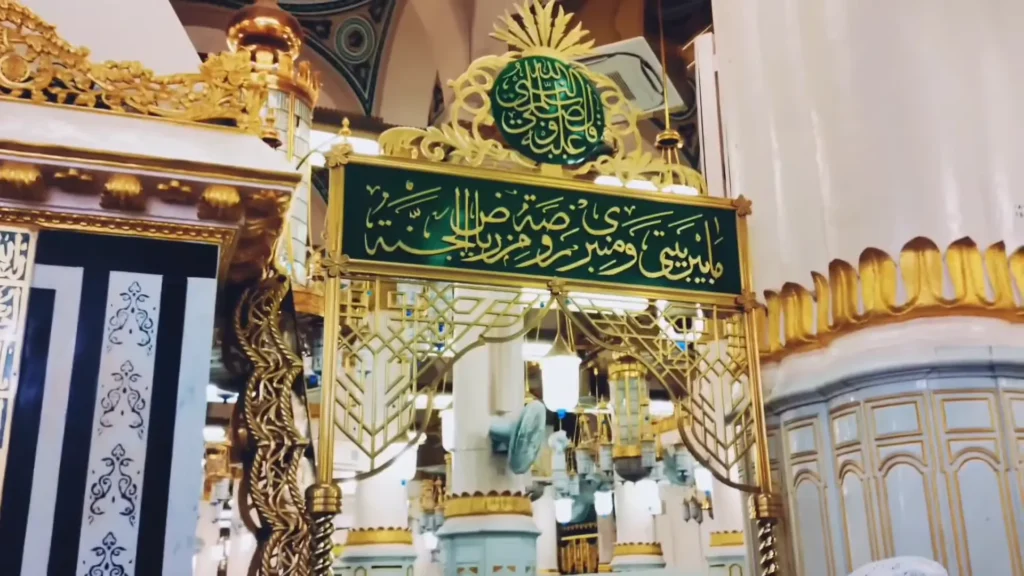
- Special Mercy Descends Here: Scholars interpret that this area reflects divine peace and closeness to Allah.
- Salah Accepted: Supplications here are more likely to be answered.
- It is a physical piece of Jannah or at least mirrors it in tranquillity and light.
Entering Paradise’ Garden in 2026: A Guided Walk Through Rawdah Booking & Entry
Praying in this sacred space is a dream for every pilgrim, but entry is tightly controlled…
Step 1: Download the Nusuk App
Use the official Nusuk app, available on Android and iOS.
Step 2: Register Your Visa
Use your Umrah/visit visa number to sign up.
Step 3: Choose the Right Option
Pick:
- “Praying in the Noble Rawdah – Men” or
- “Praying in the Noble Rawdah – Women”
Step 4: Select Date & Time
You can only book once per year. Choose wisely.
Step 5: Confirm & Save the QR Code
You’ll get a confirmation. Please don’t lose it.
Bonus Tip:
Want a smooth experience? Visit during midweek days (Tue/Wed) and early morning slots.
Where It All Began: The Story Behind the Prophet’s Garden
Foundation of the Masjid

When the Prophet Muhammad (peace and blessings of Allah be upon him) moved to Madinah, his first act after settling in was not to build a house or provide food but to establish a mosque, which in itself speaks volumes. The mosque and the Prophet’s Mosque are not just places of prayer; they are the heart of the Muslim community, a sanctuary, a court, a school, a place where souls meet truth and hearts meet healing.
The area we now call the Rawdah has become the core of this foundation. This is where the Prophet (peace and blessings of Allah be upon him) stood with his companions, led prayers, received revelations, and even gave advice to tribes who came from faraway lands. You don’t just see how the rituals take place there; you watch as the story unfolds in real time.
Every sermon that echoes through these walls becomes a thread in the fabric of Islam.
People often forget that the Messenger of Allah (peace and blessings of Allah be upon him) did not build the Prophet’s Mosque in isolation. He physically laid bricks side by side with his companions.
He carried stones, sang encouragement, and reminded everyone that building a house is a process. Behind the walls of the mosque, you can feel it when you stand where it used to be
From Palm Trees to Pulpit
The mosque you see today has stunning marble domes and bright, wide, and air-conditioned tents, but step back in time and you will see something completely different. The first roof of the mosque was made from the trunks and leaves of palm trees. Yes, simple date palms
The walls were made of clay bricks. The floor was made of sand. There was no grandeur, no gold, no ornate minarets.
Yet it was the most powerful gathering place on Earth
The Prophet (peace and blessings of Allah be upon him) originally preached the sermon leaning on the trunk of a date palm tree; this image alone was powerful. The messenger of Allah was surrounded by his followers, no fancy platforms, just the truth spoken from the bottom of his heart
Eventually, his companions suggested a change; they offered to build him a pulpit, and the Prophet (peace and blessings of Allah be upon him) agreed. This was followed by a simple but significant structure, wooden beams, eventually replaced with a three-tiered pulpit
That’s where it gets touching: on the day he started using this pulpit, the tree trunk he was leaning against started crying loudly, and his companions could hear it. And the Prophet (peace and blessings of Allah be upon him) came down from his new pulpit, came and hugged the tree trunk until it calmed down
This moment still resonates in Islamic teachings as a symbol of deep devotion and emotional connection, even between creation and its Prophet
After him, Abu Bakr (may Allah be pleased with him) used the second step. And Umar (may Allah be pleased with him) went down lower and stood on the first step out of humility
This tradition reflects the great respect of the early caliphs for the Prophet. May Allah bless him and grant him peace. They physically lowered themselves out of respect for his position
Mehrab Nabawi (Prayer Niche)
Now step further and you will see the Mihrab Nabawi, a symbolic niche that marks the spot where the Prophet (peace and blessings of Allah be upon him) stood and led the prayer. It was not part of the original design of the mosque. It was added during the later Umayyad and Ottoman expansions.
But rather as a commemorative element
Yet when you stand beside it today, you can almost imagine the Prophet praying. Facing the Qibla, leading the early Muslim community in silent reverence
This prayer niche is not only an architectural feature. It carries emotional weight. For you are not only seeing where the leader stood
You are witnessing the spiritual axis of the nation in its infancy, guided by revelation, faith, and love.
For many visitors who stand in this place, it gives rise to an indescribable wave of gratitude and longing.
You don’t just stand there and move on. You stand there and reflect
Green Carpet Symbolism
Let’s talk about this green carpet, which everyone says is more than just a visual signal. This corner of the mosque has quietly held a meaning that words rarely capture. While the rest of Masjid al-Nabawi is covered in red, this holy section has always stood apart with its lush, green floor.
Pilgrims scan the mosque for that colour, and the moment their eyes find it, their hearts start racing. That green doesn’t just mean you’re near. It means you’ve arrived. You’re standing in Rawdah.
But here’s where it gets tricky. During the recent renovation, the entire mosque was layered with green carpet. No more visual contrast. So, how do people know they’re in the real Rawdah now?
They search for the pillars. Specific ones. With calligraphy plaques and soft velvet ropes around them. The layout hasn’t changed. And no, the emotional weight hasn’t dulled either. It’s just… quieter now. Like other sacred things, it takes intention and awareness to really recognise
And despite the uniform green, when you enter the real Riyadh-ul-Jannah, something inside shifts. There’s a pull. A stillness. The air feels heavier, not in a physical way, but in a deeply spiritual one. Most pilgrims don’t need signs. they feel it in their bones before their eyes.
From the days of the palm leaf roof to the pulpit built with love, and from the red carpet of old to today’s green horizon, the evolution of Rawdah is not just about architecture. It’s about a living place. A beating heart of Islam that has touched generations
And for those blessed to step inside even once, it never leaves them. That moment becomes a permanent entry in their soul’s memory.
Architectural Wonders of Rawdah
The 8 Pillars and Their Stories
These aren’t just columns. Each has a name, history, and legacy:
- Ustuwaanah Hannanah (the weeping pillar)
- Ustuwaanah Aieshah (Aisha’s pillar)
- Ustuwaanah Tawbah (pillar of repentance)
- Ustuwaanah Wufud (pillar of delegations)
- Ustuwaanah Haras (pillar of the guards)
- Ustuwaanah Mukhallaqah (perfume pillar)
- Ustuwaanah Sarir (Prophet’s resting place)
- Ustuwaanah Jibraeel (pillar where Angel Jibraeel visited)
Each one has a plaque and a calligraphic sign to help you identify it.
Minbar Nabawi (Pulpit)
The current pulpit was installed in 998 AH by Sultan Murad. It has seven steps, and the Khateeb uses the seventh for Friday sermons.
Rawdah Map & Entry Points (2026 Layout)
Entry Gates
- Bab-e-Jibril (Main entrance for Rawdah)
- Bab-e-Rahmah
- Bab al-Salam
Recognising the Rawdah
- Look for the green carpet.
- Find the pillars with plaques.
- Position yourself between the Minbar and the Golden Gates.
What to Do in Riyadh ul Jannah
Before Entering
- Perform wudu.
- Wear clean, respectful clothing.
- Switch the phone to silent.
Inside the Rawdah
- Pray 2 rakats of Tahiyyatul Masjid
- Make heartfelt duas
- Send Salawat upon the Prophet (PBUH)
- Recite the Quran or reflect silently
After Leaving
- Thank Allah for allowing you to pray in paradise.
- Avoid selfies or turning your back on the Prophet’s grave.
Powerful Duas to Read in Riyadh ul Jannah
Visiting Riyadh ul Jannah is not just about being physically present in a sacred space. It’s about letting your heart speak when words fall short. Below are authentic duas that many pilgrims recite while in the garden of Jannah.
These are short, easy to remember, yet deeply powerful. You can whisper them from your soul or read them slowly with reflection. Here’s the full list with Arabic, transliteration, English meaning, and why each one matters.
🕌 Salawat on the Prophet (PBUH)
Arabic:
اللَّهُمَّ صَلِّ عَلَىٰ مُحَمَّدٍ وَعَلَىٰ آلِ مُحَمَّدٍ
Transliteration:
Allahumma salli ‘ala Muhammad wa ‘ala Aali Muhammad
Translation:
“O Allah, send blessings upon Muhammad and the family of Muhammad.”
Why:
Sending Salawat is one of the most beloved acts in Riyadh ul Jannah, as it’s the closest physical location to the Prophet’s (PBUH) grave. This dua connects you directly to him, honours his legacy, and opens the door to divine mercy. It’s also encouraged by the Hadith when visiting his mosque.
🌧️ Dua for Forgiveness
Arabic:
رَبِّ اغْفِرْ لِي، وَارْحَمْنِي، وَاهْدِنِي، وَعَافِنِي، وَارْزُقْنِي
Transliteration:
Rabbighfirli, warhamni, wahdini, wa‘afini, warzuqni
Translation:
“My Lord, forgive me, have mercy on me, guide me, give me health, and provide for me.”
Why:
This is a comprehensive supplication for your dunya and akhirah. In the Rawdah, where prayers are more likely to be accepted, it’s the perfect moment to seek complete healing, spiritually, emotionally, and physically.
🌿 Dua for Jannah and Protection from Hellfire
Arabic:
اللَّهُمَّ إِنِّي أَسْأَلُكَ الْجَنَّةَ، وَأَعُوذُ بِكَ مِنَ النَّارِ
Transliteration:
Allahumma inni as’aluka al-jannah wa a’oodhu bika min an-naar
Translation:
“O Allah, I ask You for Paradise and seek refuge in You from the Fire.”
Why:
You’re in a place literally called Garden of Paradise. What better time to ask Allah to make you worthy of Jannah, and to keep you away from the punishment of Hellfire? It’s short, sincere, and straight to the point, just like the most heartfelt duas.
🕊️ Dua for Peace in the Family
Arabic:
رَبَّنَا هَبْ لَنَا مِنْ أَزْوَاجِنَا وَذُرِّيَّاتِنَا قُرَّةَ أَعْيُنٍ، وَاجْعَلْنَا لِلْمُتَّقِينَ إِمَامًا
Transliteration:
Rabbana hablana min azwajina wa dhurriyyatina qurrata a’yunin waj’alna lil-muttaqina imama
Translation:
“Our Lord, grant us comfort from our spouses and offspring comfort to our eyes and make us leaders of the righteous.”
Why:
This dua is a healing prayer for families. In the stillness of this space, hearts open, not just for personal needs, but for parents, children, friends, and strangers alike. Whether you’re asking for righteous children, a better marriage, or peaceful relationships, this dua is your spiritual anchor.
❤️ Bonus Tip:
You don’t need to memorise everything in Arabic. You can also pour out your heart in your own language. Allah hears you in English, Urdu, Malay, Hausa, Somali, or even in silent tears.
In this quiet space, what reaches Allah isn’t eloquence. It’s honesty. Whether you’re whispering a personal dream, apologising for your past, or just saying “Thank You,” it all counts.
Rules & Etiquette for 2026 Visitors
- No pushing or shouting
- Respect guards and ushers
- Do not block others from praying
- Avoid long recording sessions
- Be gentle. Be patient. Be spiritual.
Female Timings (2026)
Women have separate Rawdah access:
- Usually early morning
- Limited to one visit annually
- Check the Nusuk app for real-time slots
Emotional Reflections from Pilgrims
“I broke down the moment my forehead touched that green carpet. I wasn’t ready for it. My entire life led up to that one sujood.”
“It felt like I could hear the footsteps of the Sahabah echoing around me. This isn’t just a space. It’s a memory come alive.”
📌 FAQs about Riyadh ul Jannah
What is Riyadh ul Jannah?
It’s the sacred area between the Prophet’s ﷺ pulpit and his blessed chamber in Masjid an-Nabawi, believed to be a piece of Jannah.
How can I book an appointment for Riyadh ul Jannah?
Use the Nusuk app, select “Praying in Noble Rawdah“, pick your time slot, and confirm the booking.
Why is Riyadh ul Jannah so special?
Because the Prophet ﷺ called it a garden from paradise. It’s one of the holiest and most spiritually rewarding places on Earth.
What should I recite inside Riyadh ul Jannah?
You can offer voluntary salah, make duas, recite Qur’an, and send Salawat on the Prophet ﷺ.
Can women enter Riyadh ul Jannah?
Yes, but during specific female-only time slots announced via the Nusuk app.
Do I need a permit to visit Riyadh ul Jannah?
Yes. As of 2025, entry is only allowed with a confirmed appointment.
How long can I stay in Riyadh ul Jannah?
Usually around 10–15 minutes based on crowd control and flow.
How do I find Riyadh ul Jannah inside the mosque?
Look for the green carpet, the golden gate area, and the minbar (pulpit).
What time is best to visit Riyadh ul Jannah?
Early morning weekdays are generally less crowded than weekends or after Fajr prayer.
Can I visit Riyadh ul Jannah during the Hajj season?
Yes, but it’s extremely busy. Booking in advance is highly recommended.
📍 Conclusion: Your Moment in Jannah
Riyadh ul Jannah is not just a place. It’s a memory waiting to be made. It’s the kind of experience that stays in your heart long after your visit ends. So when you finally enter, put your phone aside, focus your heart, and pray deeply. You may forget buildings and streets—but you’ll never forget making sajdah in paradise.

Farrukh Farooqi has been living in Sharaya, Makkah, Saudi Arabia since 2010. With over 14 years of firsthand experience witnessing the sacred journey of millions of pilgrims, Farrukh specializes in providing practical, insider tips for Hajj and Umrah travelers. His work blends real-world observations, the latest Saudi updates, and essential crowd management strategies — helping pilgrims and worshippers plan smarter, stay safer, and experience a spiritually fulfilling journey across the Holy Cities.


