
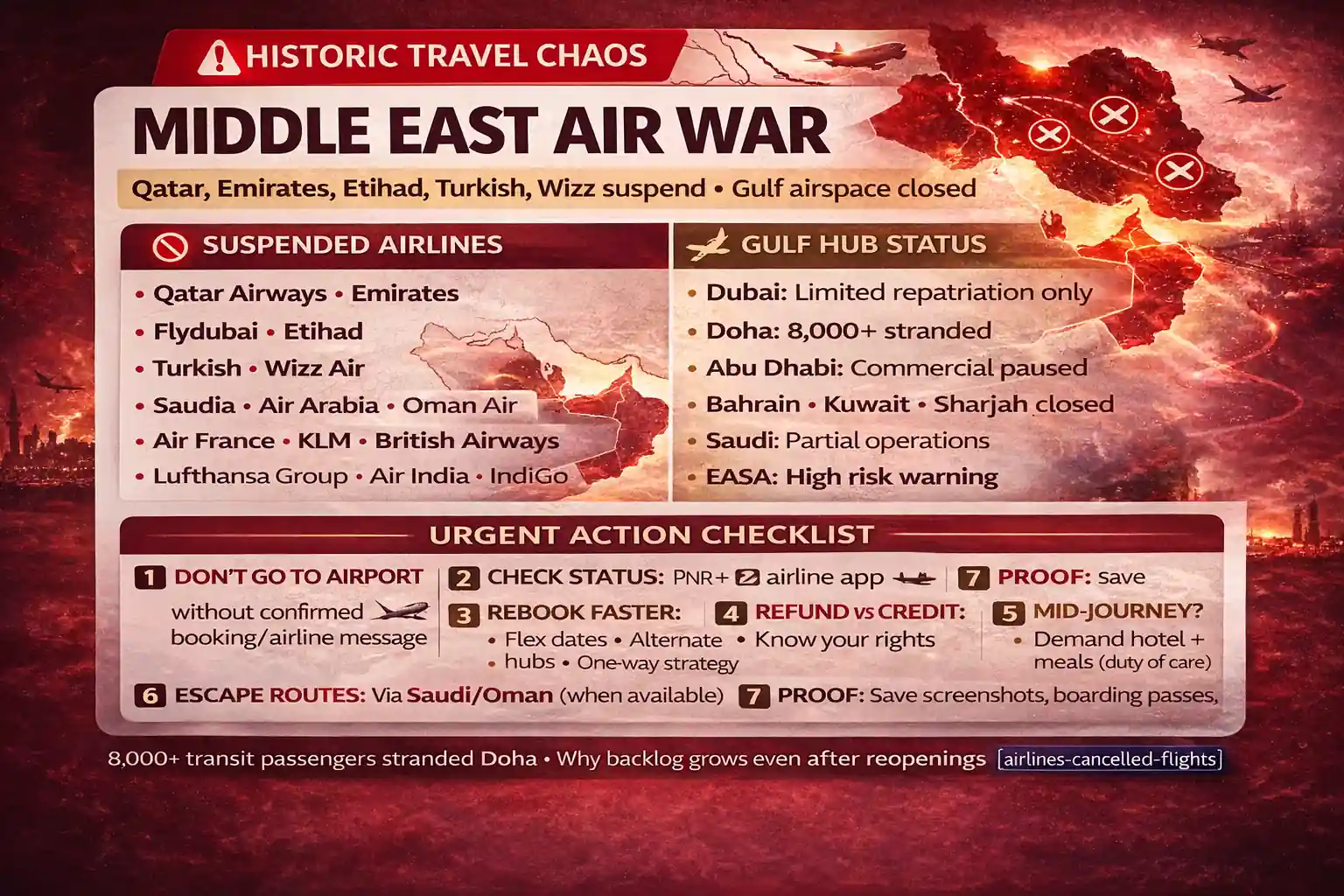
Middle East Air War Triggers Historic Travel Chaos: Qatar Airways, Emirates, Etihad, Turkish, Wizz & More Suspend Flights as Gulf Airspace Closes
It’s not “a few delays.” It’s a system break.
Across the Gulf, airspace restrictions and sudden airport slowdowns have triggered a rolling wave of suspensions. People are searching the same thing every hour: Middle East flights cancelled today, Emirates flights cancelled, and When will Middle East airspace open.
This page gives you the fast truth: what’s closed, who stopped flying, what Dubai/Abu Dhabi/Doha are actually doing, and what stranded travellers should do right now.
✅ TL;DR – Middle East flights cancelled today
Middle East flights cancelled today are being driven by conflict-linked airspace closures and safety restrictions across key corridors. Major Gulf hubs (Dubai/Doha/Abu Dhabi) are operating in “limited restart” mode—mostly repatriation, cargo, and tightly controlled departures. If you’re travelling now: don’t go to the airport without a confirmed message, rebook with flexible dates, and collect proof for refunds and claims.
Why are flights being cancelled across the Gulf right now? (Quick Answer)
Why are flights being cancelled across the Gulf right now? Because escalation triggered rapid airspace closures and corridor restrictions, and airlines can’t safely operate normal schedules through high-risk regions. Gulf hubs depend on predictable overflight routes. When those routes become unsafe or blocked, cancellations and mass reroutes happen in hours, not days.
What triggered the “sky lockdown” (airstrikes → retaliation → airspace closures)
The pattern is being described like this: strikes → retaliation → governments and aviation authorities tighten access to airspace and airports. Airlines then pause, cancel, or reroute at scale. That chain reaction is why travellers feel a “sky lockdown” even if they’re nowhere near the conflict zone.
Which airspaces are closed or restricted (Qatar, UAE, Saudi, Bahrain, Kuwait, Iran, Iraq, etc.)
Which airspaces are closed or restricted? Lists have shifted fast, but repeated reporting has described closures and heavy limits affecting routes over Iran, Iraq, and Israel, plus restrictions in parts of the Gulf, including Qatar, Bahrain, Kuwait, and corridors that impact UAE and Saudi operations. In plain language: even “open” airports can’t run normal schedules if the safe corridors are squeezed.
Why Gulf hubs matter (Dubai/Doha/Abu Dhabi = global transfer chokepoints)
Why do Dubai/Doha/Abu Dhabi disruptions hit the whole world? Because these hubs are global transfer chokepoints linking Europe and the Americas with Asia and Africa. When one hub freezes, aircraft and crews end up in the wrong places, connections collapse, and cancellations spread far beyond the Gulf.
Which airlines have suspended flights? (Airline-by-airline list people search)
Which airlines have suspended flights? A mix of Gulf carriers, European majors, and South Asian airlines have paused or reduced services, often with exceptions for repatriation, cargo, and “positioning” flights. The fastest way to treat this list: assume your flight is at risk until your PNR shows “confirmed and operating.”
Qatar Airways: flights paused until Qatar airspace reopens
Qatar Airways flights paused means: commercial operations are on hold while airspace remains shut, and resumptions depend on regulator approval. If you’re Doha-connecting, focus on rebooking paths first, not rumours.
Related: Qatar Airways Doha suspended 2026
Emirates + Flydubai: limited repatriation / freighter flights only
Emirates flights cancelled
Related: Dubai flights suspended (Mar 3, 2026)
Etihad: scheduled commercial flights paused; select evacuations operating
Etihad commercial flights paused typically means regular schedules stop, while select evacuation/repatriation flights may run under special approvals. Don’t assume “Etihad is flying” means “your Etihad flight is flying.” Check your booking status first.
Related: Etihad Abu Dhabi flights suspended 2026
Turkish Airlines: wide regional suspension list
Turkish Airlines has been described in rolling updates as having one of the broadest suspension sets across Gulf and nearby destinations. For travellers, the practical point is the same: confirm your specific flight number and date; don’t rely on a general headline.
Wizz Air: suspensions to Israel/UAE/Amman/Saudi (and more)
Wizz Air has been reported as suspending multiple routes (including Israel and parts of the Gulf). Low-cost carriers often have fewer backup options during mass disruption, so rebooking flexibility matters even more.
Saudia + Air Arabia + Oman Air + Gulf Air: rolling suspensions explained
Rolling suspensions means the airline keeps extending or adjusting pause windows as airspace rules change. You might see “suspended until X time/date” and then a new update hours later. Treat every update as temporary until you see a stable multi-day schedule.
Air France, KLM, British Airways, Lufthansa Group: cancellations + reroutes
European carriers have been cancelling and rerouting away from affected airspace. Even when they operate, routes may take longer and arrive late because they avoid entire regions.
Air India, IndiGo, Air India Express: suspensions + limited rescue flights
South Asian carriers face huge passenger pressure due to expat travel volumes. Expect a mix of pauses plus limited rescue flights on select corridors, depending on permissions and safe routing.
Related: Air India flight cancellations (March 1, 2026)
Dubai’s slow restart: what’s actually flying right now?
What’s flying from Dubai right now? A cautious, limited restart—often focused on controlled departures, plus repatriation, cargo, and repositioning flights. Even when flights operate, schedules can change repeatedly through the day.
Dubai authorities: “Don’t go to the airport unless contacted”
Don’t go to the airport unless contacted means: queues don’t help you if your flight isn’t confirmed. Airports and airlines want only passengers with a confirmed booking or direct instructions, because operations are limited and access may be controlled.
Emirates suspended scheduled flights (limited departures only)
Emirates suspended scheduled flights with “limited departures” means a small number of flights may operate, but the normal timetable is not active. If you have an Emirates booking, your best move is checking your PNR status and waiting for direct airline confirmation.
Flydubai limited schedule: few departures/arrivals, constant changes
A “limited schedule” is not reliability. It’s a trial restart. Flights can be added, moved, or cancelled again depending on corridor access and airport conditions. Keep your plan flexible and avoid tight onward connections.
Why “repatriation / cargo / repositioning” flights are prioritised
Why are repatriation/cargo flights prioritised? Because they’re easier to approve under special safety coordination and they reduce the backlog by moving people and essential goods. These flights are not the same as normal commercial schedules, and access can be restricted.
Abu Dhabi (Zayed) status: are Etihad flights operating?
Are Etihad flights operating? Limited special flights may operate while regular commercial schedules are paused. In real terms: you might see some Etihad aircraft moving, but most passengers still face cancellations or rebooking delays.
What “commercial flights suspended until (time/date)” means
It means the published timetable is paused through a stated deadline, but exceptions may operate under special approvals. If your flight is inside the suspension window, treat it as cancelled until your booking shows otherwise.
Which evacuation destinations are being used (examples passengers search)
Evacuation flights often target high-demand cities where large numbers of stranded travellers need exits. People commonly search for routes like “Abu Dhabi to London” or “Abu Dhabi to Islamabad” during these events. The catch: you can’t “guess” an evacuation route—you can only book what your airline releases.
Airport access rules: confirmed documents + controlled entry
Controlled entry usually means airport access may be restricted to passengers with confirmed documents. So don’t show up “to see what happens.” Bring confirmations, keep screenshots, and follow your airline instructions.
Doha shutdown: are Qatar flights operating at all?
Are Qatar flights operating at all? When airspace is closed, commercial flight movements can halt or reduce to near-zero, and resumptions depend on regulator approval. For transit travellers, the first priority is a confirmed rebooking path and support (hotel/meals), not waiting at the gate for a miracle update.
Hamad International aircraft movements suspended: what it means
Aircraft movements suspended means arrivals and departures are halted for civilian operations (or reduced to special exceptions). That instantly breaks connections worldwide because Doha is a major transfer hub.
8,000+ transit passengers stranded: hotels, rebooking, next steps
8,000+ stranded transit passengers has been cited in major reporting. If you’re one of them: ask the airline desk two things—(1) earliest confirmed rebooking option, (2) written confirmation of hotel/meal support and how to claim it. Don’t rely on verbal promises in chaos.
Related: Qatar Airways suspension (March 2026)
When Qatar Airways resumes: regulator approval trigger
When will Qatar Airways resume? The key trigger is regulator approval to reopen airspace and restart safe civilian movements. Until that happens, airline timelines remain “subject to change,” even if a target date is announced.
How many flights are cancelled? (Numbers + scale)
How many flights are cancelled? Tracking updates and reporting have described cancellations running into the thousands across key Gulf airports over several days. The more important travel takeaway: even after “partial reopenings,” the backlog can keep growing because aircraft and crews are displaced across the world.
Cancellations across key airports (Dubai, Doha, Abu Dhabi, Sharjah, Kuwait, Bahrain, DWC)
These airports keep appearing in cancellation counts because they form the region’s main network nodes. When several nodes drop at once, cancellations spike fast and stay elevated even if one airport restarts slowly.
Why the backlog grows even after “partial reopenings”
A partial reopening doesn’t clear the mess. It often adds new complexity: limited slots, limited crew availability, and priority rules for who gets the first seats. So passengers keep waiting while airlines rebuild schedules step by step.
Why global networks break (crews/aircraft out of position)
Why do networks break? Because aircraft and crews are scheduled like dominoes. When one leg cancels, the plane and crew don’t arrive for the next leg. Multiply that across dozens of routes and you get a worldwide chain reaction.
What stranded travellers should do now (Action checklist)
What should stranded travellers do now? Get certainty first: confirm status, secure rebooking options, and collect proof for refunds/claims. In a mass event, the “fastest” traveller is the one who has documents ready, flexible dates, and a clear one-way strategy if needed.
🧾 Action checklist (use this at the counter)
- Don’t go to the airport unless your airline confirms you should.
- Check your cancellation status using PNR + airline app first.
- Ask for the earliest confirmed rebooking (not “waitlist hope”).
- Refund vs travel credit: ask what you qualify for if the airline cancels.
- Hotel + meals: request written confirmation if you’re mid-journey.
- Keep proof: screenshots, boarding passes, receipts for claims.
Don’t go to the airport without confirmed booking / airline message
This is the simplest rule that saves the most pain. Crowds don’t create seats. Confirmation does.
How to rebook faster (flex dates, alternate hubs, one-way strategy)
How to rebook faster? Be flexible on dates, accept an alternate hub, and consider a one-way move to get out first, then fix the rest. People who insist on “same day, same routing” usually wait the longest.
Refund vs travel credit: what to ask the airline
Ask these exact questions: “Is my flight cancelled by the airline?” “Do I qualify for a full refund?” “If I take credit, can I still request a refund later?” Get the answer in writing (email or app confirmation).
Hotel + meals: what to demand if you’re mid-journey (duty of care)
If you are already travelling (especially mid-connection), ask: “Will you provide hotel?” “Meals?” “Transport?” “How do I claim it?” Keep receipts even if they say “we’ll handle it.”
If you’re connecting via Dubai/Doha: safest rerouting options
If Dubai or Doha is your connection point, the safest reroute is the one that avoids repeated Gulf transfers until stability returns. Fewer connections beats fancy itineraries right now.
Keep proof: screenshots, boarding passes, receipts for claims
This is boring, but it wins disputes. Screenshots of cancellation notices and rebooking offers matter when call centers are overwhelmed.
Rebooking routes: what works when Gulf hubs are restricted?
What works when Gulf hubs are restricted? Alternate departures and fewer connections. Some travellers try exits via Saudi or Oman when corridors allow, but availability is the boss here—if seats aren’t released, the route doesn’t exist for you.
Alternatives via Saudi/Oman (when available)
When available, travellers sometimes route through Saudi or Oman to reach onward flights. It can reduce exposure to a single frozen hub, but it can also fail if corridor bottlenecks tighten again.
Why some routes look open but fail (airspace corridor bottlenecks)
A route can look “open” on a map but still fail in practice if safe corridors are narrow, slots are limited, or airlines pull service with short notice. That’s why your app confirmation matters more than any screenshot online.
Longer flight times + higher fares: why it’s happening
Reroutes mean longer distances, more fuel, crew timing issues, and aircraft rotation problems. When seats shrink and demand spikes, prices rise. That’s the ugly math of disruption.
“Is my flight cancelled?” (High-intent FAQs)
Is my flight cancelled? Don’t guess. Check your PNR inside the airline app, then cross-check the airport departures page. If the app shows cancelled or “disrupted,” act immediately—seats vanish fast during mass rebooking.
How to check cancellation status (PNR + airline app + airport departures page)
Use this order: PNR in the airline app → airline advisory page → airport departures list. If any two show disruption, treat it as real.
Can I get a full refund if airline cancels?
Often yes, but terms vary by ticket type and airline policy. Ask directly: “Is the airline cancelling this flight?” If yes, request refund options in writing.
What if my connection is cancelled but first leg flies?
Don’t board blindly. If the connection is cancelled, you can end up stranded in a new city with fewer options. Get the full itinerary protected (all legs) before you move.
Are flights operating to Saudi right now? (country-by-country reality)
Some routes may operate while others pause. The honest answer changes by hour. Confirm with your airline and your exact flight number, not a country headline.
Is it safe to fly over the region? (why airlines reroute)
Airlines reroute because risk levels and advisories change quickly. If your flight is operating, it may still detour significantly to avoid high-risk airspace, which can add hours.
What happens next? (What travellers can expect)
What happens next? Even after reopenings, schedules won’t normalize fast. Expect rolling changes, limited capacity, and repeated re-timings while airlines reposition aircraft and crews back into a working network.
Why schedules won’t normalize immediately even after reopenings
Because the system isn’t just “one airport.” It’s global rotations. When crews and aircraft are out of place, airlines rebuild from the inside out, not in one switch-flip.
What “rolling updates” mean: expect changes every few hours
Rolling updates mean airlines keep extending, shortening, or changing suspensions as corridor access changes. So check updates more than once per day if you’re travelling soon.
When to try travelling again (best windows + flexibility tips)
Best window = when you can be flexible. If your trip is optional, delaying until schedules show consistent multi-day stability is safer than chasing a “maybe flight” in a chaotic week.
You can also read (more updates on our site)
- Gulf airspace closures 2026
- UAE flight suspensions extended 2026
- Airlines cancelled flights Middle East 2026
- Biman Middle East flights 2026
- Pakistan Gulf flights suspended
- PAA shuts Karachi/Lahore (what’s true vs rumor)
- Umrah flights cancelled: stranded pilgrims guide 2026
- Indonesia Umrah pilgrims stranded 2026
📊 Show quick status table (hubs + what it usually means)
| Hub | What travellers are seeing | What to do first |
|---|---|---|
| Dubai (DXB/DWC) | Limited restart; cancellations still high; special flights prioritized | Wait for airline confirmation; rebook with flexible dates |
| Abu Dhabi (AUH) | Commercial pauses with select evacuation/repatriation flights | Check PNR; request written support/refund terms |
| Doha (DOH) | Severe disruption when airspace is closed; transit crowding risk | Secure rebooking + hotel info before moving terminals |
| Sharjah / Kuwait / Bahrain | Rolling cancellations/restrictions depending on corridors | Avoid tight connections; keep proof for claims |

Farrukh Farooqi has been living in Sharaya, Makkah, Saudi Arabia since 2010. With over 14 years of firsthand experience witnessing the sacred journey of millions of pilgrims, Farrukh specializes in providing practical, insider tips for Hajj and Umrah travelers. His work blends real-world observations, the latest Saudi updates, and essential crowd management strategies — helping pilgrims and worshippers plan smarter, stay safer, and experience a spiritually fulfilling journey across the Holy Cities.


