
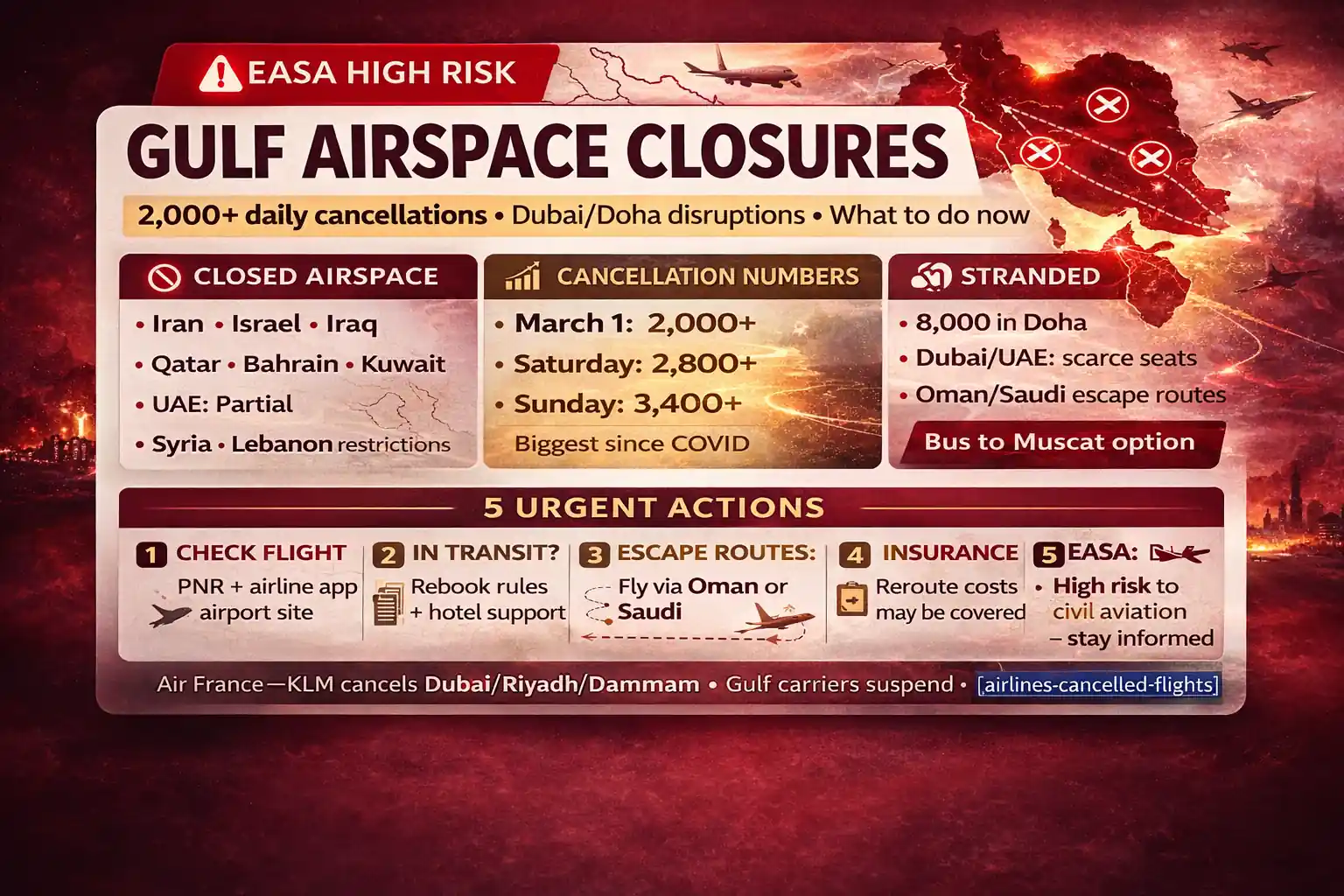
Gulf Airspace Closures (Israel–US–Iran Conflict): Dubai/Doha Disruptions, 2,000+ Daily Cancellations, and What Travelers Should Do Now
Air travel in the Gulf doesn’t “slow down” quietly. It snaps.
One minute you’re connecting through Dubai or Doha like it’s a normal day. Next minute: reroutes, cancellations, and a phone full of airline push alerts.
This page keeps one thing clear: Gulf airspace closures flights cancelled isn’t just news. It’s a real-time travel problem—especially if you’re stuck in transit or trying to leave the region fast.
✅ TL;DR – Gulf airspace closures flights cancelled
Gulf airspace closures flights cancelled are happening because regional conflict triggered rapid airspace shutdowns and restrictions. Multiple countries’ airspace has been listed as closed or heavily limited, and Europe’s aviation safety body warned of “high risk to civil aviation.” Numbers being reported include 2,000+ Middle East cancellations in one day and higher weekend totals. If you’re traveling now: confirm status in your airline app, secure a rebooking option, and ask clear questions about hotel/meal support before you leave the desk.
Why are Gulf airspaces closing right now? (Quick Answer)
Why are Gulf airspaces closing right now? Because military escalation triggered immediate safety restrictions, and several flight information services and aviation authorities have listed multiple airspaces as closed or severely limited. Airlines can’t safely operate normal routes when overflight risk rises, so they cancel, pause, or reroute—fast.
What triggered the closures (Feb 28 strikes → retaliation → restrictions)
The sequence being widely reported is: strikes in the early hours of Feb. 28, 2026 → retaliation → governments and aviation authorities tightening airspace access. That chain reaction is what turns a regional conflict into a global flight mess, because Gulf hubs connect Europe and the Americas to Asia, Africa, and Oceania.
And yes—this is why searches like Israel US Iran conflict flight cancellations spiked overnight.
Which countries’ airspace is closed or heavily restricted (latest list)
Which countries’ airspace is closed or heavily restricted? A commonly cited “closed” list has included Israel, Iran, Iraq, Syria, Qatar, Bahrain, and Kuwait, with other nearby airspaces described as open but limited. Parts of the UAE and Saudi Arabia have been described as only partially open in some reporting, depending on the day and routing rules.
Because restrictions shift quickly, treat any static list as “true for that timestamp,” then confirm right now inside your airline app and airport notices.
EASA warning: “high risk to civil aviation” — what it means
What does “high risk to civil aviation” mean? It means the safety environment is considered dangerous enough that operators may be advised to avoid affected airspace at all flight levels, due to missile/air defense activity, misidentification risk, and spill-over threats. In practical traveler terms: flights may stop suddenly, reroutes can add hours, and last-minute cancellations become normal.
This is why people also search: EASA high risk civil aviation Middle East.
How many flights are being cancelled? (Numbers that people search)
How many flights are being cancelled? Reported figures have been moving by the day, but multiple aviation analytics summaries have described cancellation totals in the thousands, with one-day Middle East cancellation counts reported above 2,000, plus even higher weekend totals across major hubs.
2,000+ flights to the Middle East cancelled in one day (March 1)
A widely repeated number is 2,000+ flights to the Middle East cancelled on March 1, described as roughly about half of scheduled operations that day in some reporting. That’s why “Dubai flights cancelled today” and “Doha airspace closed stranded travellers” started trending as search phrases.
2,800+ cancellations Saturday + 3,400+ Sunday across major hubs
Weekend totals being quoted in major coverage include around 2,800+ cancellations on Saturday and 3,400+ on Sunday across a set of major airports in the region. For travelers, the key meaning is simple: even if your flight isn’t cancelled, the network disruption can still break your connection.
Why this is being called the biggest Gulf aviation disruption since COVID
Some industry reporting has described the shutdown of major Gulf hubs as the most severe aviation disruption since the COVID era, because these hubs aren’t “just airports.” They’re global switching stations. When they pause, routes worldwide get reshuffled—then delayed—then priced higher.
Which airports and hubs are hit hardest?
Which airports are hit hardest? The most discussed hubs are Dubai, Abu Dhabi, and Doha, because they funnel huge international transfer traffic. When these hubs are disrupted, the ripple hits long-haul routes far beyond the Gulf.
Dubai, Abu Dhabi, Doha: why these hubs affect global routes
Over the past two decades, these hubs grew into the “middle bridge” for global travel—especially for travelers moving between continents. So cancellations here don’t stay local. They hit Europe-Asia, US-Asia, Africa-Europe, and more, because aircraft and crews get out of position.
Dubai International passenger scale (why the ripple effect is huge)
Dubai International has been described as the world’s busiest airport for international traffic in industry coverage, and published 2024 passenger figures have been cited around 92.3 million in major reporting. When an airport of that scale gets disrupted, even a partial pause can echo for days.
Are flights operating at all from UAE / Saudi (partial openings explained)
Are flights operating at all? In some reporting windows, limited departures have been described from the UAE while other nearby airspaces remained restricted, with airlines operating reduced schedules, repositioning flights, or repatriation-style operations. The safest assumption: “some flights may operate, but schedules are unstable.”
If your trip is UAE-focused, you can check your own rolling updates here: UAE flight suspensions extended 2026 and Etihad Abu Dhabi flights suspended 2026.
Are travelers stranded in the Gulf? (What’s happening on the ground)
Are travelers stranded in the Gulf? Yes—major reporting has described large numbers of passengers stuck in transit due to sudden airspace closure and hub shutdowns, with hotel availability tightening and rebooking queues stretching for hours.
Qatar transit passengers stranded (8,000 reported) — what to do
One reported on-the-ground figure is around 8,000 transit passengers stranded in Qatar after the airspace closure, described in major coverage. If you’re in this situation: don’t leave the secure area until you understand your rebooking path, and get written confirmation of any hotel/meal commitments.
If your case is Qatar Airways-specific, keep this update link open: Qatar Airways suspension March 2026.
Limited departures from UAE: why seats are scarce and expensive
When only a limited number of flights are allowed—or when airlines operate reduced schedules—seats become scarce. Then prices rise quickly, because reroutes add fuel, longer flight times, and crew challenges. Even a “still operating” route can become expensive if the system is clogged.
Dubai travelers are checking this page a lot right now: Dubai flights suspended March 3, 2026.
Oman + Saudi as escape routes (drive/bus to Muscat, alternate departures)
Some reporting has described travelers using Oman and Saudi Arabia as alternative exit paths when hubs are disrupted—often by reaching a different departure point with fewer restrictions, then flying out from there.
Reality check: this can work, but it’s not “easy mode.” Border rules, seat availability, and airline policies still control your outcome.
Which airlines are cancelling flights (what to check first)
Which airlines are cancelling flights? A mix of international carriers and regional airlines have announced suspensions and cancellations during this period, and the list can change daily. Your best move is to check your specific airline’s current advisory first—then confirm your exact booking status.
Air France–KLM cancellations to Dubai/Riyadh/Dammam (example updates)
Major reporting has used carriers like Air France–KLM as examples of airlines cancelling or pausing services to Gulf destinations during this escalation window. Treat airline examples as indicators of the trend, not a guarantee about your flight—your route might be treated differently.
Gulf carriers suspending service (what “repatriation flights” means)
What are “repatriation flights”? These are limited flights meant to move stranded passengers or citizens out, often under special permissions. They don’t always appear like normal flights, and they may have strict passenger eligibility rules.
If you’re tracking broader airline lists, use your internal roundup once: airlines cancelled flights Middle East 2026.
How to check if your flight is cancelled (PNR + airline app + airport site)
How do you check if your flight is cancelled? Use three checks in this order: your PNR booking inside the airline app, then the airline’s travel advisory page, then the airport departures page. Screenshots help when counters are crowded, because you can show your status without arguing.
What should passengers do right now? (Practical checklist)
What should passengers do right now? Lock down your facts first (status, routing, rebooking options), then make the quickest “least risky” move: a confirmed new itinerary, or a supported overnight plan. The worst position is uncertainty—waiting without a confirmed plan while seats disappear.
🧭 Do this now (fast, practical)
- Confirm cancellation inside the airline app using your PNR (not WhatsApp rumors).
- Ask one clear question: “What is the earliest confirmed rebooking you can issue right now?”
- Get support details in writing: hotel, meals, transport, and how to claim it.
- Protect your connections: if your first leg changes, your whole trip changes—recheck every segment.
- Don’t buy a new ticket in panic until you confirm refund/rebooking rules on your original booking.
If you’re in transit (Doha/Dubai): rebook rules + hotel support questions
If you’re stuck mid-journey, go straight to rebooking and support questions. Ask: “Is this a cancellation or long delay?” “Am I eligible for hotel?” “Is transport included?” “Can you protect my final destination ticket?” Keep it calm, but be firm.
Transit travelers also keep searching: Doha airspace closed stranded travellers. If you’re in that bucket, your goal is not comfort—it’s a confirmed plan.
If you must leave: routing via Oman or Saudi (what usually works fastest)
If you must exit the Gulf quickly, you may need a creative path: alternate departure cities, different carriers, or a land move first. When people mention Oman or Saudi as options, they’re usually trying to reach flights that are still running with fewer disruptions.
But here’s the trap: “possible” isn’t the same as “available.” Seats vanish fast during mass cancellations.
Insurance + costs: why reroutes raise fares and delays (simple explanation)
Reroutes can raise costs because flights become longer, fuel costs rise, aircraft rotations break, and crews time out. Insurance and risk management can also change how airlines schedule flights. So you may see higher fares, fewer seats, and longer travel time even on routes that remain open.
You can also read (airline-by-airline updates on our site)
- Air India flight cancellations (March 1, 2026)
- Biman Middle East flights 2026
- Pakistan–Gulf flights suspended
- Umrah flight chaos: Malaysians stranded
- Indonesia Umrah pilgrims stranded
- Umrah flights cancelled: stranded pilgrims guide

Farrukh Farooqi has been living in Sharaya, Makkah, Saudi Arabia since 2010. With over 14 years of firsthand experience witnessing the sacred journey of millions of pilgrims, Farrukh specializes in providing practical, insider tips for Hajj and Umrah travelers. His work blends real-world observations, the latest Saudi updates, and essential crowd management strategies — helping pilgrims and worshippers plan smarter, stay safer, and experience a spiritually fulfilling journey across the Holy Cities.


