
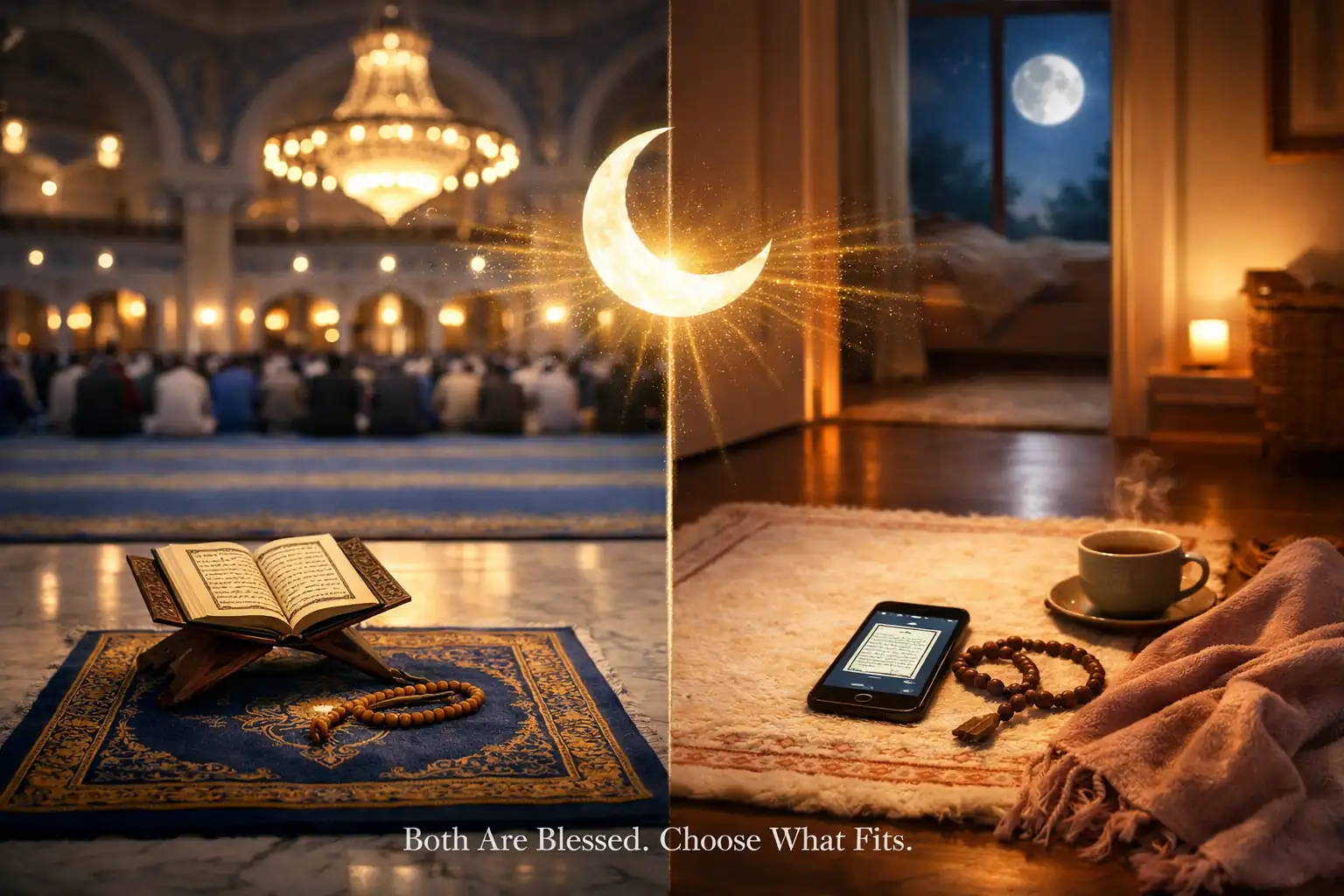
Laylatul Qadr I’tikaf vs Home: Which Is Better in the Last 10 Nights? (2026)
**laylatul qadr itikaf vs home** is a real question because people have real lives: kids, shifts, health, crowds, and energy that crashes fast after midnight. The good news? **laylatul qadr at home** is valid worship and rewarded, and **night of power itikaf** can be a powerful Sunnah path when it’s done correctly.
But here’s what most people miss: the point is not “where your body is.” The point is where your heart goes.
✅ TL;DR – **laylatul qadr itikaf vs home**
**itikaf or home worship** can both be strong ways to seek Laylatul Qadr. **laylatul qadr in itikaf** often wins for focus and consistency, but **laylatul qadr worship options** at home can be just as serious when the home setup is disciplined and sincere. Choose the plan that you can repeat with quality across the final ten nights, not just one “big night.”
Quick Answer — I’tikaf vs Home for Laylatul Qadr
Is it better to do i’tikaf or worship at home? If you can do proper i’tikaf without turning it into social time, it’s a strong Sunnah path that protects focus in the last ten nights. If you can’t—because of family duties, health, work shifts, or crowd stress—home worship is still fully valid and can be more sincere. The “better” plan is the one you can maintain with calm, repeatable worship.
Is Laylatul Qadr worship at home valid and rewarded?
Yes. **laylatul qadr at home** is valid and rewarded. Worship isn’t “locked” to a building. Many people actually worship better at home because their mind is quieter, their responsibilities are handled, and their heart is not busy performing for anyone.
One sentence I tell beginners: if you can pray with focus at home, don’t let guilt steal your worship.
Is I’tikaf the “best Sunnah method” to maximize focus?
For many people, yes—because proper i’tikaf removes distractions by design. You’re in the masjid for worship, not for browsing, gossip, snack tours, or “who’s here tonight?” energy. When it’s done right, **laylatul qadr in itikaf** often becomes easier because the environment pushes you toward consistency.
The real goal: worship quality, not just location
This is the quiet truth: someone in the masjid can still waste the night, and someone at home can win it with sincere, steady worship. **home vs mosque Ramadan** isn’t a trophy contest. It’s a worship decision.
🤲 Dua Box (Authentic) – Best-known Laylatul Qadr dua
اللَّهُمَّ إِنَّكَ عَفُوٌّ تُحِبُّ العَفْوَ فَاعْفُ عَنِّي
Transliteration: Allahumma innaka ‘afuwwun tuhibbul-‘afwa fa‘fu ‘anni.
Meaning: O Allah, You are Pardoning, You love pardon, so pardon me.
📚 You Can Also Read: Laylatul Qadr: the Night of Power (full guide)
What Is I’tikaf (Simple Definition + Purpose)
What is i’tikaf? Think of it like putting your soul on “airplane mode.” You’re still alive, still eating, still sleeping—but you cut the unnecessary noise so your worship can breathe. The purpose is not to impress anyone. The purpose is to make your heart available for Allah in the last ten nights.
What does I’tikaf mean in Ramadan?
In Ramadan, i’tikaf is a worship retreat in the masjid, especially in the last ten nights, to focus on prayer, Qur’an, and dua. It’s linked to seeking Laylatul Qadr, because Laylatul Qadr is hidden in the last ten nights, and i’tikaf helps you show up consistently.
Why the Prophet ﷺ did I’tikaf in the last ten nights
He did it to seek Laylatul Qadr seriously, not casually. That’s the lesson: don’t treat the final nights like a hobby. Treat them like a once-a-year door that can change your heart.
What “seclusion” actually requires (no social mode)
Seclusion doesn’t mean “sleep in the masjid and chat all night.” It means you reduce socializing, reduce phone time, and reduce distractions. If the masjid becomes a hangout, i’tikaf loses its meaning.
📚 You Can Also Read: I’tikaf guide (rules + practical tips)
Mosque I’tikaf: Benefits That Make Laylatul Qadr Easier
Why do people choose the mosque in the final ten nights? Because it removes decision fatigue. You don’t keep negotiating with yourself. You’re already there. The masjid environment makes it easier to pray, read Qur’an, and stay consistent.
Biggest advantage: fewer distractions, more consistency
**final ten nights at mosque** can feel like a protective fence. At home, your brain remembers chores. In the masjid, your brain remembers worship. That difference matters when you’re tired.
Taraweeh + Qiyam environment: why it boosts stamina
Praying with people can push you through low-energy moments. You stand, you listen, you keep going. It’s not “showing off.” It’s using the environment to help your worship stay steady.
Community dua vs private focus: which helps you more?
Some hearts soften in a strong group dua. Other hearts become distracted by people. Be honest with yourself. If public settings make you perform, go home. If the masjid helps you stay consistent, stay.
Home Worship: When It’s Better (and Not a “lesser option”)
When is home worship better? When home is where your responsibilities are, where your health is protected, or where your sincerity is stronger. **laylat al qadr retreat** doesn’t have to be inside a masjid to be real.
Women with childcare: how to win Laylatul Qadr at home
**women seeking laylatul qadr at home** is not a “backup plan.” It can be the best plan. If you’re feeding kids, calming toddlers, or caring for parents, your worship can still be powerful—short blocks, repeated nightly, with deep dua.
📚 You Can Also Read: Laylatul Qadr for women at home (realistic routine)
Sick, elderly, work shifts: home plan that still counts
If health limits you, worship isn’t cancelled. Same for workers on night shifts. Your goal is consistent worship blocks: two rak‘ah, Qur’an listening, dua, dhikr. For a working adult, repeatable worship beats a one-night burnout.
📚 You Can Also Read: Ramadan exemptions for sick, traveler, elderly
If masjid becomes social: why home can be more sincere
This happens more than people admit. If the masjid becomes a place of talking, selfies, or “who’s here,” then **laylatul qadr personal retreat** at home may actually be purer. I’ve seen students improve overnight when they stopped chasing the crowd and started chasing sincerity.
Women: I’tikaf in Mosque vs Home (Differences of Opinion)
What’s the ruling for women? Scholars differ on details. Keep it simple: many scholars say i’tikaf is in a masjid; some allowed a home-based i’tikaf idea for women. A beginner-safe approach is: don’t fight about labels—focus on the worship itself, and follow a trusted local scholar if you need a specific ruling.
Can women do I’tikaf at home? (madhhab difference in one clean paragraph)
There is a known difference of opinion: some scholars allowed women a form of i’tikaf at home, while many maintain that i’tikaf is tied to the masjid. If you’re unsure, don’t build your worship on argument—build it on sincere night worship and a disciplined “home retreat” routine.
If you can’t do formal I’tikaf: “home retreat” alternative
Call it a retreat, not a technical label. Choose one corner. Keep it clean. Put your phone away. Tell your family your quiet times. Then show up nightly. That’s **realistic home alternative to itikaf** in practice.
Period/postpartum nights: what worship still works (dua, dhikr, listening Qur’an)
You can still do a lot: dua, dhikr, listening to Qur’an, charity, and reflection. Don’t let “I can’t pray” become “I do nothing.” That’s a trap.
Saudi Context (Umrah/Haramain Reality) — What Changes in 2026
Saudi reality matters. Crowds, fatigue, transport, and masjid space can change what’s wise. A plan that works in a quiet local masjid may not work the same in Makkah or Madinah.
I’tikaf in Makkah/Madinah: why registration/limits may apply
In the Haramain, i’tikaf often involves organization and controls because of crowd management. So your “best worship plan” may be a hybrid: strong masjid nights when possible, strong home/ hotel routine when crowds drain you.
Crowd + fatigue: how to avoid burnout in the last 10 nights
Burnout ruins worship. Keep naps small, keep meals light, and stop trying to be a hero every night. Pace wins.
If you’re in Umrah: best worship plan that fits tawaf + rest
Do your tawaf and ‘ibadah, then protect your energy for night worship blocks. Many people waste the night because they exhausted themselves chasing every possible action in the day.
📚 You Can Also Read: Best duas for the last 10 nights
Conditions & Rules That People Get Wrong (Fast Clarity)
People get confused about rules. Here’s fast clarity without drowning you in fiqh details. If you need a final ruling, follow your trusted scholar, but don’t let confusion stop your worship.
Does I’tikaf require a masjid with congregational prayers?
Many scholars say i’tikaf is in a masjid, and commonly it’s linked to a masjid where congregational prayers happen. This is one reason people do it in main community masajid.
Can you leave the masjid during I’tikaf? (allowed vs breaks it)
Leaving for real needs is treated differently than leaving for casual reasons. Bathrooms and necessary needs are not “breaking the spirit.” Social trips and unnecessary exits are where people ruin their retreat.
Is fasting required for I’tikaf? (brief, avoid fiqh overload)
Scholars have discussed conditions, but don’t overload yourself. If you’re doing i’tikaf in Ramadan, you’re already fasting. If you’re doing a short voluntary “mini i’tikaf,” focus on worship and sincerity first.
Mini I’tikaf (Nafl) — The “Busy Person” Hack (Still Legit)
Can I do i’tikaf for a few hours? Many people do a short voluntary retreat in the masjid: enter, intend worship time, pray, read Qur’an, make dua, then leave. It’s not the full formal retreat—still, it’s a real worship move for busy people.
Can I do I’tikaf for a few hours or one night?
Yes—treat it as a focused worship block. This is perfect for people who can’t commit to full seclusion but want a serious masjid night.
Best windows: after Maghrib, after Isha, last third of night
Pick one window you can repeat across the last ten nights. Repetition is how you stop gambling on “only one night.”
Micro-goals for each window (2 rak‘ah blocks + dua blocks)
Set small goals: two rak‘ah, then a dua block, then Qur’an (read or listen), then one more two rak‘ah. Simple, repeatable, calm.
📚 You Can Also Read: Laylatul Qadr odd nights (tracker + guidance)
What to Do Each Night (Mosque Plan vs Home Plan)
What should I do each night? You need a routine that fits your reality. Below are two “plans” in styled boxes—choose the one that you can actually follow without collapsing on night three.
🕌 Mosque Routine (Isha → Fajr) – **last ten nights mosque vs home**
Isha → Taraweeh/Qiyam → Qur’an → Dua → short sleep → Tahajjud → Witr → Fajr.
🏠 Home Routine (Kids/Work Friendly) – **laylatul qadr worship options**
20 min reset → 2 rak‘ah → Qur’an (read or listen) → dua block → sleep → wake for 2 rak‘ah + dua → Fajr.
“If you only have 45 minutes” Laylatul Qadr emergency plan
This is for the person who’s exhausted but still wants a real night.
45-minute plan: 10 min dua → 10 min Qur’an → 10 min 2 rak‘ah → 15 min dua + istighfar. Keep it sincere. Keep it calm.
Best Acts on Laylatul Qadr
Best acts? Night prayer, dua, Qur’an, and consistent charity. Don’t overcomplicate it. What matters is sincere worship you can repeat in the last ten nights.
Qiyam (night prayer): how much is “enough”?
Enough is what you can do with focus. Two rak‘ah with presence can beat a long prayer with a wandering mind.
Dua focus: what to ask (forgiveness, guidance, dunya/akhirah)
Ask for forgiveness, guidance, protection, and goodness in this life and the next. Keep asking. Don’t rush like it’s a checklist.
Qur’an: read, listen, reflect—what counts most
Read if you can. Listen if reading is hard. Reflect even on small passages. A heart that understands is a heart that changes.
Sadaqah strategy: nightly giving plan (small but consistent)
Small nightly giving keeps your heart soft and your worship consistent. Don’t wait for one “big donation moment.”
📚 You Can Also Read: Ramadan dua routine (daily structure)
Common Mistakes That Ruin I’tikaf (or Home Worship)
These mistakes don’t look “haram” on the surface. They just quietly drain your Laylatul Qadr.
Turning the masjid into a hangout
If the masjid turns into social time, i’tikaf loses its soul. That’s not harsh—just true.
“I’ll only try the 27th” (why that’s risky)
**laylatul qadr itikaf vs home** becomes pointless if you gamble on one night only. Laylatul Qadr is sought across the last ten nights, especially the odd nights. Don’t put your whole Ramadan on one date.
Over-planning then crashing (how to pace energy)
Over-planning is a hidden ego trap. Pace your worship, protect sleep, and show up nightly.
Decision Guide: Should You Do I’tikaf or Stay Home?
Which plan is best for me in final ten nights? Choose the setup that increases sincerity, focus, and repeatability. A “perfect plan” you can’t follow is not a plan. It’s fantasy.
Choose I’tikaf if you have: focus, health, permission, logistics
If the masjid environment makes you consistent and you can manage logistics calmly, i’tikaf can be a strong choice.
Choose home if you have: dependents, health limits, distraction risk
If your duties are at home, or crowds harm your worship, home can be the better route—especially with a disciplined routine.
Hybrid plan: 1–3 masjid nights + strong home routine
This is the “real world” answer for many families: a few strong masjid nights, plus a serious home routine the rest of the time.
📚 You Can Also Read: Laylatul Qadr checklist (don’t-miss actions)
FAQs
Fast answers for the questions people actually type at 2 a.m.
Is it better to worship Laylatul Qadr at home or in the mosque?
Both can be strong. The mosque often helps focus. Home often helps sincerity and responsibilities. Pick what makes your worship consistent across the last ten nights.
Can I get Laylatul Qadr reward without I’tikaf?
Yes. Laylatul Qadr reward is tied to sincere worship on the night, not only to being in i’tikaf.
Can women do I’tikaf at home?
Scholars differ. If you’re unsure, do a disciplined home retreat routine and follow a trusted local scholar for the technical ruling.
Do I have to stay all 10 days for I’tikaf?
The full last ten nights is the well-known practice, but shorter voluntary worship retreats are also done by many people who can’t commit fully.
What if I miss the odd nights—can Laylatul Qadr be on another night?
Laylatul Qadr is sought in the last ten nights, often emphasized in odd nights. Don’t gamble on one night—spread worship across the final nights.
Do I need to pray the whole night to “catch” Laylatul Qadr?
No. Pray what you can with focus, make deep dua, read or listen to Qur’an, and keep your worship sincere and repeatable.
📚 You Can Also Read: Can Laylatul Qadr be on an even night?
📊 One-Table Decision Summary: Mosque vs Home (Beginner-Safe)
🌙 Show Laylatul Qadr Setup Table
| Setup | Best for | Risk to watch | Simple win move |
|---|---|---|---|
| Mosque / I’tikaf | Focus, consistency, qiyam environment | Socializing, burnout, crowd stress | Phone away + fixed worship blocks |
| Home routine | Families, workers, health limits, sincerity | Distractions, chores, low structure | One quiet corner + repeatable plan |
| Hybrid | Most people in real life | Trying to do “everything” | 1–3 masjid nights + strong home nights |

Farrukh Farooqi has been living in Sharaya, Makkah, Saudi Arabia since 2010. With over 14 years of firsthand experience witnessing the sacred journey of millions of pilgrims, Farrukh specializes in providing practical, insider tips for Hajj and Umrah travelers. His work blends real-world observations, the latest Saudi updates, and essential crowd management strategies — helping pilgrims and worshippers plan smarter, stay safer, and experience a spiritually fulfilling journey across the Holy Cities.


