
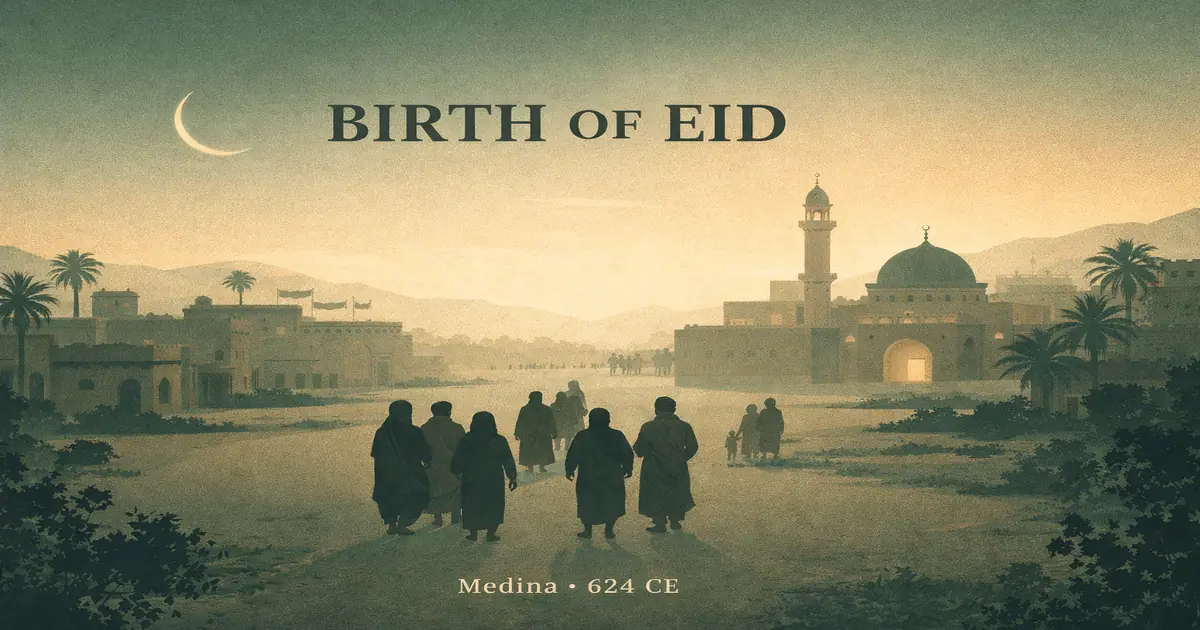
History of Eid Al-Fitr: Origin Story, 624 CE in Medina, and Why Muslims Celebrate It (2026 Guide)
History of Eid al-Fitr starts in Madinah, after Ramadan became a lived act of worship for the early Muslim community. If you only want the direct answer: eid al-fitr history goes back to 624 CE, after the Hijrah, when the Prophet Muhammad ﷺ set Eid al-Fitr and Eid al-Adha as the two recurring Muslim festival days.
So no, Eid did not appear as a vague cultural party later on. It began as a clear Islamic celebration tied to fasting, gratitude, prayer, and care for the poor.
And since many readers land here while also planning the day itself, you can also try this Eid greeting message generator for quick wishes after you finish the history part.
✅ TL;DR – history of eid al-fitr
Eid al-Fitr began in Madinah in 624 CE (2 AH) after the first Ramadan fast. The Prophet Muhammad ﷺ established it as a better replacement for two earlier festivity days. It marks the end of Ramadan, falls on the first day of Shawwal, and is anchored by Eid prayer, Zakat al-Fitr, food, and community joy.
What is the history of Eid al-Fitr?
What is the history of Eid al-Fitr? The short version is simple: origin of eid al-fitr goes back to Madinah in 624 CE, after the Muslim community completed its first Ramadan fast. From the beginning, Eid was not just a meal after hunger. It was a public thank-you to Allah, a day of prayer, and a day when nobody should be left out.
Eid al-Fitr began in Medina in 624 CE after the first Ramadan fast — the 2-sentence history
Eid al-Fitr began in Medina after the Hijrah, in the second year of the Islamic calendar. That is why many people answering when was eid al-fitr established simply say: 624 CE, after the first full Ramadan observed by the early Muslim community.
Think of it like this: Ramadan was the month of restraint, and Eid was the door opened at the end of it. Not a random break. A timed mercy.
Why it exists: Eid was set as a better replacement for two pre-Islamic festival days
Why is eid al-fitr celebrated? One early answer comes from the well-known report about Madinah already having two days of recreation. The Prophet ﷺ did not leave the community with empty space. He redirected celebration itself.
That matters. Islam did not erase joy. It cleaned it, gave it purpose, and tied it to worship.
When Was Eid al-Fitr Established? (Exact Year + Context)
When was Eid al-Fitr established? The widely cited date is 624 CE, which is the 2nd year after Hijrah. In plain words, that means it began shortly after the Muslim community moved from Makkah to Madinah and started building public Muslim life there.
The year: 624 CE (2nd year after Hijrah) — what that means
624 CE is not just a date to memorize. It tells you where Eid sits in Islamic history. This was early Islam, when worship was becoming organized as a living community practice, not just private belief.
My students always ask about this part: “Why do we keep hearing 2 AH?” Because the Hijri calendar starts from the Prophet’s migration to Madinah. So 2 AH means two years into that new Muslim communal chapter.
Why Medina mattered after Hijrah (community, worship, public celebration)
Madinah was the first place where Muslim worship could breathe in public. Prayer, fasting, charity, and communal identity were now visible together. That is one reason eid al-fitr origins are so closely tied to the city itself.
In Makkah, Muslims faced intense hardship. In Madinah, the community could finally gather, pray, share food, and mark sacred time openly. Eid makes more sense when you see that setting.
Who Started Eid al-Fitr? (Prophet Muhammad’s Role)
Who started Eid al-Fitr? In Islamic tradition, Prophet Muhammad established Eid al-Fitr as one of the two recurring Muslim Eids. So if someone asks who established eid al-fitr or who introduced eid al-fitr in Islam, the answer is the Prophet Muhammad ﷺ by Allah’s guidance.
Who established it and why it became a “mandatory” annual festival
Who started Eid al-Fitr is not a mystery in Muslim teaching. The Prophet ﷺ set it as a fixed annual festival for the Muslim community. Not optional in the sense of “celebrate if you feel like it.” It became part of Muslim communal life, year after year.
That does not mean every culture celebrates in the same style. It means the core day itself is firmly rooted in the Prophetic tradition.
The hadith story: “two days of play” replaced by Eid al-Fitr and Eid al-Adha
This report is the backbone of many summaries of history of eid al-fitr in islam. The people of Madinah had two days they used for play and recreation. The Prophet ﷺ told them Allah had given them two better days: Eid al-Fitr and Eid al-Adha.
📜 Authentic Hadith Box
وَقَدْ أَبْدَلَكُمُ اللَّهُ بِهِمَا خَيْرًا مِنْهُمَا يَوْمَ الْفِطْرِ وَيَوْمَ الأَضْحَى
Transliteration: Wa qad abdala-kumullahu bihima khayran minhuma: yawma al-fitr wa yawma al-adha.
Meaning: Allah has given you two better days instead: the Day of Fitr and the Day of Adha.
One small mistake people make is treating Eid like a leftover custom. It isn’t. In the Prophetic story, Eid is a replacement with purpose.
Why Is Eid al-Fitr Celebrated After Ramadan? (Meaning + Purpose)
Why is Eid al-Fitr celebrated after Ramadan? Because Eid marks the close of the fasting month and the return to permitted eating, drinking, gathering, and visible joy. It is the smile after the training.
“Festival of Breaking the Fast”: what “Fitr” literally points to
Festival of Breaking the Fast is the usual English meaning people hear. But the easiest way to feel the word is this: after a month of holding back, fitr points to opening up again. Like a sealed room finally letting the air in.
That is why eid al-fitr started after ramadan. The day itself says: the fast is over now. Eat. Thank Allah. Gather.
What Eid celebrates spiritually: gratitude, renewal, and community unity
Significance of Eid al-Fitr is bigger than food. It celebrates obedience completed, sins regretted, hearts softened, and a community meeting each other in clean clothes and better spirit.
Sometimes the deepest meaning is quiet. A person who struggled all Ramadan shows up for Eid prayer and whispers, “Alhamdulillah, I made it.” That is Eid too.
When Does Eid al-Fitr Happen? (Shawwal + Moon Sighting Explained)
When does Eid al-Fitr happen? Eid falls on the first day of Shawwal, the month that comes right after Ramadan. Because the Islamic calendar follows the moon, the date shifts every year in the Gregorian calendar.
Eid is on the 1st day of Shawwal — why the date moves each year
First day of Shawwal is the key phrase here. Since lunar months are shorter than solar months, Eid moves earlier by roughly 10 to 11 days each year in the common calendar.
That is why one year Eid may come in spring, another year in winter, and after enough time it circles through the whole year. A beginner once told me, “I thought someone was changing Eid by hand.” I used to mix that up too when I was younger. It’s just the lunar calendar doing what it does.
Why countries can celebrate on different days (local moon sighting vs calculations)
Countries can begin Eid on different dates because Muslim communities do not all use the same method. Some follow local moon sighting. Some follow wider regional sighting. Some rely on astronomical calculations approved by their councils.
The core point stays the same: Eid begins with Shawwal. The path used to confirm that can differ.
Core Practices From the Earliest Eids (Then vs Now)
What are the traditional practices of Eid al-Fitr? The earliest core practices were not complicated: prayer, charity, food, and public happiness. Those basics still hold the day together now, even though cultures add different clothes, dishes, and family customs.
Eid prayer: what it is and why it anchors the day
Eid prayer is the public heart of the morning. It gathers rich and poor, old and young, neighbors and strangers into one visible act of gratitude after Ramadan.
If Ramadan is the school, Eid prayer is the graduation field. Everybody comes out together.
Zakat al-Fitr: why it must be given before the Eid prayer
Zakat al-Fitr is tied to Eid so closely because it helps the poor share in the day before the communal prayer begins. That timing matters. It turns celebration into shared dignity, not private comfort.
Micro-scenario: if a family has food for the feast but forgets the poor until after prayer, they have missed the spirit of why this charity was placed before the Eid gathering.
Food and celebration: why fasting is forbidden on Eid day (breakfast tradition)
Fasting is forbidden on Eid al-Fitr because the day itself is the public breaking of the Ramadan fast. The meaning is built into the name. You do not mark the end of fasting by continuing to fast.
That is why many Muslims make sure they eat something before heading to the Eid prayer. Even a small bite says, plainly, Ramadan has ended.
- Prayer gathers the community.
- Zakat al-Fitr helps the poor share the day.
- Food marks the end of fasting.
- Greeting others spreads joy and forgiveness.
How Long Is Eid al-Fitr Traditionally? (1 Day vs 3 Days)
Is Eid al-Fitr one day or three days? Religiously, Eid begins on the first day of Shawwal. In many classical descriptions and common usage, the celebration is spoken of as spanning the first three days of Shawwal.
“Three days of Shawwal” — what classical sources say
Many summaries describe Eid al-Fitr as being celebrated during the first three days of Shawwal. That explains why people often talk about a three-day Eid atmosphere.
Still, the main turning point is day one. That is the day of Eid prayer, the day fasting is forbidden, and the day the month changes from Ramadan to Shawwal.
Why some places celebrate longer (culture + public holidays, not religion itself)
Public holidays can last longer than the religious minimum. Families may visit relatives for several days. Schools and offices may close longer. None of that changes the basic Islamic core.
So if one country has one public holiday and another has four, that is policy and culture, not a new religion.
Eid al-Fitr Traditions Around the World
Eid customs around the world look different on the surface, but the center stays the same: prayer, gratitude, food, family, and charity. The wrapping changes. The gift inside stays familiar.
Gifts (Eidiya), visits, forgiveness, and family meals — common patterns
Across many Muslim cultures, children receive eidi or small gifts, relatives visit each other, and families sit down for a special meal. Some places are known for sweet dishes, some for savory feasts, some for big community gatherings after prayer.
One-sentence truth: joy has many accents.
How cultures differ while keeping the same Islamic core (examples by region)
In South Asia, people may think of sheer khurma, biryani, and Eidi. In Arab homes, greetings, coffee, dates, and large family visits often stand out. In Southeast Asia, open-house style hosting is common. In Western countries, Eid may include masjid fairs, rented halls, and school-day adjustments.
Here’s the part most people miss: these differences are not a problem by themselves. Islam gave the core. Culture dresses the table.
Eid al-Fitr vs Eid al-Adha (Stop the Confusion)
Eid al-Fitr vs Eid al-Adha is easy once you stop mixing the calendars. Eid al-Fitr comes after Ramadan and marks the end of fasting. Eid al-Adha comes later, in Dhul Hijjah, and is tied to Hajj and sacrifice.
The quick difference: “end of Ramadan” vs “Hajj and sacrifice”
Eid al-Fitr is the Eid of completed fasting. Eid al-Adha is the Eid linked to Hajj season and the story of sacrifice. Both are major Muslim Eids, but they are not interchangeable.
Quick micro-scenario: if someone says, “Which Eid has qurbani?” that is Eid al-Adha. If they say, “Which Eid ends Ramadan?” that is Eid al-Fitr.
the part many beginners get wrong
People often confuse history with later custom. They read about gifts, clothes, sweets, grave visits, or regional decorations and assume all of that is the original core.
It isn’t.
The earliest backbone is much simpler: a fixed Muslim festival after Ramadan, public prayer, charity before prayer, and breaking the fast with gratitude.
- Don’t confuse the first day of Shawwal with a random civil holiday.
- Don’t confuse culture with the original Prophetic core.
- Don’t confuse Eid al-Fitr with Eid al-Adha.
- Don’t confuse Zakat al-Fitr with general Eid gift-giving.
- Don’t confuse moon-sighting differences with disagreement about the value of Eid itself.
a short story of a beginner mistake (and the fix)
A university student once asked me, “So was Eid basically invented as a food festival after Ramadan?”
I understood why he thought that. Online summaries often make it sound like a feast came first and prayer came later.
So I told him to picture Madinah after Hijrah: a new Muslim community learning how to live Islam together, not just believe it quietly. Ramadan teaches restraint. Then Eid arrives as a public act of gratitude, with prayer in the morning, charity before that prayer, and food after fasting ends. He paused for a second and said, “Oh. So Eid is worship with joy, not just joy after worship.” Exactly.
ending: the real origin story in one line
History of Eid al-Fitr is the story of a Muslim community in Madinah being given a sacred day of joy after Ramadan.
That’s why the day still feels so alive.
It remembers hunger, but it teaches gratitude. It remembers discipline, but it opens into mercy. And that balance is probably why Eid has lasted in Muslim hearts for almost fourteen centuries.
📊 history of eid al-fitr: early core vs later customs
Use this table to separate the original Islamic core from later cultural additions that grew around Eid in different regions.
🌙 Show Eid History Summary Table
| Topic | Earliest Islamic core | What grew later |
|---|---|---|
| Origin | Madinah, 624 CE / 2 AH after Hijrah | Local storytelling and regional history details |
| Reason | End of Ramadan, gratitude, worship, communal joy | Extra cultural themes and family customs |
| Date | 1st of Shawwal | Different local moon-sighting methods |
| Main practice | Eid prayer in the morning | Regional events, fairs, parades, open houses |
| Charity | Zakat al-Fitr before the prayer | Gift exchanges and Eidi traditions |
| Food | Breaking the fast; fasting is forbidden that day | Region-specific dishes and feasting styles |
FAQs
📘 history of eid al-fitr FAQs
when was eid al-fitr first celebrated?
Show Answer
It is commonly dated to 624 CE, in Madinah, after the first Ramadan fast observed by the early Muslim community.
who established eid al-fitr in islam?
Show Answer
In Islamic tradition, the Prophet Muhammad ﷺ established Eid al-Fitr as one of the two recurring Muslim Eids.
why did prophet muhammad replace earlier festivals with eid?
Show Answer
The hadith indicates that two existing festivity days in Madinah were replaced with two better days for Muslims: Eid al-Fitr and Eid al-Adha.
why is eid al-fitr called the festival of breaking the fast?
Show Answer
Because it marks the end of Ramadan fasting. The day itself signals that the fast has ended and normal eating resumes.
why does eid fall on a different date every year?
Show Answer
The Islamic calendar is lunar, so Eid moves through the Gregorian calendar by about 10 to 11 days each year.
what is zakat al-fitr and why is it tied to eid prayer?
Show Answer
Zakat al-Fitr is the charity connected to the end of Ramadan. It is given before the Eid prayer so poor families can share in the day.
is eid al-fitr one day or three days?
Show Answer
The key religious turning point is the first day of Shawwal, but many classical summaries describe the celebration as extending through the first three days of Shawwal.
did eid al-fitr begin before or after hijrah?
Show Answer
After Hijrah. The origin story is tied to Madinah, not pre-Hijrah Makkah.
why is fasting forbidden on eid al-fitr?
Show Answer
Because Eid al-Fitr is the day of breaking the Ramadan fast. Continuing to fast would go against the day’s core meaning.
can different countries celebrate eid on different days?
Show Answer
Yes. Communities may follow local moon sighting, wider regional sighting, or approved calculation methods, so dates can differ.
🌍 Eid al-Fitr 2026 Country & Holiday Guides
Use these quick guides to check Eid al-Fitr 2026 dates, holiday rules, and country-specific updates.

Farrukh Farooqi has been living in Sharaya, Makkah, Saudi Arabia since 2010. With over 14 years of firsthand experience witnessing the sacred journey of millions of pilgrims, Farrukh specializes in providing practical, insider tips for Hajj and Umrah travelers. His work blends real-world observations, the latest Saudi updates, and essential crowd management strategies — helping pilgrims and worshippers plan smarter, stay safer, and experience a spiritually fulfilling journey across the Holy Cities.


