
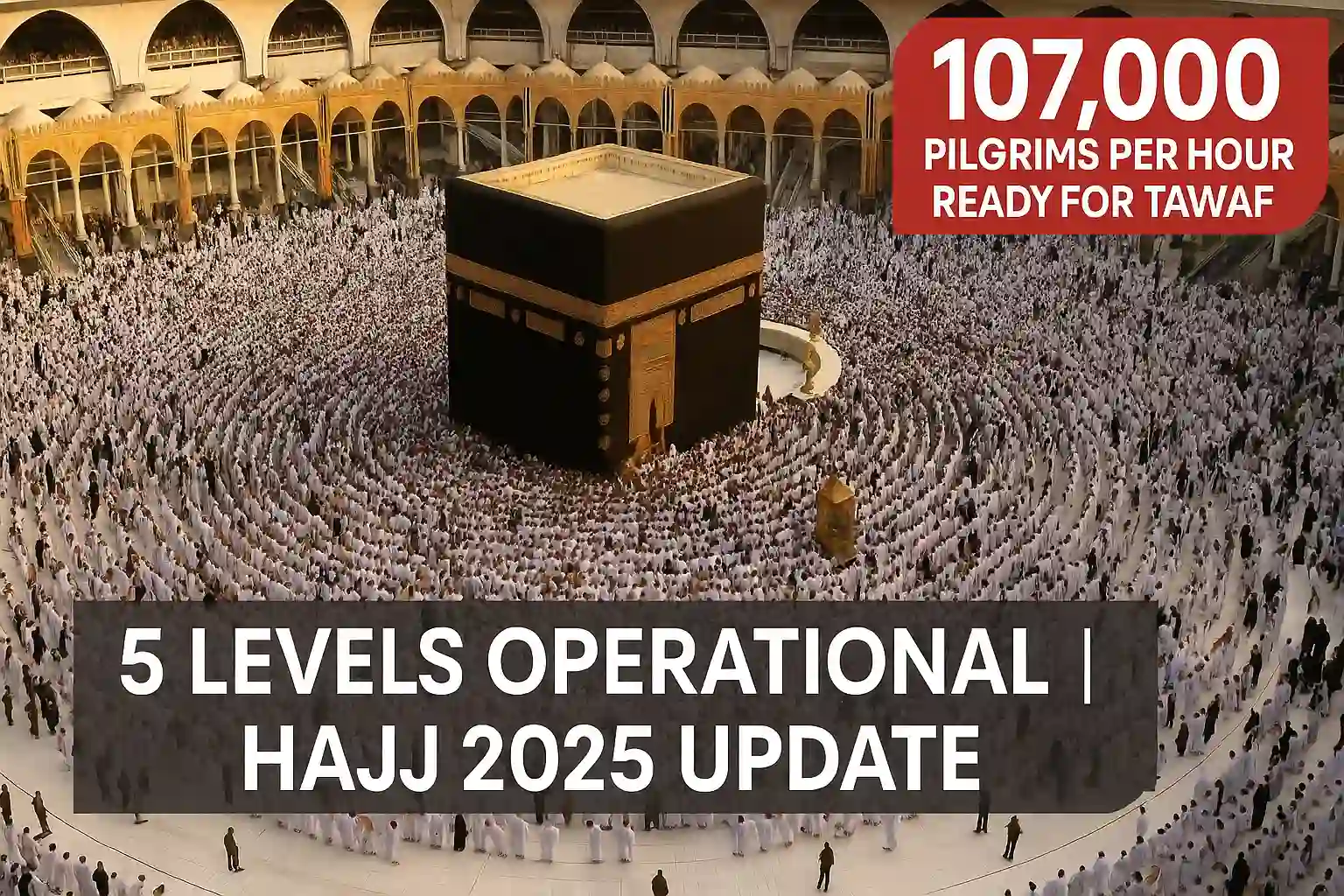
🕋 Mataf Capacity Hajj 2025 – 107,000 Pilgrims Per Hour Ready for Tawaf
📌 TL;DR – Quick Summary Box (107,000 Pilgrims Tawaf Per Hour)
Mataf capacity for Hajj 2025 has reached an impressive 107,000 pilgrims per hour, ensuring smooth flow during peak rituals. The 5 operational levels of the Grand Mosque — including the rooftop — are open and optimized.
So far, over 890,000 pilgrims have already arrived in Saudi Arabia. Airports, terminals, and entry gates have been upgraded for better efficiency. Plus, new AI and tech enhancements are actively improving the pilgrim experience across all services.
Mataf Capacity Hajj 2025 isn’t just a headline. It’s a spiritual milestone. Imagine standing shoulder to shoulder with 106,999 others, circling the Kaaba in perfect rhythm. No pushing. No panic. Just pure devotion in motion.
This year, the heart of Masjid al-Haram has been prepared like never before, ready to welcome 107,000 pilgrims per hour for Tawaf during Hajj 1446 AH.
Let’s break down how Saudi Arabia pulled off this massive feat and what it means for every pilgrim stepping into the Mataf this year.
You Can Also Read
- Tawaf FAQs: 100 Real Questions Answered for Every Pilgrim
- How to Perform Hajj: Complete 2025 Step-by-Step Guide for Muslims
- Types of Hajj (2025 Guide): Which One Is Right for You?
- What are Fard, Wajib, and Sunnah of Hajj?
- Types of Umrah (2025 Guide): Differences, Rulings & Rituals Explained
What Is the Mataf Area? Why It Matters in Hajj
Tawaf – The Spiritual Heartbeat of Hajj
Ask any pilgrim what moment touched their soul the most, and Tawaf often comes up first.
It’s the act of walking around the Kaaba seven times, connecting physically, emotionally, and spiritually with the centre of Islam.
Meaning of Mataf and Why It Gets Crowded
The Mataf is the open circular space that surrounds the Kaaba. It’s where millions perform their Tawaf, especially during Hajj and Umrah.
But here’s the catch: this sacred space can only fit so many people at once. That’s why capacity planning matters more than ever.
Mataf Capacity for Hajj 2025: Key Stats You Should Know
107,000 Pilgrims/Hour – Record Capacity Confirmed
This year, Saudi authorities officially announced that the Mataf capacity has reached 107,000 pilgrims per hour.
That’s a massive jump and a result of smart planning, strategic upgrades, and complete dedication to pilgrim safety.
5 Levels Open: Ground, Mezzanine, Rooftop
To manage the flow, the Mataf now operates across five levels:
- Ground Floor
- First Floor
- First Mezzanine
- Second Mezzanine
- Rooftop Mataf deck
The total capacity of the mosque now stands at 203,000 worshippers, meaning more people can perform their rituals safely and comfortably.
Mataf Capacity Levels in 2025 – Tawaf Area Comparison Table
🕋 Mataf Levels & Capacity Breakdown – Hajj 2025
This table outlines the five operational Tawaf levels at Masjid Al-Haram during Hajj 2025. Each level has been optimized to manage crowd flow, accessibility, and safety for over 107,000 pilgrims per hour.
| Level | Area Description | Primary Use | Approx. Capacity |
|---|---|---|---|
| Ground Floor | Closest to the Kaaba | General Tawaf | 35,000 pilgrims/hour |
| First Floor | Elevated with ramp access | Overflow + wheelchair use | 25,000 pilgrims/hour |
| First Mezzanine | Intermediate level with open view | Additional overflow space | 18,000 pilgrims/hour |
| Second Mezzanine | Wider lanes, structured movement | Managed Tawaf flow | 15,000 pilgrims/hour |
| Rooftop Mataf Deck | Fully open-air, panoramic experience | Night Tawaf + safety lanes | 14,000 pilgrims/hour |
How Saudi Arabia Manages the Massive Tawaf Crowd
Dedicated Entrances, Pathways & Crowd Routes
Saudi Arabia’s crowd management system for Hajj 2025 is a masterclass in logistics. Main and secondary gates are now dedicated exclusively to pilgrims entering the Mataf.
There are emergency doors, VIP gates, and service-only access points, all part of a larger flow system.
Emergency Response + Gate Assignments
In the unfortunate case of a medical emergency, specific gates will lead directly to emergency teams and first aid areas. Pilgrims with disabilities or mobility challenges also have designated lanes and escorts.
It’s not just about managing crowds, it’s about ensuring dignity.
High-Tech Upgrades at Masjid Al-Haram (Gates, Cameras, Access Points)
Thousands of CCTV cameras, facial recognition tools, and heat maps track movement and identify high-density zones in real-time.
These tools allow authorities to redirect pilgrim flow before overcrowding occurs, keeping the Mataf smooth and safe for everyone.
Real Pilgrim Experience – What It Feels Like Doing Tawaf in a Full Mataf
Stories from British & International Pilgrims Arriving in 2025
Earlier this month, the first group of Hajj pilgrims from the UK landed in Jeddah. One elderly man, performing Hajj for the first time, said:
“I couldn’t believe how organised everything was. From the airport to my hotel to the Kaaba, every step felt supported. I was scared of the crowds. But honestly, it was smoother than I expected.”
Airport Coordination & Hajj Terminals Preparedness
Jeddah’s King Abdulaziz Airport is running at full throttle. Across three terminals, including the Hajj Complex, there are:
- Hundreds of immigration counters
- Automated baggage systems
- Customs devices are designed for faster clearance
So far, over 890,000 pilgrims have already entered the Kingdom, with most arriving through air travel.
Saudi Arabia’s Long-Term Vision for Hajj Infrastructure
King Salman’s Directives & Vision 2030 Projects
Under the guidance of King Salman and Crown Prince Mohammed bin Salman, this year’s upgrades are part of a much bigger picture.
It’s not just about 2025, it’s about creating a world-class pilgrimage system for the next generation.
Beyond 2025: What’s Next for Mataf & Haram Facilities
Plans include:
- AI-powered navigation systems inside the mosque
- More rooftop cooling fans
- Additional escalator routes to the upper floors
It’s clear Saudi Arabia is planning with Hajj’s future in mind.
Frequently Asked Questions – Mataf Capacity & Hajj Tawaf (2025 Update)
❓ Frequently Asked Questions – Mataf Capacity & Tawaf in Hajj 2025
❓ What is the current Mataf capacity in 2025?
The Mataf can now accommodate up to 107,000 pilgrims per hour during Hajj 1446 AH.
❓ How many pilgrims can perform Tawaf per hour during Hajj?
Thanks to the multi-level design, 107,000 pilgrims/hour can now perform Tawaf safely.
❓ Can everyone access the rooftop Mataf level?
Yes, but priority is often given to pilgrims with special needs or when lower levels are full.
❓ How many gates lead to the Mataf area?
There are multiple primary and secondary gates, designated for entry, exit, emergency, and VIP flow.
❓ How does Saudi Arabia manage crowd safety at the Mataf?
Using CCTV, AI facial recognition, and heat mapping to redirect flow and prevent overcrowding.
❓ Is the Mataf open 24/7 during Hajj?
Yes, it’s open round-the-clock, though access may be limited during peak hours for safety.
❓ Are there special lanes for elderly and disabled pilgrims?
Yes — wheelchair lanes, elevators, and assistive services are available on all suitable levels.
❓ What are the busiest times for Tawaf during Hajj?
After prayers and late-night hours are most crowded. Early mornings are calmer for Tawaf.
❓ Can I perform Tawaf more than once during Hajj?
Yes — outside of obligatory rituals, pilgrims may do additional Tawafs as a spiritual act.
❓ Has Mataf capacity increased compared to last year?
Yes — this is the largest confirmed capacity to date, made possible by new levels and tech upgrades.
❓ How many people can pray in the Mataf area?
Though some do pray there, the Mataf is primarily for circumambulation, not large congregational prayer — for safety reasons.
❓ What is the max capacity of the Kaaba itself?
The Kaaba interior can only hold a few people at once — mainly for cleaning or dignitary visits. The Mataf outside is where pilgrims perform rituals.
❓ What is the capacity of Masjid an-Nabawi in Madina?
Masjid an-Nabawi can accommodate over 1 million worshippers — especially during Ramadan and Hajj.
❓ How many people fit in Makkah during Hajj?
Over 2 million pilgrims are hosted across Makkah, including hotels, Mina camps, and mosques.
❓ Is the Mataf only used for Umrah?
No — it’s used during both Hajj and Umrah. During Hajj, it plays a central role in Tawaf al-Ifadah and other core rituals.

Farrukh Farooqi has been living in Sharaya, Makkah, Saudi Arabia since 2010. With over 14 years of firsthand experience witnessing the sacred journey of millions of pilgrims, Farrukh specializes in providing practical, insider tips for Hajj and Umrah travelers. His work blends real-world observations, the latest Saudi updates, and essential crowd management strategies — helping pilgrims and worshippers plan smarter, stay safer, and experience a spiritually fulfilling journey across the Holy Cities.


