
Laylatul Qadr sunrise sign: Sun Without Rays (Hadith Meaning, Timing, and Common Myths) (2026)
The internet treats the Laylatul Qadr sunrise sign like a “photo contest.”
That’s not what it’s for.
The most useful way to understand this topic is simple: the sunrise sign is an after-the-fact sign. It can help you reflect the next morning. It is not a tool to “choose the night” like a lottery ticket.
I’ve taught this for years, and my students always ask the same thing: “If I don’t see it, did I miss Laylatul Qadr?” We’ll handle that calmly, without drama, and without turning worship into weather-watching.
✅ TL;DR – Laylatul Qadr sunrise sign
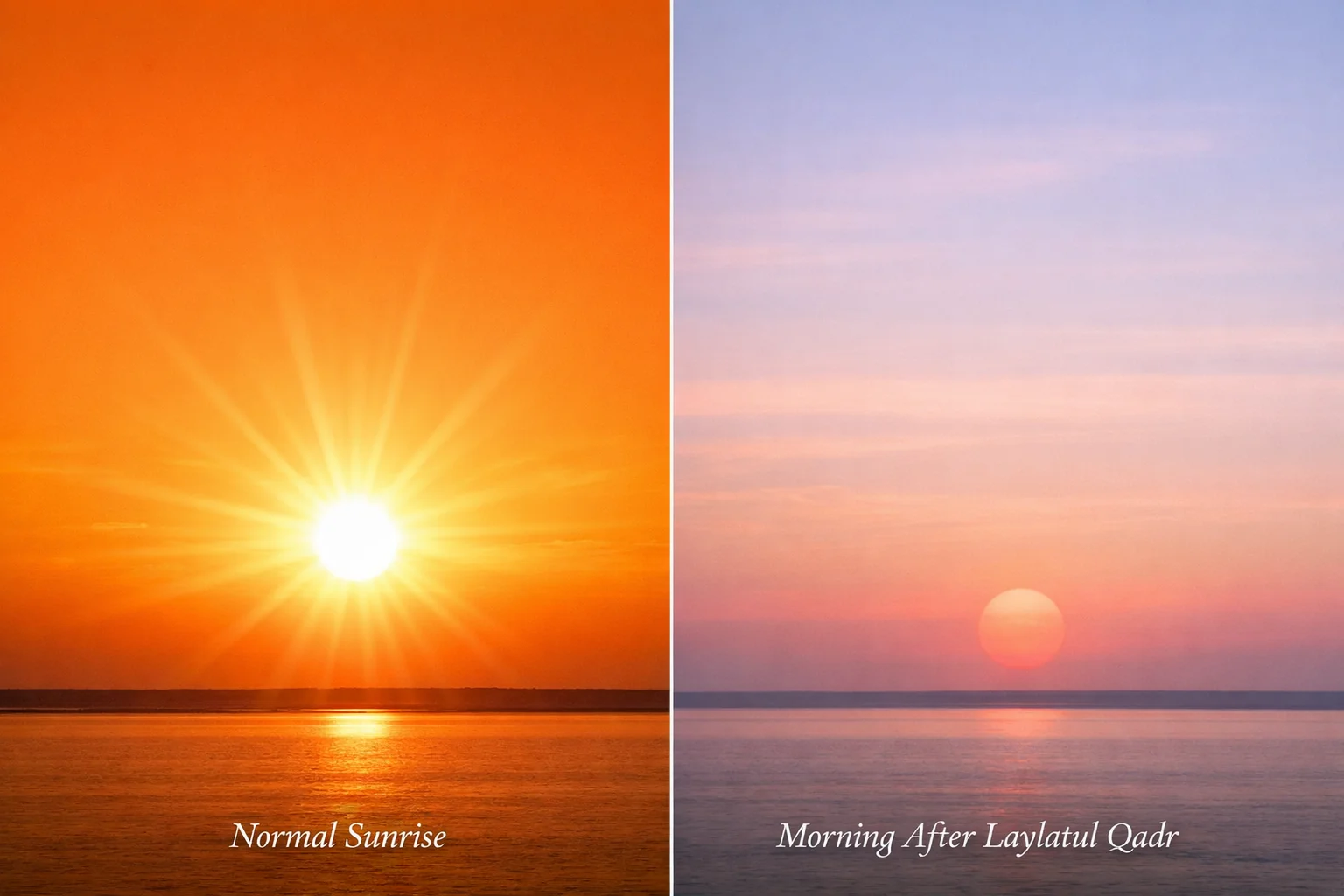
The Laylatul Qadr sunrise sign is reported as a morning-after indicator: the sun rises soft, without harsh rays, sometimes noticed as feeble and red. It’s meant for reflection, not certainty. Keep seeking Laylatul Qadr in the last ten nights, especially the odd nights. If you think you saw it, respond with gratitude and extra worship—not announcements.
Quick Answer — What Is the Laylatul Qadr Sunrise Sign?
What is the sunrise sign of laylatul qadr? It’s a reported sign seen the morning after laylatul qadr: the sun appears as a soft disk with no sharp rays, making it look gentler than usual at sunrise. It can support reflection, but it should not replace the Sunnah of seeking Laylatul Qadr through worship in the last ten nights.
The sunrise sign in one sentence (sun without harsh rays)
The sun without rays laylatul qadr description means: the sun comes up looking “muted” at first—more like a calm circle than a bright lamp shooting beams.
Think of it like a torch behind frosted glass. Same light source, but the “sting” isn’t there in that moment.
When you can see it (the morning after, at sunrise)
Can i know laylatul qadr from next morning? You can only observe a sign sunrise after laylatul qadr—meaning the night has already passed. That’s why it’s called a laylatul qadr morning sign or laylat al qadr next morning indicator. It doesn’t help you decide what to do at night, because the “decision time” is already over.
Micro-scenario: You’re up for Fajr, and you step outside for a minute. The sun looks soft. Nice. Make du‘a and gratitude. But don’t start texting ten people “IT WAS DEFINITELY LAST NIGHT.”
Authentic Hadith About the Sunrise Sign (What’s Actually Reported)
The core reports people rely on describe a sunrise that appears without rays and, in another report, a sun that rises feeble and red, alongside a calm, pleasant night. If you’re a beginner, keep your focus on the meaning: a gentle sign, not a guaranteed miracle.
📌 Hadith (Sun rises without rays)
Arabic: تَطْلُعُ الشَّمْسُ صَبِيحَةَ لَيْلَةِ الْقَدْرِ لَا شُعَاعَ لَهَا
Transliteration: Tatluʿu ash-shamsu ṣabīḥata laylati al-qadr lā shuʿāʿa lahā.
Meaning: The sun rises on its morning without rays.
“Sun rises without rays” — what the wording means
This is the line people quote when they say night of power sunriserays—the sharp beams—being missing or not obvious at that moment. It doesn’t say the sun disappears. It doesn’t say the sky turns purple. It’s a gentle observation.
Real meaning of the sunrise sign in practical terms: you may be able to look toward the sun briefly without that immediate painful glare you’d expect at sunrise.
“Like a brass dish” — simple visual explanation
Some narrations describe it “like a dish.” If you’ve ever seen a coin held up in soft morning light, you get the idea: a round shape, clear edges, not screaming-bright.
Not cinematic. Just calm.
“Feeble and red” — what people usually notice
📌 Hadith (Calm night + feeble/red sunrise)
Meaning: Laylatul-Qadr is calm and pleasant, neither hot nor cold, and the sun rises on its morning being feeble and red.
Note: This is commonly cited from Ibn Mājah and other collections in discussions of authentic signs.
People often ask: is a red sun a sign of laylatul qadr? A reddish, softer look is mentioned in reports—but here’s the careful part: red sun can also happen for normal reasons (dust, haze, humidity). So red color alone is not a “stamp.” The full picture matters: sun without rays feel + calmness + humility in your interpretation.
Does Laylatul Qadr End at Fajr or Sunrise?
Does laylatul qadr end at fajr or sunrise? The night ends at dawn (Fajr). Laylatul Qadr is a night worship window from Maghrib until Fajr. The sunrise sign is observed after that night has passed, so it’s not “part of the night”—it’s a morning indicator.
📖 Qur’an (Surah Al-Qadr 97:5)
Arabic: سَلَامٌ هِيَ حَتَّىٰ مَطْلَعِ الْفَجْرِ
Transliteration: Salāmun hiya ḥattā maṭlaʿi al-fajr.
Meaning: It is peace until the break of dawn.
Laylatul Qadr timing: Maghrib to Fajr (night ends at dawn)
Is laylatul qadr from maghrib till fajr? Yes—this is the normal way Muslims describe the night window: it begins after sunset and continues until dawn. So the worship is in the night hours, not at sunrise itself.
Why the sunrise sign is a “morning-after” indicator, not part of the night
Next morning sign of laylatul qadr explained: it’s like seeing footprints after someone has already walked by. The footprints can tell you “someone passed here,” but they don’t tell you the exact second the person walked past—and they don’t replace the need to show up on the path in the first place.
What “No Rays” Looks Like in Real Life (So You Don’t Confuse It)
What does “sun rises without rays” mean exactly? It means the sun at sunrise looks like a gentle disk with fewer visible beams—less piercing glare—so the light feels diffused. People describe it as “soft,” “muted,” or “calm.” The key is not the camera filter. The key is the real-life look.
Soft disk vs sharp beams (easy test)
Easy test: do you see obvious spiky beams and feel immediate eye discomfort the moment you look toward the sunrise? That’s a typical sunrise. A “soft” look is when the disk seems clearer but the harsh beams aren’t showing like they usually do.
Quick reminder: don’t stare at the sun. A brief glance toward the horizon is enough.
Red/pale look: what’s normal vs what’s being described
A pale or reddish sun can happen in many places, including Saudi, because dust and weather can soften the light. So does cloudy weather cancel the sign? Not “cancel,” but it can confuse your observation. That’s why the safest approach is humility: you might have seen it, you might not have.
Micro-scenario: Riyadh morning, dust in the air, sun looks orange. Don’t force a conclusion. Smile, make du‘a, and keep worship strong the next night too.
How long it usually stays “soft” (until it rises higher)
People often report it looks soft at the start, then becomes normal as it rises. That fits the idea: a sunrise moment, not an all-day event. If you missed the early minutes, you might miss the observation.
What if i miss seeing sunrise? Then you miss seeing sunrise. That’s it. Laylatul Qadr isn’t “invalid” because you slept.
3 Big Mistakes People Make With the Sunrise Sign
These three mistakes are what turn a beautiful topic into anxiety. Fix them, and the whole subject becomes calm again.
Confusing haze/pollution with the Laylatul Qadr sign
Can pollution make the sun look like “no rays”? Yes, it can soften the sun and reduce visible beams. That’s why photos can mislead. Weather and air quality can create a similar look on any day.
So don’t treat a hazy sunrise as “proof.” Treat it as a moment to remember Allah.
Expecting a miracle every year (and feeling “sure”)
This is where people break their own hearts. They expect a “guarantee moment,” and when they don’t get it, they feel empty. But the sign is not promised to be obvious for every person, every year, in every city.
Can one city see it and another not? That’s possible, because skies differ and people observe differently. Again—humility.
Using the sign to “pick the night” instead of worshipping the last 10 nights
The sunrise sign is not meant to replace the Sunnah: seek Laylatul Qadr in the last ten nights, especially the odd nights. The sign comes after.
If you turn the sign into your strategy, you’ll always be late.
Other Signs Mentioned With It (What’s Strong vs What’s Weak)
What are authentic signs vs weak narrations? The most quoted signs are the calmness of the night and the morning sunrise description. Other “signs” spread online can be weak, exaggerated, or simply cultural stories that grew over time. A beginner-safe rule: don’t share claims you can’t stand behind.
Calm, pleasant night — neither hot nor cold (what it means)
This is often described as a night with a balanced feel—no extreme heat, no extreme cold—along with a sense of calmness. But be careful: weather varies by region and season. The deeper point is the *tone* of the night: peaceful, not chaotic.
Breeze or light rain — possible, not guaranteed
Some narrations and stories mention light rain or a gentle breeze. Treat these as “possible,” not “required.” If rain happens, it can be a mercy. If it doesn’t, nothing is missing.
Viral claims to ignore (trees bowing, no dogs barking, etc.)
These claims spread fast because they sound dramatic. Trees bowing. Dogs going silent. Oceans turning sweet. If you build your iman on viral drama, you’ll always need a bigger drama next year.
Keep your worship on solid ground.
Which Nights to Look For (Odd Nights Without Overconfidence)
Which nights to look for? Focus on the last ten nights of Ramadan, with extra attention to the odd nights. This keeps you aligned with the Sunnah without turning the search into a guessing game.
Last ten nights focus
Make your plan around consistency, not excitement. Even small worship done steadily can beat one emotional night that collapses the next day.
Odd nights strategy (simple approach for beginners)
Simple approach: increase worship on every night you can, and add extra effort on the odd nights. That’s it.
If you want an on-page helper, you can link this naturally for readers: Laylatul Qadr odd nights guide.
Best “don’t miss it” plan if you can’t do all ten
Here’s a practical plan that doesn’t pretend you’re superhuman. (Max 7 steps, so it stays readable.)
- Protect ‘Isha and Fajr first.
- Pick 30–45 minutes for Qur’an + du‘a after ‘Isha.
- Add extra effort on odd nights if you can.
- Give small charity quietly, even daily if possible.
- Make one personal du‘a list (parents, debts, forgiveness).
- Sleep enough to avoid missing Fajr.
- Repeat without overthinking.
Laylatul qadr morning after checklist idea: don’t wake up to hunt photos. Wake up to pray Fajr, thank Allah, and keep your worship going.
What to Do If You Think You Saw the Sign (Action > Debate)
What to do if you think you saw the sign? Respond with worship: gratitude, repentance, extra du‘a, and better manners that day. Don’t treat it like a trophy. Treat it like a gentle nudge from Allah to stay sincere.
How to respond spiritually the next day
Start the day with quiet gratitude. If you can, pray Duha. Give a small charity. Make du‘a for others too—especially people in hardship. That’s a beautiful way to keep the spirit of the night alive.
Dua, repentance, gratitude — keep it practical
Here is the famous du‘a many Muslims make on these nights. (Arabic + transliteration + meaning.)
🤲 Du‘a to make often in the last ten nights
Arabic: اللَّهُمَّ إِنَّكَ عَفُوٌّ تُحِبُّ الْعَفْوَ فَاعْفُ عَنِّي
Transliteration: Allāhumma innaka ‘afuwwun tuḥibbul-‘afwa fa‘fu ‘annī.
Meaning: O Allah, You are Pardoning and You love pardon, so pardon me.
If you want more du‘as without hunting social media posts, link readers once to your hub: Ramadan duas.
Don’t announce it like certainty (adab + humility)
Even if you feel confident, keep your words humble. Say: “Allah knows best.” Because that’s the truth.
And if someone else says they “saw it for sure,” don’t fight. Smile. Keep worship. That’s better.
FAQs
📘 Laylatul Qadr sunrise sign FAQs
What are the signs of Laylatul Qadr sunrise?
Show Answer
The commonly reported Laylatul Qadr sunrise sign is the sun rising without harsh rays, appearing soft at sunrise. It’s a morning after laylatul qadr indicator for reflection, not a certainty tool.
Is a red sun a sign of Laylatul Qadr?
Show Answer
Some reports describe the sun as feeble and red the next morning. But red color can also happen due to weather or dust, so it’s not “proof” by itself.
What does “sun rises without rays” mean exactly?
Show Answer
It means the sun at sunrise looks like a calmer disk with fewer visible beams and less piercing glare—more “muted” than a typical sunrise.
Can pollution make the sun look like “no rays”?
Show Answer
Yes. Dust, haze, humidity, and clouds can soften sunlight and reduce visible rays. That’s why photos can mislead and why humility is safest.
Does Laylatul Qadr end at Fajr or sunrise?
Show Answer
It ends at Fajr because the night ends at dawn. The sunrise sign is sunrise after laylatul qadr—an after-the-night indicator.
Is Laylatul Qadr from Maghrib till Fajr?
Show Answer
Yes. A new Islamic “day” begins at Maghrib, so the night worship window runs from sunset until dawn.
What are authentic signs vs weak narrations?
Show Answer
The sunrise description and calmness of the night are commonly cited in hadith discussions. Viral claims like “trees bow” or “no dogs bark” are not reliable as a basis for certainty.
What if I didn’t see any sign — did I miss Laylatul Qadr?
Show Answer
No. Many people never observe a sign clearly. The Sunnah is to seek Laylatul Qadr through worship in the last ten nights, not through sunrise certainty.
Can photos confirm Laylatul Qadr?
Show Answer
Photos can capture a soft sunrise, but cameras, filters, and haze can mimic the look. Use photos as personal reflection, not public proof.
What scholars say about sunrise sign?
Show Answer
Scholars generally treat it as a reported indicator after the night, not a method for selecting which night to worship. The safer emphasis stays on worship in the final ten nights.
Laylatul Qadr sunrise in Saudi — can it look different by city?
Show Answer
Yes, because weather and visibility differ by city and even by neighborhood. Don’t turn that variation into doubt—keep your worship steady.
📊 Laylatul Qadr sunrise sign: what it can indicate vs what it can’t
One table only, beginner-friendly. Use it to keep the topic sober.
🌙 Show Sunrise Sign Summary Table
| Topic | What it suggests | What it does NOT prove |
|---|---|---|
| Soft sunrise, no harsh rays | A reported laylatul qadr signs morning indicator for reflection | Absolute certainty that “it was definitely last night” |
| Feeble / red look | A description some people notice | Proof (dust and haze can mimic it) |
| Calm, pleasant night | A supportive sign people mention | A guarantee you will “feel” it every year |
| Photos online | Personal reminder, sometimes | Public proof for everyone |
Related Articles
- Laylatul Qadr: the Night of Power (full guide)
- Authentic signs of Laylatul Qadr (strong vs weak)
- Laylatul Qadr checklist (simple action plan)
- Can Laylatul Qadr be on an even night?
- Best du‘as for the last 10 days of Ramadan
- Guide to du‘a (how to ask Allah)
- Ramadan du‘a routine (daily habit)

Farrukh Farooqi has been living in Sharaya, Makkah, Saudi Arabia since 2010. With over 14 years of firsthand experience witnessing the sacred journey of millions of pilgrims, Farrukh specializes in providing practical, insider tips for Hajj and Umrah travelers. His work blends real-world observations, the latest Saudi updates, and essential crowd management strategies — helping pilgrims and worshippers plan smarter, stay safer, and experience a spiritually fulfilling journey across the Holy Cities.


