
Laylatul Qadr 2026 in United States: Expected Date, Best Odd Nights, Dua, and Worship Plan (2026)
You don’t need “the perfect date” to win this night.
You need a plan that covers the odd nights, because the label on the calendar can shift from one masjid to another.
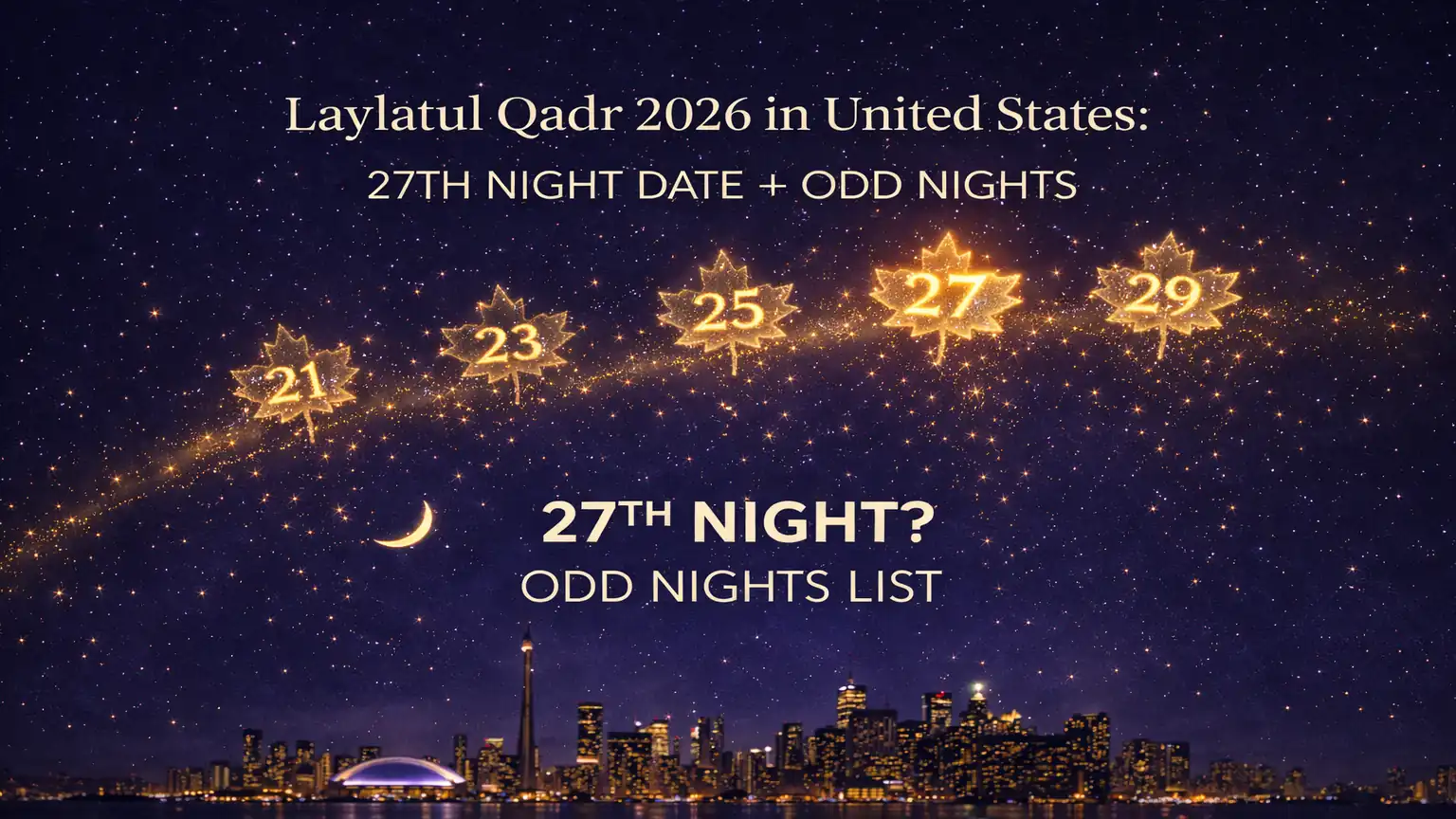
Laylatul Qadr 2026 in United States is commonly placed around the 27th night—often described as the night of March 15–16, 2026—but the safest approach in the U.S. is to treat all five odd nights as your target and show up consistently.
✅ TL;DR – Laylatul Qadr 2026 in United States
Laylatul Qadr 2026 in United States is most expected around the 27th night, often labeled March 15–16, 2026. But U.S. communities may show 15 vs 16 vs 17 because the Islamic night starts at sunset, moon-sighting methods differ, and time zones change the date label. Best move: worship on 21/23/25/27/29.
Laylatul Qadr 2026 in United States — Quick Answer
Laylatul Qadr 2026 in United States is most expected on the 27th night, often shown as the night of March 15–16, 2026. Still, it’s not guaranteed to be the 27th. Because the Islamic day starts at sunset and U.S. communities differ on moon sighting and calendars, target all odd nights in the last 10.
Most expected night in the U.S.: March 15–16, 2026 (27th night)
Many U.S. calendars place the “most expected” night on March 15–16, 2026, calling it the 27th night. That’s why you’ll see masajid plan their biggest night programs around that weekend.
But here’s what many forget: even if your local community calls it the 27th, your job is still to chase the last ten—especially the odd nights.
The 5 odd nights to target in the U.S. (21, 23, 25, 27, 29)
Your beginner-safe target list is simple: 21, 23, 25, 27, 29.
If you want a quick tool view for these nights, you can also open this page: Laylatul Qadr odd nights (tool + guide).
Odd nights only
Night # Hijri date (day Ramadan) Gregorian date (for Night start) Odd? Notes
Why You See 2–3 Different Dates in the U.S. (15 vs 16 vs 17)
Why do some calendars show March 16 or March 17? Because an Islamic “night” starts at sunset, and because communities may follow different moon-sighting methods and local calendar choices. Add U.S. time zones, and the same worship night can get a different date label depending on where you live and which calendar your masjid uses.
Islamic night starts at sunset (why “Sunday” can mean Sunday night)
In Islam, the “date feeling” flips at sunset. So when someone says “Sunday,” they may really mean Sunday night after Maghrib, not Sunday morning.
I’ve seen families argue over this at iftar tables. They’re both trying to be sincere—just using different labels.
Moon sighting vs calculation (why communities differ)
Some communities follow local moon sighting more strictly, others follow established calculation-based calendars, and many follow a trusted national masjid or council. That difference can shift Ramadan’s start by a day, which shifts the odd nights by a day too.
Neutral truth: there’s a real difference of opinion here, and U.S. communities don’t all move together. So you protect yourself by covering the odd nights.
Time zones: Eastern vs Central vs Mountain vs Pacific (same night, different date label)
Time zones make date labels messy. A program that starts after Maghrib in California is still “that night,” but it may show a different calendar date than the same night in New York.
This is why people search: Laylatul qadr 2026 in united states time and Laylatul qadr 2026 in united states calendar.
When Are the Last 10 Nights of Ramadan 2026 in the United States?
When are the last 10 nights of Ramadan 2026 in the United States? The last ten start at the sunset that begins the 20th night, then run night-by-night until the end of Ramadan. If your Ramadan start shifts by one day in your community, your last ten nights list shifts by one day too.
Ramadan 2026 start in the U.S. (so the last 10 nights shift by 1 day)
Many U.S. calendars place the first day of fasting on February 18, 2026 (meaning Ramadan’s first night begins the sunset before). If your local masjid started a day later, your “odd nights” move later too.
Last 10 nights list (by sunset-to-sunset nights, U.S. friendly)
Here’s the U.S.-friendly way to think about it: each “night” begins at sunset and ends at Fajr. So you plan around Maghrib-to-Fajr blocks, not midnight-to-midnight.
Most people don’t fail because they didn’t love worship.
They fail because they planned it like a normal calendar day.
Laylatul Qadr 2026 U.S. Dates (Odd Nights List You Can Save)
Laylatul Qadr 2026 in United States is best chased by saving the five odd nights and treating them like appointments you don’t cancel. If your community’s Ramadan started one day later, shift each night one day forward.
21st night
Target the night that begins at sunset and counts as the 21st night. Treat it like a “practice night” that might secretly be the main prize.
23rd night
Second odd night. Many people start strong then fade—don’t do that. Keep your plan realistic so you can repeat it.
25th night
This is where tiredness hits. Keep worship simple, not dramatic.
27th night (most expected)
The 27th night is widely described as “most expected,” often shown around March 15–16, 2026 on many calendars. But it’s not a guarantee, so don’t gamble everything on one night.
29th night
Some people mentally quit before the 29th. That’s exactly why you show up. Finish strong.
Is Laylatul Qadr Always the 27th Night?
Is Laylatul Qadr always the 27th night? No. What’s broadly agreed is that it’s in the last 10 nights, and many hadith discussions point you to the odd nights. The 27th is widely treated as “most expected,” but not promised. A safe U.S. plan covers all five odd nights.
What scholars agree on (last 10 nights, odd nights)
Even across different calendars, the main shared guidance remains: chase it in the last ten, especially the odds. That’s the “no-regrets” path.
Why the 27th is “most expected” (but not guaranteed)
Many communities put extra focus on the 27th because it’s commonly held as most likely. Great—use that energy. Just don’t let it make you lazy on the other nights.
Best Worship Plan for Laylatul Qadr in the U.S. (Realistic Schedule)
Best worship plan for Laylatul Qadr in the U.S. is the one you can actually repeat on multiple nights without burning out. You don’t need a “hero night.” You need steady worship across the odd nights with a simple structure: Qur’an, salah, du‘a, and a small act of charity.
If you can only do 60 minutes (minimum plan)
Perfect. Do it clean, no guilt.
Pray two rak‘ahs slowly, read a small portion of Qur’an, then spend the last part in du‘a. Keep your phone away.
2–3 hour plan (most people can do)
This is the sweet spot for many U.S. Muslims balancing work and school. Start after Isha/Taraweeh (or at home), add extra prayer, read Qur’an, and end with focused du‘a.
All-night plan (mosque / home)
If your masjid offers Qiyam, great. If not, home worship is still real worship. Just protect Fajr and keep your intentions quiet.
Work/school next morning plan (sleep strategy + essentials)
Here’s the simple approach: sleep a bit before, worship a strong block, then sleep again if needed.
- Sleep early if you can (even 60–90 minutes helps).
- Pick one block for worship (don’t try to do five things).
- End with du‘a while your heart is soft.
- Protect Fajr no matter what.
- Don’t “scroll” between acts of worship.
Best Dua for Laylatul Qadr (Most Authentic)
Best dua for Laylatul Qadr is the one the Prophet ﷺ taught specifically for this night: a short du‘a asking Allah for pardon. Keep repeating it. Don’t overcomplicate it. This one line can carry your whole night when your mind feels tired.
The famous dua “Allahumma innaka…” (meaning + when to repeat)
🤲 Authentic Laylatul Qadr Du‘a
Arabic:
اللَّهُمَّ إِنَّكَ عَفُوٌّ تُحِبُّ الْعَفْوَ فَاعْفُ عَنِّي
Transliteration: Allahumma innaka ‘afuwwun tuhibbul-‘afwa fa‘fu ‘anni
Meaning: O Allah, You are Pardoning and You love pardon, so pardon me.
Repeat it after prayer, in sujood, and in the quiet moments when you don’t know what else to say.
Short dua list for forgiveness, rizq, guidance, family
Keep it personal and short. Ask for what you actually need: forgiveness, guidance, protection for family, and halal provision. If you want a ready list to draw from, link this naturally (no shortcode): Ramadan duas (short list).
Dua mistakes that make people quit (keep it simple)
The biggest mistake is turning du‘a into a performance. Long Arabic you don’t understand, rushing, and then feeling “I did nothing.”
Quiet du‘a with a present heart beats perfect-sounding words with a distracted mind.
What to Do at the Mosque vs at Home (U.S. Reality)
What to do at the mosque vs at home depends on your situation. In the U.S., some masajid do full-night Qiyam programs, while others do Taraweeh and a short reminder. If your home situation is heavy—kids, work, exhaustion—home worship can still catch Laylatul Qadr when done sincerely.
Taraweeh vs Qiyam: what most U.S. masajid do
Many U.S. masajid offer Taraweeh nightly and then add longer Qiyam programs on the odd nights, especially the 27th. If your masjid does that, show up early and plan your parking and exit so you don’t spend the night stressed.
Women at home: how to get the full night reward
If you’re at home, your reward isn’t “less.” Set a small worship corner, pray what you can, read Qur’an, and make du‘a with focus. Keep it consistent across the odd nights.
For a deeper home-focused guide, use this once: Laylatul Qadr for women at home.
Parents with kids: “quiet Laylatul Qadr” plan
Parents don’t need a perfect silent house. You need a workable block.
Try this: settle the kids, pray two rak‘ahs, read a small portion, then du‘a. If you get interrupted, return gently. No anger. No drama.
Signs of Laylatul Qadr (What’s Authentic vs Viral)
Signs of Laylatul Qadr get shared a lot online, and that’s where confusion grows. Some signs people repeat are weak or overstated, and chasing “proof” can distract you from worship. The safer mindset: worship the odd nights, and leave the unseen knowledge to Allah.
Common signs people share (what’s weak/overstated)
Online posts often turn signs into guarantees. That’s where people slip. If you spend the night hunting signs, you may miss the real gift: worship itself.
If you want a careful breakdown, use this once: authentic signs of Laylatul Qadr.
What matters more than signs: catching the odd nights
Catch the odd nights. That’s the method that survives every calendar difference.
Charity on Laylatul Qadr (Multiply Your Impact)
Charity on Laylatul Qadr is powerful because you’re giving when hearts are soft and sincerity is easier. In the U.S., the practical trick is simple: decide your giving plan before the night arrives, so you don’t waste the night comparing links and amounts.
Best time to give in the U.S. (night automation idea)
Best time is when you’ll actually do it—early in the evening or right after Taraweeh—so you don’t forget at 3 a.m. If you want to keep it steady, set a nightly giving habit for the odd nights.
📚 You Can Also Read: benefits of sadaqah
Zakat vs Sadaqah vs Fidya (quick clarity)
Quick clarity for beginners: Zakat is an obligation with rules, Sadaqah is voluntary charity, and Fidya relates to missed fast situations for specific cases. Don’t mix them when you’re tired.
📚 You Can Also Read: fidya in Islam
FAQs
What day is Laylatul Qadr 2026 in the USA?
Many calendars place it around the night of March 15–16, 2026 (linked to the 27th night), but communities may label it differently. The safest answer is: chase the odd nights in the last ten.
What are the odd nights of Ramadan 2026 in the U.S.?
The odd nights are the 21st, 23rd, 25th, 27th, and 29th nights (each starting at sunset). If your Ramadan started one day later locally, shift that sequence one day forward.
Is Laylatul Qadr on the 26th night or 27th night?
It’s commonly expected on the 27th night, but it can be on another odd night. That’s why you don’t bet everything on one date.
Why do some calendars show March 16 or March 17?
Because the Islamic night begins at sunset, different moon-sighting methods shift the start of Ramadan, and U.S. time zones change the date label.
Can Laylatul Qadr be on an even night?
Most guidance emphasizes the odd nights of the last ten. Some discussions mention it isn’t impossible, but the practical Sunnah-based approach is to focus on the odd nights.
What time does Laylatul Qadr start in the U.S.? (sunset rule)
It starts at sunset (Maghrib) and continues until dawn (Fajr). So your “start time” depends on your local sunset time.
Do I have to be in the mosque to catch Laylatul Qadr?
No. مسجد worship is great, but sincere home worship can also catch it—especially if you’re consistent across the odd nights.
What if I can’t stay awake all night?
Do a strong 60–90 minute block with focus, repeat the authentic du‘a, and protect Fajr. Consistency beats burnout.
What’s the simplest plan for beginners?
Two rak‘ahs slowly, a small Qur’an portion, the authentic du‘a repeated often, and one sincere personal du‘a list you actually mean.
Should I chase signs or just worship?
Worship. Signs are not the goal. Catching the odd nights is the goal.
📊 Laylatul Qadr U.S. confusion map (what causes “15 vs 16 vs 17”)
| Reason | What it changes | Beginner-safe move |
|---|---|---|
| Sunset start | “Sunday” often means Sunday night | Plan from Maghrib → Fajr, not midnight |
| Moon sighting vs calculation | Ramadan start shifts by 1 day | Follow your masjid; cover all odd nights |
| U.S. time zones | Same worship night gets a new date label | Use local sunset time, not a viral graphic |

Farrukh Farooqi has been living in Sharaya, Makkah, Saudi Arabia since 2010. With over 14 years of firsthand experience witnessing the sacred journey of millions of pilgrims, Farrukh specializes in providing practical, insider tips for Hajj and Umrah travelers. His work blends real-world observations, the latest Saudi updates, and essential crowd management strategies — helping pilgrims and worshippers plan smarter, stay safer, and experience a spiritually fulfilling journey across the Holy Cities.


