
Chandra Grahan 2026 Date & Time in India (March 3): State-wise Visibility, Sutak Timings, and How to Watch
Tomorrow isn’t a “late-night eclipse.”
For most of India, it’s an evening event that lines up with moonrise—meaning many people will step outside and see the Moon already changing.
This page gives the exact India timings (IST), clear Sutak timings, what most cities will actually see, and the simplest way to watch without confusion.
✅ TL;DR – Chandra Grahan 2026
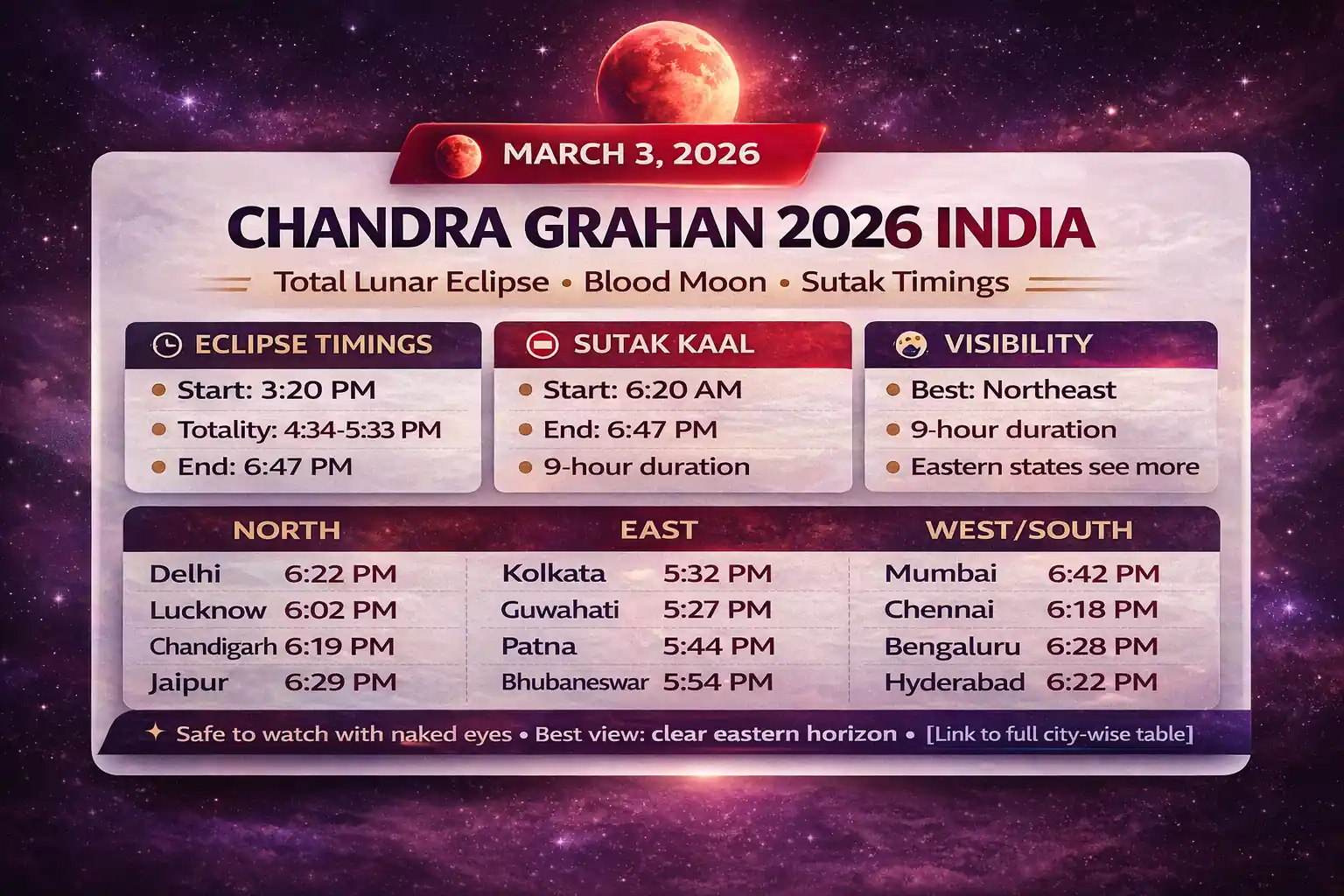
Chandra Grahan 2026 is on March 3 (Tuesday). In India (IST), the eclipse phases run from about 2:14 PM to 7:53 PM, with the “main show” (partial/total phases) happening before and around early evening. In many Indian cities, you’ll catch only the later part after moonrise. Sutak is commonly observed about 9 hours before the eclipse phase begins (local Panchang may differ by minutes).
Chandra Grahan 2026: Date and Day
Chandra Grahan 2026 date in India: March 3, Tuesday
Chandra Grahan 2026 in India falls on March 3, 2026 (Tuesday).
Is it a Total Lunar Eclipse (Blood Moon) on March 3, 2026?
Yes—globally it’s a Total Lunar Eclipse, often called a Blood Moon because the Moon can look copper-red during totality. In India, what you see depends on your location and moonrise timing (many places will catch only the later part).
Chandra Grahan 2026 India Time (IST): Start, Peak, End
Chandra Grahan start time in India (IST)
Start (penumbral begins): ~2:14 PM IST. This is when the eclipse technically starts, but it can look subtle at first.
Maximum eclipse time in India (best viewing window)
Maximum eclipse: ~5:03 PM IST (greatest eclipse). This is the peak moment globally—though visibility in India still depends on whether the Moon is above your horizon at that time.
Chandra Grahan end time in India (IST)
End (penumbral ends): ~7:53 PM IST. After this, the eclipse is over everywhere.
Total duration of lunar eclipse in India
The full event (penumbral start to penumbral end) lasts about 5 hours 39 minutes. The totality phase lasts about 58 minutes globally.
Sutak Kaal Timings for Chandra Grahan 2026
Sutak time start (kab lagega)
Many Panchang sources follow a simple rule for lunar eclipses: Sutak starts ~9 hours before the eclipse phase begins (often counted from the “visible eclipse/partial phase,” not the faint penumbral shading). That puts Sutak around ~6:20 AM IST on March 3 in many calendars (you may see a few minutes’ difference by city).
Sutak time end (kab khatam hoga)
Sutak ends when the eclipse ends, so it typically ends around ~7:53 PM IST (when the penumbral phase ends).
Sutak rules: what to do and what to avoid (quick list)
Rules vary by family tradition and local guidance. If you follow Sutak, keep it simple and respectful:
- Do: stay calm, pray/chant as your tradition follows, keep your evening flexible.
- Avoid: unnecessary travel stress, panic-forwarding “fear messages,” and risky stunts to “watch better.”
Chandra Grahan 2026 Visibility in India
Will Chandra Grahan be visible in India fully or partially?
India will see it, but not equally. Some regions (especially where the Moon is up earlier) can catch a stronger phase, while many cities will see mainly the later part after moonrise.
Why only the final phase may be visible in many cities
The eclipse’s key phases happen before or around early evening, but the Moon rises later in many Indian locations. So people step out at dusk and see the Moon already in eclipse—then watch it recover toward the end.
Best visibility states/regions (moonrise earlier areas)
Reports commonly point to northeastern India and island regions as having better chances to see a stronger phase, because moonrise timing can favor them.
Major cities visibility: Delhi, Mumbai, Bengaluru, Chennai
For many major cities, expect the practical viewing window to be after moonrise in the early evening—so you may catch only the later part rather than the full sequence from the beginning. The simplest move: be ready at dusk with a clear eastern horizon.
Blood Moon 2026: State-wise Visibility Table
States where Chandra Grahan is Total vs Partial
Different sources summarize India visibility slightly differently because “total vs partial” depends on what phase is above your horizon. The safest beginner summary is below: island + far-east/northeast regions tend to get better visibility; many central/west/south cities catch only the later part after moonrise.
State/region timings: penumbral start, totality, end (IST)
These are the **phase timings in IST** (global event times). Your local visibility depends on moonrise.
📊 Chandra Grahan 2026 (IST): phases + India visibility
| Phase (IST) | Time | What most people in India notice |
|---|---|---|
| Penumbral begins | ~2:14 PM | Often subtle to the naked eye |
| Partial begins | ~3:20 PM | Clear “bite” begins (if Moon is visible) |
| Totality begins (Blood Moon phase) | ~4:34 PM | Best red phase—many Indian cities may miss this if Moon hasn’t risen yet |
| Maximum eclipse | ~5:03 PM | Peak moment globally |
| Totality ends | ~5:32 PM | Red phase ends globally |
| Partial ends | ~6:47 PM | Many Indian viewers will mainly catch this “late part” after moonrise |
| Penumbral ends | ~7:53 PM | Event ends everywhere |
Phase times are consistent with NASA/time-and-date style eclipse tables.
Chandra Grahan Mein Kya Hota Hai? (What happens in a lunar eclipse)
What is Chandra Grahan (simple explanation)
Chandra Grahan happens when Earth comes between the Sun and the Moon, and Earth’s shadow falls on the Moon. Think of it like a streetlight being blocked by a person standing in front of it—the light doesn’t vanish, it changes shape and fades in stages.
Why the Moon turns red (Blood Moon reason)
The Moon looks red during totality because sunlight bends through Earth’s atmosphere and the red/orange light reaches the Moon more easily than blue light. That’s why people call it a Blood Moon.
How long totality lasts (when Moon is fully red)
Totality lasts about 58 minutes for this eclipse (globally).
How and When to Watch Chandra Grahan in India
Where to look: direction and timing (eastern horizon at dusk)
Where should you look? In most Indian cities, step out around dusk and look toward the eastern horizon right after moonrise. That’s when you’re most likely to catch the visible late phase.
Do you need a telescope or binoculars?
No. Binoculars can add detail, but you can enjoy a lunar eclipse with your eyes alone—especially the shape changes and color shift.
Is it safe to watch Chandra Grahan with naked eyes?
Yes. Unlike solar eclipses, a lunar eclipse is safe to watch with the naked eye.
Best viewing tips: clear sky, low light, rooftop/beach/hill
Use these quick tips (no overthinking):
- Go early: be ready at dusk so you don’t miss the moonrise moment.
- Find the east: a clear eastern horizon matters more than fancy gear.
- Reduce lights: step away from bright streetlights if possible.
- Choose a good spot: rooftop, open ground, beach, or a small hill works well.
- Phone camera tip: use a steady surface; don’t zoom too much.
- Cloud plan: if clouds block it, don’t stress—this happens.
- Share responsibly: avoid forwarding fake “danger” messages.
Quick FAQs
What time is Chandra Grahan in India on March 3, 2026?
In IST, the eclipse runs roughly from 2:14 PM (starts) to 7:53 PM (ends). Many people will mainly watch after moonrise in the early evening.
What is the Sutak time for lunar eclipse 2026?
Many calendars observe Sutak about 9 hours before the main eclipse phase begins, putting it around ~6:20 AM IST on March 3 (minute-level differences exist by Panchang).
Which states in India will see the Blood Moon clearly?
Reports commonly point to northeastern India and island regions as having better chances for stronger visibility because moonrise timing favors them. Many other places see mainly the late phase after moonrise.
Can we eat during Sutak Kaal?
This depends on family tradition and local religious guidance. If you observe Sutak, follow your household’s practice or your local priest/panchang—don’t fight about it at home.
Is Chandra Grahan visible after moonrise in my city?
In many Indian cities, yes—people will see the eclipse already in progress right after moonrise, and then watch the later stages until it ends around 7:53 PM IST.

Farrukh Farooqi has been living in Sharaya, Makkah, Saudi Arabia since 2010. With over 14 years of firsthand experience witnessing the sacred journey of millions of pilgrims, Farrukh specializes in providing practical, insider tips for Hajj and Umrah travelers. His work blends real-world observations, the latest Saudi updates, and essential crowd management strategies — helping pilgrims and worshippers plan smarter, stay safer, and experience a spiritually fulfilling journey across the Holy Cities.


