
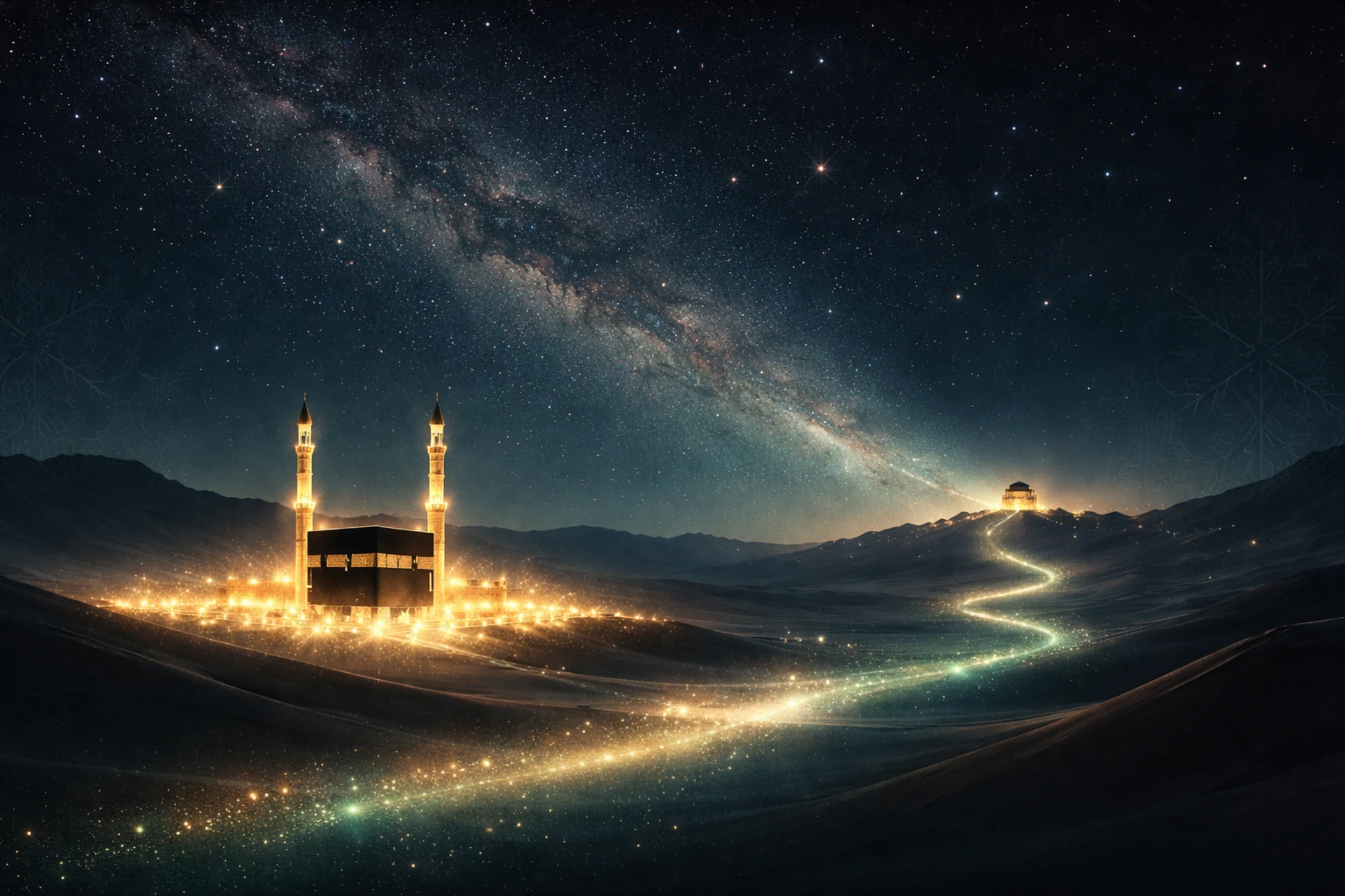
what is Isra and Mi‘raj? A Clear Beginner Guide
If you’ve heard people say “Shab-e-Mi’raj,” they’re talking about a night Muslims remember with awe and gratitude. Isra and Mi’raj is a famous miracle connected to the Prophet Muhammad’s night journey and ascension.
Some people treat it like a big mystery. It’s actually easier than it sounds.
You don’t need to know every detail to benefit.
✅ TL;DR – Isra & Mi‘raj for Beginners
Isra and Mi‘raj is the Prophet Muhammad’s miracle night: a night journey to the “Farthest Mosque,” then an ascension through the heavens. It matters because it teaches Allah’s power, the honor of the Prophet, and the gift of daily prayer.
The Qur’an hints at it, and authentic hadith explain more. The exact calendar date is debated, so focus on the meaning, not the date.
Shab-e-Mi’raj meaning (and what the name points to)
Shab-e-Mi’raj meaning is simply “the night of Mi’raj.” In everyday language, it’s the night people remember the ascension part of the story. Some communities use the term to refer to the whole event, meaning both Isra (night journey) and Mi’raj (ascension) together, not as two separate nights.
Think of it like a two-chapter trip with one ticket: the first chapter is the travel, the second chapter is the climb.
My students always ask, “So… is Shab-e-Mi’raj a different night from Isra?”
Most of the time, people are using one name for the whole story.
What happened? The simplest overview of the Night Journey and Ascension
In simple terms, what happened is this: Allah took His Prophet on a miraculous night experience that included travel and rising beyond normal human limits. First, there was a journey from the Sacred Mosque in Makkah to the “Farthest Mosque.” Then there was an ascension, where the Prophet was shown signs and realities that humans don’t normally see.
No, it wasn’t a regular trip.
And no, you can’t “explain it away” as just a nice metaphor either, because Muslims treat it as a real miracle.
Here’s a beginner-friendly “movie trailer” version (without getting lost in tiny details):
- Isra: A night journey by Allah’s permission
- A blessed place: Reaching the “Farthest Mosque”
- Mi’raj: An ascent through the heavens
- A gift: Daily prayer becomes central in a way that Muslims still live today
- A return: Back to Makkah, all in the same night
Part 1: The Night Journey (Isra)
Isra is the first part: a night journey from Masjid al Haram to al Masjid al Aqsa (the “Farthest Mosque”). The Qur’an clearly points to this event, and Muslims understand it as Allah showing His servant special signs.
If you want a picture in your mind, don’t picture a tourist bus.
Picture a moment where Allah is saying, “Watch closely. I will show you what you’ve never seen.”
That’s the heart of Isra.
Part 2: The Ascension (Mi’raj)
Mi’raj is the rising part. The word itself carries the sense of going up, like climbing beyond what normal life allows. If Isra is “the sudden travel,” Mi’raj is “the sudden elevation.”
Here’s an analogy I use with beginners:
Isra is like being taken from one city to another in a blink. Mi’raj is like being taken from the ground floor to the roof of a building that has no end, with doors opening to lessons you didn’t even know existed.
Some details are described in hadith literature, including meeting earlier prophets and being shown signs of the unseen.
What sources mention it? (Qur’an and hadith, in plain words)
The sources mention it in two main ways: the Qur’an points to the event in a firm, respectful way, and authentic hadith provide the fuller narrative details. When people argue, it’s often because they mix these two levels and demand “Qur’an level detail” for every small scene.
That’s not how Islamic knowledge usually works.
A calm approach is: take the Qur’an’s clear message, then learn the hadith details with balance.
What the Qur’an mentions (what we can say with confidence)
The Qur’an mentions the night journey from the Sacred Mosque to the Farthest Mosque and calls it a sign from Allah. That’s a strong foundation Muslims agree on.
Another set of verses (often discussed by scholars) talks about a profound sighting of great signs. Scholars differ on exactly how to connect every phrase, so it’s best to keep your words careful: the Qur’an confirms that the Prophet was shown mighty signs, and the night journey is explicitly referenced.
That’s enough to stand on with confidence.
What authentic hadith adds (details people usually ask about)
Authentic hadith collections include narrations that describe more detail about the night, including the ascension, encounters with earlier prophets, and the emphasis on prayer. These narrations are why the story feels so vivid in Muslim teaching circles.
But here’s what many forget:
Even if you don’t memorize every scene, the main lessons still land.
Also, not every popular story you hear at a gathering is equally strong. Some details are widely repeated, but scholars may grade them differently. It’s okay to say, “Allah knows best about the exact detail,” and stick to what is solid.
Why is it important in Islamic belief? (the “so what” for real life)
Isra and Mi’raj is important because it teaches three big things in a way the heart remembers: Allah’s power, the honor of the Prophet, and the central place of daily prayer. For many Muslims, this story explains why salah isn’t just a habit. It’s a gift tied to a miracle night, something bigger than routine.
If you only take one lesson, take this: prayer is not random.
It’s a link.
When a person is tired, distracted, or spiritually dry, remembering Isra and Mi’raj can feel like a gentle push back toward meaning.
Common confusions (and the safe, respectful way to speak)
People usually get stuck on three confusions: Was it physical or a vision? What exact date was it? Should it be celebrated? A respectful beginner approach is to know that scholars have discussed these points, and Muslims have different practices across cultures. You can keep your tone calm and still be accurate.
1) Physical journey or spiritual vision?
Scholars have held different views on details, and Muslims should not turn this into a fight. The safe way to speak is: it was a miracle from Allah, and the ummah has discussed the nature of the experience.
2) The exact night in the Islamic calendar
Many people mention the 27th of Rajab, but scholars also note that the exact date is not firmly established through universally agreed proof. So don’t build your faith on a calendar date.
3) “Celebration” vs “remembering”
Some communities gather for extra reminders and worship, while others avoid treating it like a special fixed festival. A neutral way to say it: Muslims agree the event is true and meaningful, while they may differ about setting specific annual rituals.
A short beginner story (a real mistake, and how to fix it)
I once taught a young revert who was excited and nervous before his first community talk.
He said, “I’ll explain Isra and Mi’raj from the Qur’an only. I’ll read the whole story.”
He stood up confidently. Then he froze, because the Qur’an doesn’t narrate every scene like a storybook.
Afterwards he felt embarrassed and said, “Did I mess up Islam?”
I told him, “No. You just mixed up where the detail comes from.”
Next week, he tried again: Qur’an for the core point, hadith for the storyline, and he did beautifully.
That’s the fix: separate the foundation from the added detail.
5 quirky beginner mistakes (I see these every year)
- Mixing Isra and Mi’raj into one single “moment,” then getting confused when the story has stages
- Calling it “Shab-e-Barat” by accident (yes, it happens a lot)
- Arguing about the exact date like it’s a pillar of faith
- Repeating weak stories as if they’re guaranteed facts because “everyone says it”
- Forgetting the main lesson about prayer, and treating it like trivia night
Quick checklist (when you’re explaining Isra & Mi’raj to someone)
If you’re teaching a friend or writing a post, this keeps you safe and clear:
- Start with the two parts: Isra (journey) and Mi’raj (ascension)
- Say clearly: it’s a miracle from Allah
- Mention sources with balance: Qur’an points to it, hadith explains more
- Avoid over confident claims about the exact date
- End with the practical lesson: prayer matters
📊 Isra vs Mi’raj Comparison (Beginner Summary)
People often mix up the two parts of this miracle night. This table gives a clean beginner view: Isra is the night journey, while Mi’raj is the ascension. Both are connected, but each part teaches a slightly different lesson. Use it when you want to explain the story without getting lost in details.
🌙 Show Full Isra vs Mi’raj Table
| Feature | Isra (Night Journey) | Mi’raj (Ascension) |
|---|---|---|
| Main idea | Miraculous travel at night | Miraculous rising through the heavens |
| What beginners confuse | They think this is the whole story | They think this is “just a dream” without proof |
| Where it’s mentioned | Clearly pointed to in the Qur’an | Explained mainly through authentic hadith details |
| Key lesson | Allah can take His servant beyond normal limits | Prayer is central, and the unseen is real |
| Best way to explain it | “A night journey to the Farthest Mosque” | “An ascent where great signs were shown” |
📘 Isra & Mi’raj FAQs (Beginner Friendly)
What is Isra and Mi’raj in one simple sentence?
Show Answer
It’s a miracle night where the Prophet Muhammad made a night journey and then a heavenly ascension by Allah’s permission.
What happened during the Night Journey and Ascension?
Show Answer
The Prophet traveled from the Sacred Mosque to the Farthest Mosque, then ascended and was shown great signs. The detailed storyline is explained in authentic hadith narrations.
Where is Isra mentioned in the Qur’an?
Show Answer
The Qur’an clearly points to the night journey from the Sacred Mosque to the Farthest Mosque in Surah al-Isra.
Is Mi’raj mentioned in the Qur’an too?
Show Answer
The Qur’an speaks about the Prophet being shown mighty signs, and scholars discuss verses connected to this. The fuller “scene by scene” description mainly comes from hadith.
What does Shab-e-Mi’raj meaning refer to?
Show Answer
It means “the night of Mi’raj,” and many people use it as a common name for remembering the whole Isra and Mi’raj event.
Why is Isra and Mi’raj important for Muslims?
Show Answer
It strengthens belief in miracles, honors the Prophet, and highlights the importance of daily prayer as a life changing gift for the ummah.
Was Isra and Mi’raj a physical journey or a spiritual vision?
Show Answer
Scholars have discussed the nature of the experience. A safe beginner way to say it is: it was a real miracle from Allah, and Muslims avoid turning the details into arguments.
Which night was Isra and Mi’raj in the Islamic calendar?
Show Answer
Many people mention the 27th of Rajab, but scholars also note the exact date is not firmly established. So it’s better to focus on the meaning, not the date.
Should Muslims “celebrate” Shab-e-Mi’raj every year?
Show Answer
Muslims agree the event is true and meaningful, but communities may differ on setting fixed annual rituals. Keep it respectful, and avoid judging others harshly.
What is the best way to explain Isra and Mi’raj to a child?
Show Answer
Say: “Allah honored the Prophet with a miracle night journey and showed him great signs, and Allah loves when we pray.” Keep it simple and don’t overload details.
What should I avoid saying when talking about this miracle?
Show Answer
Avoid bold claims about weak details, avoid arguing about the date, and don’t speak with certainty on points scholars differ about. Stick to what is widely accepted and respectful.


