
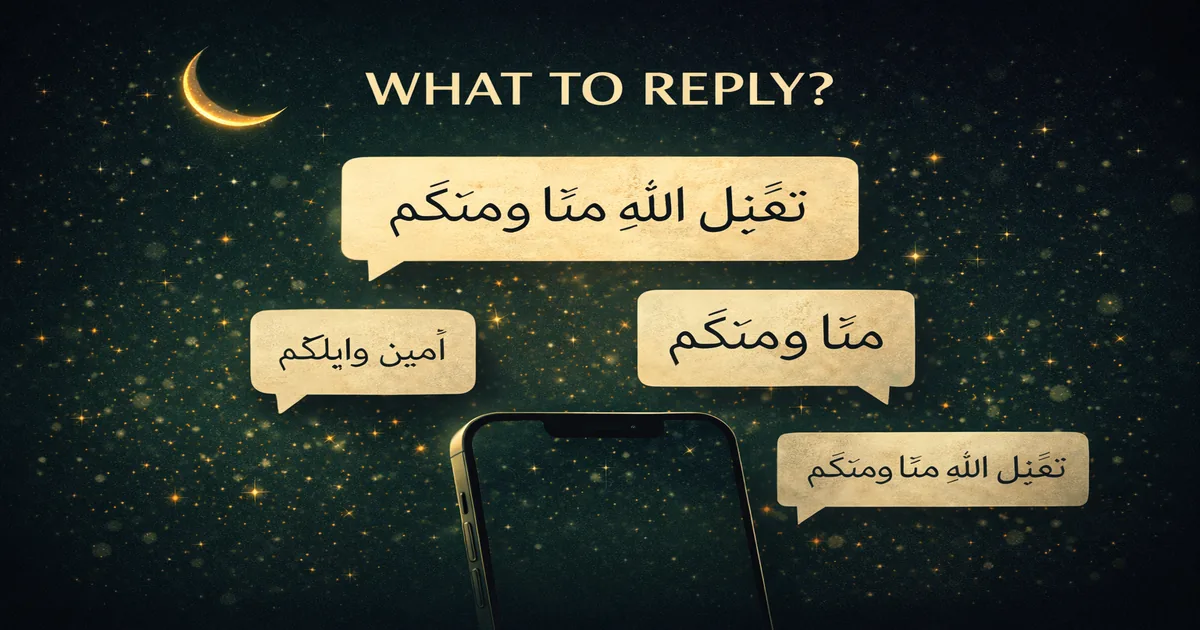
تقبل الله منا ومنكم meaning and reply (2026): Best Responses in Arabic + English
تقبل الله منا ومنكم meaning and reply is simple: it’s a du‘a that means “May Allah accept from us and from you.”
People say it most on Eid, and also after worship—like Ramadan nights, charity, Qur’an, or Umrah.
If you want ready-made greetings fast, use our Eid Greeting Message Generator (copy-paste in seconds).
✅ TL;DR – تقبل الله منا ومنكم meaning and reply
تقبل الله منا ومنكم means May Allah accept from us and from you. The safest short reply is منا ومنكم or اللهم آمين وإياكم. Say it on Eid al-Fitr and Eid al-Adha, and after worship sometimes. Keep it natural du‘a—don’t turn it into a fixed “must say it every time” ritual.
📌 Evidence that “acceptance” is a real Islamic theme (Qur’an)
Arabic: إِنَّمَا يَتَقَبَّلُ اللَّهُ مِنَ الْمُتَّقِينَ
Transliteration: Innama yataqabbalu Allāhu mina al-muttaqīn
Meaning (English): “Allah only accepts from the people of taqwa.” (Qur’an 5:27)
Quick Answer — Meaning + Best Reply (Feature Snippet)
تقبل الله منا ومنكم meaning and reply in one line: it means “May Allah accept from us and from you”, and the best quick replies are منا ومنكم or اللهم آمين وإياكم. Short, warm, and safe for Eid and after worship.
Meaning in English (1 line): “May Allah accept from us and from you”
Meaning: May Allah accept from us and from you (our worship, good deeds, and efforts).
Best short reply (1 line): “منا ومنكم” / “آمين وإياكم”
Best short replies: منا ومنكم (very common) or اللهم آمين وإياكم / آمين وإياكم (warm and du‘a-style).
📚 You Can Also Read: How to reply to Eid Mubarak politely
Full Meaning (Word-by-Word)
Here’s the easiest way to understand it: it’s like saying, “May Allah accept what we just did,” but you’re including the other person too—so nobody is left out.
تَقَبَّلَ الله = May Allah accept (your worship/good deeds)
تَقَبَّلَ الله means: “May Allah accept” (acceptance of worship and good deeds).
مِنَّا = from us | وَمِنكُم = and from you
مِنَّا = from us. وَمِنكُم = and from you.
Full form: “تقبل الله منا ومنكم صالح الأعمال” (when people add it)
Many people add: تقبل الله منا ومنكم صالح الأعمال — meaning: “May Allah accept from us and from you the righteous deeds.”
📚 You Can Also Read: Arabic Eid greetings with English meaning
When Do People Say “تقبل الله منا ومنكم”?
Most people say it at moments when hearts feel soft—Eid, finishing Ramadan, or after a good deed. It’s basically a “please accept it, Ya Allah” message between two Muslims.
On Eid (after Eid prayer / Eid greetings)
Common on Eid al-Fitr and Eid al-Adha, especially while greeting after prayer or during visits.
After acts of worship (Ramadan, Qur’an, charity, good deeds)
People also say it after worship moments—especially Ramadan nights, charity, or finishing a good deed.
After Hajj/Umrah (accepted pilgrimage greetings)
It can be said after Hajj or Umrah too—because the du‘a is about acceptance.
One tiny human note: my students always ask, “Is this only for Eid?” No—Eid is just where it’s most famous.
Best Replies (Copy-Paste) — Arabic + English
Best replies are the ones that match the du‘a and keep the mood warm. Don’t overthink it.
💬 Copy-Paste Reply Pack (Most Used)
1) منا ومنكم — “From us and from you (too).”
2) اللهم آمين وإياكم — “O Allah, آمين, and for you as well.”
3) تقبل الله منا ومنكم — repeat it back (simple and safe).
English quick reply: “Ameen, and from you too.”
Shortest reply: “منا ومنكم” (Minna wa minkum)
منا ومنكم is the shortest common reply. It’s polite and instant.
Strong reply: “اللهم آمين وإياكم” (Allahumma Ameen wa iyyakum)
اللهم آمين وإياكم is stronger because it clearly makes du‘a back for the person.
Matching reply: “تقبل الله منا ومنكم” (repeat it back)
Repeating تقبل الله منا ومنكم back is totally normal and widely used.
Longer Eid-style reply: “تقبل الله منا ومنكم وأعاده الله علينا وعليكم…”
A longer style people use on Eid is: تقبل الله منا ومنكم وأعاده الله علينا وعليكم بالخير (meaning: may Allah accept, and return it to us and you with goodness).
📚 You Can Also Read: Best Eid Mubarak wishes for family
WhatsApp / SMS Ready Replies (High-CTR Section)
If you’re replying on WhatsApp, short wins. Nobody wants a paragraph while they’re greeting 40 people.
5 ultra-short WhatsApp replies (1–3 words)
- منا ومنكم
- آمين
- آمين وإياكم
- تقبل الله
- جزاك الله خيرًا
7 polite replies for elders / boss / teacher
(Kept respectful, not too casual.)
- اللهم آمين وإياكم
- تقبل الله منا ومنكم صالح الأعمال
- بارك الله فيكم وتقبل منكم
- جزاكم الله خيرًا وتقبل الله منكم
- آمين، وتقبل الله طاعتكم
- غفر الله لنا ولكم وتقبل منا ومنكم
- عيد مبارك، تقبل الله منا ومنكم
7 warm replies for friends & family
- آمين وإياكم ❤️
- منا ومنكم يا رب
- تقبل الله منا ومنكم يا غالي
- عيدكم مبارك، آمين وإياكم
- الله يتقبل منا ومنكم
- ربي يكتب لكم القبول
- وإياكم يا حبيب
5 dua-style replies (more religious tone)
- اللهم تقبل منا ومنكم
- اللهم اجعلنا من المقبولين
- غفر الله لنا ولكم
- اللهم اعتق رقابنا من النار
- اللهم آمين وإياكم
📚 You Can Also Read: Short Eid greetings for WhatsApp
Pronunciation + Common Spellings (People Search This a Lot)
This part saves you from awkward spelling battles in comments.
Taqabbal Allahu minna wa minkum (best transliteration)
Taqabbal Allahu minna wa minkum is a clean, readable transliteration many people understand.
Common variants: Taqabballahu / Taqabbalallahu (same meaning)
People also write: Taqabballahu or Taqabbalallahu. Same meaning—just spelling choices.
Etiquette & “Is it Sunnah?” (Balanced + Practical)
Is it Sunnah? The safe way to hold this: it’s a good du‘a, commonly used on Eid, and many scholars mention it as a known practice among Muslims. The problem starts when people turn it into a fixed rule like “you must say this after every prayer every time.”
Eid greeting practice reported from early Muslims (why it’s common)
Many people mention that early Muslims exchanged du‘a-style Eid greetings. That’s why it feels natural in Muslim cultures today.
Saying it after every fard prayer as a fixed habit (what scholars warned about)
If someone makes it a strict routine after every fard prayer—like a “required line” every single time—some scholars warned against treating it like a set ritual.
Safe rule: say it naturally sometimes (dua), don’t make it a ritual
Safe rule: say it as du‘a when it fits (Eid, worship moments), and avoid acting like it’s a compulsory script after every prayer.
📚 You Can Also Read: Formal Eid wishes for colleagues & clients
FAQs (AEO / People Also Ask)
These are the exact questions people type when they’re holding a phone and trying not to reply awkwardly.
What does “تقبل الله منا ومنكم” mean in English?
تقبل الله منا ومنكم means “May Allah accept from us and from you.”
What is the best reply to “تقبل الله منا ومنكم”?
The best quick replies are منا ومنكم or اللهم آمين وإياكم.
Can I say it on Eid al-Fitr and Eid al-Adha?
Yes—people commonly say it on both Eid al-Fitr and Eid al-Adha.
Is it okay to say it after prayer? (short answer)
Yes, as du‘a it’s fine. Just don’t treat it like a fixed “must-do” ritual after every prayer.
What do I reply if someone texts me “تقبل الله”?
You can reply: منا ومنكم, or آمين وإياكم, or simply: تقبل الله منا ومنكم.
What’s the difference between “تقبل الله منا ومنكم” and “عيد مبارك”?
عيد مبارك is “Blessed Eid.” تقبل الله منا ومنكم is a du‘a about acceptance of worship. Many people use both together.

Farrukh Farooqi has been living in Sharaya, Makkah, Saudi Arabia since 2010. With over 14 years of firsthand experience witnessing the sacred journey of millions of pilgrims, Farrukh specializes in providing practical, insider tips for Hajj and Umrah travelers. His work blends real-world observations, the latest Saudi updates, and essential crowd management strategies — helping pilgrims and worshippers plan smarter, stay safer, and experience a spiritually fulfilling journey across the Holy Cities.


